Posted in Networks
November 6, 2013
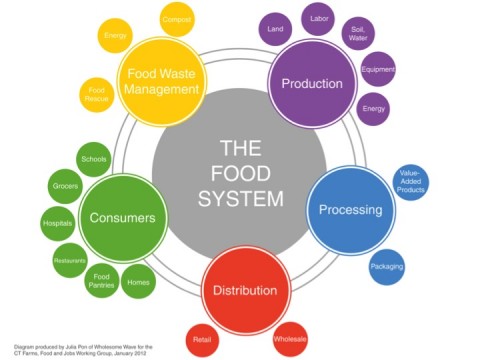
Last Friday, I worked with the Network Support Team (NST) of the Connecticut Food System Alliance (CFSA) to facilitate a gathering of over 100 food system and food security activists. This was the fourth convening in the past year and a half, and featured what have become typical elements of fostering connectivity between people (welcoming and introducing ourselves to new people, learning together, making offers and requests) and alignment around the CFSA vision. And to honor what has been growing in the network as both a call for and a question about the possibility of collective action, NST members Melissa Spear, Marilyn Moore, and Jiff Martin created the following exercise to stimulate people’s thinking about how the network could “change the game” in Connecticut and boldly advance the state towards a reality where “everyone has access to safe, nutritious, culturally appropriate, and affordable food.” Read More
October 31, 2013

As I mentioned in yesterday’s post, this week the Vermont Farm to Plate (F2P) Network held its third annual convening. This marked the move to the third year of the F2P Network’s existence, and another significant milestone.
At the first convening in 2011, there was a mix of enthusiasm, optimism, curiosity, impatience, and some reticence. Many were intrigued by the notion of this new form of multi-organizational collaboration seeking to double local food production in 10 years time, boost the state economy, and address issues of food access and security. Read More
October 30, 2013

Reporting live from the third annual Vermont Farm to Plate (F2P) Network convening, I am relishing this opportunity to work with and watch a successful network move into its third year of existence. There is much more to share about the F2P journey, which I hope to do in a follow-up post to this one, but for now, I wanted to highlight a couple of themes that continue to resonate throughout the convening and contribute to the growth and success of this network.
Read More
October 24, 2013
“Wealth and income distribution no longer resemble a familiar ‘bell curve’ in which the bulk of the wealth accrue to a large middle class. Instead, the networked economy seems to be producing a ‘power-curve’ distribution, sometimes known as a ‘winner-take-all’ economy.”
– David Bollier, from “The Power Curve Society”

As is no doubt evident from past posts on this blog, we at IISC are enthusiastic about networks and their potential to create more equitable, healthy, thriving and sustainable communities. We do not, however, subscribe to the belief that network approaches in and of themselves guarantee the kinds of just and humanizing opportunities and outcomes we seek. We do encounter people who hold up networks as a sort of panacea, hoping that in an age of more distributed technology and open source approaches to problems and solutions, we will achieve some kind of democratic ideal that has to this point eluded us. That there is promise is evident in many stories that we have heard, witnessed, and shared on this site. That there is reason to be vigilant is also illustrated in the many signs of an ever-growing and highly racialized gap between rich and poor in this country and a continued reluctance on the part of many to look at these glaring inequities or the systems that perpetuate them. Read More
October 17, 2013

I had a virtual exchange the other day with Jane Wei-Skillern of Stanford University, as we discussed different ideas for going beyond case studies to help engage people in thinking in networked ways. This is what came to mind at the time, and I am eager to hear from others what you have done:
- In the past I have asked people to think about network forms or topologies (hub and spoke, mesh, distributed); assign different forms to pairs/trios and have them think about what examples of that form exist in their lives. What are the strengths of that form? What are its limitations? How might they shift it to be more “effective” in terms of desired impact?
Read More
October 16, 2013
“Creating a culture of trust in a network can have a big payoff. Why is this so? First, when trust is well-developed in a network, people are willing to get involved in high-risk projects where their reputation and resources are at stake. These kinds of projects usually have a lot of impact. Next, high levels of trust usually make decision making easier and less time consuming. Finally, a culture of trust enables people to accept and work with people who are quite different from them, which increases the number of people working on network activities.”
– June Holley, Network Weaver Handbook

|Photo by Mike Baird|http://www.flickr.com/photos/72825507@N00/6827018401/in/photolist-bphfHP-ayA7wy-bKZzec-e4iaNi-aaixFs-bKZArr-e58faj-e52zee-e58ah1-e5838j-e586eo-e58cR5-e584Hq-8Wcf9Q-csNfzU-dftPtq-dZTbw9-bWm4ku-d6vnvU-d6vg8U-awDsBx-dz9vRu-7CW4pj-acYjbQ-agyEHk-9XrqN1-9XouvF-9XowsD-9XrpRj-9XrorW-d6vBWJ-d6vpE5-d6vFUQ-d6voKN-d6vJaN-d6vuLJ-d6vRoQ-d6vUZW-d6vxbE-d6vDLf-d6vSBq-d6vvPL-d6vWoA-d6vXLJ-d6vybf-d6vqN1-d6vQrY-d6vGTA-d6vma9-d6vzeb-d6vKqG|
The importance and power of trust in networks for social change cannot be overstated. Time and again, and despite what might show up as initial resistance, being intentional about getting to know one another beyond titles, official positions, and transactional exchanges reaps tremendous benefit, for all the reasons June Holley mentions above and more. Taking time and making space to build trust helps people to do the important work of social change and is in many cases an embodiment of the change we are trying to make in the world – when we expand our circles of compassion and inclusion; when we create new patterns of opportunity, exchange and resource flows; when we see and validate previously unrecognized or undervalued assets.
Read More
October 11, 2013
October 9, 2013
|Photo by USDAGov|http://www.flickr.com/photos/41284017@N08/7740419400/in/photolist-cMZF1U-9bjsio-9ZTS3b-9UWk5k-fomtZ4-9UYk2h-agjHzA-agjHTo-ajSoZJ-agBMia-ajSogU-ajPA7r-9X7pyg-9UVcQZ-9UVnmz-9UVof4-9X1Gip-9ZTSSh-9X1S7v-9X4syC-9ZQZbV-9X1Mbc-9UVktD-9UVqix-9UVrU6-9UYipj-9X1Kh2-9X1PgP-9X1SSH-9X1QhF-9ZQZSx-a4uQan-9X4DWN-9X1Eut-9X4va3-9X1CqT-9X1HtB-9X4x9W-a4xKTw-9X1BKF-9X1R5e-a4uUin-a4uPkp-ccXodW|
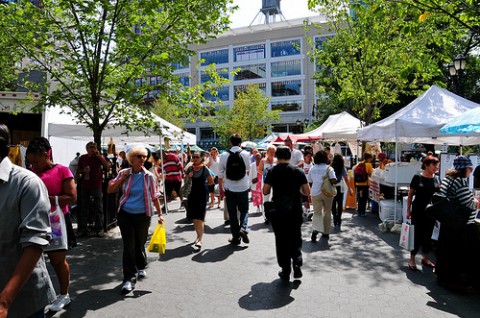
I am increasingly interested in how networks can help to reclaim and reshape marketplaces, bringing them back down to earth and keeping them more stimulating of local economies, helping give value to what is not formally valued, as well as shifting and restructuring flows for greater equity and abundance. So I was delighted to get a number of tips on this front from Lawrence CommunityWorks during a visit there last week. Staff and residents shared a number of ways in which they help to identify and exchange assets as a part of daily operations. For example, here is an exercise called “Marketplaces” which comes from Bill Traynor. Read More
October 3, 2013
Yesterday, Carole Martin and I took the Tillotson Fund Community Practitioners Network on a site visit/retreat to Lawrence CommunityWorks, to see first hand what a network approach to community and economic development looks like. There is much to be said about what LCW has done, learned, and is looking to do going forward, and some of this has already been captured in case studies and articles. Here I want to focus on one important lesson that staff and residents have learned over the past 15 years or so when it comes to taking a network approach. This lesson falls under the caution – “Avoid a Fetish for Structural Forms.” Read More
October 2, 2013

Last week I represented IISC as a presenter/facilitator in a “deep dive” session at the Council on Foundations Conference for Community Foundations. The title of the session was “Complete Capital”and was inspired by an SSIR article by the same title written by Antony Bugg-Levine of the Nonprofit Finance Fund (NFF). Briefly, complete capital is a framework to help funders and other investors develop a fuller picture of the assets required to address complex social challenges: financial, intellectual, human, and social.
After presentations by Alison Gold of Living Cities (intellectual capital), Lisa Spinali (human capital) and Jessica LaBarbera of NFF (financial capital), and in the light of a couple of helpful case studies presented by Alison and Jessica, I offered a view of social capital that is more complex than what appears in the SSIR article. Read More
September 25, 2013

Our friend Jane Wei-Skillern recently co-wrote (along with Nora Silver and Eric Heitz) another valuable contribution to the growing “network building” body of literature, entitled “Cracking the Network Code: Four Principles for Grantmakers.” This piece is part of Grantmakers for Effective Organizations’ learning initiative, Scaling What Works. While the guide mainly addresses funders, it also has something for those outside of the philanthropic world. Its core offering is a set of principles to guide what the authors call “the network mindset”: Read More
September 18, 2013
“Don’t search for the answers, which could not be given to you now, because you would not be able to live them. And the point is to live everything. Live the questions now. Perhaps then, someday in the future, you will gradually, without even noticing it, live your way into the answer.”
-Rainer Maria Rilke, 1903 in Letters to a Young Poet

|Photo by muffinn|http://www.flickr.com/photos/26445715@N00/3092761353/in/photolist-5HidcB-7fk9W4-7fk9YM-7fp2H9-7fp3vd-7ueieU-fhxQiW-8Vb4qT-8Vb3LB-8Ve8tA-8Ve8Cf-8Ve8dS-9ifHmE-9icD5Z-defTUR-d8TvrY-d8TDNN-8RZpMu-d8ToLu-daa2HF-8RAUDQ-7FG4oc-d8SYJo-da9Uxx-da9WRc|
In their article, “Using Emergence to Scale Social Innovation,” Margaret Wheatley and Deborah Frieze highlight the critical role of self-organization, spontaneous and purposeful arrangement and action without formal or “external” management, in facilitating social change. As self-organization occurs in social networks, emergent and unexpected phenomena flow through the strength and flexibility of connections between people and groups. As Wheatley and Frieze note, these emergent phenomena tend to result in “a powerful system that has many more capacities than could ever be predicted by analyzing the individual parts.” This is part of what constitutes the “intelligence” and resilience of networks. This capacity flows naturally when conditions are ripe for individuals to freely find each other and create. Read More