Posted in Networks
February 27, 2014
In “networks-as-change,” effectiveness is grounded in affectiveness.

In an essay that I continue to revisit, the poet/essayist/novelist/farmer/ conservationist and champion of overall sanity, Wendell Berry, talks about what he calls “the turn towards affection.” Having spent many years reflecting on and pushing back against the unfortunate demonstrated human tendency to despoil landscapes and “the other,” he takes a strong stand for both deep rooted connection and . . . imagination: Read More
February 12, 2014
“Grateful living brings in place of greed: sharing; in place of oppression: respect; in place of violence: peace. Who does not long for a world of sharing, mutual respect, and peace?”
–Brother David Steindl Rast

The research on the role of gratitude in supporting social resilience and thriving is quite compelling. According to the Greater Good Science Center, those who have a higher gratitude quotient or a regular practice of listing and thinking about gratitudes have been shown to experience the most significant boosts in happiness and fewer bouts of illness, have stronger social bonds in one-on-one relationships and with communities, and tend to be more generous. Connected to a host of other related positive emotions, gratitude is also shown to boost people’s willingness to reach out and connect with others, including across lines of difference, to see possibility more expansively, and to maintain a general spirit of openness. What’s not to like about gratitude?
Now imagine gratitude for one multiplied many times over in an ecosystem of social interactions and connections – that is, in a network. Read More
February 6, 2014
Collaboration is “a mutually beneficial relationship between two or more parties to achieve common goals by sharing responsibility, authority and accountability for achieving results. It is more than simply sharing knowledge and information (communication) and more than a relationship that helps each party achieve its own goals (cooperation and coordination). The purpose of collaboration is to create a shared vision and joint strategies to address concerns that go beyond the purview of any particular party.”
-David Chrislip and Chip Larson, 1994, p. 5

For a while now at IISC, we’ve referred to the above definition from Chrislip and Larson’s work, Collaborative Leadership, to describe the goal of our collaborative capacity building work. And it has informed our approach around supporting social change networks. Read More
February 5, 2014

The other day I was interviewed by Eugene Eric Kim for a project we are working on together, and he asked – “What are some of the keys to creating the conditions for successful networks for change?” I really like the question because it spurred some interesting reflection that yielded a few off-the-cuff insights that I wanted to share, extend, and test out here.
The phrase “Bring it!” came to mind as I was thinking about what is key to creating conditions for collaborative network success, with a number of iterative qualifiers: Read More
January 15, 2014

|Photo by Christian|www.flickr.com/photos/91048408@N00/322951661/lightbox/?q=vision|
For the past year, Carole Martin and I have been co-facilitating a “network leadership program” supported by the Neil and Louise Tillotson Fund called the Community Practitioners Network (CPN). The overall goal of CPN is to further develop a group of proven and promising leaders as individuals, as a cohort, and as “critical yeast and connectors” (my language, not the Fund’s) in support of community and economic development in a region that encompasses northern New Hampshire, northeastern Vermont, northwestern Maine, and southern Quebec. Throughout, we have been actively exploring a variety of leadership and network development practices for growing personal and interpersonal awareness, connectivity, alignment, resolve, resilience, and skillfulness.
In our most recent session, a two-day retreat in Pittsburg, NH, we engaged in discussion about and embodied practice of “vision.” Over the course of the two days, a robust conversation evolved about what makes vision powerful (in light of many uninspiring experiences) and its relevance in a networked world, in combination and contrasted with values. Read More
January 2, 2014

For those who read this blog on a somewhat regular basis, you know that we at IISC find and experience great promise in embracing network approaches to (and as) social change. So what happens when we truly see ourselves as and in networks; that is, appreciating how we are inextricably embodied through and embedded in interconnected flows of energy, material goods, ideas, intentions, etc.?
Ten thoughts, in no particular order, nor meant to be exhaustive: Read More
December 18, 2013

Adam Grant is a professor at the Wharton School of Business whose research focuses on “motivation, prosocial giving and helping behaviors, initiative and proactivity.” His work and writing, including his book Give and Take: A Revolutionary Approach to Success, seem to have something to offer those interested in and engaged in developing networks for social change, as much of it points to data showing that organizations of all kinds benefit from fostering cultures of giving. Read More
December 12, 2013
 Over the past five years or so of supporting self-declared “networks” for change, I have evolved in my understanding of what is new when we call something a network, versus a coalition or collaborative or alliance. On the surface, much can look the same, and one might also say that coalitions, collaboratives and alliances are simply different forms of networks. Yes, and . . . I believe that what can make a big difference is when participants in a network (or an organization, for that matter) embrace new ways of seeing, thinking, and doing. So let me propose that network approaches at their best call on us to lead with some of the following: Read More
December 11, 2013
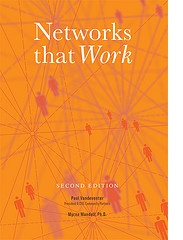
I’ve spent time the past week reading through Networks that Work, a handy and concise resource for developing organizational networks, written by Paul Vandeventer, President and CEO of Community Partners, and Myrna Mandell, Ph.D. The book lays out some very helpful pointers for more formally constructed networks. I have highlighted 10 points below that resonate with our experiences at IISC around supporting organizational networks for social change. My comments and extensions are in italics: Read More
December 4, 2013
“Ultimately if we are to avoid failure in the most critical work of this century, the deepest reaches of our beings must be brought to bear in honestly reevaluating and shifting the most basic structures of our society.”
– john a. powell
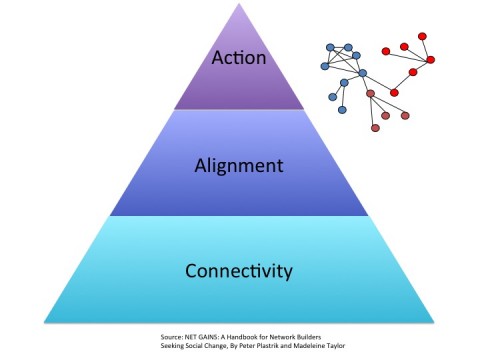
The following is a textual recapturing of a Pecha Kucha-like presentation that I gave at an ARNOVA Pre-Conference Session in Hartford, CT two weeks ago. This was part of a 3-hour interactive conversation, co-designed and facilitated with Dr. Angela Frusciante of the William Caspar Graustein Memorial Fund, focusing on the power of networks for learning and social change, primarily with academic researchers and philanthropists.
At the Interaction Institute for Social Change, we are in agreement with Professor john a. powell when he points to the need to consider and make fundamental structural changes in our country and communities for the causes of greater social justice and sustainability. Read More
November 20, 2013
“The major problems of the world are the result of the difference between the way nature works and the way people think.”
— Gregory Bateson

|Photo by amazon2008|http://www.flickr.com/photos/21654792@N03/3745280688/in/photolist-6GXxsY-6HCRqv-6L93Kt-6LFLKG-6MN2EA-6MZAwG-6NmnMj-6R9T78-6UuYYo-6VM6LM-6Wp5Qp-6ZcWpt-6ZHMrr-77FoRY-791JEy-79bwHB-7ax4Yo-7by5uN-7eRtnf-7jDnw3-7ohMBM-7qTm6G-9udNCU-bm9Sb8-asJWuq-fKs8H2-7Ayggf-9FUTKz-a5RCkJ-9rzSZ7-dZBjPo-8Hp3rc-bp5GBv-dwmDwx-djnQfa-dWAW1D-8KBQLy-8UdB66-8GFZ2z-7XBigb-8F2Gu4-7ZAMyi-87fnWU-8hZvM3-86ygbJ-81AMAg-9cYH2z-8eHptW-ei6RfC-hbUHL7-bDixAg|
A couple of weeks ago I had the pleasure of meeting Joel Glanzberg. I had been hearing about Joel and his work from numerous trusted colleagues, including Bill Reed of Regenesis Group and Ginny McGinn of Center for Whole Communities. Joel describes himself as a builder, farmer, teacher, writer, storyteller, naturalist, and permaculturalist. And I would add to that, living systems thinker. Joel has cultivated a practice of seeing and working with patterns of life’s processes, and helps others to do this, for the sake of creating healthier and more whole communities of different kinds.
I was especially interested to hear more from Joel about some of the living systems principles that guide his work, and to think about how these apply to what we at IISC do around network development for social change and focusing on networks as human environments. What appears in quotes and italics below is pulled directly from Joel’s website; the comments in regular text are my own:
Read More
November 7, 2013
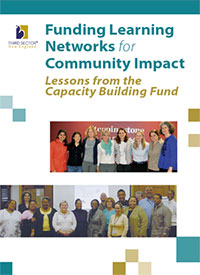
Our friends at Third Sector New England (TSNE) have released an informative report about learning networks. From 2004 to 2012, TSNE and clusters of nonprofit organizations joined in a grant program designed to further social change through building relationships and sharing insights that enabled them to better work together to achieve common goals. The resource, entitled “Funding Learning Networks for Community Impact,” includes interesting explorations of the stages in the development of learning networks and the roles and functions that are key success drivers for nonprofit networks. There are also wonderful and resonant quotes throughout from participants of the Capacity Building Fund (CBF) about the power of and key contributors to effective networks, and I wanted to share a dozen that really jumped out, while strongly suggesting you consult the entire report: Read More