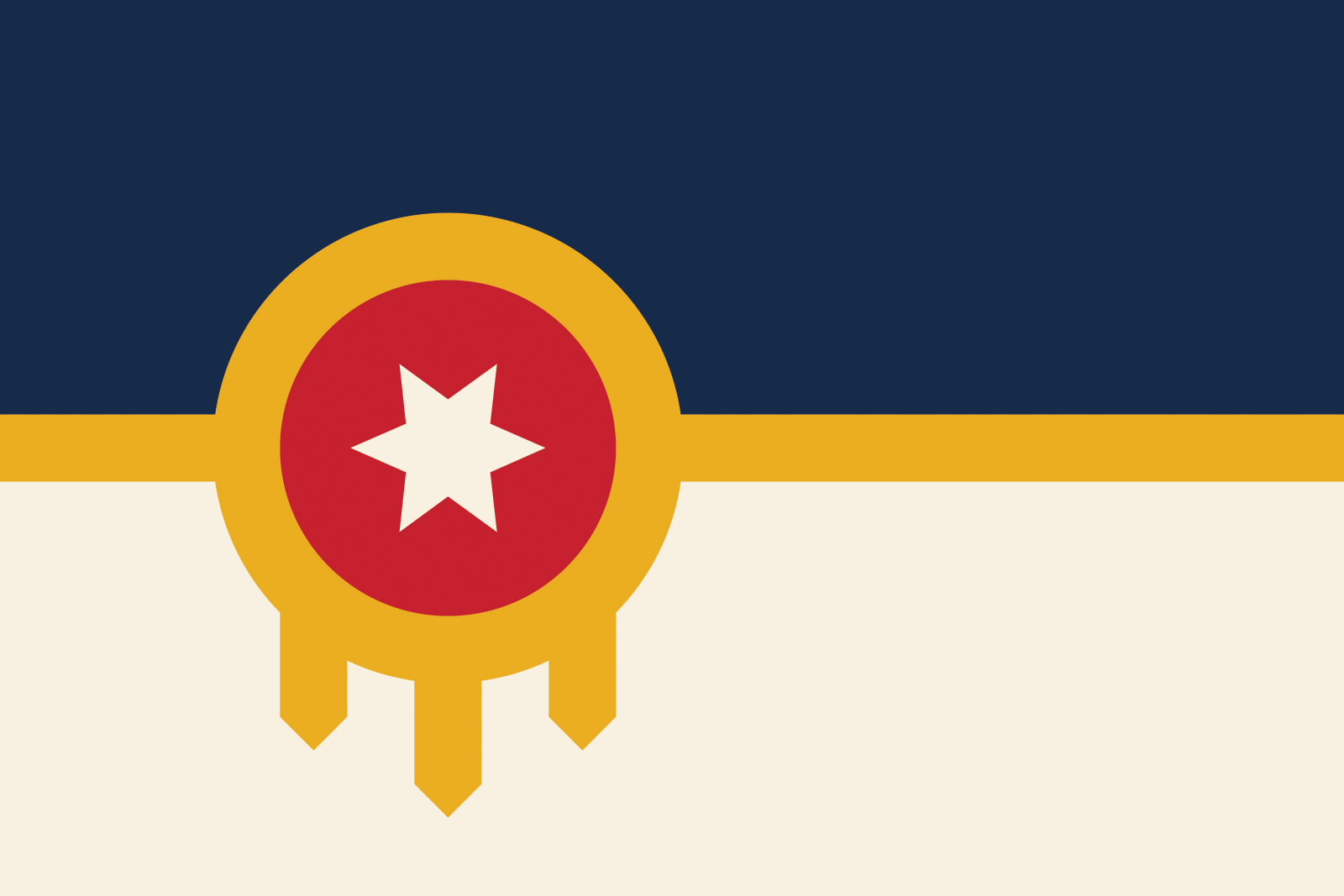
New Tulsa flag. For more on its meaning, including tribal connections, see this link.
A couple of weeks ago, I had the privilege of attending and presenting at the 25th annual White Privilege Conference in Tulsa, Oklahoma with my dear colleague Karen Spiller. We were invited to share about the past 10 years of co-producing the 21 Day Racial Equity Habit Building Challengefor Food Solutions New England, and also be in conversation with Dr. Eddie Moore, Jr., Debby Irving and Dr. Marguerite Penick-Parks, who were the originators of the 21 Day Equity Challenge through The Privilege Institute. To say that it was a rich experience is an understatement.
Meeting in the City of Tulsa and being in the state of Oklahoma was particularly poignant, for all that they represent with respect to this country’s history – the destination of the Trail of Tears and home to 39 different Indigenous tribes because of relocation and forced removal; the site of Black Wall Street and the 1921 Massacre; birthplace of the likes of Woody Guthrie, Wilma Mankiller, Jim Thorpe, Anita Hill, and Ralph Ellison; a focal point of the Dust Bowl, and known as the buckle of the so-called “Bible Belt.”
We were truly blessed to be welcomed each day by members of one of the three tribes whose reservations intersect in the City of Tulsa – Osage, Cherokee, and Muscogee Creek. Through their welcoming words and “land acknowledgments” we learned so much more about this country’s history and also the resilience and generosity of Indigenous peoples. This included a very rich morning presentation from Wilson Pipestem, a citizen of the Otoe-Missouria Tribe, Osage headright holder, Managing Partner and co-founder of Ietan Consulting and a fierce advocate for tribal self-determination. In this and a follow-up breakout session Pipestem facilitated with his colleague Lance Kelley, of the Muscogee Creek, I found myself scribbling teachings, including this list of ten, all of which seem to fit under broader headings of “be aware of the danger of the single story” and “check your assumptions”:
There are some 575 tribes in the US today and more than 300 reservations, along with 630 Canadian “reserves.”
In telling the story of the Indigenous peoples within the US, we should not speak of “conquest.” Rather we should talk about accommodation, ongoing attempts at agreement building, and of course, agreements broken and terrible harms done.
Much of the policy of the US government during the Trail of Tears era and beyond was based in a very false and harmful belief that Indigenous peoples were “inferior and would disappear eventually.”
Related to the above, laws were set around certain allowances of land for Indigenous peoples, complete with White overseers and an expiration date, all of which emphasized the false idea of “Indigenous impermanence and incompetence.”
During the Battle of Horseshoe Bend, Andrew Jackson had his life saved by a Cherokee named Junaluska. Later, Jackson, as President, would request the removal of Junaluska and his people from North Carolina as part of the Trail of Tears.
A large part of Indigenous resistance lay in the ongoing refusal to accept that “the ways we were given that we know are perfect are in any way ‘wrong’.”
The story of Little House on the Prairie could also be told as that of, “A White family that was squatting on Indigenous lands.”
There exists a range of “blood quantum” requirements among tribes which determine tribal membership (from as much as one-half to as little as 1/128).
Sitting with all of this, with much gratitude, and more committed than ever to the notion of working towards “right relationship” as well as telling the fuller story of this imperfect and amazing country.
What assumptions are you sitting with?
What single stories that could benefit from a fuller telling?
If you’re like me, I never would have thought I would be leading an organization during epic extremes and upheaval in our nation. I was not prepared for this! On many days, I feel like I’m leading through total chaos without any kind of a manual for it. That’s why IISC is bringing leaders of all kinds together on May 7th in a virtual interactive learning experience. I’ll be there, along with my colleague Simone John. We will acknowledge and cultivate the orientation and skills that are needed to lead through, well, wild times.I could use expletives in place of “wild,” but I know you get the point.
I‘ve led six organizations over my three-decade nonprofit and social justice career and none of it prepared me for what I’m up against now or what has been going on since 2020. I’ve had to lead our staff through a global pandemic, weather disasters, political and social upheaval, as well as the day-to-day struggle of accelerating our mission for racial justice and creating an organization that centers human wellbeing.
What has helped me lead through it all? Frankly, it was partly being a black biracial woman who was raised in untenable circumstances and had no other choice than to be resourceful, rely on others, and blast music in my ears when I ran out of hope. The other critical part was working in an organization such as IISC that cultivates shared and equitable leadership through our collaborative change lens of love, equity, and networks.
No one should be alone, struggling, or pushing through leadership. Not when it’s so chaotic and absolutely wild and hard out there. Not when IISC has got some wisdom and tools we’re excited to share, and we bet you’ve got some gems to share, as well!
This work is licensed to the public under the Creative Commons Attribution-NonCommercial License: CC BY-NC-SA 2.0
Traditional management has run its course. At IISC and in our network of clients and equity practitioners, we’re trying to create something new in its place. We don’t have all the answers, but we know it’s time to discover another way.
As a Generation X’er who worked “under” bosses trained in traditional command and control leadership, I saw the poor results of “do what I say” or “do as I do” leadership. In the 80s and 90s, management strategies were based on military and manufacturing leadership practices which relied on top-down hierarchies, rigid routines, and long work hours.
Obedience of the workforce was paramount. And it was suffocating.
A natural product of the system of racialized capitalism, management was – and in many cases still is – about dominion over people and making sure they work harder and faster to amass money and resources for those “at the top.” It’s too often about quantity and output over people and quality, rather than what you ultimately accomplish.
Fortunately, collaboration as a critical proposition for team effectiveness, and equity and wellbeing as vital strategies for organizational success, are now in play in more workplaces. And yet, if we’re honest, we’re still churning out work and people like generations before us. The pandemic tried to teach us otherwise, but now that we’ve moved from pandemic panic to endemic acceptance, we’ve fallen back into old habits. We’ve defaulted to management practices that are rooted in the anxiety that comes from living in a world of systems which perpetuate oppression, political chaos, and climate catastrophes. Anxiety compels us to micromanage, remove employee autonomy, and revert to workplace disciplinary practices,
At IISC we’re working hard to stay true to our values and practices by approaching our organizational structure and practices with intention. We’re moving away from traditional management to transformational leadership that is based in shared leadership and the facilitative leadership and equity practices we bring to others.
So what are we doing? Here are three strategies we’re trying:
We’re decentering ourselves as “managers.” We’re developing a new leadership and decision-making structure that envisions each of us as leaders in a network, offering our contributions individually and collectively to move the whole. People closest to their areas of work and the impact of the work will be entrusted with decisions in those domains. Multiracial and multigenerational leadership will be a core principle as we undo work norms that stem from cultures of white supremacy.
We’re creating a workplace that is about preserving dignity and wellbeing. We believe that policies that promote wellbeing help us approach our work with greater focus and creativity. And having more time outside of work to rest and connect enables us to see the world more clearly and better understand our organization’s role in making the world a better place. We have implemented a four-day work week to give people a greater balance between work and personal time, and we’ve launched a compensation pod to explore how to increase our wages through an equity lens. We’re repackaging some of our functions so they fit better within each person’s job and hiring more people to share those responsibilities. We avoid booking meetings before 10am so people have time to plan their days, do solo work, and attend to caregiving responsibilities.
We’re building new practices for holding each other accountable to our work goals and values by navigating the conflict that naturally arises in an organizational setting. We’ve had a dominant culture of “niceness” that allowed tensions to stay buried, leading to work inefficiencies and resentment. To address that, we’ve worked with transformative justice practitioners to learn to step into more radical candor with each other. We’ve learned it’s possible to have hard conversations and hold people with dignity by engaging in truth-telling that emphasizes impact over intent. And, last but not least, we’re piloting mechanisms for sharing feedback that are not based on a supervision model but rather on coaching and mutual accountability sessions.
I’m relieved that future generations may be spared the problematic management practices of the past that treated us like widgets instead of precious humans. But we need a lot more people and leaders who are willing to stand with us and our allies. And who are ready to lead us forward into this new way of working.
We want to hear from you! How are you trying to replace traditional management practices with transformational leadership? How do you want to take a stand?
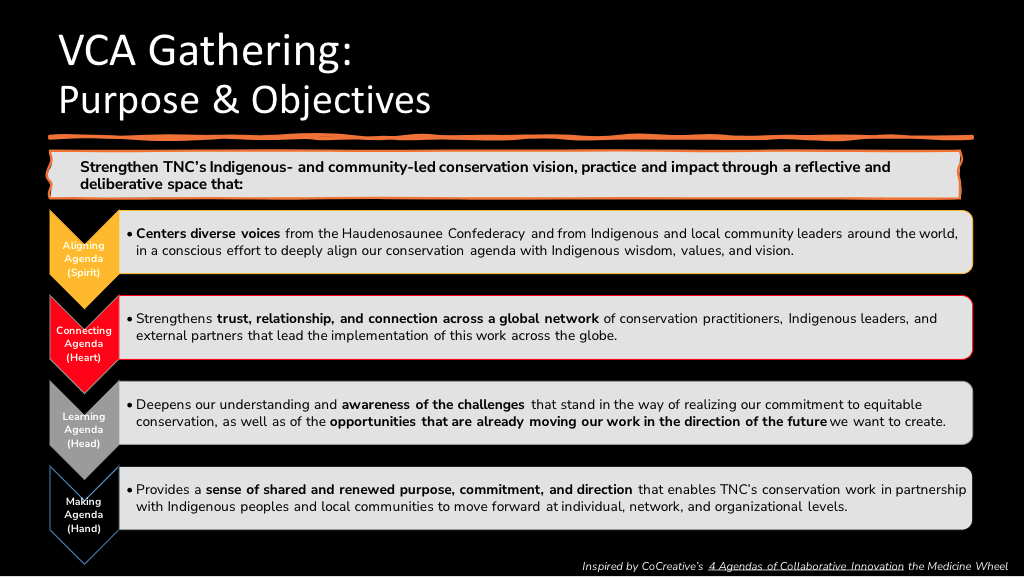
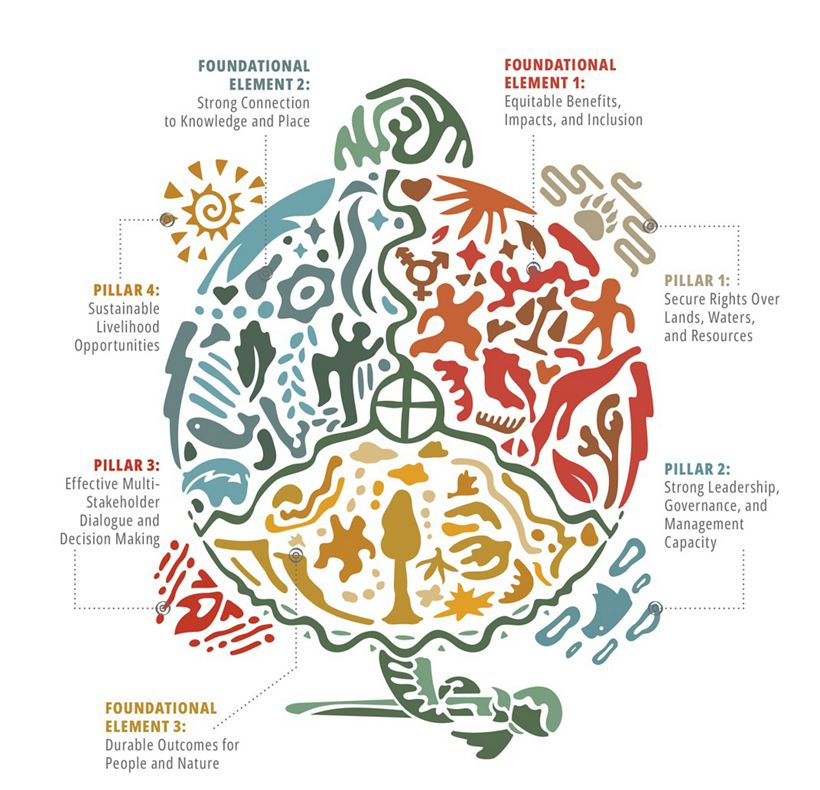
Earlier this year I had the honor and privilege of being invited to support the second Voice, Choice and Action gathering of the Indigenous Peoples and Local Communities Network. A project of The Nature Conservancy, the IPLC is devoted to centering Indigenous and local knowledge and leadership in land conservation work.
Back in 2019, I worked with lead organizer Mariana Velez Laris to support the design of the first convening, held in Bend, Oregon, but was unable to attend. Four years later, again working with Mariana and her team, we found ourselves in new territory, living in a COVID-rattled and fire-and-water-ravaged world with turbulence on many other fronts – political, economic and cultural. We also found ourselves in the midst of many promising developments, including advancements in the realm of braiding, “Indigenous knowledge” with the better practices of Westernized conservation.
This time around I was able to support the team as both a co-designer and co-facilitator with Mariana and the co-leaders of the IPLC, Andrea Akall’eq Burgess and Briannon Fraley, of a gathering that was hosted on Haudenosaunee lands in Buffalo, New York (which also happens to be my birthplace). The decision to hold it in this powerful location (think Niagara Falls, gateway to the Great Lakes, old industrial city experiencing a rebirth, the lands of the oldest standing confederacy in the world) was really the result of Mariana’s vision, and it would yield untold benefits.
We were clear from the outset that this convening was not meant to be a stand-alone event, but would build on the first VCA convening, along with all the work prior to and since that gathering in Oregon. We were also clear that to be in alignment with a “right relations” commitment, as embraced by our Haudenosaunee hosts and other Indigenous participants, we would need to operate in accordance with Haudenosaunee protocols. Much care was taken to establish trust and understanding, including with the host institution, the University of Buffalo, which is home to this country’s oldest Indigenous studies and environmental studies programs.
The agenda itself, under Mariana’s thoughtful and caring stewardship, became a story of spaciousness and flow, a slow moving river that carried us early on into a Haudenosaunee-led opening with the traditional Thanksgiving Address, or the Words Spoken Before All Else. During this time we were welcomed by faithkeeper Oren Lyons, who has seen such immense change in our world during his 93 years on this planet, and who declared our current situation as a deep spiritual battle. And we were greeted over the course of the first two of the four days by other Haudenosaunee leaders, including Gae ho Hwako Norma Jacobs, a Cayuga elder who writes in her recently released book, Odagahodhes, “We have forgotten about that Sacred meeting space between the Settler ship and the Indigenous canoe, where we originally agreed on the Two Row [wampum agreement], and where today we need to return to talk about the impacts of its violation.”
Much of our time made space to dig deeper into this violation, how it was perpetrated in different places in different though related ways, and how it is perpetuated through certain contemporary mainstream (Westernized) conservation practices. Importantly, we also pivoted towards what it would take to heal the rifts and divisions amongst the relations and the nations and to move forward together. Part of this occurred through a ritual that Mariana and I co-led, pulling from the practices of Fierce Civility and Respectful Confrontation, grounding people in their bodies and breath, and inviting us all to honor self, community, Mother Earth and future generations. This was intended to mark a “crossing of a threshold” to open up new possibilities in the community that was gathered. We framed this ritual around some of the teachings we had heard directly or indirectly from the Elders and other speakers to that point, including:
“One of the greatest gifts is to re-member.”
“Everything is built on reciprocal relationships.”
“Nature is one big family, working together to sustain Life.”
“The best way to learn is in ceremony; it pulls you together.”
“Feel our feelings. Feel the love of the Creator. Love ourselves.”
Participants also heard from a couple of powerful panels of Indigenous women leaders from around the world on their visions for reckoning and rematriation, which included these appeals:
Lead with care
Reduce competition
Protect bio-cultural systems
Embrace networks and new structures
Support women’s participation and equality
Let Indigenous groups speak for themselves
Recognize more territories that pre-existed current boundaries
In addition, we participated in other Indigenous-led rituals for healing and joy (optional sunrise ceremonies, a Listening to Niagara Falls visit, a high energy Seneca-led social dance) and ultimately to a session on “planting seeds for the future.” It was not your usual conference, to say the least, and I can safely say that it was one of the most powerful experiences of my life, in no small part because of our Haudenosaunee hosts, and the invitation to “see” (feel and sense) the world from an Indigenous perspective. And I was not alone.
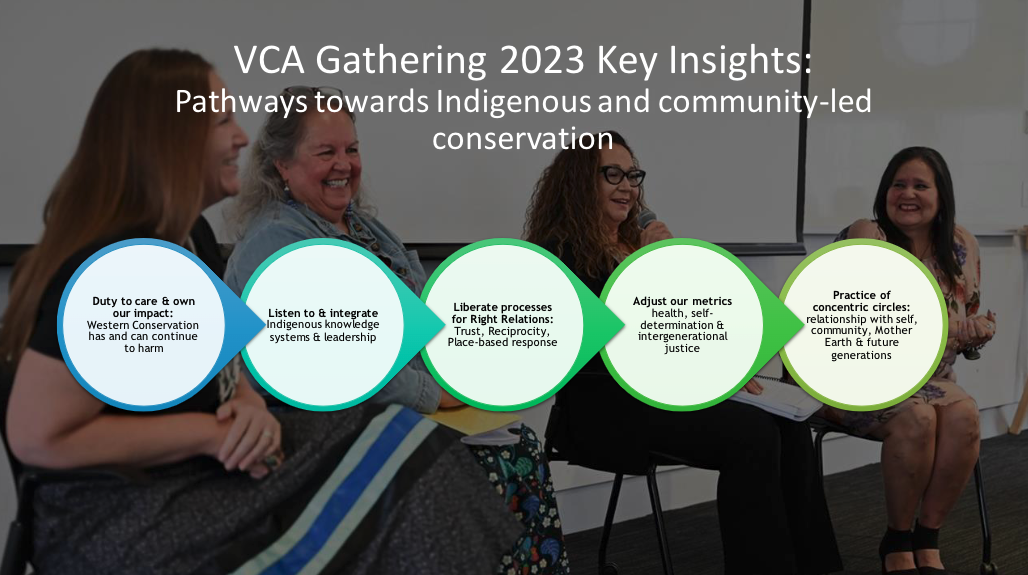
A few months after the convening, Mariana and I held a couple of follow-up sessions, to share what was gleaned from post-gathering evaluations and learn what had moved for participants since we were together. What flowed from those conversations was quite inspiring and encouraging. In the image above you can see some of the major insights that emerged regarding pathways towards Indigenous and community-led conservation. Beyond this, as we listened to those participating in our two Zoom calls share about what they still carried with them and were committing to in terms of action, this is what I heard and noted on a piece of paper:
❤️ Expand the teachings, rather than simply repeating what and how they were given to us.
❤️ Protect and nurture endangered experiences, beyond endangered species.
Folks who know me as a facilitator know that one of my first and favorite questions in planning a meeting is “who’s deciding?” It’s a question that can be counter-cultural for groups that are unaccustomed to clearly defining the decision-making process. And yet, leaving the question unanswered or unclear is one of the fastest ways I have seen to erode trust and to drive people away from working together.
Tips for doing better
Answering a few simple questions can help to avoid a great deal of frustration and prevent the fracturing of collaborative work:
WHAT decision is being made? What information will we need to make the decision? What criteria will guide the decision?
WHY is this the decision we’re making? Is there something else that we need to address first?
WHO is the final decision maker? Is it the group that’s meeting now or is it actually some other group or individual?
HOW will the final decision be made? If the group is making the final decision together, do they have an understanding of what consensus is and how to reach it? What will they do if they can’t reach a consensus? If an individual is making the final decision, will they gather input from others or proceed alone? How will they share the factors that will be considered as the decision is made? How will people be informed about the final decision? (Check out our Levels of Involvement in Decision Making framework for many more details about options for how to involve people in decision making.) What constraints will shape the decision-making process (e.g., time available, resources needed, etc.)?
Using the Questions in Sticky Situations
Do any of these situations, which we’ve seen repeatedly in our work, sound familiar to you? Here are some ideas about how applying our tips could have helped.
A team receives a task with minimal guidance about constraints, other than when the project is due. They complete their task and are told, “No, we don’t have time or money to do all of that.” or “That’s not actually what we thought you’d do with the task.” The team is asked to go back to the drawing board but many members feel disrespected and frustrated, and are reluctant to continue working on the project.
The leader who set the team up with the project could have named specific time and resource constraints to help both the leader and the team set clear expectations, and could have indicated what would happen next if the group couldn’t make its decisions within those constraints.
A coalition is meeting to decide on its goals for the year. A few priorities rise to the top, but there is no moment when the group clearly affirms the choices. Everyone goes away feeling good, but thinking differently about what was actually decided. A few days later, members read the meeting notes, which sound to some participants like they were from an entirely different meeting. Frustration ensues as individuals jockey to get the items they thought were agreed upon onto the final list of goals.
The meeting facilitator could have explicitly checked for consensus as priorities began to emerge, and clearly identified where there was/was not agreement. The note taker could have recorded on chart paper or used a computer and projector (in an in-person meeting) or screen sharing or a shared online document (in an online meeting) so that everyone could see what was happening with the information in real time.
A team receives a meeting agenda saying that the outcome of the meeting is an agreement on a solution to a pressing organizational problem. During the meeting, people spend all of the time exploring the problem. Some people are frustrated that they didn’t even begin to move towards a solution. Others are frustrated with the stated meeting outcome, since there hadn’t been any problem analysis. The meeting ends without a clear sense of what to do next and what to say to those who are waiting for the solution.
Typically, if a group is deciding on solutions, they first need to understand the problem they are trying to solve so they can identify solutions that effectively address root causes. The facilitator and meeting planners could have designed pre-meeting work or discussions to build understanding of the problem before getting into solutions. Or, they could have shifted the timeline so the group could explore problems during this meeting and solutions later.
People leave a staff meeting thinking they have reached agreement on organizational priorities. A few days later, the CEO announces priorities, which are slightly different, thanking the group for the way the meeting helped her to make her final decision on priorities. Staff members are confused and frustrated because they thought they were all making the decision together. Some team members begin to wonder if they can trust the CEO.
The leader could have first asked herself whether this is a decision the team should actually make together. If the situation really did call for her to make the final decision after consulting with the team, she could have started and closed the discussion by clearly stating why she is the final decision maker and how this discussion gives the team a chance to inform her final decision.
A colleague sends you an email, assigning you a task that you didn’t know about and asking you to do it in a way that doesn’t make sense to you. They don’t invite any questions and do not appear willing to discuss your ideas about how to get the job done. You wrestle with how much energy you want to put into asking questions and whether you have the energy to deal with a potential conflict if you just do the task in a way that makes most sense to you.
The colleague could have explained who decided that the task needed to be done in this particular way and why, spelling out important factors that led to this decision. They could have asked for your questions, concerns, or ideas about how to proceed. And they could have explained any degrees of flexibility around how the task was to be accomplished.
While clarity about decision making isn’t magic, it will make many collaborative ventures much smoother. It will grow the precious resource of trust, without which your efforts to work together are destined to fall short. It will also give you new ways to explore and expand power, which is so often experienced through the act of decision making. Questions about who decides on things like priorities and strategy; the allocation of time, money, and other resources; involvement in designing and implementing activities; and who decides who gets a seat at the decision-making table are fundamentally questions about power. Clarity around decision making will create space to address power dynamics more directly and grow more shared power to accomplish together things that you could never accomplish on your own.
Let us know how these tips are helping your efforts to collaborate for social justice and racial equity.For more on power and power dynamics, check out our series Bringing Facilitative Leadership for Social Change to Your Virtual Work, which includes sessions on Managing Power Dynamics in Virtual Meetings and Collaborative Decision Making and Shared Leadership.
All along the way, there were messages of what the times are calling for in terms of practicing resilience and transformation. Each of these deserves a fuller unpacking, and I offer them here for now, with much gratitude to many teachers along the way. I begin each of these with the word “remember,” as that was a core teaching from our gathering on Haudenosaunee lands, that one of our greatest gifts is to remember, and that so much of this is about remembering …
Remember that everything is designed to work together through reciprocal relations.
Remember where you come from, what your “creation story” is, as there is great guidance there.
Remember what matters most to you, your values, and align with them in practice.
Remember what is yours to do in this lifetime and in/with Life.
Remember to go below the neckline (to the heart and gut), without throwing out what is above it (the head).
Remember to practice belonging and accountability (they go together and support one another).
Remember to do intergenerational work/learning, thinking of those living, those passed on, and those yet to come.
Remember to bring in “the periphery” (whatever that means in your particular situation – this generally relates to power and access). There is much wisdom and fresh insight here.
Remember the importance of putting in place a “resilience or transformation infrastructure” (think process, roles and relationships) – this does not necessarily happen on its own.
Remember when it makes sense to “institutionalize” and do so in ways that do not kill spirit, vitality and diversity.
Remember not to make assumptions and be prepared to be surprised.
Remember to have faith in the unseen, the power of “practical magic.”
Remember to break bread with one another, to talk with one another and to keep leaning in to the (apparent) differences. Learning awaits!
Remember to find what grounds and nourishes you (individually and collectively) and cherish/honor it.
“What is at stake with quantum theory is the very nature of reality. Should reality be understood as something completely impervious to our interventions, or should it be viewed as something responsive to the very existence of human beings?”
Christopher Fuchs (physicist)
Image by Kevin Dooley, shared under provisions of Creative Commons Attribution license 2.0.
A mark of a good book for me is one that challenges my thinking, moves my heart, and also resonates in my body. That has been the case while reading Karen O’Brien’s You Matter More Than You Think: Quantum Social Science for a Thriving World. I want to give a big “thank you” and shout out to Fabian Pfortmüller who made this recommendation to me during a rich conversation a few weeks ago.
O’Brien’s book makes the case for bringing a quantum physics lens to the social sciences and to thinking about social change, even as she acknowledges the doubters and detractors who see this as an inappropriate move. Indeed, in posting about the book on LinkedIn recently, I was a little surprised to see a couple of comments attacking the idea of importing quantum considerations into the human realm. In anticipation of this, O’Brien notes that while quantum and classical physics, as well as the “hard” and social sciences, may have different applications, they are not totally separate from each other. Furthermore she writes:
“… given the nature of global crises, maybe this actually is an appropriate time to consider how meanings, metaphors and methods informed by quantum physics can inspire social change, and in particular our responses to climate change.”
So I have been doing what she invites – playing with these different ideas and concepts from the quantum realm and seeing what they stimulate. One I want to lift up here is the notion of subjectivity versus objectivity, and specifically that we are always participants in the world, never simply “detached observers.” This is not simply meant in an emotional sense, but that our very act of observing is actually an embodied intervention and can change what we see and also how we see the world. This “entanglement” (meant more metaphorically here, rather than in the formal scientific sense) asks us to consider how we are already connected, or part of a larger whole.
O’Brien spends some time exploring beliefs as being central to both what is possible and what is actually realized in our lives and world. If we believe we are completely separate from one another, for example. what do we and don’t we consider possible or worth while? If we believe we are more tied or woven, then what might we be inclined to do? The work of Karen Barad is referenced in this respect, pointing out the difference between talking/thinking about “inter-actions” of separate entities versus “intra-actions” among entangled elements within a larger whole. This is not just about a difference in language, but a difference in perceived and acted upon futures.
Photo taken at The Gennie in Craftsbury, VT
What comes to mind is a mantra of sorts that Valarie Kaur puts forward in her justice work focused on addressing the dynamics of othering and oppression, as well as in her book See No Stranger: A Memoir and Manifesto of Revolutionary Love –
“There is a need for an alternative vision, a beloved community where being connected to the other is seen as the foundation of a healthy self, not its destruction, and where the racial other is seen not as the infinite other, but rather as the other that is always and already a part of us.”
“Time and again, where in small or larger ways the shackles of violence are broken, we find a singular tap root that gives life to the moral imagination: the capacity of individuals and communities to imagine themselves in a web of relationship even with their enemies.”
If we treat the so-called “other” (whether human, other animals, plants … ) as apart from us, or as in some sense fundamentally threatening (“the enemy”), then where does that lead? The point here is that reality is not just “reality out there,” it is also what we make of it. We have a say. We matter. What we believe matters. What we do matters. Embracing “a bigger WE” matters. We can “bring forth worlds,” (to quote Humberto Maturana and Francisco Varela’s Santiago Theory of Cognition) at least to a certain extent. And whether this is about imagining or re-membering, acting “as if” we are joined in something larger can seemingly create tangible results, while also acknowledging that dynamics of power and privilege are important to consider in terms of who may be inclined to make first gestures and how these will be received.
“Between me and not-me there is surely a line, a clear distinction, or so it seems. But, now that I look, where is that line?
This fresh apple, still cold and crisp from the morning dew, is not-me only until I eat it. When I eat, I eat the soil that nourished the apple. When I drink, the waters of the earth become me. With every breath I take in I draw in not-me and make it me. With every breath out I exhale me into not-me.
If the air and the waters and the soils are poisoned, I am poisoned. Only if I believe the fiction of the lines more than the truth of the lineless planet, will I poison the earth, which is myself.”
A few years ago I was diagnosed with a benign tumor on my left acoustic and balance nerve (an acoustic neuroma). As the tumor continued to grow, albeit slowly, I made the decision to have radiation treatment two years ago (six months into our new COVID reality). What was presented as a fairly straight-forward outpatient procedure turned into quite an ordeal as I had a strong reaction to the treatment. What followed was dizziness, terrible tinnitus, poor sleep, muscular pain, headaches and occasional “nerve storms” in other parts of my body. After a few months of extreme discomfort I went to see a very adept acupressurist and holistic healer who made the observation that I seemed to be trying to separate myself from that part of my body, tensing against it, rejecting it, and the result was further exacerbation. With her help, over several months, I gradually got reacquainted with that sensitive area (really getting to know it for the first time), and through slow and steady integrative body work, began to relax and reclaim that part of me in a way that has brought greater ease to my overall system and life.
Image by Joe Le Merou, “Peace,” shared under provisions of Creative Commons Attribution License 2.0.
The very energizing thing about that work with this healer is that it has helped not simply to address discomfort in one area of my body, it has positively impacted other parts that I did not even realize were misaligned and/or listless until this crisis occurred. I take it as ontological truth that I am all of my body (though not simply my body), yet for many years (and especially recently) I had not been acting like that (consciously and unconsciously), with real health-related ramifications. Extend this metaphor (separate –> connected, inter-action –> intra-action) to other “bodies” of different sizes. scales and dimensions, and where might that lead?
What excites me here is acknowledging the entanglements that we do not yet know, or cannot possibly hold in our minds alone given the immensity of the world. This is where “thinking and acting in a networked way,” with some faith and conviction, comes into play for me, along with an orientation towards equity. In particular, I think of the encouragement offered in these words from the late long-time community organizer and political educator Grace Lee Boggs:
“We never know how our small activities will affect others through the invisible fabric of our connectedness. In this exquisitely connected world, it’s never a question of ‘critical mass.’ It’s always about critical connections.”
What critical connections and small moves might we make in this intricate, [vast/intimate] and mysterious world that could yield big and needed changes in our communities and lives?
Photo by Gordon M Robertson, shared under auspices of Creative Commons Attribution License 2.0.
Energy System Practice: A Sampler of Practices, Frameworks and Tools
Over the course of the last few years I have been delving deeper into the trans-disciplinary science of energy systems, largely thanks to my colleague and mentor Dr. Sally J. Goerner. Earlier in 2022, Dr. Goerner and I offered a session to The Weaving Lab on energy systems science for network weavers. A summary of that session can be found here. Since then I have been working with a few others to explore,identify and build out resources, practices and tools at different “levels” (individual, group/organization, and larger system), all within the context of the planet that sustains us, in the four different domains of Energy System Science. Together, these domains support systemnic saluto-genesis – the capacity of living systems to reproduce resilience and wellbeing. The four domains are:
regenerative flows
resilient and balanced structures
common cause culture
collaborative learning
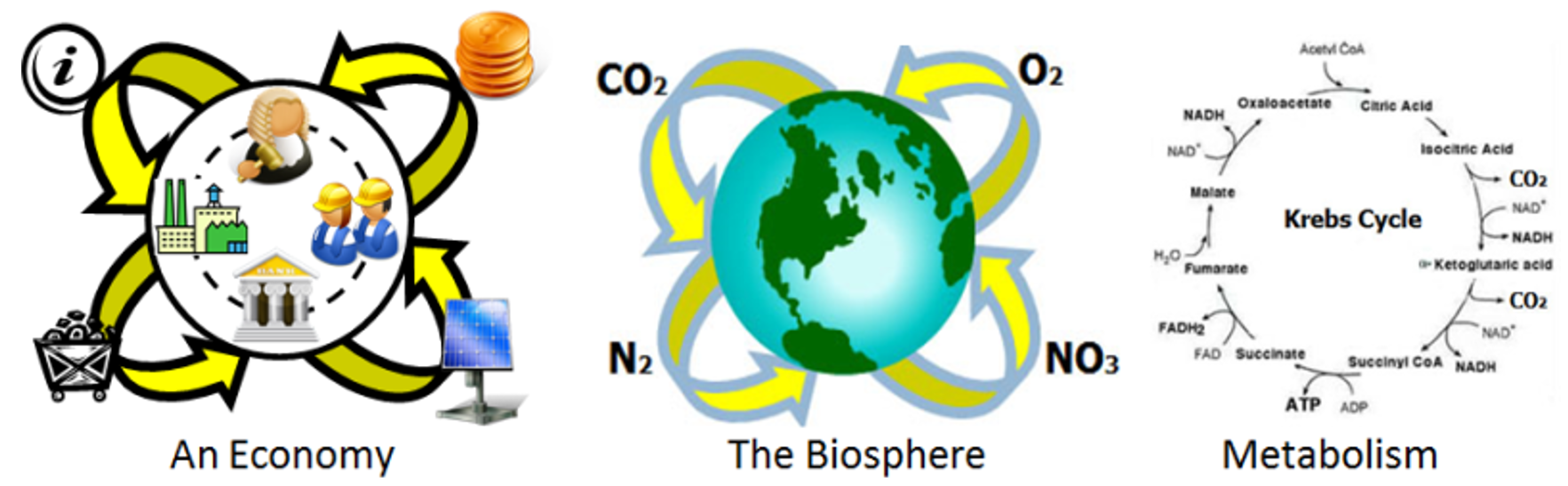
The Energy System Sciences (ESS) see all “living” systems as “flow networks” or structures that arise from the circulation of resources, information, nutrients, etc. Thinking through the lens of flow, systemic health can be seen as being based on things like:
investment and re-investment of key and diverse resources,
healthy outflows (not polluting or poisoning “the host”),
the velocity and spread of resources in the system,
cross-scale circulation, etc.
The nature and quality of these flows determines how systems are able to adapt and evolve in healthy and health-promoting ways.
The image above offers a sample collection of resources, practices and tools, that transcend specific sectors (economics, education, etc.) and that I look forward to bringing to a group later this fall. Certainly incomplete, these practices also do not all neatly fit into one category, even where they appear to in the graphic – that’s life! If you go to this link, you will find the above image as a clearer PDF document that has hyperlinks for some of what is listed (items that are underlined) that will take you to additional information. And I am always eager to hear what others would add!
I am grateful for the many teachers and collaborators, in addition to Dr. Goerner, who have guided my thinking and practice along the way: Joe Weston, Gwen McClellan, john a. powell, Eve Capkanis, Melinda Weekes-Laidlow, Rev. Dr. Jacqui Lewis, Joel Glanzberg, June Holley, Resmaa Menakem, Katya Fels Smyth, Tanya Tucker, Verna Allee, Carol Sanford, Robert Peng, Maya Townsend, Father Richard Rohr, Dorn Cox, Sherri Mitchell, Harold Jarche, Nora Bateson, Marty Kearns, Tara Brach, John Fullerton, Marilyn Darling, Daniel Christian Wahl, Anne Marie Chiasson, Dr. Chris Holder, Tyson Yunkaporta and Steven C. Hayes, among others.
“i think of movements as intentional worlds, or perhaps more accurately as worlds designed by and for intentional people, those who are able to feel the world not as an unfolding accident of random occurrences, but rather as a massive weaving of intention. you can be tossed about, you can follow someone else’s pattern, or you can intentionally begin to weave and shape existence. and yes, the makeup of your web is the same matter as all that already exists, but your direction and pattern can be new, unexpected, agitating new growth. what results from your efforts depends on your intention.”
– adrienne maree brown
I recently returned from a week-long vacation with family to the so-called Northeast Kingdom of Vermont, and a particular location that is deeply nourishing and meaningful for its landscape, its link to family history on my wife’s side and (perhaps for these times) an unusual sense of community. I count myself privileged to have had the time and the opportunity to be in that place with those loving people, with that sense of multi-generational connection.
Heading back “home,” I could feel the tension mounting as my wife and I talked about re-entry. Before thought, my body tightened in anticipation of the return to the mundane daily tasks, to-do lists and un-answered emails/phone messages. The morning after our return, I somewhat absent-mindedly dipped toes into social media and felt my blood pressure rise. “What am I doing?” I wondered, even as I continued to wade in, pulled by questions about what happened while we were away and what new opportunities might be presenting themselves – FOMO (“fear of missing out”) in full effect. When I closed the laptop, perhaps 30 minutes later, I was aware of my stiff neck, shallow breathing, hunched shoulders, and whirling brain. Saved by a 12 year old daughter almost yelling, “Dad, c’mon, let’s get outside and play ball!”
As much of a proponent as I am of collaboration and networks, I am struck by how I can get a bit caught in the approach/avoid loop of connection, and mired in questions of “How to connect?” and “How much is enough connection?” and “What kinds of connection do I really need?” As I engage with others, I realize that these are pretty fundamental ponderings for navigating a more viscerally entangled world.
“When our ancestors spoke about a web of life, they were describing what Western science calls quantum entanglement. They understood that we all originated from the same seed of life, and when that seed exploded and carried life across our universe, we remained connected. Quantum entanglement tells us that any matter once connected physically can never be disconnected energetically (or spiritually).”
– Sherri Mitchell (Weh’na Ha’mu’ Kwasset, “She Who Brings Light)
More and more is being written, spoken and (re)-presented about the fundamentally interconnected nature of our lives, and of Life writ large. In a beautiful essay in Emergence Magazine (“When You Meet the Monster, Anoint Its Feet”) , which weaves connections between climate change, race, racism, evolutionary biology, ecology, myth and narrative, Bayo Akomolafe offers …
“Perhaps most important about this time is that the image of the human is being composted—or, we are experiencing great difficulty determining where the nonhuman stops and the human begins. Everything touches everything else in the Anthropocene—an observation that is supported by, say, current thinking about ‘holobionts,’ assemblages of bodies within bodies within bodies, or intersecting communities that toss out notions of separable individuality. We are holobionts.We live and are lived through; we are composite beings, companion species, emerging within and among assemblages.”
And, as Akomolafe later shares from his indigenous and experiential knowledge, bodies and beings transcend time. More recent research into intergenerational trauma (see the work of Resmaa Menakam and Thomas Hubl) shows that our bodies indeed know the score, not only of our own individual pain, but the suffering passed through our ancestral lines. Husband and wife, and astrophysicist and physician, team Karel and Iris Schriyver, in their book “Living With the Stars,” add that our bodies are always in dynamic exchange with … the wider universe! Our cells die and are replaced by new ones, renewing our entire biological makeup, using food and water as both fuel and construction material. This rebuilding happens by using elements captured in our surroundings and cycled through geological processes, all extensions of galactic explosions and ripples and atoms that formed through collisions with our planet’s atmosphere eons ago.
We are entangled in a multiplicity of ways, containing and residing within multi-dimensional multi-scalar multitudes. I find this simultaneously liberating, dizzying, humbling and dumbfounding. Knowing that everything is interconnected can inspire a profound sense of belonging and ease, yes, and sometimes it can make it a bit hard for me to plan or get through the day!
And so here we are, exquisitely entwined, and yet also individuals, or at least bounded organisms with a sense of individuality, of distinction, of the need to preserve the integrity and dignity of something called “me” or “self.” And the question of these times would appear to be how we can honor a healthy sense of self/individual, whole communities, and Life, all at once.
“To allow oneself to be carried away by a multitude of conflicting concerns, to surrender to too many demands, to commit oneself to too many projects, to want to help everyone in everything, is to succumb to violence. The frenzy of our activity neutralizes our work for peace. It destroys our own inner capacity for peace. It destroys the fruitfulness of our own work, because it kills the root of inner wisdom which makes work fruitful.”
– Thomas Merton
Image from Charles Patrick Ewing, shared under provisions of Creative Commons Attribution license 2.0,
While there have been understandable and important pushes to get beyond the individualistic and atomistic view, I have the feeling that some of this emphasis, as with all pendulum swings, can go a bit too far. Seeing the world as profoundly interconnected might drive a strong desire to reclaim a kind of forgotten birthright, and in my experience, it can also result in getting lost, especially if it is guided by an underlying desire to fully understand, grasp and/or control it all (colonial mindset?). Or if that drive is purely to belong to something, anything, no matter its underlying values, to spare the pain of felt/perceived separation.
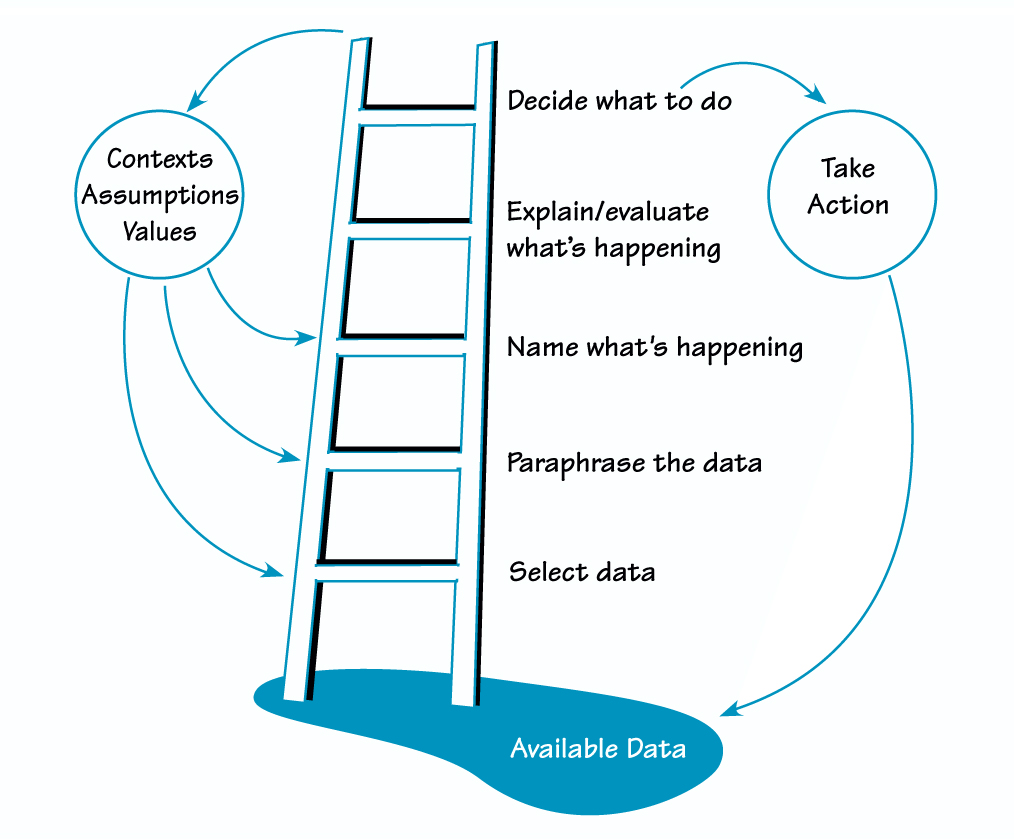
A certain view in contemporary physics holds that the world, the universe, is entirely made up of an infinite amount of information, a vast expanse of sensory inputs that all taken together would be utterly overwhelming to our individual apparatus. And so we have our human senses as filters to sift through, make sense and identify/assemble what is most … useful, interesting, advantageous. The point is, there is always more than meets (or at least is taken in by) our eyes, ears, nose, tastebuds, touch, etc. This calls to mind the ladder of inference, a framework we teach at IISC that helps people remember that we are often recycling conclusions we have drawn from a very partial understanding of reality, and that it might behoove us to expand our “view” to reach more helpful (just, prosocial, sustainable) conclusions and actions.
That said, simply taking in more, or making more connections, may not lead to a better place, if it results in overwhelming nervous systems. So it seems there is a balancing act here. Just as we often can’t do something new without letting go of something old, there is a need to modulate what one takes in – news, ideas, people, and possibilities. Connection and flow management. Energetic discernment. Intentional dis-connection and dis-entanglement.
What might this look like in this networks upon networks networked world? A few thoughts …
“Between you and me, now there is a line. No other line feels more certain than that one. Sometimes it seems not a line but a canyon, a yawning empty space, across which I cannot reach.
“Yet you keep reappearing in my awareness. Even when you are far away, something of you surfaces constantly in my wandering thoughts. When you are nearby, I feel your presence, I sense your mood. Even when I try not to. Especially when I try not to. . . .”
– Donella Meadows
Image from Visible Networks Lab
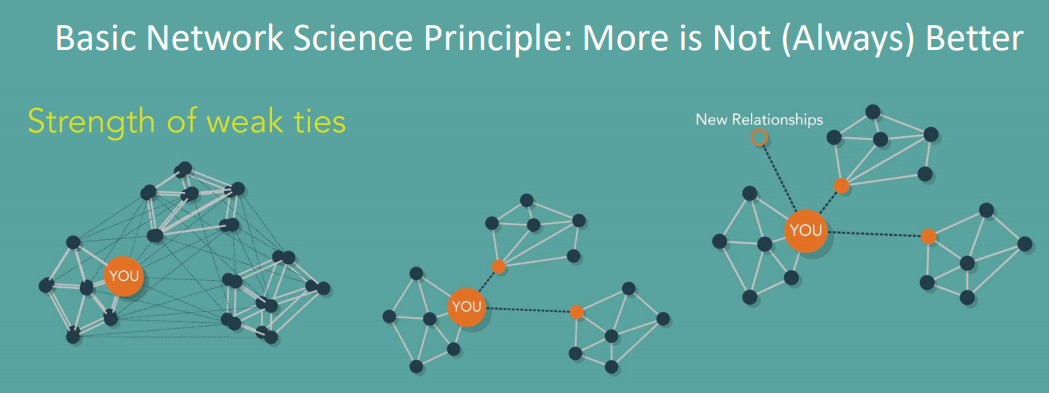
In a previous post, I shared some of the wisdom of network science as taught by Danielle Varda and colleagues at Visible Networks Lab. They make the point that when it comes to creating strong (resilient and regenerative) networks, more can be less in terms of the connections a person has. Connectivity and related flows can be ruled by a relentless growth imperative(capitalism?)that is not strategic or sustainable. More connections require more energy to manage, meaning there may ultimately be fewer substantive ties if one is spread too thin. Instead, the invitation is to think about how to mindfully maintain a certain number of manageable and enriching strong and weak ties, and think in terms of “structural holes.” For more on this social network science view, visit this VNL blog post “We want to let you in on a network science secret – better networking is less networking.”
Over the last several years, I have been playing with a set of about a dozen principles (give or take) for network thinking and action. One that seems quite helpful here is the saying, “Do what you do best and connect to the rest.” As ecosystems become more robust and complex, individual participants are invited to carve out more specific niches, and be oriented towards synergistic and supportive relationships with others. In other words – stop trying to do it all, or connect to it all! It’s not possible, it can create unnecessary competition, overwhelm and inhibit “collaborative efficiencies.” This also aligns with a metric of energy network and systems science (see below), which focuses on the importance of a diversity of roles in healthy living systems. Share and spread the wealth!
As just alluded to, the emerging field of “energy systems science” points to a number of different factors or indicators that contribute to long-term living system (including human systems) health and thriving. Four of these indicators fall under the heading of “measures of flow.” Thinking about how these apply to our own and/or collective in-take and sharing of information/energy might be helpful for knowing what is “sufficient:”
Robust cross-scale circulation: How rapidly (too fast?/too slow?) and well do a variety of resources reach all parts of an individual/social body?
Regenerative return flows: To what extent does the individual/social body recycle resources into building and maintaining its internal capacities? Is there too little (depletion)? Is there excess (hoarding)?
Reliable inputs: How much risk and uncertainty is there for critical (health promoting) resources upon which the individual/social body depends?
Healthy outflows: What impacts do the individual/social body’s outflows have externally?
On a more personal tip, I have been married for almost 20 years. What has perhaps been one marriage from the outsider’s perspective has been many from the inside, as other long-standing intimate partners can surely appreciate. We have learned and grown over the years. One important lesson has been knowing when we are too enmeshed and need to separate for some time. There is a point of diminishing returns in many of our heated discussions/ arguments, and if we do not dis-entangle or dis-connect, we have learned, we can do damage to the relationship.
Along the same lines, two of our daughters are identical twins, now twelve-years old. What we have observed about them is what we have heard about many twins – they are truly uniquely connected. There are many times when we quietly watch with fascination as they, seated on opposite ends of the room, engage in similar gestures (scratching their heads with the same hand at the same time, for example) seemingly without direct awareness. Quantum entanglement in full effect! And they can get themselves enmeshed at times and in ways that drive each of them, and the entire family system, to the edge. They are learning that they need and how to differentiate and take space, even as they have a natural gravitational pull to their other half.
Knowing when to create a bit of a boundary (what Buckminster Fuller once called, “a useful bit of fiction”), a separate amniotic sack if you will, and when it is optimal to connect more fully often requires attention and discernment, for all kinds of relationships.
“Beware of the stories you read or tell; subtly, at night, beneath the waters of consciousness, they are altering your world.”
– Ben Okri
The movie The Social Dilemma and the work of Douglas Ruskhoff (see Team Human) both point to the perils of getting caught up in our increasingly socially mediatized world. The algorithms behind these powerful tools are designed to capture our attention, pressing our buttons oriented towards hedonism (“likes”) and fear/outrage. A recent article in The Atlantic Monthly(“You Really Need to Quit Twitter”) points to how difficult it can be to break this habit. This is not to say that these tools are inherently bad or evil. They are certainly formidable, and require considerable attention and intention. Social media fasts and limited dips can help, as well as being mindful about what and why we are both sharing and consuming (see this other recent post for some considerations on this – The Wisdom of W.A.I.T.ing: Mindful Sharing in a Network Age.
If dis-engagement is not an option or ideal, there are a number of practices I have been learning and using that can help to manage energy exchanges, both in-person and virtual:
From the Rockwood Leadership Program, I learned the practice of imagining that my body is like meshwork (think a fishing net), when something intense is coming at me, so that it can pass through me, and I don’t use too much energy resisting or having it get stuck in my body/psyche.
From a couple of local trauma therapist who focuses on racialized trauma, I have learned the practice of using imaginative “shields” (in my mind’s eye) on the outside and inside of my body, to allow for energy coming in or going out. Silver shields on the exterior repel unwanted energy, and on the inside they keep precious energy in. Grey shields allow some energy in or out.
From a number of practitioners, I have learned the practice of slowing my breath to manage energy flow, in-take and circulation.
From Qigong Master Robert Peng I have learned how to use a “circuit breaker” for the life force (or “chi”) moving through me by enclosing my thumbs with the fingers on each hand, which can diminish intense energy flows when engaged with others.
Also from The Weston Network, I have learned about the practice of embodied energetic balance when reaching out to make contact with others, while not over-extending, and also maintaining a firm sense of grounding and dynamic flexibility. I have also been reminded, helpfully, that balance is never static. We are constantly in motion, if we are alive, and when “most balanced,” are actually able to recover quickly from being extended or engaged in some way. So a question to carry is “What supports my ongoing ability to recover?”
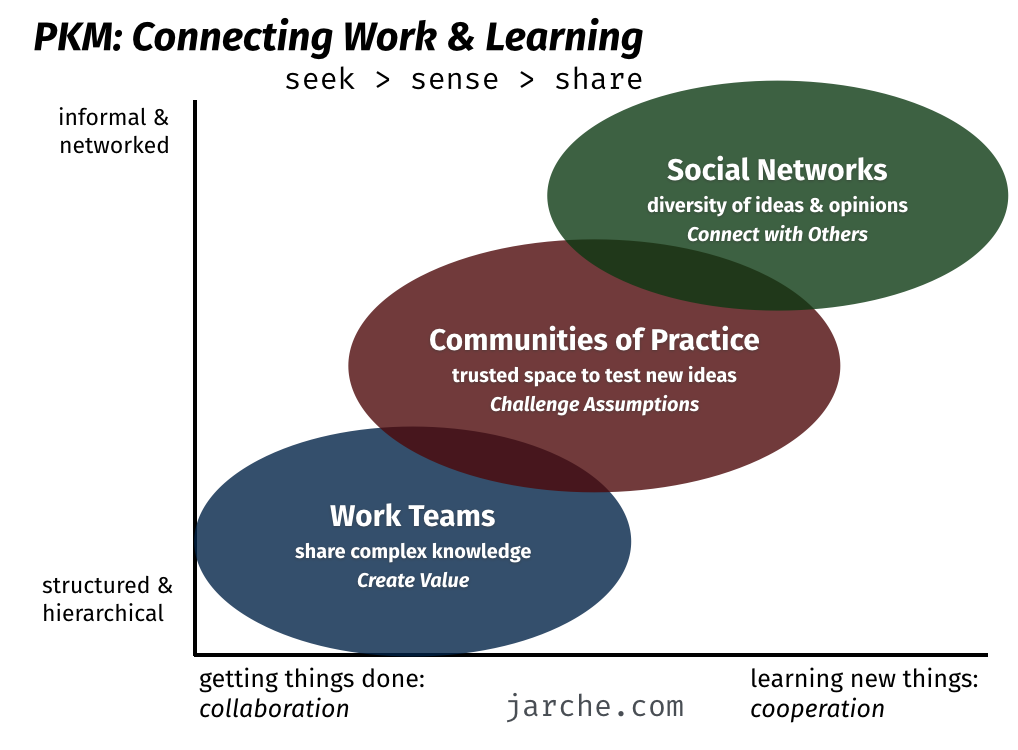
From Harold Jarche, I have learned many ways of managing personal knowledge development through mindful connection to different networks in ways that ideally make them all “smarter” and don’t simply ask them/me/us to work “harder.” Of particular help is knowing what one can reasonably expect in terms of energetic flow and return from work teams versus communities of practice versus one’s wider social networks (see image above).
Especially in work that may be emotionally challenging and draining, I have learned from both Acceptance and Commitment Therapy/Training, as well as teacher Tara Brach, the idea of “tending and befriending” otherwise unwelcome feelings that inevitably come up, so that rigid resistance does not make those emotional visitors stronger.
And in general, I am embracing and making space for more silence, solitude and stillness, challenging some of my deep seated anxieties about losing connection and a sense of belonging in the world (what some would say FOMO is really about – for more about this, see this informative talk by Tara Brach).
And there are SO MANY teachers out there and much wisdom to glean that I certainly welcome others to share! It is my hope that many more of us can become adept energy and flow scientists/artists/healers/workers as we intentionally weave patterns that are the basis of the better world we sense is possible and know is necessary.
“The point of solitude is to give yourself time to grow in your own way, while the ultimate goal remains the difficult task of love and connection.”
– Damion Searls (from the introduction to a new translation of Rainer Maria Rilke’s Letters to a Young Poet)
Over the past couple of years, I’ve worked with a state-wide health equity network, comprised of smaller coalitions, that has been looking at living into being more of a network in thinking and action. After some conversation and consideration, we decided to use a framework that derives from the writings of Madeleine Taylor and Pete Plastrik.
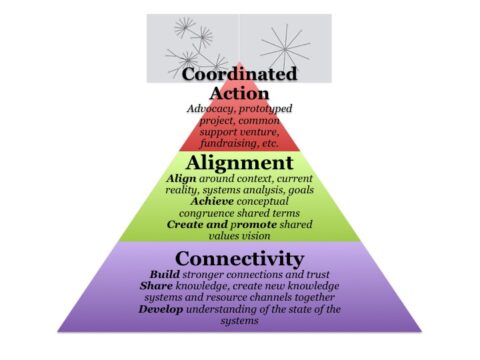
The Connectivity-Alignment-Coordinated Action/Production framework (see graphic above) lifts up three different network modes, through which value and impact is created. First of all, network value and impact is grounded at a fundamental level in creating connectivity, by building linkages and trust between key stakeholders and perhaps unusual bedfellows. This can be done by convening people; closing triangles, sharing stories, data and other forms of information; co-creating knowledge; learning together, etc. Part of the value of this connectivity is that it can lead to orthogonal thinking and bolster individual network participants’ efforts in the shared domain where the network is focused. What also might happen is self-organized action between those who are meeting one another for the first time or getting to know one another better.
“Healthy networks measure their impact, in particular by establishing the links between decentralized network action and outcomes.“
Up a level, networks may be compelled to create some kind of collective and aligned commitment or value proposition in the form of shared vision, values, public statements, etc. This can create greater impact/ripples, and provide additional value to individual participants and self-organized efforts, as they are more prone to head in the same general direction or with some kind of deeper shared understanding of context.
And then there are those instances when there is a call to some form of collective action, such as advocacy, a communications campaign, fundraising, or some other co-produced venture. This can happen even as smaller self-organized action continues (really, from a network perspective, most collective action should be about creating the conditions for those self-organized efforts, which is what is meant by “making the periphery the norm” in network building lingo).
With all of this in mind, after doing interviews, some observation, as well as evaluations and other documentation from the sub-networks of this state-wide advocacy network, a few patterns seemed to surface that suggested ways for the network to strengthen itself and leverage network effects.
Here is a list of what was surfacing as opportunities seen through the C-A-CA/P lens:
In the calls that the network does with its members, there appeared to be more of a one-directional download of information from staff (the hub) to its members (the periphery). And in various documents there appeared to be some suggestion that people were not connecting except through the hub. Furthermore, an annual report said that state partners expressed a desire to know more about one another’s capabilities, constituencies, and connections. All of this suggested an opportunity for creating greater CONNECTIVITY, especially member-to-member.
In an interview the observation was made that on membership calls there were often the same people speaking while others were silent. This suggested that greater CONNECTIVITY could be created for those who were less outspoken and silent. There appeared to be some correlation between those who were longer standing members (more outspoken) and those who were new to the network (more quiet).
In assessments of meetings, comments were made that while people appreciate the great information and education they receive, they were also eager to meet, learn from and strategize with one another. This again suggested an opportunity to strengthen member-to-member CONNECTIVITY.
Questions had come up about whether relationships with state and county lawmakers, behavioral health experts, and others might be better maximized for trust and information sharing. Another area to explore strengthening CONNECTIVITY to and among those stakeholder groups.
Related to the above, while the network’s political capital was appreciated by many members, there were also questions about democratizing that power, and helping members to be more involved in the legislative process. This suggested that beyond creating greater CONNECTIVITY among members, there might be some opportunity to provide COORDINATION support to enhance access.
“Clusters” of members in certain parts of the state had been mentioned in interviews and documents. It was observed that in one region, there is some evidence of people getting tighter and that in another region, organizations were using lists to get together. This lifted up the question about more intentional CONNECTIVITY and ALIGNMENT that the network might suggest or provide to those existing and other potential clusters to strengthen their advocacy work.
An annual report identified some expressed concern about the challenge with creating alignment among collation partners on behavioral health priorities, and that “collective buy-in” and “intentional relationship building” will be key to establishing alignment. This is another reason to keep building that trust and CONNECTIVITY and also to explore actively facilitating ALIGNMENT around core priorities.
It was shared in staff interviews that there have been questions from members about the network’s long-term vision – “Where are you trying to go?” This raised some possible opportunities to facilitate ALIGNMENT around a shared, guiding and galvanizing vision with members.
Related to the above, the suggestion was raised around exploring he coalescing of sub-networks to consolidate and create more ALIGNMENT and COORDINATION between those separate coalitions.
And here is what was offered as a set of initial recommendations:
Consider the points above and if there is agreement among staff about where to weave greater connectivity, facilitate alignment and/or coordinate activity in different domains. Specifically: Who needs to be better connected and what would that achieve? Would alignment around a shared vision and high-level goals be helpful? Who would need to be aligned?
As these opportunities are identified, consider existing network (staff) capacity to provide weaving, facilitation and coordination support. Where and how might this capacity be added or developed?
Think about ways to create greater connectivity within existing calls, meetings and trainings. For example, have a check-in question; invite people to share news, victories, needs; break people into pairs and smaller group discussions; create open space for people to explore interests and opportunities to work together.
Consider creating a toolkit and perhaps a training for building relationships and maximizing connections in networks.
Reach out to less out-spoken and newer coalition members to see if there is anything that would support their participation. Related to this, make sure there is an on-boarding process for new members so that they feel up-to-date and know how to participate.
To gauge “network impact,” follow up with members to see what they do with the content, capacity and connections they get from calls. Are they able to leverage these for greater impact in their communities and regions to create “ripple effects”?
Reach out to other networks to see how they go about democratizing power and opportunity in a network. In addition, look to other groups across the state to see how they are working with grassroots groups to mobilize around policy.
Consider having an open conversation with member organizations about how to strengthen the sub-networks (coalitions) as a network. What ideas do they have? This might include giving them some overview of networks and network effects/impacts.
Consider conducting an assessment to find and leverage “network champions.” Are there certain members who are particularly enthusiastic about and active in network activity and might be ambassadors for the collective work? Might they be more formally enlisted as network weavers?
Consider the virtual tools currently used for keeping members connected (virtual meeting platforms, shared files and documents, archives, private group pages). Are they working? Are people taking full advantage of them? Is there additional value they are looking for that might be provided by other tools?
Consider using a more formal network assessment to look for strengths and areas for growth and improvement in the network’s structures and practices. This could be conducted among staff alone and also include key partners. Examples include “Network Effectiveness: Diagnostic and Development Tool”, “Partnership Self-Assessment Tool” and “Network Health Scorecard.”
“Out on the edge you see all kinds of things you can’t see from the center. … Big, undreamed-of things – the people on the edge see them first.”
– Kurt Vonnegut
I have used the above quote in a number of cases to illustrate a network principle of thinking and action – Don’t get stuck in the core, make the periphery the norm. As we come to the end of 2020 (as arbitrary as that calendrical designation may be), I am thinking about Vonnegut’s words in different and perhaps more expansive ways.
Seemingly many of us have been asked to live (in some cases, even further out) on any number of edges over the past several months – political, economic, psychological, social, spiritual. While exciting in certain cases, it has also been quite exhausting and for some it has been a push to and over the brink.
It is also the case that many have woken or are waking up to the realization that life can only continue in some form or fashion at various edges, especially in times of considerable change. The Aboriginal artist and complexity scientist Tyson Yunkaporta reminds us that from an indigenous perspective –
“Sedentary lifestyles and cultures that do not move with the land or mimic land-based networks in their social systems do not transition well through apocalyptic moments.”
And it would seem we are at an apocalyptic moment, if we take that term to mean a great revelation, along with a call for reckoning, healing and re-creation. “The Great Turning,” maybe, allowing that transitions take us to the edge, because that is where qualitative growth lies.
“Look well to the growing edge. All around us worlds are dying and new worlds are being born; all around us life is dying and life is being born. The fruit ripens on the tree, the roots are silently at work in the darkness of the earth against a time when there shall be new leaves, fresh blossoms, green fruit. Such is the growing edge.”
– Dr. Rev. Howard Thurman (philosopher, theologian, educator, civil rights leader)
Earlier this year I joined a beautiful community stewarded by Joe Weston, which has been brought together by a common desire to cultivate deeper shared capacity among people for what Joe calls “respectful confrontation” and “fierce civility.” The Weston Network is grounded in a set of practices drawn from martial arts, mindfulness and somatics, which help practitioners cultivate four core pillars – grounding, focus, strength and flexibility. These pillars support people to express and get their needs met in ways that can contribute to co-evolution (my word, not Joe’s), or mutualistic growth in groups and communities. I can really vouch for the power and the personal test of the practice!
A helpful concept that Joe introduced back in March at an in-person workshop, just before things started to close down because of COVID, was the idea that our individual and collective growth is found at “the resilient edge of our resistance.” The idea is that people tend to be resistant at the edges of their comfort zones, for some good reasons. And yet it is also true that staying hunkered down is not always helpful, and may even be dangerous. People also have the capacity to become more resilient at and over the edges of their perceived comfort zone. Life, in fact, requires this!
“Evolution is what happens when patterns that used to define survival become deadly.”
– Nora Bateson (filmmaker, writer, regenerative thinker and educator)
Through the Weston Network, I have been learning more about how to read resistance and sense its invitations beyond, “Don’t move. stay safe!” … feeling these messages in my body and a complex mixes of emotions, along with the dynamism of dancing on different edges. Resistance when met with a combination of respect, rootedness, receptivity, and recreation can build muscle, confidence, and open up new possibilities. How many people have I heard say that one thing they have learned this year is that they are in fact stronger and more adaptive than they might have thought? Or that they have found meaningful connection in struggle and disruption?
“We don’t have to resist entropy … or push the river. We just need to learn how to get out of the way and cooperate with the direction.”
As I have gone and been pushed to my growing edges this year, seen myself and the world from new vantage points, and tasted “resilient power” (Joe Weston’s words), I’ve been contemplating what this looks like as collective practice. And I’ve been dabbling a bit with both the Weston Network practices as well as those of the PROSOCIAL community in a few different groups and networks.
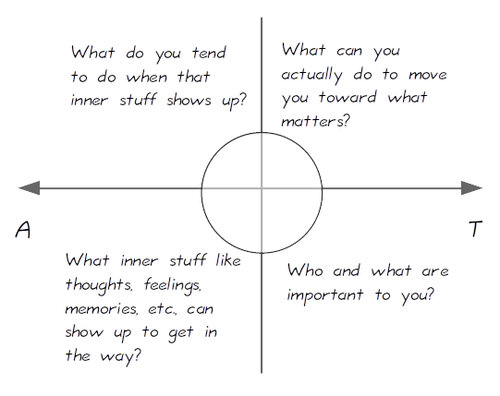
The PROSOCIAL community is rooted in extensive field research (including the commons-focused work of Nobel Prize winning economist Elinor Ostrom) and evolutionary and contextual behavioral science. PROSOCIAL offers tools and processes to support groups in cultivating collaborative skillfulness and the critical capacity of psychological flexibility, including the application of Acceptance and Commitment Training/Therapy (ACT) techniques.
The ACT Matrix (see above) is a tool that individuals andgroups can use to name what matters most to them, along with aligned behaviors, as a way of laying a foundation for transparency, agreement, support and accountability. The Matrix also helps people to name andwork with resistance found in challenging thoughts and emotions that might move them away from their shared values. In essence, this helps to normalize resistance and when used with other ACT practices (defusion, acceptance, presence, self-awareness), can encourage more sustainable, fulfilling (over the long-term), and mutually supportive choices.
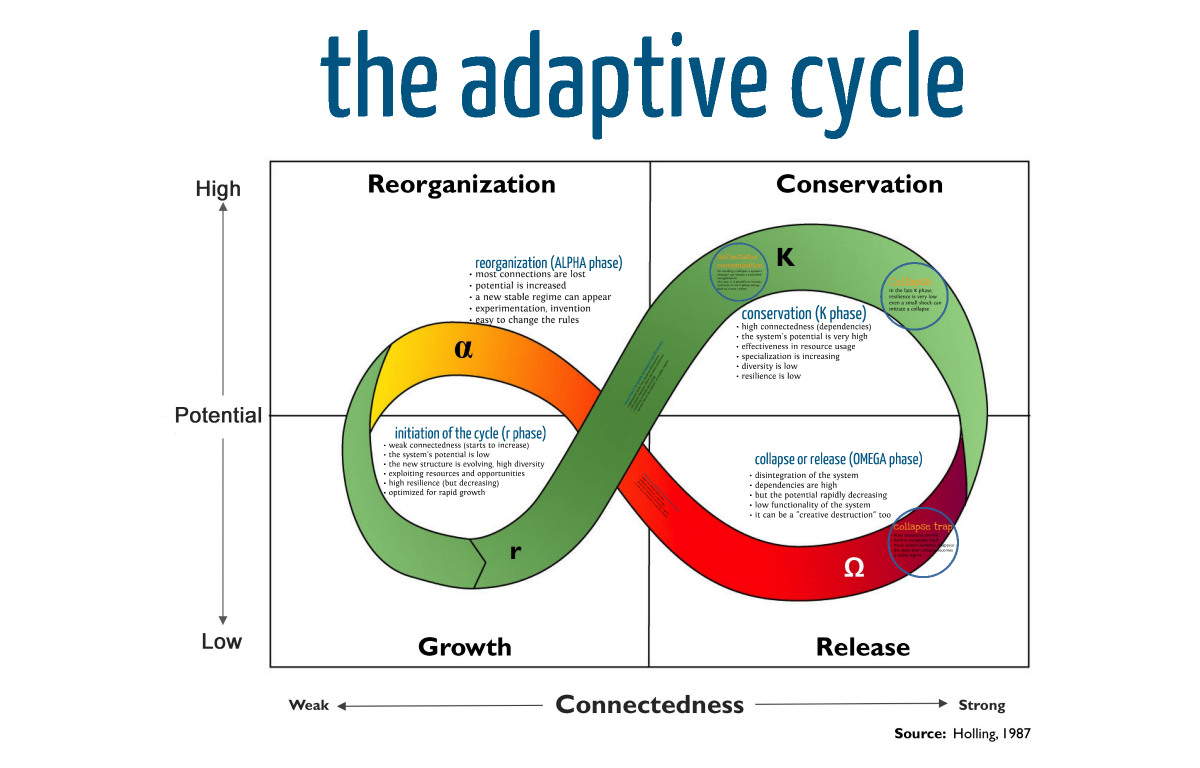
I’m eager in the new year to lean more into these different practices with others, knowing that more of us are moving with intention into the “omega” (release) and “alpha” (reorganize) phases of the adaptive cycle (see below). While letting go and stepping into the unknown may not be a very compelling invitation to everyone, I’m hoping that the prospect of finding our resilient power and cultivating regenerative futures will be incentive to keep moving to meet, greet and play on our edges.
I am struck by how the network building and weaving field has really mushroomed over the past several years, and with it, so much learning around approaches, structures, roles, strategy, etc. I regularly hear myself say that there is no one right way to go about “net work” for change (which is why I regularly reference this compendium of thoughts on networks – “A Network Way of Working”). That said, I have found that “principles” (for lack of a better word) for network thinking and action have been helpful in a number of different contexts to support people in finding ways to leverage the promise of networks (or “network effects”).
This is a list that I continue to play with, expanding and contracting given new learning and different contexts. I recently offered the following version to a food system network. Always open to riffs and improvements …
Come First as Givers, Not Takers – Of course people should (and will) think about their self-interest, but if everyone holds out for what they are going to get, then nothing gets created in the first place. Generosity leads to generativity.
Support Intricacy & Flow, Beyond Bottlenecks & Hoarding – Many kinds of connection and robust movement of resources of all kinds is what contributes to the adaptive and regenerative capacity of networks.
Make the Periphery the Norm, Don’t Get Stuck in the Core – In the words of Kurt Vonnegut, “Out on the edge you see all kinds of things you can’t see from the center. … Big, undreamed-of things–the people on the edge see them first.”
Work with Others and/or Out Loud, Not in Isolation – Otherwise, what is the point of creating a network?! Connect, cooperate, coordinate, collaborate, and for God’s sake, share!
Value Contributions Before Credentials – Valuable contributions come from all kinds of places and people. Credentials and holding out for a certain kind of “expertise” can get in the way of seeing the greater abundance around you, benefitting from it, and contributing to it.
Lead with Love and a Sense of Abundance, Not Fear and Scarcity – Fear and scarcity narrow our view, shrink our thinking about what is possible, and inhibit our willingness to share. Love is love and does what love does.
Think Spread and Depth Before Scale – Because it’s easier in many ways, can avoid mechanical and inappropriate replication thinking, and helps to establish a more firm foundation (think roots under the tree).
Support Resilience and Redundancy Instead of Rock Stardom – Because we aren’t all that special (though we may be unique) and because its not strategic to put all eggs in one basket, however shiny. And then there’s the ego thing …
Trust in Self-Organization & Emergence, Not Permission & Predictability – COVID19 has driven this lesson home, big time. We are not in control. Life is complex, and beautifully so. Evolution is real, and so is people’s capacity to be response-able when they are trusted.
Say “We’re the Leaders!” Instead of “Who is the Leader?” – Who and what are you waiting for? And why?
Do What You Do Best and Connect to the Rest – Stop trying to do it all. It’s not possible, it creates unnecessary competition and burnout and it inhibits collaborative efficiencies (yes, they exist).
Attract a Diverse Flock, Not Birds of a Feather – Homophily (like being attracted to like) is a strong tendency in people. In network speak, we should not simply bond, but also bridge. This is important for the wok of equity and inclusion, tapping creativity and innovation, and tasting the wonder-full spice in Life.