Image Description: Illustration of a person standing with their hands on their hips in front of multiple brightly colored doors floating in a dark, star-filled space. Curving pink pathways weave between the doors. By Adriandra Karuniawan via Unsplash.
In our last blog, we explored the importance of clarifying your North Star: the purpose, values, and vision that anchor your organization in times of uncertainty. That clarity is essential. But clarity alone is not enough.
When predictions are shaky and change is constant, nonprofit leaders are navigating conditions that feel more complex than ever:
Shifting funding and political landscapes
Increasing demand for services
Workforce burnout and capacity constraints
Rapid political, social, and technological change
Traditional strategic planning, built on stability and predictability, no longer meets this moment. This is why we are seeing organizations shift toward strategic direction-setting: an approach where the direction is clear, but the path remains flexible
Within strategic direction setting:
North Star = Direction (what stays constant)
Scenario Planning = Conditions (what may change)
Strategies = How we move (what adapts)
And within this approach, scenario planning is a critical practice. But the question remains: How do we stay purposeful when the conditions around us are constantly shifting?
Why Scenario Planning Matters
In times of uncertainty, our ability to radically imagine multiple futures becomes essential. Not only to stay grounded and hopeful, but also to prepare for changing conditions while holding onto our North Star.
Scenario planning is one of the most useful tools for doing exactly that.
Our colleagues at Building Movement Project, in their 2026 Brief on Solidarity: Lessons from a Year of Crisis and Change, noted that organizations can no longer afford to treat scenario planning as an occasional exercise. Increasingly, it is becoming a necessary practice for preparing, protecting, and adapting in these times.
At its core, scenario planning is the process of imagining and exploring multiple potential futures based on a range of uncertainties. Organizations often try to plan for one expected future, but in times of uncertainty, it is more useful to prepare for multiple possible futures while staying grounded in your core purpose, values, and North Star.
Scenario planning helps us imagine and shape the future we want, rather than only reacting to the future we get.
Ask: What do we know, what can we imagine, and what remains uncertain? How can we hold the future lightly as we plan and move with purpose?
This is what makes scenario planning for multiple futures such a powerful component of strategic direction setting. It helps organizations maintain both clarity and flexibility.
Making Scenario Planning Real
Scenario planning does not require predicting the future perfectly. Instead, it invites organizations to reflect on a range of possible conditions and consider how they might respond while staying grounded in their values, purpose, and North Star.
This can look like:
Identifying the external forces most likely to shape your work
Exploring a few plausible future scenarios
Reflecting on what opportunities, risks, and decisions each scenario raises
Identifying strategies and priorities that would remain important across multiple futures
Organizations might ask:
What happens if funding decreases significantly?
What if community needs increase faster than capacity?
What political, technological, or social shifts could affect our strategy?
What remains essential no matter the conditions?
The goal is not to predict exactly what will happen. The goal is to build readiness, adaptability, and shared understanding so organizations can move with greater clarity.
What Scenario Planning Makes Possible
The scenario planning process provides organizations with an opportunity to:
Stay Grounded in your North Star across different possible futures. This process clarifies what is core to your organization’s purpose and what cannot be compromised, even when strategies need to shift.
Move from Prediction to Preparation. In moments like these, with shifting conditions, scenario planning helps provide clear direction while remaining flexible to changing circumstances. Instead of trying to predict exactly what will happen, organizations can focus on building readiness and flexibility for changing conditions.
Strengthen Decision-Making by reflecting on what decision makes sense across multiple futures and conditions. This leads to resilient long-term decisions, rather than reacting only to immediate pressures.
Build Organizational Nimbleness & Emergence. By anticipating change and responding early, organizations can become more adaptive, identify risks sooner, and better recognize emerging opportunities.
Deepen Strategic Thinking & Collaboration across the organization. Scenario planning encourages organizations to move beyond timelines, tasks, and fixed long-term plans to reflect on current realities, risks, opportunities, possibilities, and strategic actions. In doing so, organizations strengthen their capacity for shared sense-making, collaborative leadership, and collective action.
No matter the scenarios you explore. We don’t need to have all aspects certain to move forward. You need clarity of purpose and readiness to adapt.
Folks who know me as a facilitator know that one of my first and favorite questions in planning a meeting is “who’s deciding?” It’s a question that can be counter-cultural for groups that are unaccustomed to clearly defining the decision-making process. And yet, leaving the question unanswered or unclear is one of the fastest ways I have seen to erode trust and to drive people away from working together.
Tips for doing better
Answering a few simple questions can help to avoid a great deal of frustration and prevent the fracturing of collaborative work:
WHAT decision is being made? What information will we need to make the decision? What criteria will guide the decision?
WHY is this the decision we’re making? Is there something else that we need to address first?
WHO is the final decision maker? Is it the group that’s meeting now or is it actually some other group or individual?
HOW will the final decision be made? If the group is making the final decision together, do they have an understanding of what consensus is and how to reach it? What will they do if they can’t reach a consensus? If an individual is making the final decision, will they gather input from others or proceed alone? How will they share the factors that will be considered as the decision is made? How will people be informed about the final decision? (Check out our Levels of Involvement in Decision Making framework for many more details about options for how to involve people in decision making.) What constraints will shape the decision-making process (e.g., time available, resources needed, etc.)?
Using the Questions in Sticky Situations
Do any of these situations, which we’ve seen repeatedly in our work, sound familiar to you? Here are some ideas about how applying our tips could have helped.
A team receives a task with minimal guidance about constraints, other than when the project is due. They complete their task and are told, “No, we don’t have time or money to do all of that.” or “That’s not actually what we thought you’d do with the task.” The team is asked to go back to the drawing board but many members feel disrespected and frustrated, and are reluctant to continue working on the project.
The leader who set the team up with the project could have named specific time and resource constraints to help both the leader and the team set clear expectations, and could have indicated what would happen next if the group couldn’t make its decisions within those constraints.
A coalition is meeting to decide on its goals for the year. A few priorities rise to the top, but there is no moment when the group clearly affirms the choices. Everyone goes away feeling good, but thinking differently about what was actually decided. A few days later, members read the meeting notes, which sound to some participants like they were from an entirely different meeting. Frustration ensues as individuals jockey to get the items they thought were agreed upon onto the final list of goals.
The meeting facilitator could have explicitly checked for consensus as priorities began to emerge, and clearly identified where there was/was not agreement. The note taker could have recorded on chart paper or used a computer and projector (in an in-person meeting) or screen sharing or a shared online document (in an online meeting) so that everyone could see what was happening with the information in real time.
A team receives a meeting agenda saying that the outcome of the meeting is an agreement on a solution to a pressing organizational problem. During the meeting, people spend all of the time exploring the problem. Some people are frustrated that they didn’t even begin to move towards a solution. Others are frustrated with the stated meeting outcome, since there hadn’t been any problem analysis. The meeting ends without a clear sense of what to do next and what to say to those who are waiting for the solution.
Typically, if a group is deciding on solutions, they first need to understand the problem they are trying to solve so they can identify solutions that effectively address root causes. The facilitator and meeting planners could have designed pre-meeting work or discussions to build understanding of the problem before getting into solutions. Or, they could have shifted the timeline so the group could explore problems during this meeting and solutions later.
People leave a staff meeting thinking they have reached agreement on organizational priorities. A few days later, the CEO announces priorities, which are slightly different, thanking the group for the way the meeting helped her to make her final decision on priorities. Staff members are confused and frustrated because they thought they were all making the decision together. Some team members begin to wonder if they can trust the CEO.
The leader could have first asked herself whether this is a decision the team should actually make together. If the situation really did call for her to make the final decision after consulting with the team, she could have started and closed the discussion by clearly stating why she is the final decision maker and how this discussion gives the team a chance to inform her final decision.
A colleague sends you an email, assigning you a task that you didn’t know about and asking you to do it in a way that doesn’t make sense to you. They don’t invite any questions and do not appear willing to discuss your ideas about how to get the job done. You wrestle with how much energy you want to put into asking questions and whether you have the energy to deal with a potential conflict if you just do the task in a way that makes most sense to you.
The colleague could have explained who decided that the task needed to be done in this particular way and why, spelling out important factors that led to this decision. They could have asked for your questions, concerns, or ideas about how to proceed. And they could have explained any degrees of flexibility around how the task was to be accomplished.
While clarity about decision making isn’t magic, it will make many collaborative ventures much smoother. It will grow the precious resource of trust, without which your efforts to work together are destined to fall short. It will also give you new ways to explore and expand power, which is so often experienced through the act of decision making. Questions about who decides on things like priorities and strategy; the allocation of time, money, and other resources; involvement in designing and implementing activities; and who decides who gets a seat at the decision-making table are fundamentally questions about power. Clarity around decision making will create space to address power dynamics more directly and grow more shared power to accomplish together things that you could never accomplish on your own.
Let us know how these tips are helping your efforts to collaborate for social justice and racial equity.For more on power and power dynamics, check out our series Bringing Facilitative Leadership for Social Change to Your Virtual Work, which includes sessions on Managing Power Dynamics in Virtual Meetings and Collaborative Decision Making and Shared Leadership.
Welcome to the Racial Affinity Group Field Guideproduced by the Interaction Institute for Social Change (IISC) for public distribution. Affinity groups are an important part of the journey towards understanding and promoting racial equity and racial justice. We are so glad that you have signed up to support people in having these important conversations.
This guide provides practical advice for leading and facilitating racial affinity groups in your organization or community. It includes the nuts and bolts of organizing affinity groups; potential topics to cover in your groups; the importance of managing your own interior condition while participating in an affinity group; and links to various tools and resources.
Many questions are likely to arise as you design and lead your affinity groups. It’s important to remember that there are no perfect answers to these questions; there are always pros and cons to trying different things. We encourage you to avoid a false sense of urgency and the pressure to make everything perfect, both of which are characteristics of white dominant culture. Some things will work and some things won’t. You’ll make mistakes and that’s okay, particularly because that means you are learning along the way.
We encourage you to try out different affinity group content and techniques, and eventually you will have greater comfort and ease in the role. If possible, surround yourself with a community of other facilitators so that you can learn, experiment, and grow together. Please know that there are many others doing this work; you are not alone!
Please note this guide was written for people living and working in the United States. Racism is a global phenomenon, as Europeans displaced and oppressed non-white people all around the world. However, racism in other countries may operate in unique ways based on the historical context and the expression of modern-day racism in that location. We encourage you to further adapt the ideas in this guide to reflect your own local context.
HOW TO USE THIS GUIDE
This guide is structured to address the most common questions that arise when designing and facilitating race-based affinity groups. It addresses the who, what, when, where, why, and how of all things related to affinity groups. Read the whole guide or skim to get the answers to your most burning questions. And, as always, we welcome your comments.
“What is at stake with quantum theory is the very nature of reality. Should reality be understood as something completely impervious to our interventions, or should it be viewed as something responsive to the very existence of human beings?”
Christopher Fuchs (physicist)
Image by Kevin Dooley, shared under provisions of Creative Commons Attribution license 2.0.
A mark of a good book for me is one that challenges my thinking, moves my heart, and also resonates in my body. That has been the case while reading Karen O’Brien’s You Matter More Than You Think: Quantum Social Science for a Thriving World. I want to give a big “thank you” and shout out to Fabian Pfortmüller who made this recommendation to me during a rich conversation a few weeks ago.
O’Brien’s book makes the case for bringing a quantum physics lens to the social sciences and to thinking about social change, even as she acknowledges the doubters and detractors who see this as an inappropriate move. Indeed, in posting about the book on LinkedIn recently, I was a little surprised to see a couple of comments attacking the idea of importing quantum considerations into the human realm. In anticipation of this, O’Brien notes that while quantum and classical physics, as well as the “hard” and social sciences, may have different applications, they are not totally separate from each other. Furthermore she writes:
“… given the nature of global crises, maybe this actually is an appropriate time to consider how meanings, metaphors and methods informed by quantum physics can inspire social change, and in particular our responses to climate change.”
So I have been doing what she invites – playing with these different ideas and concepts from the quantum realm and seeing what they stimulate. One I want to lift up here is the notion of subjectivity versus objectivity, and specifically that we are always participants in the world, never simply “detached observers.” This is not simply meant in an emotional sense, but that our very act of observing is actually an embodied intervention and can change what we see and also how we see the world. This “entanglement” (meant more metaphorically here, rather than in the formal scientific sense) asks us to consider how we are already connected, or part of a larger whole.
O’Brien spends some time exploring beliefs as being central to both what is possible and what is actually realized in our lives and world. If we believe we are completely separate from one another, for example. what do we and don’t we consider possible or worth while? If we believe we are more tied or woven, then what might we be inclined to do? The work of Karen Barad is referenced in this respect, pointing out the difference between talking/thinking about “inter-actions” of separate entities versus “intra-actions” among entangled elements within a larger whole. This is not just about a difference in language, but a difference in perceived and acted upon futures.
Photo taken at The Gennie in Craftsbury, VT
What comes to mind is a mantra of sorts that Valarie Kaur puts forward in her justice work focused on addressing the dynamics of othering and oppression, as well as in her book See No Stranger: A Memoir and Manifesto of Revolutionary Love –
“There is a need for an alternative vision, a beloved community where being connected to the other is seen as the foundation of a healthy self, not its destruction, and where the racial other is seen not as the infinite other, but rather as the other that is always and already a part of us.”
“Time and again, where in small or larger ways the shackles of violence are broken, we find a singular tap root that gives life to the moral imagination: the capacity of individuals and communities to imagine themselves in a web of relationship even with their enemies.”
If we treat the so-called “other” (whether human, other animals, plants … ) as apart from us, or as in some sense fundamentally threatening (“the enemy”), then where does that lead? The point here is that reality is not just “reality out there,” it is also what we make of it. We have a say. We matter. What we believe matters. What we do matters. Embracing “a bigger WE” matters. We can “bring forth worlds,” (to quote Humberto Maturana and Francisco Varela’s Santiago Theory of Cognition) at least to a certain extent. And whether this is about imagining or re-membering, acting “as if” we are joined in something larger can seemingly create tangible results, while also acknowledging that dynamics of power and privilege are important to consider in terms of who may be inclined to make first gestures and how these will be received.
“Between me and not-me there is surely a line, a clear distinction, or so it seems. But, now that I look, where is that line?
This fresh apple, still cold and crisp from the morning dew, is not-me only until I eat it. When I eat, I eat the soil that nourished the apple. When I drink, the waters of the earth become me. With every breath I take in I draw in not-me and make it me. With every breath out I exhale me into not-me.
If the air and the waters and the soils are poisoned, I am poisoned. Only if I believe the fiction of the lines more than the truth of the lineless planet, will I poison the earth, which is myself.”
A few years ago I was diagnosed with a benign tumor on my left acoustic and balance nerve (an acoustic neuroma). As the tumor continued to grow, albeit slowly, I made the decision to have radiation treatment two years ago (six months into our new COVID reality). What was presented as a fairly straight-forward outpatient procedure turned into quite an ordeal as I had a strong reaction to the treatment. What followed was dizziness, terrible tinnitus, poor sleep, muscular pain, headaches and occasional “nerve storms” in other parts of my body. After a few months of extreme discomfort I went to see a very adept acupressurist and holistic healer who made the observation that I seemed to be trying to separate myself from that part of my body, tensing against it, rejecting it, and the result was further exacerbation. With her help, over several months, I gradually got reacquainted with that sensitive area (really getting to know it for the first time), and through slow and steady integrative body work, began to relax and reclaim that part of me in a way that has brought greater ease to my overall system and life.
Image by Joe Le Merou, “Peace,” shared under provisions of Creative Commons Attribution License 2.0.
The very energizing thing about that work with this healer is that it has helped not simply to address discomfort in one area of my body, it has positively impacted other parts that I did not even realize were misaligned and/or listless until this crisis occurred. I take it as ontological truth that I am all of my body (though not simply my body), yet for many years (and especially recently) I had not been acting like that (consciously and unconsciously), with real health-related ramifications. Extend this metaphor (separate –> connected, inter-action –> intra-action) to other “bodies” of different sizes. scales and dimensions, and where might that lead?
What excites me here is acknowledging the entanglements that we do not yet know, or cannot possibly hold in our minds alone given the immensity of the world. This is where “thinking and acting in a networked way,” with some faith and conviction, comes into play for me, along with an orientation towards equity. In particular, I think of the encouragement offered in these words from the late long-time community organizer and political educator Grace Lee Boggs:
“We never know how our small activities will affect others through the invisible fabric of our connectedness. In this exquisitely connected world, it’s never a question of ‘critical mass.’ It’s always about critical connections.”
What critical connections and small moves might we make in this intricate, [vast/intimate] and mysterious world that could yield big and needed changes in our communities and lives?
Photo by Gordon M Robertson, shared under auspices of Creative Commons Attribution License 2.0.
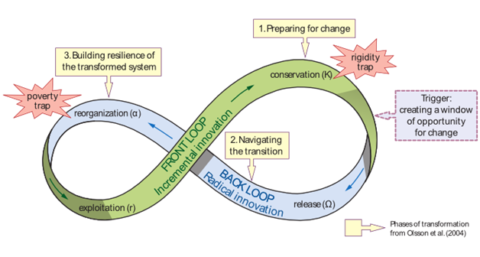
I’m fInishing up David Fleming’s book Surviving the Future, and buzzing with ideas and questions about the role of networks, network weaving and energy network science in these times of “systemic release” (see the adaptive cycle above, and more about the cycle here).
Fleming’s book, a curated collection of essays from the heftier Lean Logic, offers some compelling thinking about the trajectory of globalized and national economies – at best de-coupling, de-growth, and regeneration, and at worst catastrophic collapse – and the ways in which intentional and more localized culture building and reclamation as well as capacity conservation, development and management, might steer communities to healthier and more whole places post-market economy.
One of my favorite quotes from Fleming is that large-scale problems do not require large scale solutions; they require small-scale solutions within a large scale framework. That resonated immediately, even if I didn’t know exactly what he meant when I first read it. Re-reading more carefully, I hear Fleming making the argument that to take on systemic breakdown at scale is a fool’s errand – too massive, too slow, too much rigidity to deal with, too much potential conflict, too abstracted from real places and people.
Instead what is required is more nimble small-scale solutions happening iteratively and quickly (relative to how slow things move at larger levels). This suggests that action for resilience must happen at more local and regional levels, connecting diverse players in place, helping to encourage more robust exchanges of all kinds (including multiple “currencies”) and culture building. David Fleming offers the following definition of the lean economy (as opposed to the taut perpetual growth economy): “an economy held together by richly-developed social capital and culture, and organized around the rediscovery of community.” How might we weave that fabric even as others unravel?
Lean (network) weaving (a new term?) would focus on helping to create more intricate, high quality/high trust and diverse connections as well as facilitating robust, nourishing flows in tighter and more grounded cycles and systems. Part of the lean weaving would entail ensuring that smaller systems remain alert, quick and flexible so as to experiment, learn and adapt. And it would also maintain connection and communication between these smaller systems/clusters (Fleming’s “larger framework”), to facilitate learning and feedback of various kinds between them (not unlike proposed bioregional learning centers).
“The more flexible the sub-systems, the longer the expected life of the system as a whole.”
David Fleming
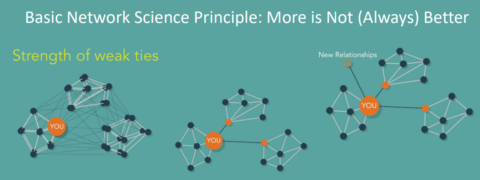
Image from Visible Networks Lab
This idea of “lean weaving” also brings to mind the wisdom of network science as taught by Danielle Varda and colleagues at Visible Networks Lab. They make the point that when it comes to creating strong (resilient and regenerative) networks, more can be less in terms of the connections we have. Connectivity, like so much else in our mainstream economy and culture, can be ruled by a relentless growth imperative that is not strategic or sustainable and can cheat us of quality in favor of quantity.
More connections require more energy to manage, meaning there may ultimately be fewer substantive ties if we are spread too thin. Instead, the invitation is to think about how we mindfully maintain a certain number of manageable and enriching strong and weak ties, and think in terms of “structural holes.” For more on this network science view, visit this VNL blog post “We want to let you in on a network science secret – better networking is less networking.”
The COVID19 pandemic along with other mounting challenges may already be presenting the mandate and opportunity to get more keen and lean in our network thinkingand weaving, not simply in the spirit of austerity and regression, but to cut an evolutionary path of resilience and regeneration (renewal). Network weavers of all kinds, what are you seeing and doing in this respect?
Over the last couple of months I have really savored my reading of Tyson Yunkaporta’s Sand Talk: How Indigenous Thinking Can Save the World. Yunkaporta is an academic, arts critic and researcher who belongs to the Apalech clan in Queensland, Australia. His book met me during found me in these times of disruption when I was searching to further disrupt myself and pry open some widening cracks in my older ways of thinking, feeling and being.
It is important to say that any review of the book or excerpting from it necessarily de- and re-contextualizes the content, which is a key point Yunkaporta makes – many people are caught up in low context cultures that are rather disconnected from the specifics of place and community. With that awareness, I wanted to offer some take-aways that have helped me to bring different, more energizing, engaging and empowering perspectives to multiple contexts in which I move, in the event that they may help others make enlivening shifts.
Towards the end of the book, Yunkaporta sums up what he and a number of other indigenous people with whom he “yarns” see as an indigenous approach to engaging with living systems – respect, connect, reflect, direct. He offers corresponding embodied centers for doing this work as: gut, heart, head, hands. He also makes the point that Western colonizer cultures reverse this progression, leading with action and control (direct), and only perhaps later capitulating (respect, or “looking again”), if at all, when things do not go according to plan. This “indigenous progression” aligns strongly with a community of practice of which I am a part (Respectful Confrontation/Fierce Civility), which is based in Taoist philosophy and practice, and invites devotees to lead in grounded and focused ways that put one in right relationship with their (multiple) selves and so-called “others.” I can say from experience that this is a very powerful way to prepare myself for engagement, especially in these volatile and unpredictable times.
Yunkaporta also lifts up what Aboriginal and indigenous knowledge asks of those who are attempting to bring about change in complex systems (all living systems). What he calls the “complexity agent protocols” includes:
Connectedness (create bonds to self, others and wider networks)
Diversity (respect and engage across difference)
Interaction (continuously transfer knowledge, energy and resources)
Adaptation (remain open to change, as that is the constant)
This, of course, is the much older wisdom that more recent so-called “regenerative” (agriculture, development) efforts are calling for and building upon, engaging the dynamics of network structures and energetic flows that constitute life.
The rest of what follows is a selection of twenty quotes that I pulled from the book, and that I can continue to read from time to time, to jolt my own tendencies towards complacency and stasis.
“Increase is different from growth, because you don’t want the size of the system to grow, but you want the relationships within the system, the exchange within the system, that needs to increase. And you can increase that quite infinitely.”
“Many Aboriginal stories tell us how we must travel in free-ranging patterns, warning us against charging ahead in crazy [linear] ways.”
“All Law-breaking comes from that first evil thought; that original sin of placing yourself above the land or above other people.”
“Nothing is created or destroyed; it just moves and changes, and this is the First Law.”
“Every unit requires velocity and exchange in a stable system, or it will stagnate – this applies to economic and social systems as well as natural ones.”
“Sedentary lifestyles and cultures that do not move with the land or mimic land-based networks in their social systems do not transition well through apocalyptic moments.”
“People today will mostly focus on the points of connection, the nodes of interest like stars in the sky. But the real understanding comes in the spaces in-between, in the relational forces that connect and move the points.”
“If you live a life without violence, you are living an illusion: outsourcing your conflict to unseen powers and detonating it in areas beyond your living space. … The damage of violence is minimized when it is distributed throughout the system rather than centralized into the hands of a few powerful people and their minions.”
“It is difficult to relinquish the illusions of power and delusions of exceptionalism that come with privilege. But it is strangely liberating to realize your true status as a single node in a cooperative network.”
“There is more to narrative than simply telling our stories. We have to compare our stories with the stories of others to seek greater understanding about our reality.”
“There’s no valid way to separate the natural from the synthetic, the digital from the ecological.”
“Most of us today are living in a state of compliance with imposed roles and tasks rather than a heightened state of engagement. We are slaves to a work ethic that is unnatural and unnecessary.”
“The assistance people need is not in learning about Aboriginal knowledge but in remembering their own.”
“The only sustainable way to store data long term is within relationships.”
“[From an Aboriginal perspective] an observer does not try to be objective, but is integrated within a sentient system that is observing itself.”
“Understanding biological networks appropriately means finding a way to belong personally to that system.”
“Somewhere between action and reaction is an interaction, and that’s where all the magic and fun lies.”
“Your culture is not what your hands touch or make – it’s what moves your hands.”
“Guilt is like any other energy: you con’t accumulate it or keep it because it makes you sick and disrupts the system you live in – you have to let it go. Face the truth, make amends, and let it go.”
“Stop asking the question: ‘Are we alone?’ Of course we’re not! Everything in the universe is alive and full of knowledge.”
“The ability to self-organize is the strongest form of system resilience. A system that can evolve can survive almost any change by changing itself.”
– Donella Meadows, Thinking in Systems: A primer
I just finished reading Leading From the Roots: Nature-Inspired Leadership Lessons for Today’s Worldby Dr. Kathleen E. Allen. It was a great resource to dig into for the past few weeks as I have been getting out into the woods in western Massachusetts and tuning into the emergent spring season in a way that I never have. Allen’s book has certainly helped with my attunement, along with some interesting readings on edible plants (Northeast Foraging), becoming more local to place (The Natural History of Western Massachusetts), and regenerative gardening and farming (Gaia’s Garden: A Guide to Home-Scale Permaculture). This is certainly one of the mixed blessings of these times, noting the relative privilege that my family and I have, to focus in a slower and more concentrated way on some of what might feed us more deeply and over the long-term.
Allen’s book provides a lot of food for thought. It is an exploration of a series of design principles from mature ecological systems (living systems) and how these can be applied to human organizations. These principles include:
Run on sunlight (tap the power of photosynthesis/positive energy)
Waste is never wasted (conserve energy, cultivate wise use)
Fit form to function (and function to purpose, paying attention to context)
Reward cooperation (respecting connection and interdependence)
Bank on diversity/difference (for intelligence, resilience, adaptation)
Curb excess from within (via feedback loops)
Depend on local expertise and self-organization (for more response-ability)
Tap the power of limits (constraints can inspire creativity)
In the first chapter, Allen also highlights some of the key dynamics of living systems that provide a better understanding of how generous and generative human organizations might operate. These include:
Living systems are interdependent – change in one part of the system influences other parts of the system in expected and unexpected ways
Living systems become more diverse as they evolve
Living systems are never static; they are always in flux
Living systems are filled with feedback loops that facilitate evolution
Living systems cannot be steered or controlled, only attracted or nudged.
Living systems only accept solutions that the system helps to create
Living systems only pay attention to what is meaningful to them here and now.
As I was reading, I pulled out a number of quotes and posted them on Twitter, which provoked some fun interactions. Many of these have to do with the underlying network structure and dynamics of living systems, for which I have a particular fondness. Here is a sampling, that will give you a taste of the book and perhaps entice you to dig deeper. Curious to hear what thoughts, feelings and sensations these inspire:
“Once we shift our worldview to seeing our organizations as living systems, then we can begin to see that generous organizations behave more like dynamic networks rather than traditional hierarchies.”
“The quality and authenticity of the relationships between people, and between people and ideas, increase the flow of positive energy in organizations.”
“The structure of nature’s network, the connections and interdependencies, allow the living system to self-regulate, adapt to changing conditions and evolve to survive.”
“Mutualistic relationships can help buffer partners against extreme conditions, open new niches for both partners, and amplify the baseline of resource acquisition.”
“Diversity allows for multiple ways that nutrients can be exchanged, making the entire system more resilient.”
“Opposition is necessary for wholeness.”
“When we recognize organizations are in constant movement, we then see organizational strategies as adaptive cycles instead of linear constructs.”
“We need to let go of the assumption that all of our assets are tangible.”
“Wet sand operates like a network. It is made up of grains of sand held together by saline. When it encounters force, those elements combine to resist; however, when it encounters a slow entry into its system, it accepts the presence of our foot. Living systems are networked and the nudge and wait for change is very effective in influencing them.”
“Generous organizations are open to the wider world. There are no silos in a generous organization.”
“What if a job description articulated a philosophy of relationships and connections that this person would need to develop and maintain while doing their job?”
“What would leadership look like if its highest purpose was to ensure that future generations thrive?”
“While a network, like a group, is a collection of people, it includes something more: a specific set of connections between people in the group. These ties, and the particular pattern of these ties, are often more important than the individual people themselves. They allow groups to do things that a disconnected collection of individuals cannot. The ties explain why the whole is greater than the sum of its parts. And the specific pattern of the ties is crucial to understanding how networks function.” – Nicholas A. Christakis
At the Interaction Institute for Social Change, we have a collaborative change lens that includes the facets of (1) naming and building power and working for equity and inclusion; (2) seeing and advancing networks as the unit of action and analysis and (3) embracing love as a force for social transformation. With respect to networks, we have noticed that there are a lot of different takes on what networks are, why they matter, and how to “leverage” them for positive social change. Part of this may be due to the fact that network science and approaches span a variety of schools of thought and practice, including sociology, psychology, mathematics, political science, communication, anthropology, economics, and epidemiology.
I recently came across an article by Nancy Katz, David Lazer, Holly Arrow, and Noshir Contractor (2004) that names some of the commonalities that exist across these different schools and approaches that we’ve been experimenting with to advance social change networks, support resilience, and to shift patterns and flows in “systems as networks” to create regenerative communities and equitable wellbeing. The article, entitled “Network Theory and Small Groups,” refers to the work of Barry Wellman (1988), which lifts up five core principles of network theory that might provide some more coherence and alignment to “network approaches.”
People’s behavior is best understood and predicted by the web of relationships in which they are embedded. These webs present opportunities and impose constraints on people’s behavior. So working with connections and flows can facilitate, inhibit and shape possibility.
Nothing can be properly understood in isolation or in a segmented fashion. The focus of analysis should be the relationships between people or groups, rather than the units themselves or their intrinsic characteristics. So the quality of relationship matters and needs tending.
Methods of “analysis” should not assume independence, but rather interdependence. People should be understood relationally. So think in terms of “collisions and ripples” as one network we are working with likes to say, characterizing network effects.
The flow of information and resources between two people depends not simply on their relationship to each other but on their relationships to everybody else. Or in network science speak, “Understanding a social system requires more than merely aggregating the dyadic ties.” So focus not just on one-to-one exchanges, but one-to-many and many-to-many (scale-linking).
Groups have fuzzy rather than firm boundaries. The building blocks of organizations and communities are not discrete groups but rather overlapping networks. Individuals generally have crosscutting relationships to a multitude of groups. So focus not simply on the impacts of bonding within groups but bridging across, and what this manifests.
Webs, relationships, flows, interdependence, intricacy, scale-linking, bonding and bridging. This is certainly not a full list of what network mindsets make visible to us, but hopefully lifts up some of what can help us better understand and work with reality, in these and at all times.
I just finished reading Douglas Ruskoff’s Team Human and found it very provocative and timely. As I find myself in more spaces where it feels like there is a tendency towards breaking as opposed to bridging, I and others with whom I work are asking, (1) What is really going on here? and (2) What we can do to better hold things together, while respecting diversity and difference? Team Human offers some insights by lifting up how the digital-age technologies in which many of us are engaged are making dangerously simplistic abstractions of our world (and of people) and appealing to the worst of our humanity.
Rushkoff uses 100 aphoristic statements in what amounts to a manifesto that speaks to how forces for human connection have turned into ones of isolation and repression. This includes algorithms that constantly direct our attention to what outrages us and sound bite biased social media undermining democracy by encouraging people to spread incendiary partial and untruths (because they outrage us!).
The book is certainly a wake up call to understand the manipulation behind digital media and to go beyond false appearances and reductionist reactivity to embrace prosocial behavior and make contributions towards regenerative patterns and flows. I highly recommend the book and have pulled some of my favorite quotes, which you will find below:
“Whoever controls media controls society. … Social control is based on thwarting social contact and exploding the resulting disorientation and despair.“
“Engineers at our leading tech firms and universities tend to see human beings as the problem and technology as the solution.”
[Under capitalism] “people are at best an asset to be exploited, and at worst a cost to be endured.”
“We’ve got a greater part of humanity working on making our social media feeds more persuasive than we have on making clean water more accessible.”
“The internet reinforces its core element : the binary. It makes us take sides.”
“Memetic warfare, regardless of the content, discourages cooperation, consensus, or empathy.”
“If we don’t truly know what something is programmed to do, chances are it is programming us. Once that happens, we may as well be machines ourselves.”
“There is no ‘resistance’ in a digital environment/ only on or off.”
“We reduced ideas to weaponized memes, and humankind to human resources. We got carried away with our utilitarian capabilities, and lost touch with the reasons to exercise those capabilities in the first place.”
“The long-term danger is not that we will lose our jobs to robots. … The real threat is that we lose our humanity to the value system we embed in our robots, and that they in turn impose on us.”
“We must learn that technology’s problems can’t always be solved with more technology.”
“Might the apparent calamity and dismay around us be less the symptoms of a society on the verge of collapse than those of one about to give birth?”
“The first step toward reversing our predicament is to recognize that being human is a team sport.”
“Happiness is not a function of one’s individual experience or choice, but a property of groups of people.”
“Evolution may have less to do with rising above one’s peers than learning to get along with more of them.”
“Challenging the overt methods of separation is straightforward: reject that hate speech of racists, zero some economics of oppression, and the war mongering of both tyrants and neoliberal hawks.”
“We can be utterly in charge of the choice not to be utterly in charge. We can be fully human without being in complete control of our world.”
“It’s neither resistance nor passivity, but active participation: working in concert with what’s happening to make it down river in one piece.”
“New experiments have revealed that after just a few moments of awe, people behave with increased altruism, cooperation and self-sacrifice.”
“True awe is timeless, limitless, and without division. It suggests there is a unifying whole to which we all belong – if only we could hold onto that awareness.”
“If we are not going to follow the commands of a king, a CEO, or an algorithm, then we need unifying values in order to work together as a team to work toward mutually beneficial goals.”
“Unless we consciously retrieve the power inherent in our collective nature, we will remain unable to defend ourselves against those who continue to use our misguided quest for individuality against us.”
“The future is not a discontinuity or some scenario we plan for so much as the reality we are creating through our choices right now. We just need to observe the flows, recognize the patterns, and apply them everywhere we can.”
“Find the others. Restore the social connections that make us fully functioning humans, and oppose all conventions, institutions, technologies, and mindsets that keep us apart.”
Image by Adam Meek, shared under provision of Creative Commons Attribution license 2.0.
Two pieces of art have been working me over lately. And I have been sharing them with others in different social justice spaces. One is a poem by Simon J. Ortiz, “Culture and the Universe,” shared with me by Mariana Velez Laris of The Nature Conservancy’s Indigenous Peoples and Local Communities Network. The second is the book Race and the Cosmos by Barbara A. Holmes, that I know through the good people at the Center for Action and Contemplation. Both works invite the reader to stretch and open in different ways for the sake of change and … evolution.
Here is Ortiz’s poem:
Two nights ago
in the canyon darkness,
only the half-moon and stars,
only mere men.
Prayer, faith, love,
existence.
We are measured
by vastness beyond ourselves.
Dark is light.
Stone is rising.
I don’t know
if humankind understands
culture: the act
of being human
is not easy knowledge.
With painted wooden sticks
and feathers, we journey
into the canyon toward stone,
a massive presence
in midwinter.
We stop.
Lean into me.
The universe
sings in quiet meditation.
We are wordless:
I am in you.
Without knowing why
culture needs our knowledge,
we are one self in the canyon.
And the stone wall
I lean upon spins me
wordless and silent
to the reach of stars
and to the heavens within.
It’s not humankind after all
nor is it culture
that limits us.
It is the vastness
we do not enter.
It is the stars
we do not let own us.
Very recently I brought this poem to a group of community organizers from a state-wide political action network, and after hearing it, many said they were really touched by this notion of there being a vastness they do not enter, and are therefore limited by. References were made to systems of oppression, to antagonism, to fear and lack of love. There is so much more to this world and by extension to ourselves that we do not tap into that keeps us repeating patterns of behavior and systems that do not serve our fuller humanity.
“We use language not so much to convey factual information as to construct worlds.”
– Barbara A. Holmes
Image by NASA Goddard, shared under provisions of Creative Commons Attribution license 2.0.
Holmes’ book extends this same theme of vastness, drawing from the fields of quantum physics, cosmology and ethics as a way of inviting a broader perspective and creating new language and thinking that points in the direction of a world where everyone belongs. She writes, for example, about “dark matter” and “dark energy,” which is pervasive and cohesive in the universe, the essentially creative energy that holds things together. Considering this profound and primordial force, Holmes says, we can only wonder at and celebrate “darkness,” not fear or denigrate it.
Holmes also invites us to consider that physics and cosmology point to the fundamental nature of reality as existing in relationship and interdependence and that systems of oppression go against the grain of the unfolding cosmos. She writes, “Our desire for justice is deeply rooted in systems that are holistic and relational. We have not forced, created, or dreamed this shared destiny; it seems to be the way of the universe.”
In times of breakdown and cynicism, both Ortiz and Holmes tell us that creativity and hope are to be found by looking more deeply into nature and more widely into the heavens to re-member who we are and that there are so many more possibilities than what we have created and perpetuate.
What vastness have you not yet entered, what wonders in our world and beyond have you not allowed to grab hold of you that might liberate and generate new possibilities in your change agency?
Image by garlandcannon, used under provisions of Creative Commons Attribution License 2.0.
In a couple of articles that have been re-cycling in different social circles, the reminder is offered that tipping points for social change do not need anywhere close to a majority of actors.
A few years ago, scientists at Rensselaer Polytechnic Institute explored what it takes for an idea to spread from few to many, for a minority opinion to become the majority belief. According to their study, the RPI researchers said that the answer is 10%. When one in ten people adopt a stance, eventually it will become the dominant opinion of the entire group, they say. What is required is commitment.
More recently, researchers from the University of Pennsylvania and the University of London conducted an experiment that suggests that for activists to achieve a tipping point around change, 25% of a given population is required. They published their study in the journal Science.
Of course there are complicating factors, including the fact that there are often competing factions each vying for their own 10-25% and with social media and disinformation campaigns, confusion can rein and commitment may require an additional degree of diligence. Nonetheless, we might take more heart in the power of the few.
And this is clearly not just about numbers and counting.
“Innovation is as much a function of the right kind of relationships as it is of a particular kind of individual vision.”
-Carter Phipps
The following is a slightly edited post from a couple of years ago. In many ways it feels more pertinent to me now …
Among other reads, I’ve been revisiting the book Evolutionariesby Carter Phipps. Phipps is the editor of EnlighteNextmagazine and enthusiastic about what we calls “the evolutionary worldview” and how it is showing up in many different fields, from biology to sociology to philosophy and theology. He sees this perspective as transforming one’s understanding of just about everything.
“The debate about our origins is also a cultural referendum on our future.”
The book is in part retrospective, looking at the history of “the evolutionary perspective” that shook up perceptions of “a fixed world” when it suggested that creation is not static, but ever-changing. This realization is still making waves and sinking in. Phipps writes – “As the fog of fixity lifts, we are finding ourselves much more than observers and witnesses to life’s unfolding drama.” In other words, the view of an evolving world is associated with a sense of movement, possibility, engagement, and response-ability (an ability to respond).Read More
Make Change Stick Beyond the MeetingTurn ideas into agreements that stick, and keep change going after the meeting ends. Perfect for teams stuck in “great conversation, little action.”