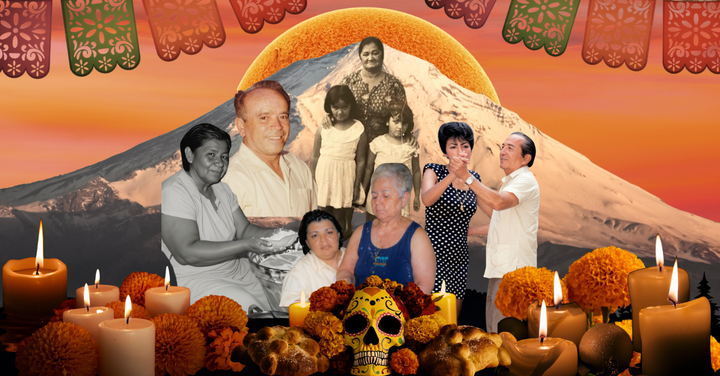
Image Description: A collage featuring photos of some of my ancestors, layered in front of Popocatépetl with an orange sun rising behind its peak and a sunset sky. Papel picado hangs above, and candles, marigolds, pan de muerto, and a painted sugar skull fill the ofrenda below. By Sandra Herrera.
Growing up, I never celebrated Día de Muertos. My father is from Atencingo, a town in southwestern Puebla, Mexico, and celebrated it his whole life before coming to the U.S. in his late 20s. But he didn’t pass it down to my three sisters and me. Like a lot of things in immigrant families, it stayed behind.
It wasn’t until I got older that I wanted to connect more deeply with my roots. As a young adult, I carried a lot of anxiety, including a deep fear of death. That can happen when you come from a long line of trauma on both sides. Somewhere in there, I felt called to do some spiritual, ancestral work.
Finding the names
It started on my Puerto Rican side, where U.S. census records made genealogy a little easier. I looked up my grandfather, who’s someone I still feel all around me, even though he passed when I was 16. I was able to find his family and put names to people I’d never heard of. But as my colleague Simone John writes in Southern Census, records can give you names, but not the stories behind them. Records from Mexico are harder to access, but I found some of our people and my grandmother’s Indigenous last name, which led to a whole path of reconnecting.
So much has been lost to colonization and assimilation. Reconnecting is ongoing – I’m still learning (shoutout to C.C. Anahuac) and asking questions, and I’m careful not to claim what isn’t mine. I couldn’t get everything back. But I could start with one practice with Indigenous roots in Mexico: celebrating the dead.
I wasn’t the first to find my way back this way. In 1972, Chicana/o artists at Self-Help Graphics in East Los Angeles revived Día de Muertos as an act of cultural reclamation. Most of them hadn’t grown up with it either. They learned it as adults, together.
My first ofrenda
I built my first ofrenda in 2020 at my parents’ house, our family gathering place, because I wanted my dad to see us taking part. I included the four elements: tequila for water (why not?), crystals for earth, papel picado for wind, and candles for fire. I added marigolds and pan de muerto, and lit ethically sourced copal in a burner made of volcanic rock from Popocatépetl, the volcano you can see from my father’s hometown. Even though I’d never done this before, it felt like something my soul remembered.
Then the photos came out. Once I brought out some of my grandfather, my mom started pulling out more. She’s always been the keeper of the family photos, and she had a lot from my dad’s side too. The ofrenda filled up fast. We’d also lost people to COVID that year, and they joined it too. It could have been a really sad day, but it turned out to be a joyful one. It started my healing around death. I found comfort in believing these are the people who’ll greet me on the other side.
I’ve built an ofrenda every year since, and it’s become a family tradition. Along the way, I learned a lot about the work I do: storytelling.
What the ofrenda taught me about storytelling
Scholar Tomás Ybarra-Frausto once wrote that “altares often serve as a cumulative historical narrative for the life of a family.” That’s exactly what ours became. Year after year, it holds our family’s story, and building it has taught me a lot about storytelling.
Details make people real. On Día de Muertos, it’s tradition to set out the foods your loved ones enjoyed in life. When I asked my mom what to make for my grandfather, she told me he loved rice and steak with ketchup. That was his thing. It’s the kind of detail you’d think doesn’t matter, but it adds so much texture to how I remember him.
The same goes for comms. We often reach for big descriptions like “a loving father” or “a dedicated leader,” but those could describe anyone. The small, specific stuff is what sticks: the coffee mug someone brings to every meeting, or the phrase a facilitator always opens with. Those details are what make a reader feel like they know someone. You usually can’t find them in a report or a bio, so you have to talk to people and listen for the details that make a person who they are.
Curiosity opens the story. When I held up an old photo and asked, “Who’s that?” a whole new story came out. Curiosity has a way of leading you to stories you weren’t looking for. And the best stories usually start with a good question. A few to try:
What’s a moment from this that you keep coming back to?
What surprised you?
What did it look, sound, or feel like?
Who else was part of this?
What changed, for you or for someone else?
What do you want people to understand after hearing this?
And…a list of go-to questions only gets you so far. I enjoy staying present and following the energy of the person telling the story. I notice when they lean in, talk faster, or light up. That’s usually where the real story is, even if it’s not the one I came for. So it’s important to leave room to wander.
Stories last when we retell them. Every year, many of the same memories come up around the ofrenda, and that’s how they stay alive. In comms, it’s easy to forget that we’re the only ones who see every story an organization tells, but someone reading your newsletter might be hearing a story for the very first time. So don’t be afraid to repeat yourself or find different ways (or platforms!) to tell the same story. A good story is worth retelling.
Storytelling is shared. Whenever my family looks at photos together, the stories start flowing. My mom usually starts, and my dad jumps in with details she missed. I knew my grandfather one way, but my older sisters will share stories that show me a side of him I never got to see. Each of us holds a piece, and the story gets fuller every time someone adds to it.
In comms, the strongest stories work the same way. When I’m writing about a project, I try to talk to more than one person: the people who led it, the people it served, and anyone who saw it from a different angle. Inviting others to add their pieces, through a quick form, voice note, a shared board, or a simple “what do you remember?”, means no one has to hold the whole story alone. My job is to help all those pieces come together.
Joy and grief belong in the same story. The ofrenda holds both at once, and real stories do too. But storytelling, especially social justice storytelling, often leads with the hardest part of people’s lives. We share and tell stories of injustice, and we have to, because people need to understand the harm. When that’s the only story we share and tell, though, people get reduced to their pain, and readers end up feeling hopeless or numb.
We need stories of repair too. My ofrenda is one. Colonization and assimilation took a lot from my family, and building it is one small way of taking something back. Stories of repair, whether that’s reparations, healing, or communities reclaiming land, culture, and resources, show people what justice could actually look like. That’s what helps them believe it’s possible.
It’s about balance. We can and should talk about trauma. We need to talk about joy too, because joy is how we get through it, especially with so many crises happening in the world right now. Joy also helps us imagine the future we want, and imagining is how we start to create it. So when I interview someone, I’ll ask what was hard, and I’ll also ask what brought them joy or kept them going.
The people who have my back
I look forward to building an ofrenda every year. It’s one of many links to my ancestors, the people who look out for me. Many of them carried so much in their lives. Now they’re at peace, and every year around this time, we get to celebrate them with joy. And I know they have my back.
So I’ll leave you with a question. If you built an altar for the people who shaped your life and your work, who would be on it? And what’s the small detail you’d want everyone to remember about them? Start there – that’s where every good story begins.
Image Description: Illustration of a person with brown skin and long yellow hair leaning forward to smell white dandelion-like flowers, with eyes closed and one hand grabbing the flower’s stem. By Naila Conita via Unsplash.
In July of this year, we said goodbye to a beloved organizational leader and steward with a tenure of 10 years. Her transition didn’t mark the beginning or the end of the transition period we’ve found ourselves in as a team, but it did magnify some of the stretch pains we were already experiencing.
Decision making got murkier, alignment got harder to find, and sustainability started to feel more like an ideal than an actionable commitment. I write this, still in the thick of the challenge and opportunity of this change, as a reminder to my nervous system that there is beauty and learning to be found here. I invite you to share your own reflections as additions to this running list of an attempt to answer – what can transition reveal? So far, this is what I’ve come up with that feels solidified enough to share.
What’s for us will find us
This is one of those affirmations, mantras, that I keep on a sticky note attached to my computer. It’s a grounding reminder to myself that we will move through this in the way we were supposed to. Whether you believe in fate or some grand design or not, I believe there’s wisdom to be found in returning to a foundational trust in the winding path that leads to the abundant future (however different that future may be from current expectations).
A side benefit of rooting in this reminder is that it’s allowed me to hold on more gently and leave space for the emergent, unexpected, and confronting. How freeing it can be to release the tight hold on an outcome when you trust it will be the right one, reached at the right time, by the right people!
Love is a discipline
Organizationally we acknowledge love as a powerful and critical force for change. I’ve been delighted to see love woven into some of the larger discourse within the non-profit sector at large lately. And, this transition has shown me the rigor required to center love not just as a catalyst to change, but to carry you through it.
When I’ve found myself stressed, pressed, and ungrounded, love as an action has felt hard to access and to describe. How do I show up in love for you when your activation is inflaming mine in a way that has my nervous system spinning? How do I find love for the unknown when everyone, myself included, seems to be looking for certainty? Part of the answer for me has been to just commit to it. To slow down, take a beat, and consider what my response would be if it was rooted in love before I share it.
My needs are my responsibility
It may be unsurprising given my work in the people and culture space that I’ve been told I’m a relationship perfectionist. A lot of the labor I do for others is anticipatory. And though I still see the value in thinking three steps ahead, I’ve realized how unhelpful a lot of the assumptions are that go into that kind of work. I’ve found this to be especially the case in a time of transition when change, grief, and fear show up and tug on each of us differently. To assume others’ needs, and that I can tend to them, impedes on agency and self-determination in a way that is neither supportive nor careful.
In the same vein, I can neither expect nor accept others’ assumptions about my needs. Fortunately (and sometimes unfortunately) what I need is up to me to decide. This is not the same as not asking for or accepting help; it’s the opposite! Getting very clear on what support looks like for me and voicing it clearly to those who can offer it demystifies my internal conditions for myself and for them.
Prevention over intervention
There’s a saying we have in our Facilitative Leadership™ for Social Change training – “an ounce of prevention is worth a pound of intervention.” It speaks to the fact that a well-designed container can hold a lot more than a flimsy one. Imagine every transparent decision making process, community norm, and clear agenda as fortification and expansion to the sides of a bucket. Every drop of water you intend to fill it with is a process, a desired outcome, a decision, an expressed feeling.
The more fortification people can see, the more trust they have that the bucket can hold heavier and larger amounts of water. The less fortification and trust in the bucket, the higher the risk of water spilling, cracks forming, and alarms being raised out of fear of a flood. It’s a lot more effective to build a strong container at the start than it is to patch a broken one as you go along.
Prevention isn’t the same as assumption, and it’s so important to stay mindful of the distinction. Prevention requires actively seeking clarity on needs and strong facilitation. I admit that determining what those preparatory practices are can be laborious, but as someone with a couple of leaky buckets in my life, I can absolutely confirm it’s worth it.
Different rest for different stress
The final thing I’ll share is around my noticing that my usual stress-busting practices aren’t as effective right now. Creativity has felt elusive and my body’s resisted rest and recovery more persistently than usual. That’s a signal to me that this time of change and disruption is causing a different kind of stress and calling for a different kind of rest.
I’ve found some relief in leaning on one part of my being to rest another. To rest the brain, use the body. To rest the body, use the heart. To rest the heart, use the spirit. What it means to use my body, heart, or spirit shifts depending on what feels most easeful and resonant that day. The most important thing about whatever it may be is to release any expectation of productivity or outcome. Paint with no reference, dance with no choreography, and meditate for stillness over revelation.
May what’s for us find us. May love guide us always. May needs be clear and met. May the container hold us. May the rest be real. And ultimately, may change be a good thing.
Image Description: Illustration of a faceless person with dark brown skin in a light blue shirt against a black background, with a red swirling tornado or storm cloud obscuring their head. Colorful red, pink, yellow, and blue marks and symbols surround the figure. By Allison Saeng via Unsplash.
As we came into 2026, all indications were that there would be no slowing down of what I have been calling The Great Unraveling. Indeed, things feel like they are only accelerating and that virtually no one is being spared the pain and discomfort of mounting pressures.
I personally have been experiencing this quite deeply for the past year, and most prominently in many of my most intimate social and professional circles. I had spent the better part of several years before that doing my own individual healing work, some of which I have written about here. And of course, given that we are interconnected with everyone and everything else, at least at a certain level, there is no healing that insulates us from the suffering of others. In fact, according to many of my healers and elders I know, if we are truly healing, part of “the arrangement” seems to be that we become more – not less – open to vulnerability in the world.
Nothing in so-called “mainstream culture” suggests that this is something we should chase after. And yet, what I have learned is that something much larger than our individual preferences has the ultimate say in this.
However you might characterize the forces that are pushing dominant systems to the brink, one thing seems clear – not everything that is unraveling can, or should, be held together. This does not mean that we should stop standing up for justice and care. Quite the opposite. But it does mean to be open to the bigger energies of change, beyond sick power-hungry people, that are intent on cleaning house and making space for something else.
What is ours to protect? What is ours to transform? And what may need to come apart? Some discernment is crucial in picking one’s battles. And that is one of the big lessons I have learned, along with a few others…
– The unraveling is unavoidable. I repeat, the unraveling is unavoidable. It has been very important for me to adopt this mantra. What we have had as dominant systems for such a long time (at least in the United States) are death traps. The bigger forces of Life are letting us know this LOUDLY. It is time for a new way of doing and being.
– A corollary to the reminder above is the teaching from energy systems science that things have to come apart in order to come together better. This has been the case even in relationships that to some extent might have seemed to be “okay” on the outside. If Fierce Love is what’s taking hold right now (and I believe it is, despite some outward appearances), then that means there is a lot of reckoning to be done, and connections forged in distorted or harmful conditions may be in need of deep cleansing.
– Having all of the feelings that flow from what is happening has also been very important. This includes grief, anger, fear, relief, love, hope, and disappointment. And it has also been important to make sure that my feelings are not running the show. Keeping things bottled up is just not healthy – the pressure gets too great. Allowing them to flow is a key part of the necessary release.
– Maintaining connections with those who can meet me, feed me and be fed by me has been essential. More mutualism feels like it is being called for. And this has meant that my world has gotten smaller at times, which does not necessarily mean I have less. Sometimes a smaller circle can create more room for honesty, reciprocity, and care.
– As the unraveling accelerates, I sense how helpful it is to allow change to happen while alsogrounding in the energies of the Earth that are here to support us.
– Keep practicing what makes another world possible. Some guiding principles and practices for this have included:
Keeping the faith and being resolute that a better world is possible and actually wants to come forward;
Remembering the many things for which I am grateful; and
Practicing fierce love, balancing generosity with requests for accountability.
This is what “so now what?” looks like for me. Not figuring out how to stop the unraveling, not pretending that it isn’t painful, nor surrendering our commitments to justice, care, or one another.
And it means learning how to stay present as things come apart, what to release, what to protect, what to grieve, and what to nurture. Learning to recognize that the ending of one way of being can also be the beginning of another.
How about you? How are you navigating the unavoidable unraveling without losing hold of what matters most?
Image Description: Illustration of a human head silhouette filled with branching, colorful neural pathways in red, blue, pink, and yellow, resembling both a brain and tree roots. The background features abstract shapes in red, blue, yellow, and pink. By Yeti Iglesias via Unsplash.
What happens when communities, not corporations, shape the future of AI in schools? This case study illustrates how IISC facilitated a cross-sector collaboration to build a bold, equity-centered AI framework rooted in equity, ethics, and human engagement in education. The work centers on the belief that how we come together determines what becomes possible and that those closest to the problem hold critical wisdom for the solution.
The Big Picture
AI is transforming classrooms, influencing everything from instruction and assessments to mental health monitoring. But while AI holds promise, it also carries serious risks: amplifying bias, eroding privacy, and deepening educational inequities, especially for Black, Brown, and low-income students.
AI tools are appearing in schools quickly and often without anyone checking how they’re used. Companies are selling directly to teachers, skipping over school districts, parents, and community voices. That means decisions are being made behind the scenes, with little clarity or accountability. Without clear guardrails, AI risks doing more harm than good.
A Community-Led Response
In response to these urgent challenges, a collaboration of national organizations, led by the NAACP, National Black Child Development Institute, and the Schott Foundation for Public Education, and facilitated by the Interaction Institute for Social Change (IISC), co-designed a collaborative process to guide the ethical and equitable integration of AI in public education. This case study captures that effort and explores how community-led design and racial equity principles can inform the future of education technology.
This initiative emerged from the recognition that most school districts and communities lack the tools, knowledge, and infrastructure to meaningfully shape AI policy. The current landscape allows for ad hoc AI adoption without community input and accountability, risking harm and undermining trust. To protect students and promote equity, it is essential to center human engagement, community wisdom, and ethical guardrails in the development and deployment of AI technologies.
Dr. John H. Jackson, President and CEO of the Schott Foundation for Public Education, emphasized,
“We wanted to ensure that there’s a democratic process by which parents, educators, and students are engaged in the integration of AI in their lives.”
IISC’s Role: Holding the Space for Transformative Collaboration
At IISC, facilitation is at the heart of our work – we teach it, practice it, and refine it every day. Our “special sauce” lies in designing meetings, experiences, and networks that are inclusive, equity-based processes that build a bigger we, rooted in the simple conviction that:
Together, we know much more than we know individually, and people closest to a problem have important wisdom about the solutions.
True buy-in is built through invitation and inclusion. Successful processes require not just engaging individuals, but intentionally designing the right level of involvement, ranging from consultation to co-creation to shared leadership.
In this project, IISC created a six-month journey grounded in those values. Our facilitation helped our partners:
Build a shared language around AI
Name and honor fears, tensions, and power dynamics
Surface both the threats and the possibilities of AI
Move from uncertainty and skepticism to strategy and collective action
As Dr. John H. Jackson, President and CEO of Schott, reflected: “It was a journey – moving from the threat space to imagining the opportunities.”
Many came to the table with different levels of tech literacy, policy experience, and emotional readiness. IISC’s role was to meet each of them where they were, not to force consensus, but to cultivate connection. Through careful design and deliberate facilitation, we helped shift the tone from caution to courage.
“Through intentional facilitation, this collaborative journey honored where people began, nurtured curiosity, and guided partners in shifting toward shared possibilities and collective action.” – Amy Casso, IISC Co-Facilitator on the project
“Schott Foundation and the other partners were brave and forward-thinking for hosting these conversations and community.” Kelly Frances Bates, IISC Co-Facilitator on the project
The Framework
Together with significant support from HR&A, the group created an AI Equity Framework designed to help educators, parents, and communities:
Ask the right questions when AI is introduced
Push for transparency, consent, and ethical use
Ensure decisions are made at the district and community level, not just by vendors
The framework is accessible and actionable. It includes decision trees, guiding questions, and language that empowers non-technical stakeholders to speak with clarity and confidence.
Why This Work Goes Beyond the Classroom
Beyond schools, the framework offers a model for philanthropy, tech accountability, and community-led governance. Dr. Jackson noted that many funders are either engaging tech companies without equity guardrails or sitting out entirely.
The implications reach far beyond pedagogy. As AI tools like chatbots shape youth relationships, decision-making, and mental health, the urgency to center human connection and community wisdom becomes undeniable.
Where the Movement Is Headed
With the framework now in distribution, partners are gearing up to support its implementation through technical assistance, storytelling campaigns, and sector-specific adaptations. The goal is to ensure educators, parents, and communities can meaningfully apply the framework, not just in schools, but in adjacent fields like healthcare and housing.
“It’s not just about learning outcomes. It’s about human development.” – Dr. John H. Jackson
Want Support Facilitating an Equity-Centered Process?
Whether you’re navigating a moment of change, bringing new voices to the table, or co-creating strategy, alignment, and coordination across lines of difference, how you gather matters. IISC designs processes and facilitates individuals, organizations, coalitions, communities, and networks through processes that are interactive, inclusive, participatory, and grounded in equity.
We can help you:
Bring people together across roles, power, and lived experience
Ensure collaborative and coordinated action amongst your partners
Align around shared values and direction
Navigate complexity and conflict with purpose
Build trust and collective ownership of the work ahead
Let’s talk about how we can support your process! Transformational systems start with transforming how we come together.
Image description: A bold 2D illustration of a woman with dark brown skin and blue hair cradling a blue Earth and leaves amidst the night sky. By Yeti Iglesias via Unsplash+.
In times of great change and uncertainty, where can we turn for guidance for how to navigate? Well, it turns out there is a lot of wisdom that we can all tap into that comes in many different forms. And we don’t really need to stretch that far to access it. How do I know this? Because we have asked.
One of my favorite group check-in questions over the past month has been:
“Who (or what) is one important teacher you have had in your life, and what is one important teaching you have received from that teacher?”
People have really loved this question, both conjuring up beloved teachers in many different forms – formal teachers, family members, friends, mentors, pets, a favorite tree, a powerful experience – as well as sharing with and hearing from one others.
This is a taste of what came up in answer to the question over the past couple of weeks, which people agreed provided some solid grounding for them:
Stand in integrity.
Trust your gut/intuition.
Remember your purpose.
Always save a place for joy.
Honor the intelligence of your body.
Don’t let the knuckleheads get you down.
Be as clear as you can in your communication with others.
Sometimes you have to break big things down into smaller pieces.
Show you care by overcoming challenges and showing up.
Remember to laugh and take your mistakes lightly.
Remember the power of pausing and reflecting.
Remember there is always more to the story.
Don’t try to win the game … change it.
Forgive, both yourself and others.
In the end, love wins.
What about you? Who is a teacher you would lift up and a teaching from them that might be helpful to remember now and perhaps to share with others?
In the weeks following the election, I was on the road all over the country, gathering with thousands of leaders, organizers, and funders. When I got on the plane to Washington, DC on the day after the election, I felt a power I didn’t know I had—to look straight into the face of my worst fears for our country and greet it with power and resolve.
The memory of Harriet Tubman jumped into my body. I felt ten-feet taller and engulfed in a heavy cloak of protection. Harriet brought enslaved Africans to freedom in Canada through an elaborate system of travel, shelter, and care. Harriet could easily have brought her family to Canada and stopped there, but she repeatedly came back to the United States and carried hundreds of others to freedom. Her unyielding bravery reminds us that the fight for justice isn’t a singular act but a lifetime commitment to freedom for all. Her legacy fuels my determination and our collective mission at IISC to keep returning for those still seeking liberation.
She was not done. I am not done. IISC is not done.
What I learned from my days in DC and in subsequent convenings and conversations is that we have a duty to work for justice—for ourselves and for others, unequivocally. Come January and the inauguration, we will enter a strong era of oppression and suppression. Rest assured IISC will not let any human or system of hate stop the work for justice. We will work to significantly expand human connection and collaboration so that no oppression or its deep shards of pain and injustice can stand.
At IISC, we know this country has the potential to reset in the right direction. Doing so will require us to be facilitative leaders—people who create the conditions for everyone to lead, to forge new pathways, to reach for and love “the other,” and to create enduring and bold networks that together are big enough and resilient enough to take on any fight that comes its way.
We’re so excited to launch new offerings to support you. Our staff and members of our “Dream Lab” will roll out a new interactive learning session in 2025 on network leadership, a training on shared leadership, a new program to amplify and protect the leadership of women of color who are leading organizations and brave movements, and more. These resources are designed to prepare you for this next chapter in America’s story.
Go back to your communities and expand who will be on the side of love and liberation so that we can reach our North Star. Change what you can control—make your workplace more humane, join actions of resistance, talk with people who others won’t talk with, and collaborate instead of competing out of fear.
Powerlessness is pernicious. But it can’t stand up to the strength of connection, collaboration, and interaction. And the persistence of love, the greatest force for change.
“Find a river, that flows to the sea put your feet in the water, carry you home.”
-The Mitchell Twins, from the song “Find a River”
Last week I had the opportunity to hear a talk given by Kari Kastango, who is the first person known to have swum the length of the Connecticut River. She was the perfect kick-off speaker at a gathering of Rivershed protectors in my home region who are looking to grow and strengthen their efforts through what amounts to a network of networks. To me, Kastango’s talk set a wonderful foundation for this collaborative work, highlighting the importance of being in deeper relationship with the river itself, and taking guidance from this connection.
Kastango began her talk by saying that she was influenced from an early age by extreme athletes who tested the limits of human capacity. This led her to participate in various endurance events, such as “iron man” contests, and eventually to the idea of swimming the entire length of the Connecticut River. She shared that when she made the commitment she initially thought the river was around 200 miles in length. She then learned it was 410 miles. Her response – “Double the fun!” – was an affirmation of what has been coming through loud and clear for some months now – We can do hard things and sometimes the best thing to do is to run towards the danger.
As further illustration of this point, Kastango talked about how one summer she chose a couple days to swim a particularly challenging length of the river that fell between two hurricanes. With torrential downpours having stirred the waters into considerable turbulence, she learned that she should not fight the currents, but respect them, giving time to get a sense of the flows, and to go with those. The teaching that came through to me is that – even in what may feel like chaos and threatening conditions – a more coherent pattern can become evident if we are both patient and flexible.
Kastango also talked about how over time she became more observant, not simply of the waters and the sky, but other “kin” moving in and around the waters. Birds and other critters who are more familiar with certain environments and conditions have much to teach us if we choose to listen/watch/sense. Lesson – there is much wisdom to be learned from those who are indigenous to a place or land/waterscape, both human and more-than-human.
Another point I took away from Kastango’s talk was when she shared about getting toward the end of her swim. As she approached the Long Island Sound she said she could feel the pull of the larger waters. “It was like they were calling me home,” she said with a smile on her face. At that point she could relax more and let the waters carry her towards the sea. From this I heard that there can be a pull underlying our efforts to create change, or navigate challenge, and that this force actually wants to guide us to a “better” place, a place of greater belonging, beyond any of our efforts to force or even imagine.
Though she wrapped up her swim a year ago, Kastango said that after all those months and miles, she still feels the river in her. She still is in relationship with those waters. And that is why she tells her story – that others might develop that kind of special connection, that we not forget our more-than-human kin, and that more of us work to protect the rivers and other waterways that are (in the words of an Indigenous teacher) “the elixir of life.”
For those who live in and/or love the Connecticut River Watershed and want to learn more about the efforts to connect and protect, go to this link. And for some fun facts about Kari Kastango’s swim, go to this link.
As the fall season is soon to begin, I am about to mark the beginning of my (to this point) seven year journey since re-entering the “workforce” after experiencing clinical burnout and proceeding with an intentional rhythm aimed at more balance. This has entailed gradual, focused, and caring support from a range of healers as layers upon layers have sloughed off, revealing deeper wounds and cries for attention.
“The function of freedom is to free someone else.”
All this said, as I feel that much “lighter” and learn-ed in my process, I am reflecting on seven steps that have been and will continue to be core to this journey, including the work that my colleagues and I do to help weave the more beautiful world we know is possible.
🌀 Re-cognize: bring awareness to the realities of dis-ease and dis-association
🌀 Re-lax: breathe into this awareness, let what bubbles up come up; keep breathing
🌀 Re-lease: let go of what may have served and no longer does and that which never did
🌀 Re-claim: start inviting back those parts/aspects that have been ostracized and ignored
🌀 Re-member: embrace more and more of our underlying, essential and limitless identity
🌀 Re-surge: allow what has been regathered to both guide and deepen trust in our core
🌀 Re-cycle: this process is not linear but more of a spiral that can encompass others
*******
*******
And as the poets often capture it better than anyone, I will end with this from Danna Faulds:
This post picks up where Part 1 left off. To read that post, go to this link.
In a recent conversation with a cherished elder, we got to talking about these times and the story of the caterpillar changing into the butterfly. In her usual no-nonsense way, she shared that she often hears people talking about the cocoon, and maybe something about the “imaginal cells” that get to work in the cocoon to create the beautiful butterfly form (so cool!). “What I don’t necessarily hear is that whole thing about destruction of the caterpillar body – it basically gets pulverized and turns into goo!” This followed by laughter (she laughs a lot). Right, the goo. Not a lot of talk about the goo, about the dis-integration of the previous body that is necessary for the new body to organize.
I have caught myself doing this, banging my head against the question “What is the next (and better) form of family, community, organization, institution, society, etc.?” without allowing for the necessary meltdown of old forms. A version of this old adage just came to mind – “Can you be patient enough to let the mud settle?” Sometimes. Hopefully a little more each day. As I spend a fair amount of time working with social change networks, I am trying to remind people I work with (and myself) that the work of “network weaving” is not simply about always reaching out, always bringing in more and supporting more growth, but also about stepping back, seeing what is, perhaps doing some pruning. And remember to exhale.
The other thing that I try to remember is that if what we are moving through is really and truly “transformation,” not just some superficial rearrangement of the furniture, then it is going to be very hard to imagine not just what “the other side” will look like, but how I will feel inside of that new reality. I find that I can be prone to feelings of “fluttery-ness” these days, and if I don’t take care to listen more closely, I might assume that I am feeling nervous/anxious about the current state of the world. Of course sometimes I am (for example, when I wake to several days here in Western Massachusetts feeling as if I am in the Caribbean, weather-wise). Other times, when I slow down enough to actually interrogate the fluttery sensation, I realize that it can also be akin to the excitement I have felt when getting to the top of a tall rollercoaster and anticipating that moment of release. And I wonder…is that what the butterfly feels when it emerges from the cocoon, and when it takes its first flight? Just how does it go about adjusting to its new embodied reality?
Several years ago, I read the book The Net and the Butterfly, which is full of examples and suggestions of methods for opening ourselves to “the new.” A core point of the authors, Olivia Fox Cabane and Judah Pollack, is that in order to access new ways of being and doing, we do not have to be artistic geniuses or spiritual adepts. What we do need are ways to make the time and space to peacefully pay attention and notice differently, allowing insight and novelty to emerge on their own.
The common theme underlying the practices that the authors explore is supporting so-called neuroplasticity, our brains’ remarkable ability to rearrange neural pathways for new possibilities. Neuroplasticity happens on its own, to a certain extent, but is reduced by practiced habits and routines – i.e. staying stuck in ruts. This happens as we age and get too comfortable with or protective of the familiar. So in order to encourage an openness to new pathways, what can we do?
Stop trying to figure it out. Simply grinding on a situation or challenge or sitting in fear and frustration can prevent “solutions” from showing up. Give your mind a rest – take a shower/bath, take a walk, relax and breathe, or engage in relatively mindless activity (wash dishes, bounce a ball).
Try on new perspectives.Looking at the world differently can help us to see possibilities we had not observed from our usual vantage points. Read literature from different and unfamiliar disciplines. Talk to someone who sees the world differently (culturally, politically, professionally). Study a different language. Take a different route to work or for your daily walk. Lie down on the ground and look up and around, or climb a tree to literally get a different perspective on things.
Open up to different sounds, tastes and sensations. Intentionally seeking out and paying attention to unusual sensations can also strengthen our flexibility, adaptability, and openness to novelty. Research shows, for example, that by using our non-dominant hand to perform daily routines (brushing teeth, brushing hair, drinking from a cup) we can strengthen neuroplasticity. The key is to really pay attention to what we notice.
Learn from the intelligence and wonder of our more than human kin. Much more is being written about biomimicry and the wisdom of following the larger living world’s innate capacities for resilience and regeneration. And the power of awe is in some ways hard to beat in terms of its ability to crack us open. Check out this website for inspired ideas from our broader family or look at the writings of Dr. Robin Wall Kimmerer, Tristan Gooley and others that can help us read the patterns of living systems.
Be as full bodied as you can be, remembering we are bigger than our bodies give us credit for.As Richard Rohr writes, “To finally surrender ourselves to [transformation], we need to have three spaces opened within us – and all at the same time: our opinionated head, our closed-down heart, and our defensive and defended body. That is the work of spirituality.”
Lastly, I want to return to what I started with in Part 1 – listen/feel music.A philosopher once said, “The world without music would be wrong,” (or something close to that). I certainly find that the right song at the right time can create a kind of full-bodied resonance that is incredibly “regenerative” of my entire being and brings the world alive around me. I offer one more favorite here through an excerpt and invitation to watch the full video below:
I don’t wanna be someone who walks away so easily I’m here to stay and make the difference that I can make Our differences they do a lot to teach us how to use the tools and gifts We got yeah we got a lot at stake And in the end you’re still my friend at least we did intend For us to work we didn’t break, we didn’t burn We had to learn, how to bend without the world caving in I had to learn what I got, and what I’m not And who I am
I won’t give up on us Even if the skies get rough I’m giving you all my love I’m still looking up
What are you finding helps you to stay grounded and navigate these transformative times?
“Transformation is a process and, for survivors, it’s a process with ups and downs, flashbacks and panic attacks. But as [regeneration] confirms, it’s the better way.”
As I’ve been coming more and more into “the second half of life,“ I have found that I pay more attention, or perhaps I pay attention differently and to different things. One particular area I’ve noticed is song lyrics. Music that I may have previously enjoyed for the beats or melodies, I now find I am also appreciating for the timeliness and depth of the words. One example is one of my favorite songs from one of my favorite artists – “The Wood Song” by the Indigo Girls. I remember driving on a country road in my late 20s with windows rolled down and the radio cranked feeling the lift from both the rushing air and the rising chorus. In a more recent listen, these particular words grabbed me:
“Sometimes I ask to sneak a closer look Skip to the final chapter of the book And then maybe steer us clear from some of the pain it took To get us where we are this far But the question drowns in it’s futility And even I have got to laugh at me No one gets to miss the storm of what will be Just holding on for the ride”
Ah yes, how many times do I catch myself wanting to know “What comes next?” This could be for my own healing process, our family, “the work,” this country, the world as we know it. I suppose that curiosity is understandable/natural, and it can certainly be a trap when it keeps taking me out of the present moment. Also when it becomes a ploy to try and circumvent dis-comfort, noting here that the root of that word means to “not be coming with or connected to strength.” To feel uncertain and out of my zone of confidence and strong suit can of course be disorienting (anyone else out there having sensations of sloshiness?). Well, that really is the point, as the Indigo Girls sing later in that song.
“The wood is tired and the wood is old We’ll make it fine if the weather holds But if the weather holds we’ll have missed the point That’s where I need to go“
The point is to be present with whatever is, including the hardships of life and the turmoils of the soul. I don’t have to like it, and in fact many times have/will not, but should try not to immediately evade or skip over what’s hard and what hurts. To riff on a line from a country song, if you want to miss the pain then you’ll have to miss the dance.
*******
There is a poem I come back to every now and again, from David Wagoner, called “Lost”:
Stand still. The trees ahead and bushes beside you Are not lost. Wherever you are is called Here, And you must treat it as a powerful stranger, Must ask permission to know it and be known. The forest breathes. Listen. It answers, I have made this place around you. If you leave it, you may come back again, saying Here. No two trees are the same to Raven. No two branches are the same to Wren. If what a tree or a bush does is lost on you, You are surely lost. Stand still. The forest knows Where you are. You must let it find you.
You must let it find you. What is the “it”? The here and now. Not the “over there” or “next.” The present moment, as liminal and shaky as it may feel. And it certainly can feel shaky, at least in my experience and from what I am hearing and learning from others with whom I have been working.
When I do manage to settle and tune in to where and how I am, to where and how others are, and what guidance there might be from that powerful stranger, here is some of what I am hearing …
Take it easy.
Take good care.
Take care of endings.
Take care of beginnings.
Take care of one another.
Breathe … and remember to exhale …
Let things, “all the things,” bubble up; let them pass.
Lean in, engage; lean back, relax; repeat.
Stay curious.
Be humble.
Be kind.
Be.
Over and over, I am hearing and feeling these messages. And in moments of more extreme discomfort and pain, there is the reminder that “healing often hurts.” To recover you might have to do more uncovering, peel back more layers. Before you reweave you might have to unravel, maybe get rid of some of those dangling threads. To do differently or better, as my colleague Kellly Bates has beautifully written, you just might have to come undone …
Last month, I had the privilege of co-training the final session of a Facilitative Leadership™ for Social Change workshop at an organization that strives to improve the health of their community. It is a large system with a well-established hierarchy and a focus on deliverables.
At the end of the session, my co-trainer Marie Michael asked – on behalf of the two of us plus Marie’s co-trainer for much of the workshop, Kiara Nagel – “What is one gift you are grateful to have received from others in this space that we’ve created?”
Whoo! The tears and emotion were evident. Through that, here are some of the words that we heard:
The materials speak to me and allow me to know that I am on the right track and then have the tools to implement.
The gift of belonging – in a world that otherwise tells me I am not worthy, I felt worth and belonging.
I now have the ingenuity and relationship about what we are trying to achieve in our respective units.
As an introvert, it’s great to have this space and to meet people and learn ways to channel leadership as an introvert.
The gift of the listening heart; knowing I am not alone.
Inspiration. I am motivated and inspired to work differently and more collaboratively.
The ability to pause. Initially when I saw the time commitment I was not sure if I could commit. Now I realize I’ve used this time to pause and grow individually and not just “not be at work.”
I gained a community of like-minded people who I can bounce ideas off of and be challenged by when needed.
The feeling and energy of hope. One of the values where I work is hope (we do that for others but less for ourselves). I left feeling full.
Grateful to be in a space of mutuality where I can gain so much knowledge. Thank you for the materials and to everyone who shared deeply and honestly.
Facilitative Leadership™ for Social Change remains an enduringly impactful learning experience – and a transformative one for many who participate. It is gratifying for us to hear how the workshop is experienced so if you have a story to share, we invite you to share it here!
New Tulsa flag. For more on its meaning, including tribal connections, see this link.
A couple of weeks ago, I had the privilege of attending and presenting at the 25th annual White Privilege Conference in Tulsa, Oklahoma with my dear colleague Karen Spiller. We were invited to share about the past 10 years of co-producing the 21 Day Racial Equity Habit Building Challengefor Food Solutions New England, and also be in conversation with Dr. Eddie Moore, Jr., Debby Irving and Dr. Marguerite Penick-Parks, who were the originators of the 21 Day Equity Challenge through The Privilege Institute. To say that it was a rich experience is an understatement.
Meeting in the City of Tulsa and being in the state of Oklahoma was particularly poignant, for all that they represent with respect to this country’s history – the destination of the Trail of Tears and home to 39 different Indigenous tribes because of relocation and forced removal; the site of Black Wall Street and the 1921 Massacre; birthplace of the likes of Woody Guthrie, Wilma Mankiller, Jim Thorpe, Anita Hill, and Ralph Ellison; a focal point of the Dust Bowl, and known as the buckle of the so-called “Bible Belt.”
We were truly blessed to be welcomed each day by members of one of the three tribes whose reservations intersect in the City of Tulsa – Osage, Cherokee, and Muscogee Creek. Through their welcoming words and “land acknowledgments” we learned so much more about this country’s history and also the resilience and generosity of Indigenous peoples. This included a very rich morning presentation from Wilson Pipestem, a citizen of the Otoe-Missouria Tribe, Osage headright holder, Managing Partner and co-founder of Ietan Consulting and a fierce advocate for tribal self-determination. In this and a follow-up breakout session Pipestem facilitated with his colleague Lance Kelley, of the Muscogee Creek, I found myself scribbling teachings, including this list of ten, all of which seem to fit under broader headings of “be aware of the danger of the single story” and “check your assumptions”:
There are some 575 tribes in the US today and more than 300 reservations, along with 630 Canadian “reserves.”
In telling the story of the Indigenous peoples within the US, we should not speak of “conquest.” Rather we should talk about accommodation, ongoing attempts at agreement building, and of course, agreements broken and terrible harms done.
Much of the policy of the US government during the Trail of Tears era and beyond was based in a very false and harmful belief that Indigenous peoples were “inferior and would disappear eventually.”
Related to the above, laws were set around certain allowances of land for Indigenous peoples, complete with White overseers and an expiration date, all of which emphasized the false idea of “Indigenous impermanence and incompetence.”
During the Battle of Horseshoe Bend, Andrew Jackson had his life saved by a Cherokee named Junaluska. Later, Jackson, as President, would request the removal of Junaluska and his people from North Carolina as part of the Trail of Tears.
A large part of Indigenous resistance lay in the ongoing refusal to accept that “the ways we were given that we know are perfect are in any way ‘wrong’.”
The story of Little House on the Prairie could also be told as that of, “A White family that was squatting on Indigenous lands.”
There exists a range of “blood quantum” requirements among tribes which determine tribal membership (from as much as one-half to as little as 1/128).
Sitting with all of this, with much gratitude, and more committed than ever to the notion of working towards “right relationship” as well as telling the fuller story of this imperfect and amazing country.
What assumptions are you sitting with?
What single stories that could benefit from a fuller telling?
Make Change Stick Beyond the MeetingTurn ideas into agreements that stick, and keep change going after the meeting ends. Perfect for teams stuck in “great conversation, little action.”