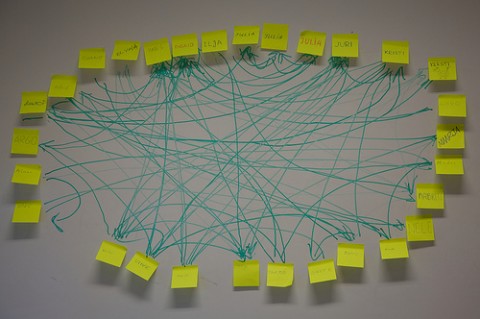
Two things reminded me of the power of design and physical space this week. First, in a workshop for Juvenile Justice leaders, the 12 participants were seated at three tables. It was a cozy arrangement and the tables were useful for handling the volume of materials they were using. After a morning focused on race, class and culture dialogue skills, we brought the chairs together in a circle in the front of the room to close a segment of the conversation. I asked folks how that arrangement felt and they say “Good!!” There’s nothing like removing physical barriers and enabling everyone to see everyone else easily to foster relational and conversational intimacy!
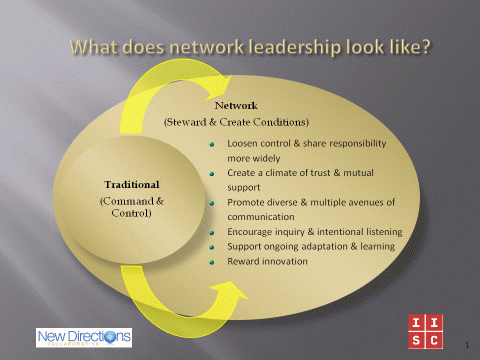
As I prepare to do a couple of trainings for leadership in multi-stakeholder networks in the New England region (focus being on the skills of facilitation, process design, and managing decision-making), I intend to frame our conversations with some exploration of the differences between traditional organizational leadership and what is required to steward networks towards positive impact. I begin with the presumption that network form and function are chosen strategically for the ability to accomplish something that could not be done at all or as well through other approaches. Whether trying to develop a food system to eliminate food insecurity or change an educational system to yield more equitable opportunities and outcomes, the attraction to a network approach is likely due to a desire for some combination of the following: Read More
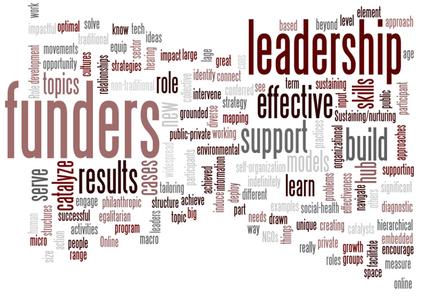
Compared to my post from yesterday, this certainly feels like a big shift, going from the sublime to the tactical. At a recent gathering that I facilitated, members of the steering committee of a food system change initiative, local and regional funders, and members of other organizational networks came together to discuss ideas for ensuring the long-term financial sustainability of the committee’s work around ensuring community food security. We came at this from a few different angles, including a conversation about actual and perceived constraints and challenges to supporting this kind of net work. Here is a taste of what came up, which resonates with what I am hearing in other networks as well: Read More
|Photo by Kelly B|http://www.flickr.com/photos/foreverphoto/147660610|
The late David Bohm pointed out the lost potential of quantum physics as he saw it being assimilated by a traditional and very mechanical mindset that wanted to make it another instrument of control, prediction, and quantification. For him the power of the field was much more subtle, qualitative, and lay in the understanding that there is an “implicate order” to reality from which form emerges via our thoughts and efforts to make meaning. From Bohm’s perspective, much of what ails us stems from disorganized thought that has us attaching to form, regurgitating and defending our prejudices, as opposed to thinking that embraces the more creative flow of life. As he once expressed it, “Thought is creating divisions out of itself and then saying that they are there naturally.” Read More
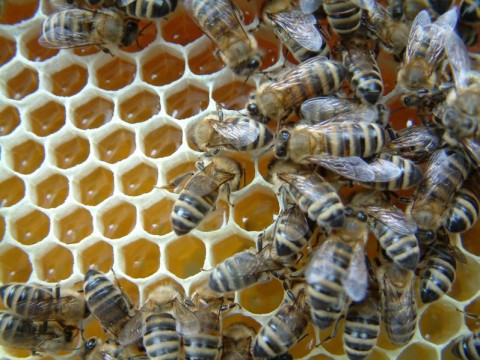
“From honeybee swarms we’ve learned that groups can reliably make good decisions in a timely matter as long as they seek diversity of knowledge. By studying termite mounds we’ve seen how even small contributions to a shared project can create something useful. Finally, flocks of starlings have shown us how, without direction from a single leader, members of a group can coordinate their behavior with amazing precision simply by paying attention to their nearest neighbor.”
Last week I was privileged to attend a gathering of practitioners from across sectors to discuss the successes and challenges of working in networked ways. The Northern New England Network Community of Practice met in Portsmouth, NH for a full day of conversations facilitated by members of Maine Network Partners. Throughout the day many critical questions were raised about and stemming from net work. No one pretended to necessarily have all of the answers to these, or to imagine that what works in one case will necessarily work in another. Nonetheless, we look forward to exploring any patterns that do show up across experiences in our respective network efforts, whether we are talking small or large scale, local or regional, within a sector or across sectors . . . Read More
Picking up from Gibran’s post yesterday and continuing in the vein of follow-up to our LLC webinar on collective leadership, I want to respond to some of the questions we did not have a chance to answer or answer fully from participants, including requests for examples of collective leadership in action and inquiries about blocks and how to work through or overcome them. Read More
On the cusp of the Martin Luther King Jr. day of remembrance and celebration, IISC is gearing up to lead a webinar on the day after the Monday holiday focused on a very relevant topic – collective leadership. Much is being made of the Occupy Movement and its potential for showing us a new way to lead (we would call it leader-full, not leader-less). Prior to this important civic groundswell, many have been looking at how to create the conditions for emergent and collaborative leadership to move us in more just and life-affirming directions. Given the complexity of the issues we face and the diversity of perspectives in our various systems, it has been recognized that we cannot rely on individual, expert, or command-and-control leadership to move us forward. We must unleash more robust and adaptive collective intelligence. If this conversation interests you, come join Gibran Rivera and me as we explore stories of and practices for creating the conditions to unleash leader-full momentum that embodies and leads to the social change we seek. More information about this free opportunity can be found here.
|Photo by Simon Cockell|http://www.flickr.com/photos/sjcockell/3251147920|
Last week, I had the opportunity to work with a cross-sectoral group of emerging and established leaders from around southern Maine through the Institute for Civic Leadership, an initiative IISC had a hand in establishing some 18 years ago. For the past six years I’ve offered three days of collaborative capacity building entitled “Facilitative Leadership and Teams” to each successive cohort, and it’s been interesting to see how the offering has evolved over time. Throughout there has been an interest in looking at how to leverage what is now an incredible base of 500 + individuals who have been through this leadership program. And so this year we dived formally into network building strategies. Read More
If you read this blog regularly, you’ve heard me talk about the Networks and Decentralized Organizing Community of Practice that I’m a part of. I’m continually buzzing with inspiration from this very special node in the network.
Part of our process includes a “daily practice” that is offered each day by a different member of the community. Jenny Lee, of the Allied Media Projects, recently offered this practice – she titled it “Murmuration.” I invite you to share your reflections.
Even if you’ve seen it before, watch it again and think about the questions:
If another species was observing and analyzing the shape, rhythm, contours of our movements what would they look like?
What is the most breathtaking structure and form of movement that you can imagine our networks taking? What would be the most inner-working mechanics that structure?
“While conventional views of power and authority seem to indicate that you should co-opt and capture other tribes, you can often achieve more by freeing your own people to maximize their vision alongside yours.”
– Seth Godin
In today’s world of mergers and acquisitions and nonprofit consolidations, I was struck by the conclusion of Seth Godin’s recent blog post. I read it as yet another argument for the power of networks and decentralization. There is so much good work to be done in this messy world of ours – why do we wish we could consolidate it under a single leader or strategy?
“Networks are not just about sharing the pie. They are about growing the pie.”
– Ellen Kahler, VSJF
It has been a privilege and an inspiration to spend the past two days working with my colleague Beth Tener and the amazing team at the Vermont Sustainable Jobs Fund (VSJF) to help launch the Farm to Plate Network. Over 150 people came together to connect and take the conversation deeper around how they want to work together to double local food production in the state over the next 10 years, as a way of boosting economic development, increasing jobs, and ensuring that every resident has access to healthy food. A big rallying cry has been the devastation that Tropical Storm Irene wrought on the farming community. And as we learned from former Secretary of Agriculture Roger Allbee during a very enlightening presentation about the Great Flood of 1927, once again Vermonters responded in ways that have impressed those (including the American Red Cross) who came to help, with their self-organizing and neighborly efforts to get one another back on track.
In an encouraging speech to launch the proceedings, Governor Shumlin highlighted the challenges and opportunities that stem from the changing climate that is predicted to increase precipitation 20% in the state in years to come. “Our best days are ahead of us if we can pull together,” he said. Read More