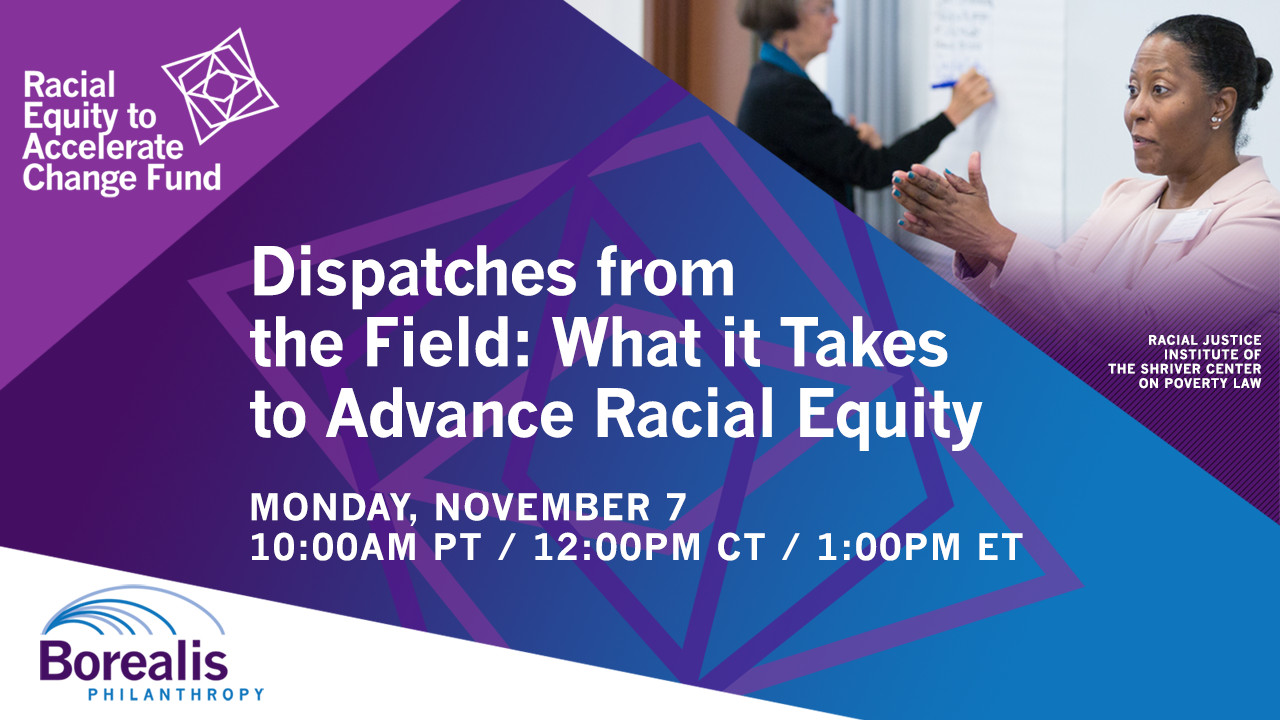
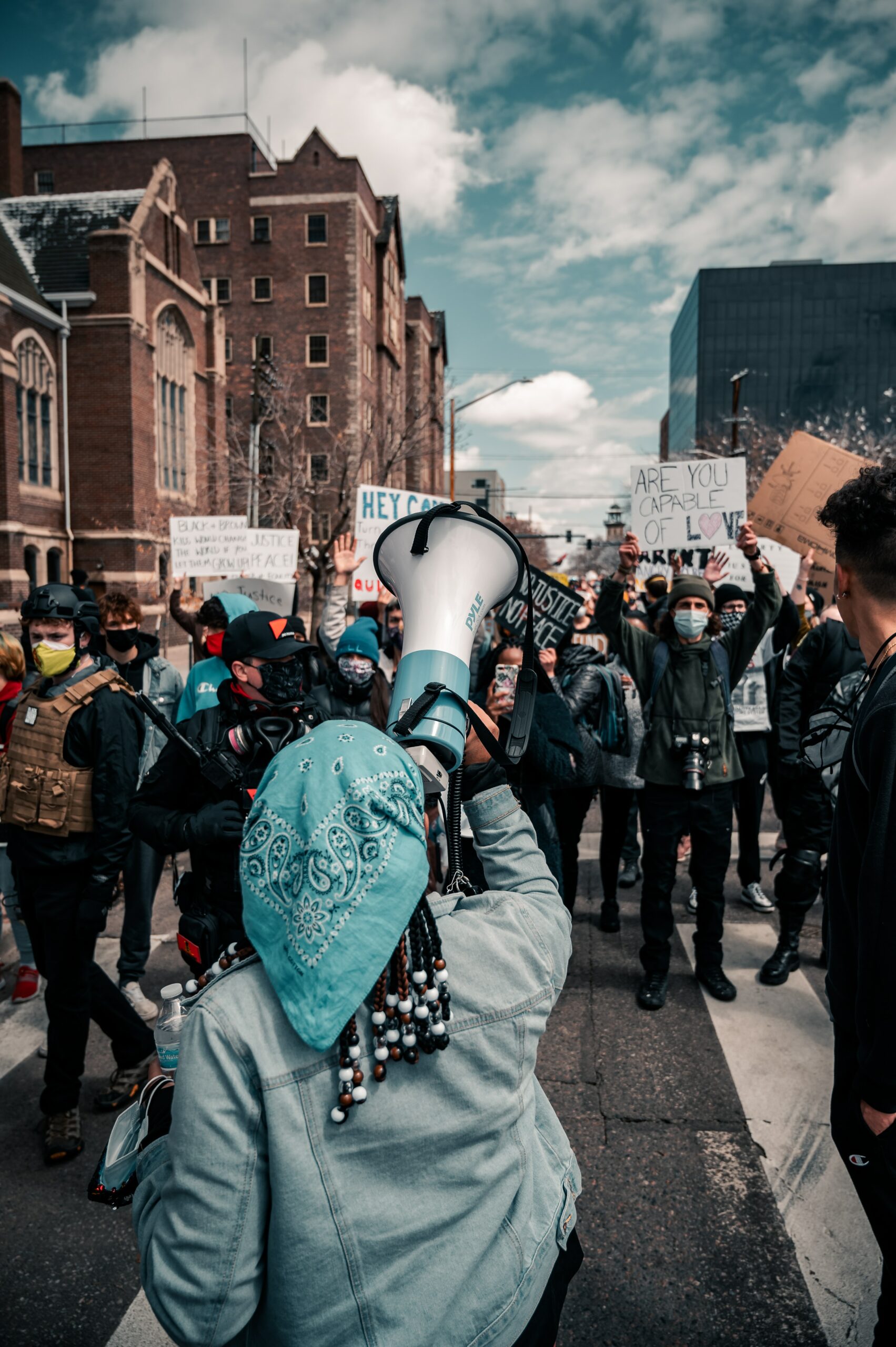
Last week, the REACH Fund (the Racial Equity to Accelerate Change Fund of Borealis Philanthropy) invited us all to participate in the building of a collective muscle that reflects the future we envision. With Kelly Bates from Interaction Institute for Social Change and Natalie Bamdad from Change Elemental leading the way, we explored the journey of racial equity, trends we should anticipate, and what’s needed from philanthropy to elevate and prioritize this vital work.
Here are a handful of high-level learnings the REACH Team shared after the conversation with Kelly and Natalie:
We must expand our lens for the type of work that contributes to the advancement of racial equity. Racial equity work is about more than toolkits and evaluative reports—it is about data and also storytelling, relationships, process, design, healing, and implementation. As funders, we must acknowledge the value and breadth of this work and its unique component parts.
The pie is big enough for everything. Funders must abandon a scarcity mindset in funding racial equity work and choose multiple streams of work to resource. The potential for change is limitless when we collectively approach our work with abundance.
Racial equity work is reparations. Racial equity work is reparatory work. As funders, we have to acknowledge the source of concentrated wealth, incorporate this history into our funding decisions, and let resources “flow like a river.”
Philanthropy must grapple with the scale of transformation needed. Part of “readiness” for radical racial equity work is understanding the depth of engagement required to untangle the impacts of white supremacy on our organizations and ourselves. Racial equity work is not one-off, project-based work. It is a years-long journey and a vision that must be embedded into the core of our organizations.
We have to design for the future we envision. Ultimately, racial justice requires we exist to serve the future we envision—not simply act against oppressive and oppositional forces. We must center our vision for the future in our organizations’ racial equity journeys and missions.
The REACH Team also shared that they were meditating on a lesson they learned long ago—one that speaks to their Fund’s very existence, which they are reminded of repeatedly: the work of racial equity practitioners is vital to leading the movement ecosystem towards liberatory principle and practice. The wisdom, approach, and tools of these facilitators, coaches, and healers are essential to supporting the nonprofit and philanthropic sectors to dismantle and repair the systems designed to uphold white supremacy—and, importantly, to do so in a way that centers healing and joy.
This post is a revision of one that was shared on June 11, 2020. The poem has been revised.
As the world tries to return to the “old normal” of racism in every facet of our life, or to the exhaustion from an overproducing system, let’s resist it fiercely and walk into the next one hundred years together in the spirit of new creation and norms.
May this poem that I wrote be a source of vision and inspiration.
Sun rays coming through trees, Pikrepo
Let not the slow creep of the old return
Like childish feet come slipping through your doorways
Look in the direction of the sun
Remember the lessons of staying in place?
Wading into presence
Tending to family
Resting your breath
Facing scars
Embracing insecurities
Abandoning perfection
Slowing your heart to hear cries of “I Can’t Breathe”
For the futures of humankind
Erase the “old normal”
Walk toward the light
Grieve the long path of injustice you were in
And stand upright
There can be no turning back
You can look over your shoulder and peek once in awhile
But there is no freedom behind you
Greed, exhaustion, and oppression live there
You said you wanted change in your lifetime?
Keep walking forward
Keep pausing to hear your heartbeat
To hear the people in the streets
And create the next 100 years
And you will not return
Because we will rise forward with the force of 100,000 horses galloping
Tens of thousands of drums pounding
And a Planet alive with millions dancing
Plants growing
Animals running
Seas churning
Temperatures readjusting
Life spilling over into our lineage of children
With Earth healing
We will reclaim the Earth!
And live into a future we’ve never been to before.
IISC is delighted to share that a number of our staff will have the opportunity to attend this year’s Facing Race National Conference, presented by Race Forward. Enthusiasm for this flagship racial justice convening is popping, especially given that it’s happening in person for the first time since 2019.
We are looking forward to being in community with other racial justice practitioners as we gather to gain a deeper sense of what is needed in this moment and how we at IISC – both individually and collectively – can best contribute. We’re also excited to hear from Dr. Ibram X. Kendi, now our fellow Bostonian in his role as director of the Boston University Center for Antiracist Research.
In addition to attending the conference as participants, members of our team will also be leading workshops!
IISC President Kelly Bates and Director of Practice Miriam Messinger are co-leading a session – Let’s fight the return of the “Old Normal!” – Leading for liberatory systems and racial justice transformation – in which they will lead participants through a process of co-creating visions of racial justice in practice and strategizing about leading our organizations and networks out of “old normal” white supremacist systems and practices toward liberation and transformation.
IISC Senior Associate Cynthia Silva Parker is co-leading a workshop with Sean Thomas-Breitfeld, Co-Executive Director of Building Movement Project on behalf of the Deep Equity Practitioners Network. Real Talk About Building Organizational Capacity for Racial Equity: A peer exchange. The workshop will offer people who facilitate learning, strategy development, healing, team building, coaching, organizational change, and more to advance racial justice an opportunity to build community and share ideas about engaging tough issues – from getting past performative efforts and moving toward liberation to helping organizations embody racial justice in their operations as well as their programming.
We are committed to sharing reflections once we attend and process the conference experience. Stay tuned!
In middle and high school, I challenged (and most likely annoyed) my teachers around this time of the year. I went to school in Plymouth, MA and wondered out loud why Native Americans would want to celebrate Columbus Day. “Shouldn’t it be a day of mourning for them?” I’d ask. I don’t recall any teacher having a good answer to my question or even being willing to engage in meaningful dialogue. I’ve always been a little proud of myself for having some level of consciousness at that age. And, I’m well aware that there is so much more to learn and to do.
Indigenous People’s Day isn’t just another three-day weekend. It’s a great opportunity to honor Indigenous people and to recognize and grieve the genocide and land theft that is at the heart of the founding of this nation. It’s a day to tell a more truthful story about the founding of this nation: the story of how the land that is now the U.S., which became the basis for wealth and well-being for the original settlers and their descendents, was stolen, swindled or taken by force. We Shall Remain and Unnatural Causes Episode 4: Bad Sugar provide powerful reminders of that history and connections to present-day conditions. Honestly, the more I learn, the more I feel regret, shame, and powerlessness to redress the wrongs. After all these years, I am still looking for ways to be an effective ally to Native American communities and to leverage the considerable privilege that being a U.S. citizen affords me.
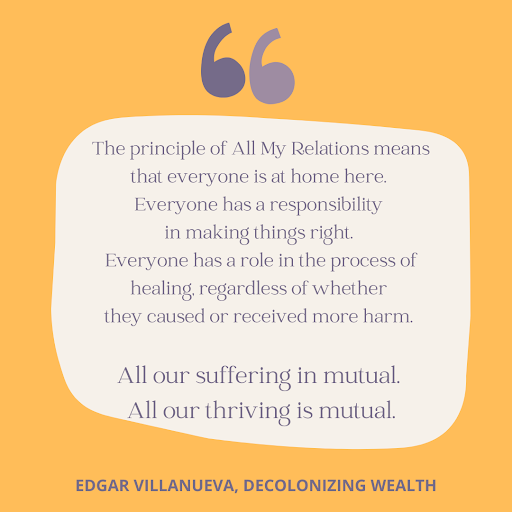
Indigenous People’s Day is also an important opportunity to learn what Indigenous communities are doing in the present day and what it means to decolonize. It’s an opportunity to live into solidarity. For me, one powerful step in that direction has been learning from and participating in small ways in the Decolonizing Wealth Project, from which I borrowed the title of this post. The project asks:
“Are you a decolonizer?”
“Are you fighting for a more just and sustainable world? Are your efforts to bring about change rooted in a deep love for humanity and the earth?”
My response? Yes, I am fighting for a more just and sustainable world. Yes, my efforts to make change are rooted in a deep love for humanity and the earth. And yes, I have a long, long way to go to call myself a decolonizer.
In 2019 and early 2020, my colleague Eugenia Acuna and I had the privilege of working with Edgar Villanueva and the Decolonizing Wealth Project to help develop some of the project’s tools and resources. Since then, I have been diving more deeply into Edgar’s work (Decolonizing Wealth: Indigenous Wisdom to Heal Divides and Restore Balance is now in its second printing!) and taking baby steps toward using money as medicine to heal what’s broken in our world. I got my decolonizer t-shirt (You should get yours too! Proceeds support organizations working with Native-led organizations working on racial justice.), though I still feel like I have more to do before I can actually wear it.
This year I’m revisiting Edgar’s seven steps to healing and challenging myself to apply them more consciously and consistently in my practice and my life. The steps are so straightforward. They are simple to state and oh, so challenging to do. (No spoilers here! Get the book and find out what the steps are.) As I reviewed them recently, I realized how often I skip past some of the steps and sometimes even practice their exact opposite. I invite you to join me in digging deeper, reflecting more honestly, loving harder, and practicing grace with oneself and with others more often. How will you open yourself to being guided by Indigenous wisdom as we seek to heal divides and restore balance?
IISC is honored to share that we were selected as a finalist in the Diversity, Equity, and Inclusion category of the 4th annual .ORG Impact Awards. This program – sponsored by the Public Interest Registry (PIR), the people behind .ORG – honors and celebrates inspiring mission-driven organizations and leaders from around the globe that not only demonstrate a passion for making the world a better place, but also work tirelessly to create a positive impact in their communities. IISC is pleased to be one of only five finalists in this category – selected from a record number of submissions from around the world.
The winners in each category will be announced on November 15 and we will certainly be even more delighted should we win that final honor (along with a cash prize!). That said, regardless of the outcome, IISC is pleased with this recognition as a finalist and will be happy to celebrate with the winner should it be one of our co-finalists.
Most importantly, we honor the people of IISC who make this all possible. So much hard work and dedication is behind why we have been recognized in this way. Learn more about us here!
All past workshop participants are invited to join a facilitated LinkedIn group to connect with others. The groups will be a place to share successes and challenges, exchange resources, ask questions, and support each other in continuing to apply and practice the workshop frameworks and tools.
In addition, all group members will be invited to attend quarterly online gatherings hosted by a talented lineup of IISC facilitators. These gatherings will be a space to connect with others and to continue to build on the content and experience of the workshops.
IISC has long dreamed of creating these communities and we are delighted to launch this project with the support of The Kresge Foundation.
If you have attended a workshop and are interested in joining us, please complete this short survey. Survey respondents will receive a link to join the LinkedIn communities. We are excited to welcome you into the IISC community in this new way as we grow our network of social change practitioners.
Thanks in part to the work of Tema Okun, Dr. Kenneth Jones, and DismantlingRacismWorks, we have been leaning into the characteristics of white supremacy culture for decades. I find the sense of urgency particularly challenging. Okun and Jones define it as “our cultural habit of applying a sense of urgency to our every-day lives in ways that perpetuate power imbalance while disconnecting us from our need to breathe and pause and reflect. The irony is that this imposed sense of urgency serves to erase the actual urgency of tackling racial and social injustice.”
I struggle with this regularly. In the early days of the pandemic, IISC wrestled with what contribution we could make. I had to temper my desire to move quickly with a sober assessment of our actual human capacity. Even now, on any given day, our team – and the staff and volunteers practically everywhere I turn – ranges from sick, exhausted, and overwhelmed to joyful, optimistic in the midst of it all, and eagerly seeking new possibilities. I continue to remind myself that we can only go as fast as we can go, even if that doesn’t seem fast enough given the conditions around us.
Therein lies the struggle. The work of making a better, more just world IS urgent. People are paying with their lives every day because of the way our society is constructed. Take health as an example. Healthcare is a for-profit industry and the profit motive drives who gets treated, what kinds of treatments are approved or even exist, and what unhealthy conditions are allowed to persist. Access to healthcare is granted mostly as a privilege for people with certain kinds of jobs, rather than to all people as a human right. People are dying every day because of this. Getting care to people who need it most – people who are unhoused, and/or unemployed, disabled, elderly, or otherwise unable to participate in the paid labor force – is urgent. At the same time, we have to devote attention to the necessary, long-term work of building political will and shifting the political system in the direction of making health care a human right. Otherwise, we’ll be forever doing the urgent work of helping people on the margins to survive. As our friends in public health remind us, we have to “get upstream” to stop the “flow” of people who need urgent support that the system doesn’t provide.
Generations of warriors for justice have taught us that the struggle for justice is costly and urgent. In my earliest days of political formation, my mentors argued (sometimes explicitly and sometimes by example) that I didn’t deserve a good night’s sleep or many creature comforts because people were suffering and dying every day due to racism and poverty. This led me to an unhealthy kind of self-denial and overwork. While my group members saw me as productive and committed, in the eyes of some folks who I was both critiquing and attempting to recruit, I appeared unbearably self-righteous and absolutely no fun to be around.
This posture didn’t win over a lot of new people to our way of thinking and it ingrained in me a habit of ignoring my own needs that has been extremely hard to break. While I can say with conviction to others that “self-care isn’t selfish,” and “it’s essential to find joy in the midst of struggle,” I still have trouble taking my own advice sometimes. I’m making progress, though it’s slow! I still hold onto this quote from George Bernard Shaw: “I want to be thoroughly used up when I die, for the harder I work, the more I live. I rejoice in life for its own sake. Life is no ‘brief candle’ to me. It is sort of a splendid torch which I have a hold of for the moment, and I want to make it burn as brightly as possible before handing it over to future generations.”
One thing I find striking and encouraging about the current generation of racial justice activists is their explicit focus on wholeness, healing, belonging, and restoration – think of emergent strategy and the work of healing justice to name just a few. We are beginning to recognize that we can’t do any of this necessary and urgent work at the expense of people and relationships. And I think we still have a long way to go.
If we want to make change at the scale of an entire society and beyond, we have to find new ways and rediscover ancient ways of doing both the urgent work of survival and the urgent work of structural change in ways that don’t exhaust and exploit the people doing that work and that make space for new more beautiful ways of being together. At IISC, as we take up this challenge and offer what we can share, I’m trying to remain vigilant so that a sober assessment of the urgent need for justice doesn’t push me toward dominant-culture ways of pressing beyond the capacity of our human community.
How are you replacing a dominating sense of urgency with an appropriate sense of urgency that honors and cares for people?
I went to synagogue last week to support friends who were leading the service and I got a gift in return. My friend Hilary shared some words that really resonated with me. I’ll translate them here as “this space is sacred.”
We create and move through spaces every day and all the time, at work as well as at home and in community. And, we are in times that can feel challenging, frightening, or even dangerous. And so how do we nourish ourselves and find the belonging that is a basic human need? Without being trite, I left synagogue reminded that I am already in those spaces and that I can do more to notice when the spaces I am in have elements of the sacred: belonging, grace, wonder, possibility, joy.
Here are some of the spaces I’ve been in just in the last month that I realize now were sacred, even if only for a moments:
At the dinner table in western Massachusetts, surrounded by the laughter of family who have only known one another for at most eight years, creatively weaving our connections as we anticipate the next generation
Floating in the ocean, swaying in the waves
Recently at a staff gathering where we were together in person for the first time in two and a half years…feeling the presence, seeing more than just the faces.
In a zoom room of white anti-racists sharing vulnerable stories of failure and intentions to be in deep partnership and sibling-hood in multi-racial spaces
In a zoom room of mostly strangers exploring generative conflict
Perhaps harder to conceive, and problematic if held in the wrong way, I wonder how we can find or create sacredness amidst a world or workplace that feels challenging. One way I saw that was in a beautiful interaction between two clients. One is leaving their job; another, in tears, processing the endless change and loss, spoke to how much they appreciated that person and how in seven months the departing person had pulled them into community and increased their capacity for important work.
I know that I, and many of our clients, yearn for and need wonder and sacredness as we move through a world full of challenges, violence, and fear. And, in discussing how we sometimes choose what we see, I would be remiss not to also name that it is a world full of beauty, changemakers, and organizing, with much to celebrate.
At IISC, we try to bring joy and foster belonging as we work on challenging issues, thereby creating and noticing the sacred space in which to do our work. Please join us and share your stories of sacred space.
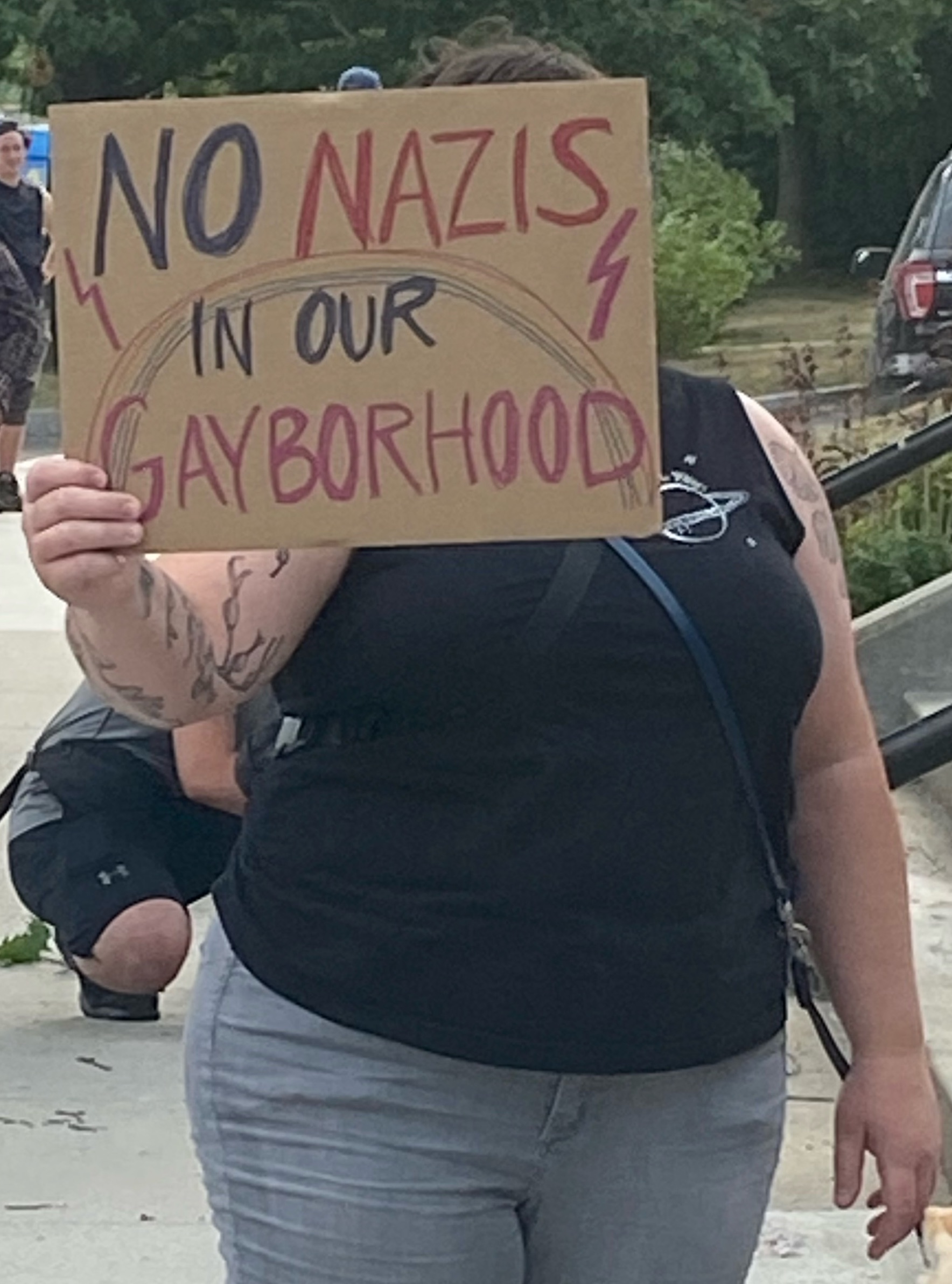
When the Patriot Front marched in Boston earlier this month and assaulted Charles Murrell, a Black artist and activist, city officials and residents alike were taken by surprise. The Patriot Front was back in Boston over the weekend, this time in Jamaica Plain, spewing their vile ideology on the LGBTQ community. We can’t claim to be surprised any more. According to the Boston Globe, the Patriot Front has been building a constituency right here, in one of the supposedly most liberal states in the country. And they have spent more time in Massachusetts than other places over the past few years. This isn’t in our “backyard” folks. This is the front yard, where we can’t deny it any more.
I used to think of the visible, vocal, and sometimes violent displays of racism as the death throes of a dying beast. But white nationalism is reproducing itself, finding support among a whole new generation of young people. We’re told that these extremist groups offer the allure of physical discipline, gun-toting machismo, community, and ideological unity. It’s frightening to me, though not surprising, that this ideology has such allure; an ideology laden with hatred and lies that obscure the real drivers of economic insecurity and political polarization and instead scapegoat people of color and LGBTQ people. It’s literally a page from the Nazi’s playbook.
If nothing else, January 6, 2021 should have taught us that it’s time to get behind efforts to prevent and intervene on the radicalization of young white people. Since 911, law enforcement has had a relentless focus on monitoring radicalization of young Muslim men, trampling civil liberties and demonizing whole communities in the process. Police have been monitoring Black and Brown street gangs for generations, also often trampling civil liberties and justifying police violence in the process. When young white men become radicalized, the strategy seems to be “do nothing,” and to explain away any crimes they commit by focusing on their mental health and social marginalization. I’m not calling for a trampling of their civil liberties, or justifying the abuses of Muslim, Black and Brown youth at the hands of police. But I am calling on us as a society to take the radicalization of young white people seriously. In the words of Wajahat Ali, author of Deradicalizing White People, “I have lost count of how many times I have been asked as a Muslim, ‘Where are the moderate Muslims?’ So allow me to ask, ‘Where are the moderate whites, and what are they doing to combat extremism?’”
What are we – those of us working for social justice – doing to combat extremism in our communities? It’s not a problem over there, in “red America,” it’s right here, in our front yard.
There’s never been a more important time to claim your full power in philanthropy. We need you – your authentic and most daring selves during these times. This is the moment to relinquish power and exercise deep trust in the field. This is the moment to recognize the important role we need you to play as a catalyst for transformative and progressive social change.
Remove and redefine the boundaries of what a funder or program officer should be.
Resist rolling out long applications and grant reports again. The field is working and we can’t be overtaxed as we fight the many battles that have been placed upon us. We need you working alongside us, not reading proposals and reports.
Avoid reverting back to prioritizing program grants. We need unrestricted general operating funds to apply what we are learning each day to what must be done.
Fund movement organizing and capacity building organizations so that we can work together to unlock profound social change during this period.
Make strategy with us, not for us. Together we must be emergent and adaptable to our challenges and opportunities. Change is not always linear. Like COVID-19, further attacks on social and racial justice will be unpredictable and hate and greed will produce new variants.
Please…come now out of your homes and offices to toil alongside us. You are not apart from us. You are us. And we need you.
We need all hands on deck. Come as you are, but come, and please do all that you can to make justice easier for us.
P.S. I share these words as someone who has spent twenty years in philanthropy – leading a charitable foundation, working with foundations, and advising donors. Discard the constraint of what you think philanthropy is and was. Philanthropy, a Greek word, means love of humanity. That’s your job now – to love humanity – and it’s urgent.
June 24th, 2022 was a dark day in our fight for liberation of Black bodies and for Black power. Reproductive justice is centrally linked to Black liberation: it is our right to know our bodies, make decisions about our bodies, and feel safe in our bodies. Self-determination has been challenged, disregarded, and disrespected. To my Black sisters, trans brothers, and gender-non-conforming kin: I rage with you, cry with you, and continue the work of building a world in service of our liberation with you today and all days.
The Supreme Court’s conservative decision to overturn Roe v. Wade is a calculated attack on our bodies, our freedom, and our personal sovereignty. This is not the first action taken by the courts in what has been a long history of reproductive control rooted in classism, sexism, and racism. It is class, sex, and race-based violence designed to further oppress, control, dehumanize, delegitimize, and imprison. I stand in opposition to this decision and in solidarity and support of Black Lives Matter’s calls for expanding the court, ending the filibuster, and passing the Women’s Health Protection Act.
I recommit to centering Black voices, to fighting for Black freedom, and to standing in solidarity with Black organizers, activists, and communities of color. I stand with you.
“If one really wishes to know how justice is administered in a country, one does not question the policemen, the lawyers, the judges, or the protected members of the middle class. One goes to the unprotected – those, precisely, who need the law’s protection most! – and listens to their testimony.”