Two years ago, the Food Solutions New England (FSNE) Network Team, with support from IISC, committed to putting racial equity at the center of its work in trying to bring the six state region together around a vision of a more sustainable food system. Since formalizing that commitment with more than 150 delegates at last year’s annual Food Summit, and taking it to other food system-focused networks by invitation, the FSNE Network Team has faced the big question – Now what? How to deliver on this commitment and in a regional context? At the very least we continue to deepen our learning around and commitment to equity, modeling for and learning from and with others, growing and strengthening our understanding and action. A sub-committee of the Network Team, of which IISC is a part, has put together a racial equity plan consisting of various areas of activity, including education, communication, convening, network weaving/organizing and curating tools and resources for food system advocates at all levels (organizational, community, municipal, state).
One step that has just been launched is a bit of an experiment, and takes the 21 Day Racial Equity Habit Building Challenge from Debbie Irving (author of Waking Up White) and Dr. Eddie Moore, Jr. (founder of the White Privilege Conference), and turns it into a virtual community of practice. The ongoing challenge of the Network Team is to figure out a variety of means to keep knitting the network, and to keep communication and learning flowing. This is where the proliferation of social media tools and collaboration platforms has been extremely helpful. Read More
Every now and then we get the question about what is the best way to structure a social change network, to which the most frequent response is, “It depends.” Case in point, in a past post, I offered examples of three different network forms growing out of the same region (New England) in a similar field (food systems). These forms that have evolved in three states have largely depended upon the initial framing question for the change effort (how to tackle food insecurity vs. how to grow the agricultural economy vs. how to achieve food justice), contextual factors (political dynamics, what already exists, who is engaged), and resources (not just funding, but certainly funding) available. And since the writing of that post, each has evolved, more or less significantly, in line with new challenges and opportunities. Some of the take-aways from this align with the lessons of moving from a more mechanistic to a regenerative outlook –
The following article appeared in an email newsletter from the Vermont Farm to Plate Network (VTF2P) one of IISC’s clients in network and collaborative capacity building. The author is Beth Cullen, co-chair of the Farm to Plate Consumer Education & Marketing Working Group and owner of Root Consulting, who attended the New England Food Summit that Cynthia Parker and I helped to design and facilitate. It is great to see the power of that two day convening and conversation continuing to ripple out into the region. VTF2P plans on integrating the conversation about equity into their upcoming October convening . . .
New England Food Summit targets social justice to drive change in the food system
The 4th Annual New England Food Summit, organized by Food Solutions New England, convened over 110 delegates in June to discuss racial equity and food justice in the region. Summit organizers unveiled the New England Food Vision, a regional aspiration to locally produce at least of 50 percent of the fresh, fair, just, and accessible food consumed by New Englanders by 2060.
Every now and then we get the question about what is the best way to structure a social change network, to which the most frequent response is, “It depends.” Case in point, in a past post, I offered examples of three different network forms growing out of the same region (New England) in a similar field (food systems). These forms that have evolved in three states have largely depended upon the initial framing question for the change effort (how to tackle food insecurity vs. how to grow the agricultural economy vs. how to achieve food justice), contextual factors (political dynamics, what already exists, who is engaged), and resources (not just funding, but certainly funding) available. And since the writing of that post, each has evolved, more or less significantly, in line with new challenges and opportunities. Some of the take-aways from this align with the lessons of moving from a more mechanistic to a regenerative outlook –
I will admit to being a bit dubious when I read articles about “scaling social impact.” A fair number of these pieces come from rather privileged places and can smack top-down solutions that perpetuate existing and problematic power dynamics and largely ignore the specifics of local realities. I am also concerned that many continue to hold an industrial/mechanistic/extractive view that renders “scaling up” simply more of the same old damaging same old.
So I have been heartened to hear different takes on scale this past month in a few conversations about evolving a more regenerative, “human scale”, and equitable economy. Read More
|Photo by Ace Abendale Rothschild-Faber |http://www.flickr.com/photos/50809036@N02/5282577422/in/photolist-93NAe5-bATUbs-gV4zgZ-8pZXib-aajHgz-aaxd1T-bES8E1-aeZsVL-adC7oV-9ZbeNe-d6jhdm-aE8uVX-8ocwaF-a6Y5uR-7G2gQK-7Awvkg-93ruBR-bELXgv-8WABY3-8WxxEt-8E1NsT-8YsvVZ-93XFRM-bgKVuk-9JB9Ue-bdAYXM-d6jeZN-d6jePW-9hccxc-d6jh4s-8mraY5-dAkbkS-84LPQd-84HGNZ-84LPP7-9bALtz|
In the regional food system network development that IISC has been supporting, we have been making a habit of building certain rituals into our meetings. One is to invite offerings of various kinds to open and close meetings, an opportunity for people to share what matters most to them and bring more of what moves them to the conversation. The following poem has been making the rounds, and has become a favorite for some of the universals it seems to invoke. Wishing you all a deeply nourishing Thanksgiving. Read More
From August 20-23, IISC is excited to once again partner with the Center for Whole Communities to offer our jointly created workshop “Whole Measures: Transforming Communities by Measuring What Matters Most” at beautiful Knoll Farm in Vermont’s Mad River Valley. This summer’s offering is meant especially for New England-based and focused food system and food security advocates. This includes those working from different angles (production, distribution, access, public health) and scales (neighborhood, community, state, region). Read More
I recently had a lively and illuminating conversation with an unexpected teacher. He came in the form of a well-spoken and measured man who works in the field of emergency food. We were talking at a state-wide food system convening about the causes of and solutions for hunger and he mentioned the idea of the “two footprints.” Read More
|Photo by Alper Cugun|http://www.flickr.com/photos/alper/5222966685|
Last week I posted an entry on this blog about the myriad ways that people and organizations are engaged in “net work” for social change, by profiling three different initiatives focused on strengthening local food systems and food security. Not only is there a difference in the process, but there is also variation in terms of so-called ends or outcomes. The topic of “planning” has come up quite a bit in these networks and many questions asked about what “a plan” looks like in the context of multi-stakeholder/organizational initiatives tackling complex issues. Once again, the answer is that it depends. In both direct experiences at IISC and in additional research about other initiatives, there is a wide variety around what constitutes a plan for social change. Read More
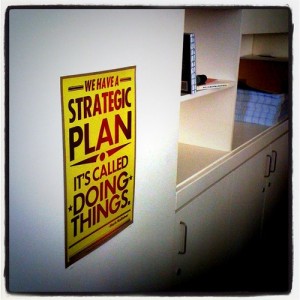
A question that has come up across a lot of the network building and advancement work with which I’ve been involved lately is one form of “What constitutes ‘doing’?” I would say that it is a fairly predictable pattern that people come together to launch the network, eager to take action to increase local food production and/or food access, to restructure the education system for more equitable outcomes, etc., and they pretty quickly discover that there is some foundation building they need to do first. This work includes building trust and relationships and establishing some common expectations, goals, processes, and indicators for their collaborative efforts. After a while, another pretty predictable dynamic occurs when people who often identify themselves as “activists” and “doers” start to ask, “When are we actually going to DO something?!” And then we see the classic tension emerge between what often gets labelled as “talking vs. doing” or process vs. action.
A question that has come up across a lot of the network building and advancement work with which I’ve been involved lately is one form of “What constitutes ‘doing’?” I would say that it is a fairly predictable pattern that people come together to launch the network, eager to take action to increase local food production and/or food access, to restructure the education system for more equitable outcomes, etc., and they pretty quickly discover that there is some foundation building they need to do first. This work includes building trust and relationships and establishing some common expectations, goals, processes, and indicators for their collaborative efforts. After a while, another pretty predictable dynamic occurs when people who often identify themselves as “activists” and “doers” start to ask, “When are we actually going to DO something?!” And then we see the classic tension emerge between what often gets labelled as “talking vs. doing” or process vs. action.