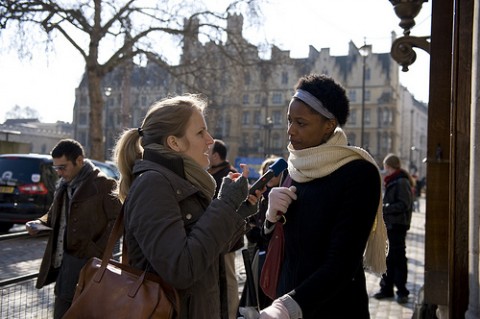
Beautiful and timely video. Historically, we have shown and unbelievable ability to dehumanize one another. We seem to like dehumanizing one group at a time. In the United States today, it seems like Muslims have become the latest target – this video goes a long way to bring our beauty into perspective. Art leads.
|Photo by UU-Jackson|http://www.flickr.com/photos/9240679@N04/2876693936/in/photostream|
This post comes courtesy of IISC friend Beth Tener of New Directions Collaborative. You can find the original post here.
One of the most inspiring speeches we heard at the Slow Money National Gathering was from Tom Stearns, President of High Mowing Organic Seeds. His company is based in Hardwick, a small town in northern Vermont, which was featured in The New York Times article entitled “Uniting Around Food to Save an Ailing Town”. Remarkably, over the last three years, the local area has added 150 new jobs to an existing 500 jobs, spread across many small companies, all associated with the local food economy.
One of the key ways this came about was through strong locally-based business networks. Read More
|Photo by DownTown Pictures|http://www.flickr.com/photos/raylopez/485753391|
Last month I was asked to present to the Children and Nature Network’s Grassroots Gathering in Princeton, New Jersey, along with Ginny McGinn of the Center for Whole Communities. We were invited by a common acquaintance who knows both our respective organizational work and our recent collaborative endeavor in developing and offering a training entitled Whole Measures: Transforming Communitiesby Measuring What Matters Most (the next public workshop will be in Boston from November 16-18). Both IISC and CWC work to build the collaborative capacity of social change endeavors, albeit in slightly different and complementary ways. The topic of our presentation was “Collaborative Leadership,” and what became core to our joint plenary address was the story of our own partnership. Read More
I’ve been getting into Umair Haque lately, he is among those of us concerned with this emergent paradigm shift, and he comes at it from a business perspective. I was specially appreciative of one of his manifestos – yes, he has many.
This one he calls “The Builder’s Manifesto,” and he is pointing towards a new model of leadership – the leader as builder. Read More
I have a paradoxical relationship with September 11. Like most of us, I am affected by our shared experience on that terrible day nine years ago. Like many Latin Americans, I remember the US sponsored coup against the democratically elected Chilean government of Salvador Allende in1973. But in what is the most significant twist, it also happens to be the anniversary of the most important day in my spiritual life – the day I met my teacher – September 11, 2004, an event that has changed my life forever. Read More
|Photo by kevindooley|http://www.flickr.com/photos/pagedooley/1875348372|
I was recently sorting through some of my thoughts and feelings about complexity and social change when I arrived at a question to gnaw on – What is the difference between taking an “emergent” versus a “quantum” approach to complex problems? We are told that complexity does not lend itself to existing, linear, cause-and-effect responses. The multiplicity of factors contributing to complexity make it difficult for traditional kinds of expertise to grasp. So what is one (or many) to do? Read More
|Photo by mattwi1s0n|http://www.flickr.com/photos/piccadillywilson/132561245|
Another school year begins and with it we students of life are filled with excitement and perhaps some nervousness about what will be asked of us. For me, I look forward to work that will keep me deeply aligned with purpose and, yes, challenged. No doubt there will be moments when my outlook will be buffeted. I will admit to being someone who in the genetic cortical lottery was not bestowed the rose colored glasses. It’s not that I didn’t get a winning ticket, I just have to work for my earnings.
And as I have blogged about in the past, I am aware and research shows that keeping a net positive outlook can be critical to heightening collaborative outcomes and staying engaged in the tough times. So what are some steps for staying on point without veering towards disconnected or disconnecting pessimism? Read More
|Photo by RandomChu|http://www.flickr.com/photos/randomchu/251646898/sizes/m/|
Just yesterday in a meeting of the Senior Associates at the Interaction Institute for Social Change, Gibrán Rivera made a comment about the ways in which being too fixed with an identity prevent us from getting to a place of liberation. I’ve heard him talk about this before – and am challenged by it every time he says it.
I’m just returning from Santa Fe, where I had the privilege of facilitating the 2nd Creative Change Retreat. The Opportunity Agenda brought together an amazing intersection of artists and activists who are committed to social justice. It was one of the most inspiring and diverse groups of people I have had a chance to work with. Experiencing such a combination of passion, creativity and commitment is enough to make one hopeful again. Read More
Tomorrow’s post is about Creative Change, the retreat I just facilitated in Santa Fe – the intersection of arts and social justice. With that in mind, and in solidarity with working people who are celebrating Labor Day, I thought it would be good to share the following video clip – an excellent example of creativity for social change:
|Photo by conscience: taxes for peace not war|http://www.flickr.com/photos/consciencetaxesforpeacenotwar/4422031309|
A couple of weeks ago I worked with a special group of special education facilitators who will be helping to coordinate key players in their school district to provide services to students with different learning needs. This work will put these people in some difficult circumstances when it comes to occasionally not being able to provide exactly what parents want for their children. For this reason, we spent a fair amount of time talking about how one can be of service when faced with irreconcilable differences. Much of this came down to staying grounded in one’s values, continuing to regard the humanity of those of others, and standing firm for what the district could reasonably provide.
What I also also saw on display for those three days was the incredible power of artful and compassionate inquiry. Read More
Make Change Stick Beyond the MeetingTurn ideas into agreements that stick, and keep change going after the meeting ends. Perfect for teams stuck in “great conversation, little action.”