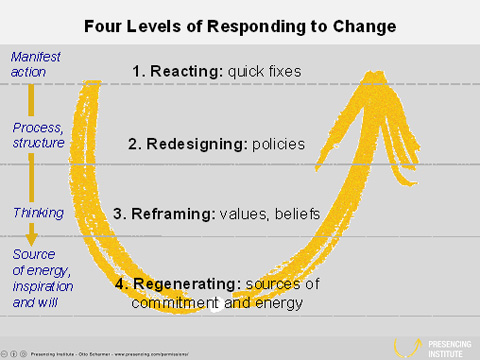
Tomorrow my colleague Melinda and I officially launch an exciting endeavor with the William Caspar Graustein Memorial Fund in Connecticut, as we meet for the first time with a Process Team that will begin designing a state-wide early childhood systems building initiative. The Memorial Fund is stepping boldly into its leadership as a convenor, at the urging of its grantees and the many communities with whom it has cultivated deep trust. In its sights is a process that ultimately yields a broadly shared and community-rooted vision for providing high quality and equitable care and education for all of the Connecticut’s youngest children, as well as policies and structures that support greater community-state collaboration towards this vision. Read More
“How do you do that? How do you step back and get perspective?” The question came from a table mate in an Art of Hosting workshop at this week’s Systems Thinking in Action conference. The earnest and wide-eyed inquisitor silently suggested the qualifier, “And how do you do this when there is so little time?” The question hung in the air in the midst of our World Café-inspired conversation about the kinds of change that are being called for in our respective communities, however we choose to define them.
My first response was to laugh. How indeed? As parents of three small children under the age of five, my wife and I often scratch our heads at how we can create more breathing space in general. Frankly, the notion of stepping back often feels like a luxury we can’t afford. And I know there are others in the same space with a variety of unremitting demands. My laugh was surely an acknowledgment of this seemingly impossible situation. And in the context of this rich albeit brief cafe conversation it also became something else, thanks to the careful attending of my colleagues.
Many of us have read about the power of presence, of being more attentive to the reality which faces us in any given moment. We also know about the amazing experience of flow, when we have been deeply connected to whatever we happen to be doing, whether playing a sport, creating art, having a conversation. I will admit that this is something with which I struggled with our first child, trying to be present for some of the seemingly mundane moments. For some reason, since our twins have come along, this has really shifted. I find myself much more in the moment, perhaps because it is abundantly clear that there is nowhere else to go. Escape is just not an option.
The result has actually been quite profound – greater enjoyment for sure and, I now realize, insights that speak to a deeper truth underlying events. Settling into the moment, I have become more aware of patterns and dynamics, both in the personalities and behaviors of my little ones and our family as a whole, that have helped me to understand better how we work as a system. This has inspired greater compassion, curiosity and an ability to be more adaptively responsive as a father and husband. So interestingly, it has been by leaning in to events that I have ended up in a place that I thought was beyond my grasp.
A couples counselor once gave my wife and me the following advice – “Have what you have.” I think I now have a greater appreciation for the wisdom of this statement. Having what we have is not settling for or giving up. It can be a gateway to abundance that we thought was “out there” and the perspective we thought only resided on the mountain top. I left our Cafe conversation with these words in my head – “Slow down, come inside, stay a while.”
I am a huge fan of C. Otto Scharmer’s Theory U. It is one of the most powerful frameworks for understanding the essential shifts we need to make as we step into this paradigm shift. Scharmer sums up his Theory U with seven propositions, I’m going to write a series of blog posts taking a closer look at each of them: Read More
“Everyone today has to be an artisan and bring something extra to their jobs.” This says Thomas Friedman in the New York Times. I’m not sure I like where he is coming from, it sounds a little bit like adding obscure features to a DVD player. But I do like the point. I like this idea of being artisans, of engaging our work as a craft, adding meaning to our tasks by putting our own signature on what we do.
Somewhere beyond Friedman’s capitalistic “do more,” in places outside the yupified fields of trendy taste, there is significant power to the work of an artisan. For example, the work of social change has become so professionalized that it is often disconnected from the depths of purpose that could unleash transformation. But by thinking of ourselves as artisans our own self-expression can actually serve connection, it can bring us closer to that place where hearts can meet.
Consider the purpose of your work, then think of what you do every day… how much more of yourself could you bring to this field where we toil? What’s your craft? What is it that you can create?
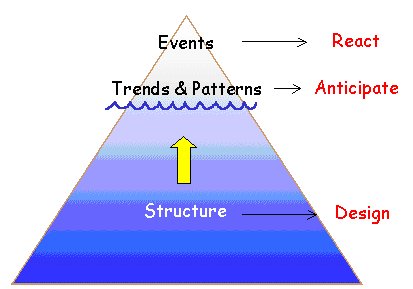
|Image from Pegasus Communications|http://www.pegasuscom.com/course_preview/gettingstarted/whyiceberg.htm|
Systems thinking is in the air. This past weekend I was delighted to have the opportunity to teach an introductory course on the topic with John McGah of Give Us Your Poor. Together we took 17 graduate students in the UMass-Boston MSPA program through an intensive and interactive look at the world through the systems lens. Even before we got things rolling on Saturday morning, the pre-reading (Donella Meadows’ Thinking in Systems) had provoked two people to say that they were already seeing the world differently (and more clearly). By the end of our 36 hour romp, which included guest presentations by David Peter Stroh and Paul Plotczyk, students were saying that all public sector employees, nay EVERYONE, should be required to take a systems thinking course. All of this enthusiasm comes just a week in advance of Pegasus Communications’ annual systems thinking conference here in Boston, which has a focus on “Fueling New Cycles of Success.” I am very excited to attend, and look forward to building upon the wisdom I’ve gleaned thus far about surfacing and living with systems (human and otherwsie), which includes these gems: Read More
|Photo by epSos.de|http://www.flickr.com/photos/epsos/3432528120|
Last week, in preparation for a session with Ontario-based community grantmaking board members, I blogged about what to look for in the proposed and early stages of a collaborative change initiative to suggest that it was on the right track. The ensuing session was incredibly rich, filled with two robust and impressive case studies featuring the YSI Collaborative, which focuses on strengthening youth social infrastructure in the region,
and an environmental collaborative focused on minimizing corporate polluting in the Hamilton area. Both presentations and subsequent dialogue in the room were filled with great tips regarding what makes for successful collaboration based on practice. Here is some of the wisdom that was shared by those in the room: Read More
Vote Today! It does matter. But you probably already knew that. I’m down on the state these days. And I don’t mean Massachusetts. I mean “the state,” the dominant organizing structure for human affairs. But I still think we should vote – wield some of the influence we have. Read More
Do you want to start a meditation practice? Why not start today? It’s November 1, and we have about 50 people committed to meditating at least 5 minutes per day for the next 28 days!
What do you look for up front to suggest that a collaborative endeavor is on the right track? This is the question that former IISC colleague and current VP of Programs at Grantmakers for Effective Organizations, Courtney Bourns, and I are charged with answering today. Our audience and partners in this endeavor are a group of community grantmaking committee members convened by the Ontario Trillium Foundation. The attendees want to know what to look for in applications and out in the field (‘beyond the grant”) as hints of future success.
This is an intriguing and challenging question, especially given the fact that the signs of success are often in places we do not think to look and of course there are never any guarantees. I certainly look forward to an engaging conversation with this group, and these are the thoughts I am prepared to share with folk at this point: Read More
|Photo by marcomagrini|http://www.flickr.com/photos/marcomagrini/698692268|
“We don’t talk about what we see,
we see only what we can talk about.”
– Fred Kofman
This week I’ve been rereading Donella Meadows’ Thinking in Systemsand really savoring it. Each time I look at it, I pick up something new, not just about systems thinking but about life in general. I’ve been focused primarily on Meadows’ chapter “Living in a World of Systems,” which considers how we can work with complex systems while acknowledging that even when we understand them better, we cannot predict or control them. One of her suggestions is that we learn to pay attention to what is important, not just what is quantifiable. This is not a question of throwing out what we can quantify as being somehow overly reductionist. Rather, it is a matter of not giving up on what we cannot measure and making quantity more important than quality. How important this is for our social change work! Read More
Over the last few days my family has been going through a sort of sacred grief. The mystery of connection, the power of vulnerability, turning to life with one’s whole heart – these are the themes covered by this wonderful talk and confirmed by my own experience.
It is quite likely that you landed in this page to take a quick peep at this blog, that you did not come here for a twenty minute commitment, but I encourage you to take the time, a shift in perspective is enough to change a life. Samantha and I are so convinced that this is central to our work in the world that we have decided to prototype a “Whole Heart Workshop,” a place for us to practice better ways of being-with. Stay tuned for more, this will be good.
With thanks to Kathy Sferra, our Mass Audubon “apprentice,” for the tip, here is a lighter look at leadership and movement building, Happy Friday and Bon Weekend!
 Tomorrow my colleague Melinda and I officially launch an exciting endeavor with the William Caspar Graustein Memorial Fund in Connecticut, as we meet for the first time with a Process Team that will begin designing a state-wide early childhood systems building initiative. The Memorial Fund is stepping boldly into its leadership as a convenor, at the urging of its grantees and the many communities with whom it has cultivated deep trust. In its sights is a process that ultimately yields a broadly shared and community-rooted vision for providing high quality and equitable care and education for all of the Connecticut’s youngest children, as well as policies and structures that support greater community-state collaboration towards this vision. Read More