Blog
December 7, 2010

Click here to see The 1st Proposition
Click here to see The 2nd Proposition
Click here to see The 3rd Proposition
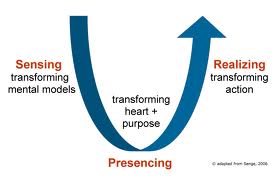
The 4th Proposition of Theory U is:
The most important tool in that leadership technology is the emerging Self – the leader’s highest future possibility. Theory U is based on the assumption that each human being and each human community is not one but two: one is the current self, the person that exists as the result of a past journey; the other is the Self, the self that we could become as the result of our future journey. Presencing is the process of the (current) self and the (emerging) Self listening to each other.
Read More
December 6, 2010
My friends at the Engage Network recently asked me this provocative question:
What does it mean to create social change that is “human sized” and prioritizes people and relationships, rather than prioritizing large email lists, or campaigns, or raising money? What does that mean to you and YOUR work in the world?
Here is my first take at an answer:
I think of our obsession with scale as a vestige of the industrial paradigm that still has many of us ensnared. It is my hope that many more of us will shift towards a more organic paradigm as we pursue the work of social transformation. As my friends at the Berkana institute like to say, emergence is not about critical mass, it is about critical connections.
Transformative social change becomes possible as we move away from the abstractions of social scientists and an increasingly obsolete state apparatus. When we begin to own our role in the pursuit freedom we begin to understand that real relationships, with real people, who have real names and real faces are the actual field where justice grows.
My commitment is to design, host and facilitate spaces where this become palpably real. As we become practiced in new ways of being-with, as we get more frequent tastes for what it means to be more authentically connected, we ourselves begin to shift – and organic, sustainable growth becomes the way we do movement.
What about you? What does “human sized” social change mean to you and YOUR work in the world?
November 30, 2010
We are so lucky! The Pew Hispanic Center just published a report titled “National Latino Leader? The Job is Open,” and it seems we can’t agree on who our leader is. The report seems to lift this as an area of concern: “national leadership” has often been helpful for groups facing injustice. A down economy and anti-immigrant fervor make this a particularly difficult time for our community – so shouldn’t we be worried that we don’t have a leader?
The paradigm shift that is affecting our lens on EVERYTHING is also at play here. While it is wise to find lessons, we can’t look at the struggles of the past as providing the model for how to deal with the struggles of the present. If we are seeking an experience of justice and freedom that is significantly greater than what we have earned thus far, then we better be looking at movement with a very different lens.
The closer you get to Washington, the more likely you are to find allies in the immigration movement who would LOVE for Latinos to have an easily identifiable leader. But this is because Washington works that way, and the media works that way – the power structure loves to know who to call, and who to dance with.
While it would certainly be easier to move policy forward if we could act as a coherent whole, I think there is great promise in the unruly dynamism that our movement is working through. As we pull together to response to this crisis, we are being forced to recognize ourselves as a community and to support each other as such. This effort builds resiliency in a way that photo ops and headlines with policy makers could never achieve.
I am glad to be a part of a leaderless community that has finally braced itself to be a movement; it is a vibrant context that welcomes my leadership, and the leadership of many others.
November 30, 2010

We are so lucky! The Pew Hispanic Center just published a report titled “National Latino Leader? The Job is Open,” and it seems we can’t agree on who is our leader. The report seems to lift this as an area of concern, “national leadership” has often been helpful for groups facing injustice. A down economy and anti-immigrant fervor make this a particularly difficult time for our community – so shouldn’t we be worried that we don’t have a leader? Read More
November 29, 2010

Click here to see The 1st Proposition
Click here to see The 2nd Proposition
“Let’s all keep an open mind” How many times have you heard that one? How often has it worked? Keeping an open mind is not as easy as following a ground rule once it has been stated, specially not in a culture where we are rewarded for being right – for knowing. Read More
November 25, 2010
Wishing you all a restful and nourishing Thanksgiving, along with reminders of the bounty that may be closer than we think.
The Wild Geese
Horseback on Sunday morning,
harvest over, we taste persimmon
and wild grape, sharp sweet
of summer’s end. In time’s maze
over fall fields, we name names
that went west from here, names
that rest on graves. We open
a persimmon seed to find the tree
that stands in promise,
pale, in the seed’s marrow.
Geese appear high over us,
pass, and the sky closes. Abandon,
as in love or sleep, holds
them to their way, clear,
in the ancient faith: what we need
is here. And we pray, not
for new earth or heaven, but to be
quiet in heart, and in eye
clear. What we need is here.
From Selected Poems of Wendell Berry, by Wendell Berry. Copyright 1998 by Wendell Berry.
November 24, 2010
Just coming off the second public offering of Whole Measures: Transforming Communities by Measuring What Matters Most, IISC’s joint venture with the Center for Whole Communities. I have to say, the workshop experience keeps getting better and better. More is yet to come (next stop, New Jersey in March), and I wanted to offer these words as a way of summarizing our evolving co-creation.
What we talk about is what we see,
so must convene conversations that matter.
What we see is what we measure,
so we must see the whole (system).
What we measure is what gets done,
so we must measure what matters.
What must be done cannot be done alone,
so we must design and facilitate collaborative processes.
We cannot do any of this by transaction or command and control,
so we must embody transformational leadership.
November 22, 2010
I had the pleasure of meeting Jennifer Sertl on the Twitter sphere. Together with Koby Huberman, they have written a book that seems to touch on many of the aspects of this paradigm shift that I spend so much time writing about. It looks like in writing Strategy, Leadership and the Soul, Sertl and Huberman are articulating a series of powerful responses to the changes our organizations are experiencing. I see a lot of alignment between the principles outlined in this 3-minute video and the work we do here at IISC. We are moving forward; see what you think.
November 19, 2010
Web of Change from Web of Change on Vimeo.
November 18, 2010
Sometimes it takes science a little time to catch up with the world’s wisdom traditions. Recent research findings from a couple of Harvard psychologists, Matthew Killingsworth and Daniel Gilbert, confirm what meditation and mindfulness practitioners have long known – our ability to stay focused in the present has a strong correlation with contentment. Using data collected from a specially designed iPhone application, the researchers report that people spend nearly 47 percent of their waking hours thinking about something other than what’s happening in front of them. Furthermore, they find that, “Mind-wandering is an excellent predictor of people’s happiness. How often our minds leave the present, and where they tend to go, is a better predictor of our happiness than the activities in which we are engaged.” You still with me?
My colleague Gibran Rivera has recently been blogging about Otto Scharmer’s Theory U, and the power of collective presence this framework promotes. Essentially, Scharmer affirms that how we attend and the quality of our individual and shared attention and intention affects what emerges. We know this from the simple and yet profound experience of listening to someone in a fully engaged way and or when we cultivate and participate in sacred spaces and rituals. In other words, “presencing” is not just about happiness, but ultimately new ways of seeing, being and doing. Knowing all of this, can we more boldly accept the invitation of mystics and poets in the midst of our otherwise mundane and muddled lives?
For Presence
Awaken to the mystery of being here
and enter the quiet immensity of your own presence.
Have joy and peace in the temple of your senses.
Receive encouragement when new frontiers beckon.
Respond to the call of your gift and the courage to
follow its path.
Let the flame of anger free you of all falsity.
May warmth of heart keep your presence aflame.
May anxiety never linger about you.
May your outer dignity mirror an inner dignity of
soul.
Take time to celebrate the quiet miracles that seek
no attention.
Be consoled in the secret symmetry of your soul.
May you experience each day as a sacred gift woven
around the heart of wonder.
– John O’Donohue
November 17, 2010
Last week I attended Pegasus Communications’ annual Systems Thinking in Action Conference in Boston and had the privilege of meeting and hearing from extraordinary people from around the country and globe, all interested in helping others to better see and work with wholes. From systems mappers and modelers to complex facilitation practitioners to researchers and preachers, my teachers were many. I was one of many tweeters spreading the wealth of wisdom cycling through that dynamic event and system. Here are some of my favorite take-aways in the form of quotes heard, read, and spiritually imbibed:
- We have seen the system, and it is us! – overall theme
- “There is a big difference between trying to be the best organization IN the world and the best organization FOR the world.” – Art of Hosting workshop participant
- “Love, allowing the other to be a legitimate other, is the only emotion that expands intelligence.” –Humberto Maturana
- “Collective will is the attractor that allows form to emerge from chaos.” -Tracy Huston, from her book Inside Out
- “Trying to be right is a learning disability.” – Ray Jorgensen
- “There are three conditions PROVEN to bring out the best in us – the ongoing dispersion of power, transparency, and mutual accountability.” – Frances Moore Lappe
- Why vision matters – “You can solve all of your problems and still not have what you want.” – Robert Fritz
- The good news – “We are once again learning what life is and what consciousness is.” – Peter Senge
- Key question – “How can we each own our own fatalism, which continues to support systems that no longer serve us?” – closing plenary audience comment
- And another one – “How do we make more visible and accessible the many promising changes and good news happening around the world?”
November 16, 2010
Click here to see the 1st proposition
The 2nd proposition of Theory U reads:
(1) The leadership process requires three movements: (1) establishing the horizontal connection (“observe, observe, observe”), (2) establishing the vertical connection (“connecting to Source”), and (3) acting from what emerges in the Now (“acting in an instant”).
Read More