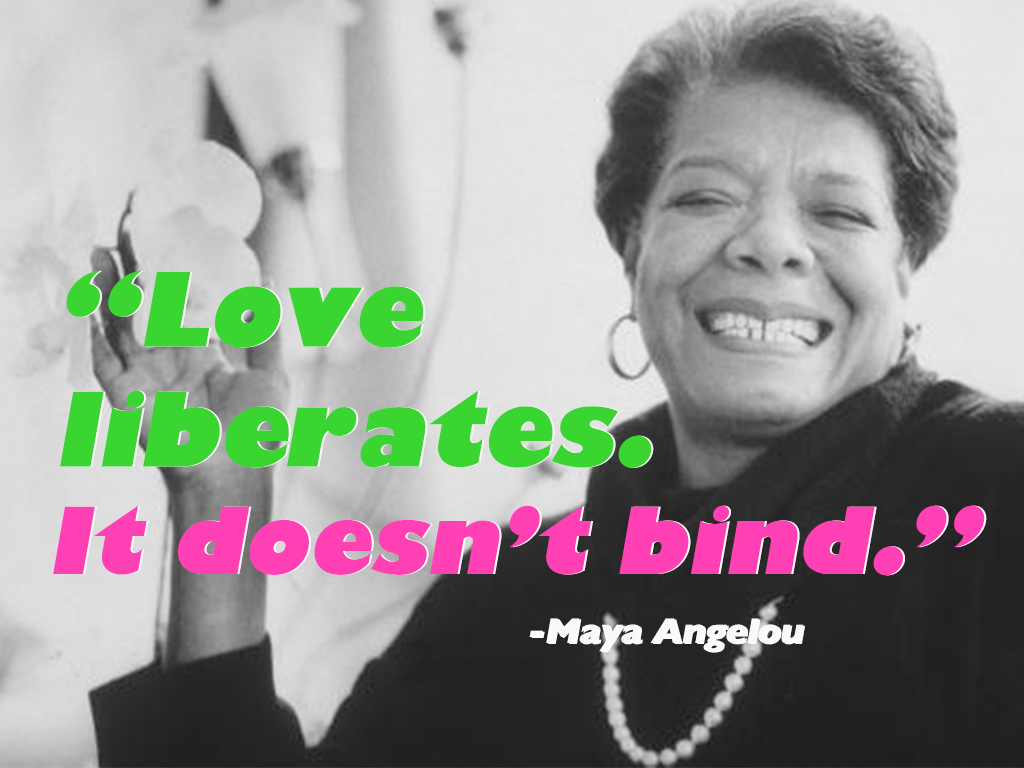
We continue to explore the power of love. Listen to Dr. Maya Angelou speak about the power of love to liberate the human spirit. She speaks of how her mother’s love liberated Maya to become her fullest self and how Maya’s love liberated her mother at the end of her mother’s life. She speaks of the unconditional love that frees a person to make their highest and best contribution to the world—a love that is at once personal and public, individually meaningful and essential to our collective lives.
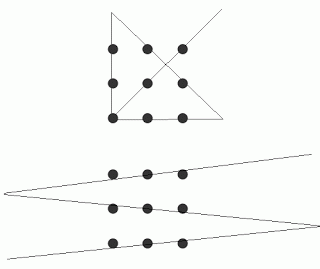
You probably know this challenge. Start with 3 rows of 3 dots in the form of a square. Now using only three or four straight lines, connect all of the dots without lifting your pen or pencil from the paper (see answers above). I was reminded of this exercise by some of the participants in the Tillotson Fund Community Practitioners Network (CPN). They used it as a metaphor during a presentation about a multi-functional collaborative platform they are proposing to connect a rather vast and disparate region of New Hampshire’s northern most county, including parts of western Vermont, southern Quebec, and eastern Maine. The vision for the platform is that it would help to build connectivity and alignment around a core set of regional values that would also inspire action for community and economic development. Read More
I find this to be a powerful piece, and it confirms intuitions and observations from my ten years of doing this work. It is too often that we collaborate for collaboration’s sake. And it is too often that we fall into the tyranny of a consensus that yields subpar results.
Last week’s New England Food Summit was a unique opportunity to bring a conversation that had begun in the northern more production-oriented parts of the region to a place where access, equity and urban ag are leading edges of the conversation. Food Solutions New England (FSNE) is leading a charge that challenges the imagination of people in six states to see and work together for a day in 2060 when we are able to produce (farm and fish) at least 50% of what is consumed here. This challenge takes on unique dimensions in different parts and communities of the region. In Rhode Island, where this year’s Summit was held, this means working with the highest unemployment rate in the country, an ever more diverse population and the reality of very limited space in which to place new food operations.
But as Ken Payne, member of the Rhode Island delegation and chair of the Rhode Island Food Policy Council, reminded Summit attendees, a central call is to creatively go about the work of “repurposing space” – physical, moral and economic.
This past weekend’s CommonBound Conference was quite the experience. It was inspiring to be with the more than 600 participants from around North America talking about and sharing examples of what it might take to evolve a just and sustainable economy. I found the event’s closing plenary, an interview of and conversation between Adrienne Maree Brown, Gar Alperovitz, and Gopal Dayaneni, to be particularly stirring. For those who missed it, here is a smattering of what was buzzing in the Twittersphere . . . Read More
Very much looking forward to joining my IISC colleague Andrea Nagel while facilitating at this weekend’s CommonBound Conference, hosted by the New Economy Coalition. The proceedings will feature Ed Whitfield from the Fund for Democratic Communities. Whitfield is a long time social justice activist, who has been involved in labor, community organizing and peace work since the late 1960‘s . He was the chairman of the Greensboro Redevelopment Commission for 9 years and formerly board chairman of Greensboro’s Triad Minority Development Corporation. In the short video clip above Whitfield speaks to the fallacy of the “teach a man to fish parable” noting that to know how to fish is one thing, “having access to fishing poles and water holes” is another. His message is very much in alignment with our commitment at IISC around lifting up issues and dynamics of power, equity and inclusion.
If you are interested in following CommonBound on-line, you can check out this link. Or follow along on Twitter via #CommonBound. Read More
In my current work with the Cancer Free Economy Network, I have the opportunity to partner with a very skilled team of consultants, including Joe Hsueh from Second Muse. Joe’s core offering to this initiative is system mapping and helping people to hold systemic complexity. The short video above, taken by another team member, Eugene Kim, features some of Joe’s thinking about what it takes to gain “strategic clarity” when striving to evolve a complex system.
One of the many things I appreciate about Joe is his holistic approach to system mapping which renders it much less mechanistic than I’ve seen from other practitioners. In fact, as this great article in The Guardian about Joe and his work illustrates, he comes from a very deep, some might call it spiritual, place. As the article quotes him, “Systems mapping, system modeling – all these scientific tools and methods – these are not ends in themselves. For me, they are tools for us to create a space where we open our minds, open our hearts and open our will.” In this sense, the (system) map is not the territory in more ways than one.
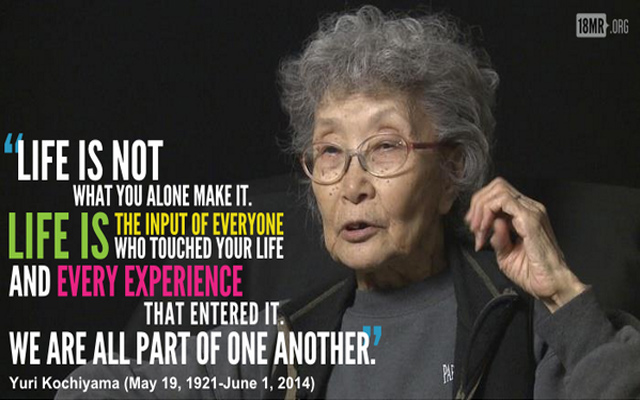
Monday at our staff meeting Maanav Thakore called attention to Yuri Kochiyama’s passing. This post is a compilation of articles and media that honor her life and legacy.
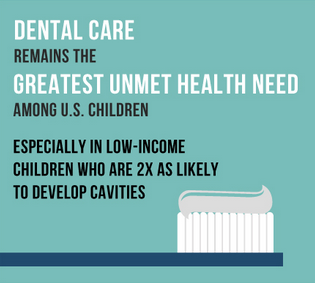
What is the number one reason for school absences in low income communities in the U.S.? It’s dental-related illness. I was blown away when I learned this. It was not what those of us working on the Boston Promise Initiative, a holistic approach to children’s academic success age 0-24 in the Dudley neighborhood, would have guessed. How can we expect children to learn if they are in pain? Why should any children suffer from an entirely preventable disease?
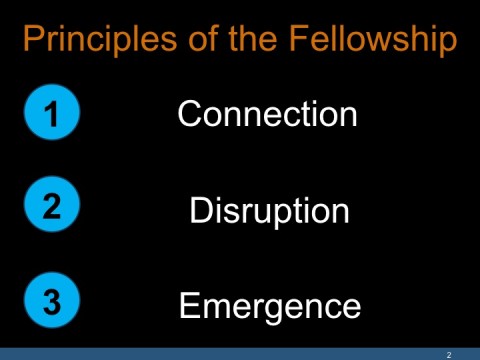
If you are a regular reader you’ve heard me talk about the Barr Fellows. It is one of the most powerful experiments in developing a leadership network within a geographic context – the City of Boston. I have the privilege of being on the design and facilitation team for this remarkable project.Read More
I am grateful to have been loved and to be loved now and to be able to love, because that liberates. Love liberates. It doesn’t just hold—that’s ego. Love liberates. It doesn’t bind. Love says, ‘I love you. I love you if you’re in China. I love you if you’re across town. I love you if you’re in Harlem. I love you. I would like to be near you. I’d like to have your arms around me. I’d like to hear your voice in my ear. But that’s not possible now, so I love you. Go.’
Maya Angelou, the memoirist and poet whose landmark book of 1969, “I Know Why the Caged Bird Sings” — which describes in lyrical, unsparing prose her childhood in the Jim Crow South — was among the first autobiographies by a 20th-century black woman to reach a wide general readership, died on Wednesday in her home. She was 86 and lived in Winston-Salem, N.C.
I will admit to being a bit dubious when I read articles about “scaling social impact.” A fair number of these pieces come from rather privileged places and can smack top-down solutions that perpetuate existing and problematic power dynamics and largely ignore the specifics of local realities. I am also concerned that many continue to hold an industrial/mechanistic/extractive view that renders “scaling up” simply more of the same old damaging same old.
So I have been heartened to hear different takes on scale this past month in a few conversations about evolving a more regenerative, “human scale”, and equitable economy. Read More