Andrew Zolli is a long time friend of the Interaction family. His recent piece on the New York Times, Learning to Bounce Back, reminded me of why Marianne Hughes, founder and former Executive Director of IISC has been raving about his new book on resilience.
Winter Solstice is just around the corner. I find it’s a good time to reflect on the past year, and look toward the year ahead. Every year at each of the Solstices, I scan my life and consider what I’d like to let go of and what I’d like to invoke.
|Photo by Melissa Wiese|http://www.flickr.com/photos/42dreams/518103211|
I was so grateful when Laura Moorehead, Director of Training with the Institute for Civic Leadership, shared this reading from Margaret Wheatley at the close of my time with this year’s ICL class. From my perspective, there is much wisdom here, and the words do a very nice job of summarizing much of what IISC was there to share and discuss regarding leadership, networks, and collaborative change . . .
There is no power greater than a community discovering what it cares about Read More
For two years, we at IISC have been working with the staff of the William Caspar Graustein Memorial Fund, based in Hamden, CT, as it has responded to a “community call” and stepped up to convene a multi-stakeholder process to create a “blueprint” for a state-wide early childhood development system that works for all children and families, regardless of race, income, or ability. Read More
David Peter Stroh hits the nail on the head with his recent post on the relationship between systems thinking and spiritual practice on the Leverage Points Blog. Our ways of seeing and ways of being are profoundly affected by our interior condition. Many aspects of systems thinking are deeply aligned with the wisdom of many spiritual traditions.
What is decolonial love, why must we cultivate it, and how can we practice it? These are a few of the questions that have been turning over and over in my mind since I heard Junot Díaz speak so brilliantly at ARC’s Facing Race conference in Baltimore a couple of weeks ago – decolonial love is a term I had not heard before Díaz used it and now I will surely be bringing it up a lot. Building on Cynthia Silva Parker’s previous post about the conference, I want to share a bit of what Díaz had to say and ask YOU, what would look like if we really really good at practicing decolonial love? I think the implications are profound and exciting!
|Photo by Patrizio Cuscito|http://http://www.flickr.com/photos/kirtaph/2282499034/sizes/m/in/photostream|
I think it could be said that so much of what ails us in this day and age stems from a severe case of fragmentation. The combination of silos, specialization, segregation, industrialization, derivation (think processed food and “derivative” investment instruments), and abstraction has rendered us strangers and adversaries to one another, the larger systems that sustain us, and perhaps even to ourselves. Hence the call that you see often in this blog for a more holistic view and picture, one rooted in an understanding of the systemic nature of reality. It is also what drives our approach at IISC in terms of being more network-centric in bringing about progressive social change for healthy whole people, communities, and ecosystems. This is fundamentally about work that reconnects us to what matters most. And to be clear, this is not simply heady work, which keeps our minds separate from our bodies and emotional selves. Perhaps no one says it better than farmer, poet, and land activist Wendell Berry, who in his recent Jefferson Lecture framed the solution to our current situation with the title – “It Turns on Affection.” Below you will find an excerpt, that I shared this very morning with the Food Systems New England Network Design Team: Read More
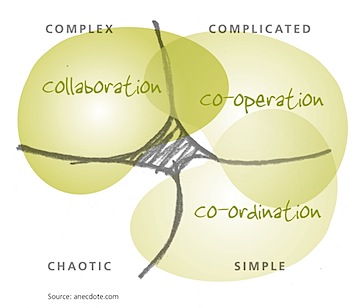
I like to describe IISC as a collaboration shop. We look at collaboration through three lenses. When looking through the lens of networks we are acknowledging a shift from “complicated to complex” (see image). We often rely on the Cynefin framework to encourage an attitude of exploration, a more open attitude than the quest for technical answers that obsesses so much of our work for social change.
I had not seen the overlay of complexity and collaboration that Shawn Callahan articulates so well. I love the work of our friends at Anecdote, and this blog post is a must read:
Thanks to Beth Tener for pointing me in the direction of this graphic from Occupy NYC. The headline reads: “Let’s acknowledge the reality: The future of the human race requires the cooperation of its members. Our increasingly interconnected world obscures the underlying truth that all of our grievances are connected.” What connections do you see between economic inequality, ecological irresponsibility, concentrations of political and economic power, racism, sexism, and more? How are you making those connections real in your life and your work? (P.S. Click on this hyperlink if you want to see the article that follows the graphic).
I often feel overwhelmed by the magnitude of change that’s needed and how far we have to go to realize the just society we’re working towards. It can feel daunting and on a bad day, nearly impossible.