Six weeks from now, on October 10, 2010, 350.org is sponsoring a global work party to spread and deepen awareness about and inspire further action around our growing climate challenge. This grassroots movement is spreading at a time when most governments and businesses seem inexplicably stymied about how to make fundamental commitments toward shifting unsustainable behaviors. And it feels like we are on the edge of a tipping point, perhaps spurred by this summer’s record breaking heat wave and dramatic weather events in places like Pakistan and Russia. So consider signing up for or hosting a local event if you have not, and take a moment to read this call to action by co-founder Bill McKibben following the failed climate bill in Congress – “Get mad and then get busy.”
“The seeds of Reunion are sprouting everywhere. That which was hidden for millennia is coming to light. Soon, fertilized by the detritus of our decaying civilization, the sprouts will mature, bloom, and bear fruit. Our job is first to receive them, then to spread them everywhere and to guard and foster them with every ounce of our love.”
This is our last week in the Cambridge office – as of Monday, we’ll have moved to South Boston, in the Seaport area. Most of the IISC staff have been driving to work over the years we’ve been in Cambridge (with a few taking the bus or riding bikes). Once we’re in our new office, we’ll be switching to most of us on public transportation or on bikes. It’s good news for the planet! I’m looking forward to shrinking my carbon footprint. Thought you might enjoy this video!
|Photo by sarniebill1|http://www.flickr.com/photos/sarniebill/4723746702|
Picking up from where I left off yesterday, I want to share some additional insights gleaned from my tour of Lauren Chase-Rowell’s permaculture garden and land. Something else that struck me was when Lauren said that beyond her training and intuition as a master gardener, “attitude is everything.” Illustrating this statement with stories it became clear that while she is incredibly skilled in her craft, Lauren’s psychological and emotional approach take it all to another level. In essence, permaculture starts with your self.
Channeling Lauren, I offer these three attitudinal guidelines for your consideration and application to your social change/leadership efforts, especially those geared towards leveraging the potential of systems and collective intelligence: Read More
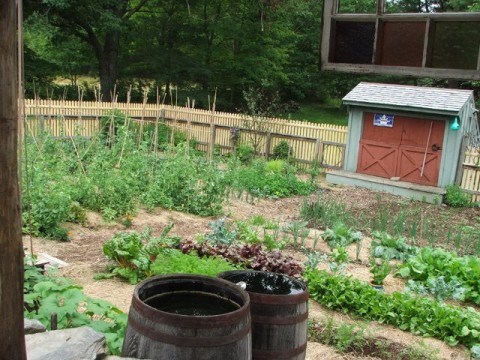
Last week I was in the presence of a master. For more than 25 years, Lauren Chase-Rowell has skillfully and intuitively cultivated the land around her house in Nottingham, NH to the point that it exists in great harmony with the beautiful farm house, people and fauna occupying that space. Lauren is an ecological landscaper, organic farmer, and permaculture design teacher. Her home, Dalton’s Pasture Farm (not pictured above), is a vibrant classroom and testament to the possibility of practicing earth-centered living.
For the better part of the last year and a half, my colleagues Ashley Welch and John McGah and I have been moving forward an IA/IISC cross-sectoral practice to bring Interaction methods + to the support of sustainability endeavors. Our early meetings around this budding practice included conversations about how best to frame leadership development for sustainability. We arrived at the graphic above, which combines what we see as the core elements needed for leadership to embrace and enroll others in sustainable pursuits.
With a foundation (watermark, if you will) of content knowledge about what sustainability is, the three elements are as follows:
• Systems Thinking (Seeing) – This is all about helping individual leaders and collective leadership see the whole, to understand that nothing stands in isolation, and that we must have a deeply felt sense of the interconnectedness of phenomena in order to make truly informed decisions. We take both our inspiration and instruction in this realm from the likes of the Sustainability Institute, the Center for Whole Communities, and The Elumenati.
• Self-Awareness (Being) – What we do is informed by who and how we are in the world. Awareness of our own beliefs, mental maps, and inherent tendencies is a powerful lever for making the sustainability shift, for aligning thought behind action. Self-awareness might also be cast as mindfulness, or the ability to be present to what is. Here we build upon our existing work around the inner side of leadership with the contributions of the Pachamama Alliance and John Milton.
• Collaborative Capacity (Doing) – With the whole in mind and awareness of our inner state, leadership will have a greater understanding of the need to work collectively toward more sustainable lifestyles and ways of doing business. Collaborative skill is key, including knowing how to frame sustainability efforts, create the right conditions for innovation, build agreement, structure decision-making, and design life-affirming experiences for diverse stakeholders. This is the heart and soul of the Interaction Method, and it is supplemented by the work of Keith Sawyer, CRED, and the many pioneers of large group methods and network-building.
Another key element and overlay for all of these is leadership’s ability to understand and navigate power dynamics as they play out in systems, in ourselves, and in our chosen methods for working together.
Eager to hear your reactions, tweaks, and additions.
|Photo by Flowery *L*u*z*a*|http://www.flickr.com/photos/luchilu/747345256|
For the past few weeks, in a series of Thursday posts, we’ve addressed what it takes to tap the full potential of collaboration to shift to more environmentally sustainable ways of living and working. We’ve explored the importance of bringing diverse systemic perspectives together and developing shared identities and values as a way of achieving greater ecological intelligence and commitment. And as a friend of mine says, you can bring great groups together with the best of intentions and still end up with nothing or a mess. So what else can we put into place to help ensure we reach the sustainable ends we seek? Read More
|Photo by jordigraells|http://www.flickr.com/photos/jordigraells/2097554407|
“In dealing with complex problems, our ability may be bounded, but our diversity is not.Diversity – be it based on identity, training or vocation — may be our best asset.”
– Scott E. Page
In last Thursday’s post, we talked about the importance of developing a shared identity among stakeholders, and doing this early in a collaborative process, as a way of developing greater commitment to collective interests as well as bolstering the inclination to think about and act in accordance with more long-term risks and benefits. Clearly more needs to be said about the WHO that is engaged in this work and how this aligns with sustainability.
|Photo by Peter Forbes|http://www.wholecommunities.org/programs/|
“To work at this work alone is to fail.”
-Wendell Berry
Picking up from where I left off last Thursday . . . How might collaboration be a key to making the sustainability shift? At its best, collaboration is the act of modeling complex systems at work, and with awareness and intention comes critical adaptive capacity. The goal is to achieve collective and distributed intelligence that can respond in timely ways to threats to sustainability (stressed ecosystems, injustice, etc.) and that can be proactive in creating optimal conditions for future generations to meet their needs. That’s the ideal, right? How do we get there?
For the past few decades, the Interaction Institute for Social Change and Interaction Associates have worked to develop the collaborative capacity of individuals, organizations, and communities with the conviction that this holds the promise of greater effectiveness with respect to shared missions and goals. We have long upheld and witnessed the importance of bringing more minds and hands together for the purposes of creating insight, understanding, alignment, agreement, strategy, and shared ownership. Lately, I have been trying to specifically clarify the value all of this has to offer the unsustainable relationship we have with our planet.
I am honored to be presenting at the Symposium on Sustainability that is being organized by the Institute for Sustainable Social Change at Prescott College in Arizona. Following are some ideas on the themes we want to explore together:
Everything is changing, we are in the midst of a significant – and desperately needed – paradigm shift. The industrial models of the dominant paradigm no longer serve us, they are in fact holding us back. But what does this emergent paradigm look like? And how do we live our way into it? Read More
It is rare for any of us, by deliberate choice, to sit still and weave ourselves into a place, so that we know the wildflowers and rocks and politicians, so that we recognize faces wherever we turn, so that we feel a bond with everything in sight.”
|Photo by Muffet|http://www.flickr.com/photos/calliope/150903281/|
Some dozen years ago I went on a road trip with my grandfather to our ancestral home in Arkansas. Leaving from upstate New York at this time of year was not exactly a recipe for easy driving and awe-inspiring views. After a particularly dreary stretch in Ohio, I was ready to snooze the rest of the way when we crossed over into Kentucky. Suddenly things opened up. As we continued south on Route 75, I felt my body started settling into the lovely rolling farm-studded landscape. I remember how my breathing eased and the extraordinary sensation of “being home,” though I had only been to the state once before.