Winter Solstice is just around the corner. I find it’s a good time to reflect on the past year, and look toward the year ahead. Every year at each of the Solstices, I scan my life and consider what I’d like to let go of and what I’d like to invoke.
|Photo by Melissa Wiese|http://www.flickr.com/photos/42dreams/518103211|
I was so grateful when Laura Moorehead, Director of Training with the Institute for Civic Leadership, shared this reading from Margaret Wheatley at the close of my time with this year’s ICL class. From my perspective, there is much wisdom here, and the words do a very nice job of summarizing much of what IISC was there to share and discuss regarding leadership, networks, and collaborative change . . .
There is no power greater than a community discovering what it cares about Read More
For two years, we at IISC have been working with the staff of the William Caspar Graustein Memorial Fund, based in Hamden, CT, as it has responded to a “community call” and stepped up to convene a multi-stakeholder process to create a “blueprint” for a state-wide early childhood development system that works for all children and families, regardless of race, income, or ability. Read More
David Peter Stroh hits the nail on the head with his recent post on the relationship between systems thinking and spiritual practice on the Leverage Points Blog. Our ways of seeing and ways of being are profoundly affected by our interior condition. Many aspects of systems thinking are deeply aligned with the wisdom of many spiritual traditions.
What is decolonial love, why must we cultivate it, and how can we practice it? These are a few of the questions that have been turning over and over in my mind since I heard Junot Díaz speak so brilliantly at ARC’s Facing Race conference in Baltimore a couple of weeks ago – decolonial love is a term I had not heard before Díaz used it and now I will surely be bringing it up a lot. Building on Cynthia Silva Parker’s previous post about the conference, I want to share a bit of what Díaz had to say and ask YOU, what would look like if we really really good at practicing decolonial love? I think the implications are profound and exciting!
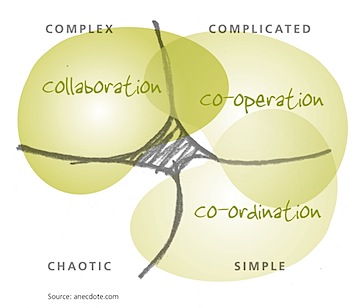
I like to describe IISC as a collaboration shop. We look at collaboration through three lenses. When looking through the lens of networks we are acknowledging a shift from “complicated to complex” (see image). We often rely on the Cynefin framework to encourage an attitude of exploration, a more open attitude than the quest for technical answers that obsesses so much of our work for social change.
I had not seen the overlay of complexity and collaboration that Shawn Callahan articulates so well. I love the work of our friends at Anecdote, and this blog post is a must read:
I often feel overwhelmed by the magnitude of change that’s needed and how far we have to go to realize the just society we’re working towards. It can feel daunting and on a bad day, nearly impossible.
Seeing the words “Critical Systems Heuristics” may tempt you to run screaming from this post, but please hang in there while I distill what this important framework and addition to the systems thinking body of work has to offer our social change efforts! CSH is attributed to Swiss social scientist Werner Ulrich and his efforts to bring critical analysis to the boundaries that we construct around and within systems. Far from being primordial, these boundaries and divisions are an expression of what people see and value from their particular perspectives. As Ulrich writes, ” The methodological core idea [of CSH] is that all problem definitions, proposals for improvement, and evaluations of outcomes depend on prior judgments about the relevant whole system to be looked at.” His effort is to help make these boundary judgments explicit so that both those affected by and those implementing such judgements might see alternatives that better serve the whole. Read More
Today we often use the word extraordinary to refer to something amazing, something great. The overwhelming re-election of the nation’s first Black President through the worst economic crisis since the Great Depression is a truly extraordinary event.
Make Change Stick Beyond the MeetingTurn ideas into agreements that stick, and keep change going after the meeting ends. Perfect for teams stuck in “great conversation, little action.”