That the New Year used to be marked on March 25th makes total sense for a number of reasons, most obviously because the spring is the beginning of the planting season. It is a time to sow the fields and start again.
|Photo by MontyPython|http://www.flickr.com/photos/montypython/3853109452/|
Last week a few of us here at IISC had the privilege of reconnecting with Peter Forbes and Ginny McGinn of the Center for Whole Communities. The focus of our two day summit was the development of a training to help people implement Whole Measures, CWC’s holistic framework for thinking about social, community, and organizational change. Rooted in narrative, Whole Measures has its own interesting story.
This week, Melinda and I will be facilitating two workshops at the Transforming Race conference, hosted by the Kirwan Institute at The Ohio State University. Here’s a sneak preview of some of what we’ll be covering.
Facilitating discussions and dialogues about race can be tough. Lack of information and knowledge, different lived experiences, unspoken assumptions, varying definitions of key concepts and differing interpretations of problems and solutions are just a few of the things that can get in the way of groups communicating authentically and building solid agreements. I’ve found that attention to three dimensions of preparing for such conversations can make all the difference between productive engagement and destructive experiences that take years to repair.
In a recent conversation with professors and students at Savannah College of Art and Design’s Design Management program, I was asked to share what we at IISC mean when we use the phrase “design thinking” in social change initiatives. Talking with vocational designers about designing for social change was a very different conversation from conversations with change agents and activists on the same topic. I subsequently came across this insightful blog entry by interaction designer Dan Saffer, “Thinking about Design Thinking”, and although he does not apply a social change agenda to his thinking here, he helps lay out distinctive features of what designers mean by the term “design thinking” as follows (we can apply the social change lens on our own): Read More
|Photo by bitzi took his umbrella and left|http://www.flickr.com/photos/bitzi/193922475/|
My wife and I are wrapping up our annual winter vacation to visit family in Florida. Each year this proves to be something of a spiritual practice for me, and this trip has been no different. As wonderful as it is to slow down, un-hunch shoulders, and wear fewer layers, the focus of my practice tends not to be the natural surroundings and climate so much as what I find to be the challenging social environment.
As technology continues to redefine our daily interactions, it is becoming clear that we need to learn a new form of literacy and quickly. Even more important than literacy though is the need to critically analyze and comprehend the new language which we encounter. An overwhelming call at first, but one that is made easier when we begin to embrace exploration and collaborate with one another as we learn. Here is a brilliant little Ted TalkLawrence Lessig gave in 2007 regarding copyright and creativity.
I want to thank Susan Wright of Wright Momentum for spurring on this post, which is in essence a response to a thoughtful dialogue we have had going for a few months. My thoughts here are further inspired by a training my colleague Melinda and I did at the historic Penn Center on St. Helena’s Island in South Carolina, a site where the first school was built in the US to educate freed slaves. It was also an important site for people to come together across racial lines to do strategy work during the Civil Rights movement. Melinda and I had the good fortune to spend three days with the amazing Gulf Coast Fellows, a diverse group of grassroots leaders from Louisiana, Alabama, Mississippi, and Texas. Our time with the Fellows affirmed for me the strategic direction IISC has recently adopted. Specifically, in considering the next three years (2010-2012), our IISC”s staff has collectively committed to concentrating more of our efforts around: (1) helping to build power and collaborative muscle at the grassroots, and (2) supporting social change work that bridges sectors and organizations (including building networks).
One of my passions is related to what happens when two of my passions fuse together: art and social justice. I thought I’d share some justice-related poems, and ask you to share some of yours – artists (whether poets, musicians, painters, actors, dancers, or others) that inspire you, or movements for change you know of, in a social-justice-kind-of-way.
February is Black History Month, so I’ll share two poems of the great Langston Hughes (b. February 1, 1902 – d. May 22, 1967). A poet, novelist, playwright, short story writer, and columnist, Hughes was one of the earliest innovators of a new literary art form: jazz poetry. The poems that follow reflect justice issues of his day. Read More
|Photo by Reenie-Just Reenie|www.flickr.com/photos/flickrchickr/2589059730|
In a previous post I referenced the work of Marcial Losada, which indicates that elevated group performance is associated in part with a high degree of “positivity.” Specifically, groups that excel in terms of innovation and productivity tend to be those where there is at least a 5:1 ratio of positive to negative interactions. The importance of this ratio has been further highlighted by some other findings and experiences I have had working with community-based activists.
Its been a week of provocative, profound and promising experiences on behalf of IISC. I’ve been on the road — learning, training, networking and promoting our work. Here’s a rundown of some of the great ideas, people and organizations I’ve had the honor of connecting with these last few days:
Interaction Design 10 Conference, held in Savannah, GA, February 7 – 10, 2010:Interaction design is defined as “the art of facilitating or instigating interactions between humans mediated by products. ” Check out my twitter posts from these dates for in the moment impressions and ideas shared at the Conference. Read More
|Photo by Mikl Roventine|http://www.flickr.com/photos/myklroventine/2372327933/|
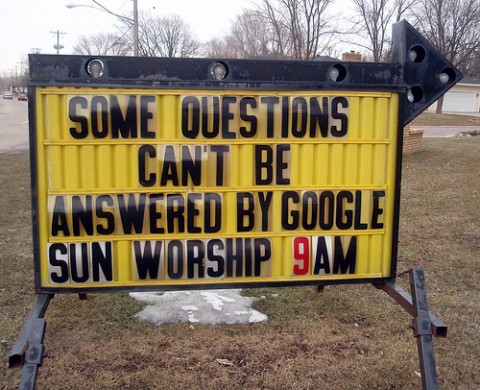
My wife and I recently missed one of our favorite church services of the year – The Question Box Service. For a few weeks leading up to this particular Sunday, parishioners are typically invited to submit questions for the ministers to respond to. These questions can be of any number of varieties – philosophical, ethical, political, personal, whimsical – and tend to be very wide ranging. The answers to selected questions become that day’s sermon. As interesting and entertaining as it is to hear the clergy offer their spontaneous reflections (they dress down for the occasion, doffing their robes and sitting crossed-legged on stools in front of the pulpit, a la talk show hosts), I find the questions themselves fascinating, especially when artfully phrased. Just the reading of the card can elicit a ceremonious “oooh” or “ahhh” from the listeners.
Make Change Stick Beyond the MeetingTurn ideas into agreements that stick, and keep change going after the meeting ends. Perfect for teams stuck in “great conversation, little action.”