In our collaborative capacity and network development work at IISC, there is considerable complexity to hold. This can create quite a mental exercise for everyone involved – What is the system we are trying to develop/problem we are trying to solve? What are the contributing factors? What is our desired future state? Who should be at the table? What are the systemic leverage points and associated strategies? Etc.
This is necessary work, and it can become incomplete or rather one dimensional when it only taps some of our collective faculties. Read More
“How Not to Manage an Introvert” (by Nguyen Hung Vu)
For several months I’ve been meaning to read Susan Cain’s book Quiet: The Power of Introverts in a World That Won’t Stop Talking. Having completed it this past weekend, I have both a sense of validation (being one of ever-more introverted tendencies as the years pass) and being able to see with new eyes. IMHO, it is well worth the read, and if the thought of tackling the 300 pages is daunting, you might enjoy a taste via Cain’s TED Talk.
Here I wanted to reflect on some of the insights Cain’s work has to offer collaboration and “net work” for change. Read More
The above quote caught my attention in light of much thinking about and work around the importance of being more fully embodied in social change efforts. This year I have personally made some commitments to more intentionally acknowledge and care for my own body, including investing in a rather basic standing desk, and recommitting to a morning workout (this post on the lasting benefits of just a 20 minute exercise routine served as an extra-added push). And I’ve been carrying this commitment directly into my work with clients, not just in terms of focusing on the importance of caring for themselves, but also grounding aspirations they have for their work. Read More
|Photo by Christian|www.flickr.com/photos/91048408@N00/322951661/lightbox/?q=vision|
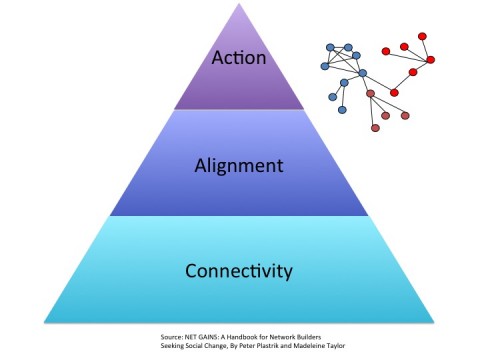
For the past year, Carole Martin and I have been co-facilitating a “network leadership program” supported by the Neil and Louise Tillotson Fund called the Community Practitioners Network (CPN). The overall goal of CPN is to further develop a group of proven and promising leaders as individuals, as a cohort, and as “critical yeast and connectors” (my language, not the Fund’s) in support of community and economic development in a region that encompasses northern New Hampshire, northeastern Vermont, northwestern Maine, and southern Quebec. Throughout, we have been actively exploring a variety of leadership and network development practices for growing personal and interpersonal awareness, connectivity, alignment, resolve, resilience, and skillfulness.
In our most recent session, a two-day retreat in Pittsburg, NH, we engaged in discussion about and embodied practice of “vision.” Over the course of the two days, a robust conversation evolved about what makes vision powerful (in light of many uninspiring experiences) and its relevance in a networked world, in combination and contrasted with values. Read More
For those who read this blog on a somewhat regular basis, you know that we at IISC find and experience great promise in embracing network approachesto (and as) social change. So what happens when we truly see ourselves as and in networks; that is, appreciating how we are inextricably embodied through and embedded in interconnected flows of energy, material goods, ideas, intentions, etc.?
Ten thoughts, in no particular order, nor meant to be exhaustive: Read More
This past week we have featured a couple of posts on empathy (see “Empathy + Equity –> Justice” and “Empathy Connect, Sympathy Disconnects”). In light of these and also on the heels of recent powerful experiences in a couple networks for change around the use of storytelling to deepen connectivity and commitment, I found the video above to be instructive. It is featured in a blog post entitled “How Stories Change the Brain” through the Greater Good Science Center.
Adam Grant is a professor at the Wharton School of Business whose research focuses on “motivation, prosocial giving and helping behaviors, initiative and proactivity.” His work and writing, including his book Give and Take: A Revolutionary Approach to Success, seem to have something to offer those interested in and engaged in developing networks for social change, as much of it points to data showing that organizations of all kinds benefit from fostering cultures of giving. Read More
Over the past five years or so of supporting self-declared “networks” for change, I have evolved in my understanding of what is new when we call something a network, versus a coalition or collaborative or alliance. On the surface, much can look the same, and one might also say that coalitions, collaboratives and alliances are simply different forms of networks. Yes, and . . . I believe that what can make a big difference is when participants in a network (or an organization, for that matter) embrace new ways of seeing, thinking, and doing. So let me propose that network approaches at their best call on us to lead with some of the following: Read More
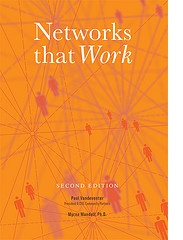
I’ve spent time the past week reading through Networks that Work, a handy and concise resource for developing organizational networks, written by Paul Vandeventer, President and CEO of Community Partners, and Myrna Mandell, Ph.D. The book lays out some very helpful pointers for more formally constructed networks. I have highlighted 10 pointsbelow that resonate with our experiences at IISC around supporting organizational networks for social change. My comments and extensions are in italics: Read More
|Photo by Manuela de Pretis|http://www.flickr.com/photos/24141546@N06/8559396140/in/photolist-e3n9gw-cTpPPN-d1dvTd-d1dvC9-d1dvto-d1dvjW-d1dvbm-cZuvob-cZunHN-9zX8Sz-ax3pnQ-e4wUZj-eaf1p3-bEqAP4-9zJw2f-brvfdL-bEqguP-brvtTs-bEqo76-8Eev3a-bdwXog-9kfqCB-9HgmuC-7L5k6b-ax9ASs-9Nt9k5-c62iqA-bEqygR-f5eTyJ-f4ZDuv-bEqzcZ-bEqoDB-brvFWY-brvpph-83RYMt-bEqrup-fCnaiV-bEqfpi-bEqkhM-bEqpCK-bEqnBe-bEqkVM-bEqdpz-e46RkD-e46RGP-e4cw9J-e4cwju-e46Sxk-e46Rqx-e4cubU-bEqzCR|
When I take time to slow down, as I was able to do over the holiday break last week, my interest is refueled in practices that support our ability to maintain perspective and a sense of effective agency in the world. My line of inquiry is not simply around what can keep us energized, pull us back from the edge, or deal with burn-out, but focused on how we can align our internal state with external aspirations in an integrated way and grow ourselves so we can help evolve larger systems. My thinking and reading often takes me back to the work of Barbara Fredrickson, the emotions scientist based at the University of North Carolina, as well as to a host of others in the fields of positive and social psychology. Having revisited some of these writings over the break, here are 10 recommended practices for personal and social resilience and development: Read More
“Ultimately if we are to avoid failure in the most critical work of this century, the deepest reaches of our beings must be brought to bear in honestly reevaluating and shifting the most basic structures of our society.”
The following is a textual recapturing of a Pecha Kucha-like presentation that I gave at an ARNOVA Pre-Conference Session in Hartford, CT two weeks ago. This was part of a 3-hour interactive conversation, co-designed and facilitated with Dr. Angela Frusciante of the William Caspar Graustein Memorial Fund, focusing on the power of networks for learning and social change, primarily with academic researchers and philanthropists.
At the Interaction Institute for Social Change, we are in agreement with Professor john a. powell when he points to the need to consider and make fundamental structural changes in our country and communities for the causes of greater social justice and sustainability. Read More
Make Change Stick Beyond the MeetingTurn ideas into agreements that stick, and keep change going after the meeting ends. Perfect for teams stuck in “great conversation, little action.”







 Over the past five years or so of supporting self-declared “networks” for change, I have evolved in my understanding of what is new when we call something a network, versus a coalition or collaborative or alliance. On the surface, much can look the same, and one might also say that coalitions, collaboratives and alliances are simply different forms of networks. Yes, and . . . I believe that what can make a big difference is when participants in a network (or an organization, for that matter) embrace new ways of seeing, thinking, and doing. So let me propose that network approaches at their best call on us to lead with some of the following: