Blinded by Privilege
August 1, 2014
University of California researcher, Paul Piff, and his colleagues have been studying privilege.
In one study, they set up a rigged game of monopoly. The players who had been randomly assigned to get more money and other advantages began to demonstrate some disturbing differences from the other players. They began to move their pieces around the board more loudly, displayed “signs of dominance and nonverbal displays of power and celebration,” ate more pretzels, and came “ruder, less and less sensitive to the plight of the poor players, and more likely to showcase how well they were doing.” After the game, the rich players attributed their success to their skills and strategy, not the systematic advantages they had over the other player, even though they knew the advantages were real and were randomly assigned.
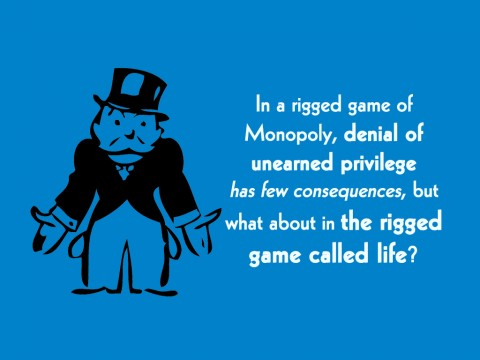
In a rigged game of Monopoly, denial of unearned privilege has few consequences, but what about in the rigged game called life?
Acknowledging and dealing with unearned privilege – advantages conferred on people based on their identity rather than actions – turns out to be an important aspect of understanding structural inequities and facilitating social change. It’s often challenging to facilitate a clear-eyed examination of privilege that enables people to grapple with the implications of privilege for their self-concept. And, that examination turns out to be important for building commitment to social change and building agreement on strategies to address inequities.
For us, it’s a matter of emphasizing how the personal, internal work and the external work depend on one another. What do you find useful in helping individuals and groups to explore these issues?
1 Comment
The Monopoly game dynamics dynamics described remind me of how some people change when promoted to the Squares group in Starpower.
In my facilitation, I am finding that starting off with conversations about unearned privilege and other concepts/terms some people may not use regularly often creates unhelpful defensiveness or confusion.
So, I’ve been shifting to getting people to connect with a time in their lives when they experienced some fortune or benefit that wasn’t necessarily tied specifically to their efforts or particular skills. I let them talk about this time with each other and then shift the large group conversation to exploring language they might use to describe such times. This allows me to add privilege if no one else raises it.
I’m still in refinement mode, but I feel like this type of approach gets people into the conversation instead of shutting some of them down. It takes longer, but ultimately, I think it is worth it.