Blog
Network Building AS Strategy

At IISC we like to define the success of collaborative change efforts in multi-dimensional ways. In particular, we make reference to results, process, and relationship elements. Results are what we typically think of as the “measurable” outcomes of a change undertaking – policy change, livable wage, job creation, healthier communities, etc. Process has everything to do with the how of the work – how we approach our change efforts, the steps we take, how work is shared and by whom, and with what spirit. Relationship is about both the quality of interpersonal connections as well as how people relate to the work itself. From what one might call an “old school” mindset, there is an assumption that process and relationship are only important insofar as they help to achieve results. Read More
Leave a commentWhat can we Offer?

It has become a common feeling, I believe, as we have watched our heroes falling over the years, that our own small stone of activism, which might not seem to measure up to the rugged boulders of heroism we have so admired, is a paltry offering toward the building of an edifice of hope. Many who believe this choose to withhold their offerings out of shame. This is the tragedy of the world.
For we can do nothing substantial toward changing our course on the planet, a destructive one, without rousing ourselves, individual by individual, and bringing our small imperfect stones to the pile.
From Alice Walker’s “Anything we love can be saved”
Leave a commentTransforming Racism- linking the personal and the social

The following blog post is Part 1 of a series dedicated to Race and Social Transformation. Special thanks to Gibrán Rivera, Miriam Messinger, Curtis Ogden, Sara Oaklander, Mistinguette Smith and Maanav Thakore for their support in completing this series! We encourage you to share and comment!
In the U.S., the work of transforming racism is often stuck in an unproductive binary: either transform people or transform systems. Fortunately, more and more people recognize that we have do both and more. Read More
1 CommentCivil Rights Hero

The following article has been reblogged from our friends at NPR. We hope you find it as inspirational as we did!
Bob Moses is 78, but he has the same probing eyes you see behind thick black glasses in photos from 50 years ago when he worked as a civil rights activist in Mississippi. The son of a janitor, Moses was born and raised in Harlem. He’s a Harvard-trained philosopher and a veteran teacher.
Leave a commentWhy Networks for Social Change?
“Thinking in terms of networks can enable us see with new eyes.”
– Harold Jarche
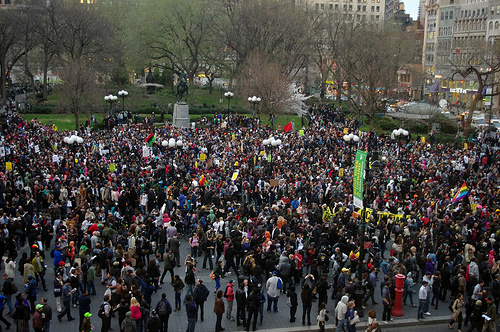
Photo by David Shankbone
The biological sciences have revealed that all living things in an ecosystem are interconnected through networks of relationship; that is, they literally depend upon a web of life to survive and to thrive. On the social science front, we are also beginning to appreciate that groups, organizations, and communities depend upon and function in distributed networks of relationship that go beyond contrived boundaries, formal roles, communications, or decision-making protocols. After all, we are a part of life! Read More
6 CommentsFruitvale Station
Have you seen “Fruitvale Station”? If not, please stop reading this (seriously) and take a moment to make plans to go out and see it. It is probably playing somewhere close to you and, yes, it is that important of a film. The film is difficult and triggering but profoundly beautiful and timely. If you know someone like Oscar (or the thousands of others of young Black men who have lost their lives via extrajudicial killing) this film will hurt. However it succeeds in doing what mainstream portrayals of Black men almost never do by portraying Oscar as a whole, complex, deeply lovable person.
Leave a commentEngaging and Building Power

We facilitated a network focused on improving early childhood education and care. The initial focus was to build leadership capacity and facilitate strategy development with stakeholders across a state to design a more holistic statewide structure for decision-making related to early childhood. Read More
Leave a commentBlack to the Land

The following post has been reblogged from our friends at Grist.org and features our newest colleague Mistinguette Smith. We hope you find it as inspiring as we did! Please note one correction: Smith was born in the Midwest.
Gastronomically enlightened Grist reader that you are, you’ve probably participated in a CSA, or at least heard of them. Community-supported agriculture is so common that in many circles the acronym needs no explanation. (Sorry, mini football helmet collectors, we’re talking about farmers who sell “shares” of their seasonal fruits and veggies, then deliver them to members when they’re ripe.) But a pint of locally sourced strawberries says you didn’t know a black man came up with the idea.
2 CommentsBrother Ali on Trayvon
“When somebody says ‘I’m in pain,’ when somebody says ‘I’m being targeted,’ when somebody says ‘there are too many young black boys being killed…’ if our first reaction is to defend ourselves, then that shows a great degree of loveless-ness. Nobody is saying that you hate black people… but I am asking you the question, do you love them?” -Brother Ali
Leave a comment#WhatBlackMenDo

A world that loves, honors and respects young black men must first SEE them. This seeing is a political act.
I am consciously seeing black men more clearly since my friend Victor Lewis hashtagged the Charles Ramsey story #WhatBlackMenDo. Ramsey, who acknowledges that he battered his former partner, stepped up without hesitation to rescue the women held prisoner for a decade in a basement in Cleveland, OH. He assumed that he was witnessing a domestic violence situation and intervened because this is #WhatBlackMenDo.
4 CommentsPresident Obama on Trayvon Martin
On Friday, President Obama spoke about the Trayvon Martin tragedy, in terms that were both personal and presidential. If you haven’t heard his talk you can listen here. Read More
Leave a comment