With thanks to Jeffrey Cufaude from Idea Architects, who I met on Twitter and from whom I learned about this video, I wanted to pass along this reminder of the power of empathy and the fact that the shoes of another are often our own.
The following post was rebloged from our friend Adrienne Maree. We hope you enjoy it as much as we did!
If you are a frequent reader you know of my love and admiration for Adrienne Maree Brown. She is the one who introduced me to the work of Octavia Butler. Art, science fiction, futurism – these are powerful exploratory fields. Here Adrienne begins to capture what Octavia teaches us about emergence, and since we have been on the topic lately, I thought it important to share her post.
The following blogpost was rebloged from our friends at Speaking Presence. We ope you enjoy it as much as we did!
(This article, in its original form, was written in 2009 and posted on my website: www.riverways.com. I’ve since reworked it slightly and wanted to share it in this blog space. The three people described below are each composites of a number of clients who have come through my public speaking programs and services.)
Jane was bright, experienced, and the only female on her work team. Frustrated, she felt that nothing she said at team meetings was taken seriously and her participation was frequently discounted or ignored. When she came to me, she wanted to become more visible as a strong member of her team.
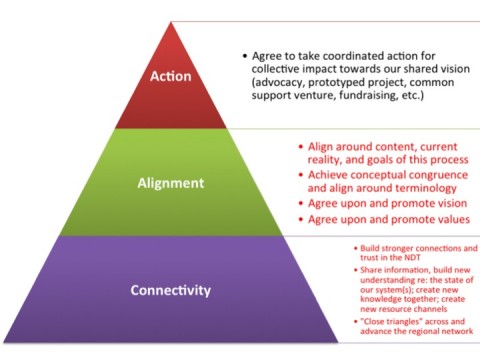
While doing some research on network evaluation techniques, I stumbled on a very helpful and interesting resource entitled “Network Evaluation: Cultivating Healthy Networks for Social Change” by Eli Malinsky and Chad Lubelsky (respectively for the Centre for Social Innovation and the Canada Millenium Scholarship Foundation). While it dates back to 2008 (5 years seeming like eons these days), the paper does a nice job of raising some of the inherent and necessary tensions and balancing acts of engaging in “net work.” I lifted a number of quotes from the paper as a preface to some thoughts about network value, which I laid out according to a framework that I developed (see above) using the work of Peter Plastrik and Madeleine Taylor in their seminal “Net Gains: A Handbook for Network Builders Seeking Social Change.”
“We have an obligation to wake others up so that they can share their light.”
– Mayor Cory Booker
|Photo by Veni Markovski|http://www.flickr.com/photos/veni/3408307467|
It was a privilege to see and hear Newark, New Jersey Mayor and possible Senatorial candidate Cory Booker speak this week. His topic was education, which is near and dear to his heart, and he began by telling a remarkable story about his parents. Booker’s mother and father were both born into relative poverty in the south, and both benefitted tremendously from other people looking out for them, extended family and community members. His father, who was raised by a single mother, was able to attend college in North Carolina because neighbors came together and took up a collection for his tuition. Ultimately both of his parents received a college education and went on to become successful executives at IBM. Read More
Shout out to our colleagues at Southern Jamaica Plain Health Center for their Youth Racial Healing Project—making the connections between health, social determinants of health and racism; making the connections between what folks know, see and feel; and making the deep connections between young people across racial differences.
“First they ignore you, then they laugh at you, then they fight you, then you win.”
– Mahatma Gandhi
|Photo by David Hogg|http://www.flickr.com/photos/davehogg/74341943|
Winter is certainly a time that can test our resolve in the Northeast. This winter in particular feels like it has done that on many fronts, including the volatility of the weather and the seemingly exceptional virulence of multiple strains of viruses making their way through the region. And this is to say nothing of the ongoing personal and social challenges with which many of us are wrestling. Read More
“The trickster is anybody who’s a bit of an outsider. They’re the ones who make change. They’re not thinking about making change; they’re almost doing it in a selfish way. But because they’re working outside the rules, they change the rules. Everything around them is always new, everything is an opportunity.”
Over the long weekend, my wife and I spent some time looking through the archives of old TED talks and stumbled upon a great one from humorist-philosopher Emily Levine where she talks about the important role of the trickster in facilitating change. Read More
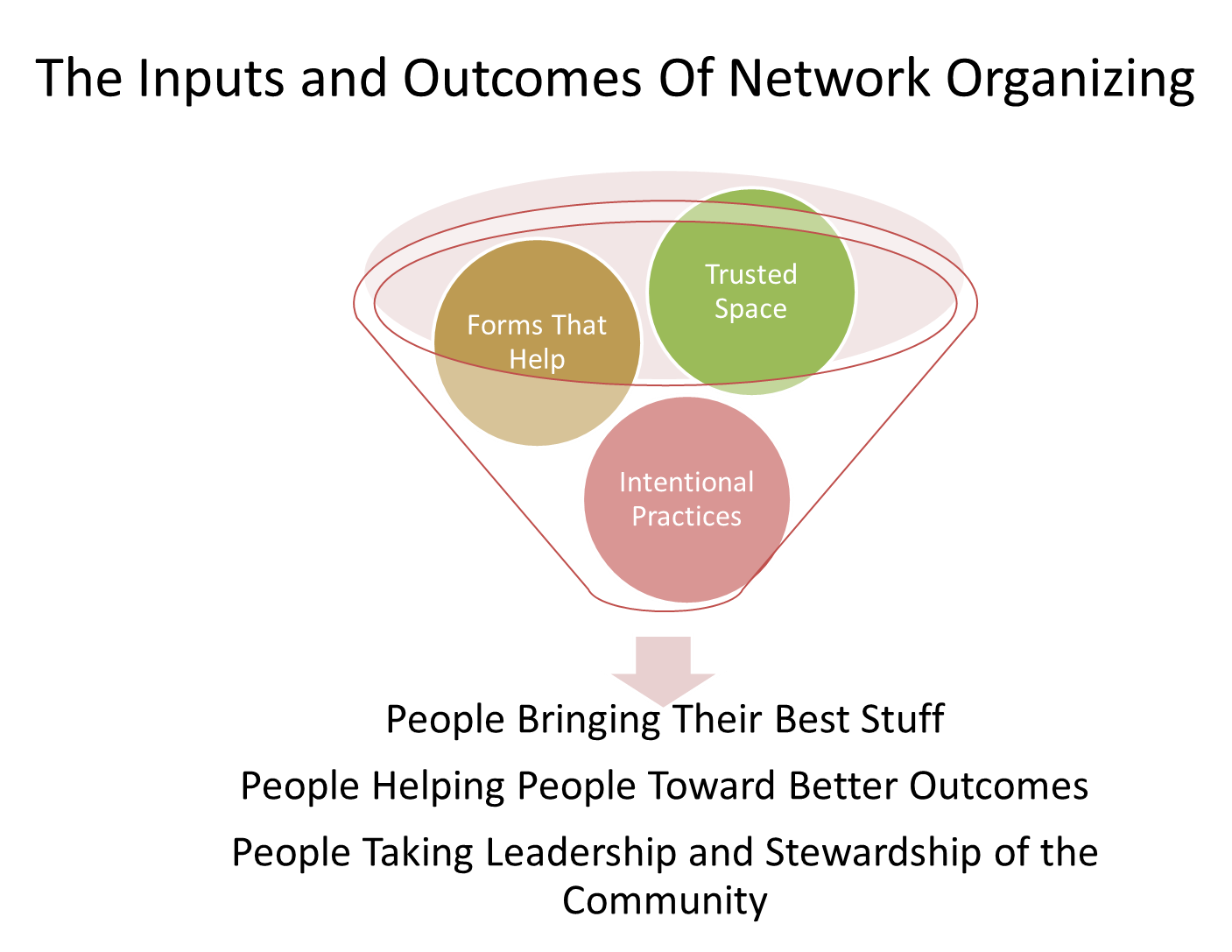
In a recent presentation to the Ways and Means Staff of The Community Builders, we discussed the primary inputs and resulting added value that the Network Organizing practice can bring to a service environment. This slide captures the essence of this.
Ellen Gurzinsky posted this on facebook this week (in honor of International Women’s Day).? Rather than adding my own words, I thought I’d pass it along here — a beautiful piece by Maya Angelou.? In the spirit of Melinda’s recent posts of wonderful poetry, here’s another gem. Really – what more is there to say?
The following post is taken from a message I recently posted on the Community Food Security Coalition listserv. I have already heard from a few people and am setting up conversations with them to hear more about what they are doing process and form-wise to advance the work, and look forward to sharing what I learn from them in this space. While the topic of this blog is networks focused on just and sustainable food system development, reactions are welcome from those working on new structures to address other social change issues . . .
IISC currently works with a number of food system-related initiatives around the country, providing process/structure design and facilitation support to collaborative multi-stakeholder approaches to change. As we strive for more healthy, just, sustainable, and community-enriching food systems, part of our role is to hold the stake for the “how” of the work, to ensure that it aligns with the multi-dimensional ends we seek, and to fine-tune this to the essence of the particular geographic and social locale (municipality, state, region). Read More