Last week I attended Pegasus Communications’ annual Systems Thinking in Action Conference in Boston and had the privilege of meeting and hearing from extraordinary people from around the country and globe, all interested in helping others to better see and work with wholes. From systems mappers and modelers to complex facilitation practitioners to researchers and preachers, my teachers were many. I was one of many tweeters spreading the wealth of wisdom cycling through that dynamic event and system. Here are some of my favorite take-aways in the form of quotes heard, read, and spiritually imbibed:
We have seen the system, and it is us! – overall theme
“There is a big difference between trying to be the best organization IN the world and the best organization FOR the world.” – Art of Hosting workshop participant
“Love, allowing the other to be a legitimate other, is the only emotion that expands intelligence.” –Humberto Maturana
“Collective will is the attractor that allows form to emerge from chaos.” -Tracy Huston, from her book Inside Out
“Trying to be right is a learning disability.” – Ray Jorgensen
“There are three conditions PROVEN to bring out the best in us – the ongoing dispersion of power, transparency, and mutual accountability.” – Frances Moore Lappe
Why vision matters – “You can solve all of your problems and still not have what you want.” – Robert Fritz
The good news – “We are once again learning what life is and what consciousness is.” – Peter Senge
Key question – “How can we each own our own fatalism, which continues to support systems that no longer serve us?” – closing plenary audience comment
(1) The leadership process requires three movements: (1) establishing the horizontal connection (“observe, observe, observe”), (2) establishing the vertical connection (“connecting to Source”), and (3) acting from what emerges in the Now (“acting in an instant”).
Tomorrow my colleague Melinda and I officially launch an exciting endeavor with the William Caspar Graustein Memorial Fund in Connecticut, as we meet for the first time with a Process Team that will begin designing a state-wide early childhood systems building initiative. The Memorial Fund is stepping boldly into its leadership as a convenor, at the urging of its grantees and the many communities with whom it has cultivated deep trust. In its sights is a process that ultimately yields a broadly shared and community-rooted vision for providing high quality and equitable care and education for all of the Connecticut’s youngest children, as well as policies and structures that support greater community-state collaboration towards this vision. Read More
“How do you do that? How do you step back and get perspective?” The question came from a table mate in an Art of Hosting workshop at this week’s Systems Thinking in Action conference. The earnest and wide-eyed inquisitor silently suggested the qualifier, “And how do you do this when there is so little time?” The question hung in the air in the midst of our World Café-inspired conversation about the kinds of change that are being called for in our respective communities, however we choose to define them.
My first response was to laugh. How indeed? As parents of three small children under the age of five, my wife and I often scratch our heads at how we can create more breathing space in general. Frankly, the notion of stepping back often feels like a luxury we can’t afford. And I know there are others in the same space with a variety of unremitting demands. My laugh was surely an acknowledgment of this seemingly impossible situation. And in the context of this rich albeit brief cafe conversation it also became something else, thanks to the careful attending of my colleagues.
Many of us have read about the power of presence, of being more attentive to the reality which faces us in any given moment. We also know about the amazing experience of flow, when we have been deeply connected to whatever we happen to be doing, whether playing a sport, creating art, having a conversation. I will admit that this is something with which I struggled with our first child, trying to be present for some of the seemingly mundane moments. For some reason, since our twins have come along, this has really shifted. I find myself much more in the moment, perhaps because it is abundantly clear that there is nowhere else to go. Escape is just not an option.
The result has actually been quite profound – greater enjoyment for sure and, I now realize, insights that speak to a deeper truth underlying events. Settling into the moment, I have become more aware of patterns and dynamics, both in the personalities and behaviors of my little ones and our family as a whole, that have helped me to understand better how we work as a system. This has inspired greater compassion, curiosity and an ability to be more adaptively responsive as a father and husband. So interestingly, it has been by leaning in to events that I have ended up in a place that I thought was beyond my grasp.
A couples counselor once gave my wife and me the following advice – “Have what you have.” I think I now have a greater appreciation for the wisdom of this statement. Having what we have is not settling for or giving up. It can be a gateway to abundance that we thought was “out there” and the perspective we thought only resided on the mountain top. I left our Cafe conversation with these words in my head – “Slow down, come inside, stay a while.”
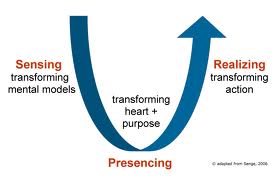
I am a huge fan of C. Otto Scharmer’s Theory U. It is one of the most powerful frameworks for understanding the essential shifts we need to make as we step into this paradigm shift. Scharmer sums up his Theory U with seven propositions, I’m going to write a series of blog posts taking a closer look at each of them: Read More
“Everyone today has to be an artisan and bring something extra to their jobs.” This says Thomas Friedman in the New York Times. I’m not sure I like where he is coming from, it sounds a little bit like adding obscure features to a DVD player. But I do like the point. I like this idea of being artisans, of engaging our work as a craft, adding meaning to our tasks by putting our own signature on what we do.
Somewhere beyond Friedman’s capitalistic “do more,” in places outside the yupified fields of trendy taste, there is significant power to the work of an artisan. For example, the work of social change has become so professionalized that it is often disconnected from the depths of purpose that could unleash transformation. But by thinking of ourselves as artisans our own self-expression can actually serve connection, it can bring us closer to that place where hearts can meet.
Consider the purpose of your work, then think of what you do every day… how much more of yourself could you bring to this field where we toil? What’s your craft? What is it that you can create?
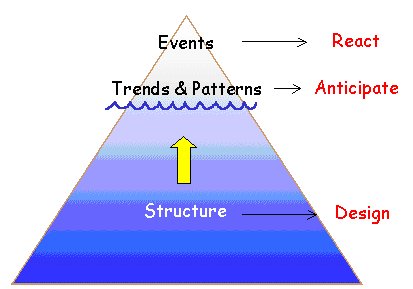
|Image from Pegasus Communications|http://www.pegasuscom.com/course_preview/gettingstarted/whyiceberg.htm|
Systems thinking is in the air. This past weekend I was delighted to have the opportunity to teach an introductory course on the topic with John McGah of Give Us Your Poor. Together we took 17 graduate students in the UMass-Boston MSPA program through an intensive and interactive look at the world through the systems lens. Even before we got things rolling on Saturday morning, the pre-reading (Donella Meadows’ Thinking in Systems) had provoked two people to say that they were already seeing the world differently (and more clearly). By the end of our 36 hour romp, which included guest presentations by David Peter Stroh and Paul Plotczyk, students were saying that all public sector employees, nay EVERYONE, should be required to take a systems thinking course. All of this enthusiasm comes just a week in advance of Pegasus Communications’ annual systems thinking conference here in Boston, which has a focus on “Fueling New Cycles of Success.” I am very excited to attend, and look forward to building upon the wisdom I’ve gleaned thus far about surfacing and living with systems (human and otherwsie), which includes these gems: Read More
Do you want to start a meditation practice? Why not start today? It’s November 1, and we have about 50 people committed to meditating at least 5 minutes per day for the next 28 days!
|Photo by marcomagrini|http://www.flickr.com/photos/marcomagrini/698692268|
“We don’t talk about what we see,
we see only what we can talk about.”
– Fred Kofman
This week I’ve been rereading Donella Meadows’ Thinking in Systemsand really savoring it. Each time I look at it, I pick up something new, not just about systems thinking but about life in general. I’ve been focused primarily on Meadows’ chapter “Living in a World of Systems,” which considers how we can work with complex systems while acknowledging that even when we understand them better, we cannot predict or control them. One of her suggestions is that we learn to pay attention to what is important, not just what is quantifiable. This is not a question of throwing out what we can quantify as being somehow overly reductionist. Rather, it is a matter of not giving up on what we cannot measure and making quantity more important than quality. How important this is for our social change work! Read More
Over the last few days my family has been going through a sort of sacred grief. The mystery of connection, the power of vulnerability, turning to life with one’s whole heart – these are the themes covered by this wonderful talk and confirmed by my own experience.
It is quite likely that you landed in this page to take a quick peep at this blog, that you did not come here for a twenty minute commitment, but I encourage you to take the time, a shift in perspective is enough to change a life. Samantha and I are so convinced that this is central to our work in the world that we have decided to prototype a “Whole Heart Workshop,” a place for us to practice better ways of being-with. Stay tuned for more, this will be good.
I’ve been doing more and more work with arts organizations lately – events like Creative Change and groups like the Arts and Democracy Project. I’ve been seriously considering the role of the arts in our quest for social transformation, and I have to agree with my future wife, Samantha Tan, who is an artist herself – “We’ve exhausted out left-brain approach, linearity found its limits and the problems that we face are now calling on our full self, art is the way.”
I’ve said a word about my point of agreement with Gladwell, and then a word about my first point of disagreement, I will wrap up this series with my second point of contention – Gladwell’s apology for centralized hierarchy. The popularized story of a civil rights movement “run” by a few male leaders and a few national organizations is actually offensive to the rich history of a diverse and decentralized movement that provided an ecology through which the notion of civil rights could thrive. Read More
Make Change Stick Beyond the MeetingTurn ideas into agreements that stick, and keep change going after the meeting ends. Perfect for teams stuck in “great conversation, little action.”