Tag Archive: action
March 10, 2016

Photo by Randy Read|http://www.flickr.com/photos/randyread/3583187019|
In an article in Fast Company, entitled “The Secrets of Generation Flux,” Robert Safian writes that in these uncertain times, there is no single recipe for success. Safian profiles a number of leaders who have been relatively successful at riding the waves in different ways, and notes that they are all relatively comfortable with chaos, trying a variety of approaches, and to a certain degree letting go of control. This resonates with our experiences at IISC helping people to design multi-stakeholder networks for social change. For example, even in a common field (food systems) and geography (New England) we witness different forms emerge that suit themselves to different contexts, and at the same time there are certain commonalities underlying all of them.
The three networks with which we’ve worked that I want to profile here exhibit varying degrees of formality, coordination, and structure. All are driven by a core set of individuals who are passionate about strengthening local food systems to create greater access and sustainable development in the face of growing inequality and climate destabilization. They vary from being more production/economic growth oriented to being more access/justice oriented, though all see the issues of local production and equitable access as being fundamentally linked and necessary considerations in the work.
Read More
October 22, 2014
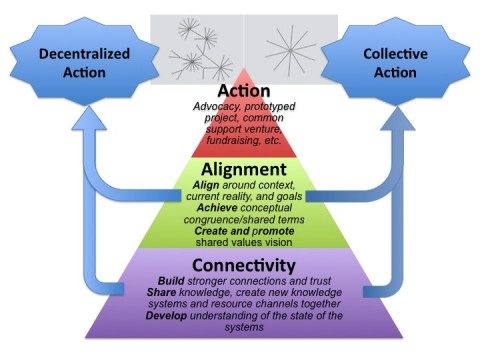 The above graphic is something that I recently created, borrowing heavily from the good work of Peter Plastrik and Madeleine Taylor, to help convey what is meant by engaging in “network strategy.” One of the challenges we’ve encountered in working with different networks is helping people to understand the difference between strategy development and network development. I try to meet this challenge, in part, by showing how they are not so different, or at least, that they are intimately connected. The diagram is also designed to help people get beyond some of the either/or thinking that we encounter. For example, it’s not that we have to choose between decentralized self-organized action and more formally coordinated collective action. It can be both!
So here’s what the graphic is meant to convey. First of all, network strategy is grounded at a fundamental level in creating (strategic) connectivity, by building linkages and trust between key stakeholders and perhaps unusual bedfellows. This can be done by convening people; sharing stories, data and other forms of information; co-creating knowledge; learning together, etc. Part of the value of this connectivity is that it can lead to orthogonal thinking and bolster individual network participants’ efforts in the shared domain where the network is focused. What also may ensue is self-organized action between those who are meeting one another for the first time or getting to know one another better (see the arrow to the left side of the triangle). This is all well and good and is something that networks should try to track. Read More
June 24, 2014
You might have picked up that I’m down on too much process and too much meeting. It’s a funny place for someone that makes a living facilitating. It is part of a semi-conscious effort to look at the opposite of my core assumptions and seek the wisdom there.
Read More
May 14, 2014

In a number of the social change networks that I am supporting there is very active and interesting conversation, and experimentation, going on around what I would call the process-action tension. As I have written elsewhere, I see this as a bit of a false and often unhelpful dichotomy, and I have certainly seen and been part of networks that have gotten bogged down in some version of analysis paralysis and never-ending consensus building. Increasingly there is a leaning towards getting out there sooner than later and trying things, learning from experiments and actions, readjusting, etc., which is all well and good. At the same time, I see it as part of my role to raise questions about how the embrace of “do-acracy” might have unintended consequences around long-term alignment as well as sustained and truly systemic impact. Read More
April 16, 2014

Photo by Kevin Doyle. Some rights reserved.
Conferences and other large in-person convenings provide a great opportunity to launch and further develop networks for social change. As has been mentioned previously on this blog, and borrowing from the work of Plastrik and Taylor, at IISC we see networks for change as developing in various inter-related “modes,” including connectivity, alignment, and action. Paying attention to multiple dimensions of success can inform a variety of approaches to support a more robust, trust-bound, commonly-oriented, self-organizing and (as needed) formally coordinated collective.
Here are some methods to consider for convenings to help feed and grow networks for social change: Read More
March 27, 2014

Photo by Crunchy Footsteps
Process can sometimes get a bum rap in our work, as in: “I’m not a process person. I’m action-oriented.” This attitude can become a source of considerable frustration, and yet, I get it. Some people are tired of what seems like endless talk that gets them no where. And yet to translate this kind of seemingly circular conversation (what Chris Thompson has referred to as co-blaboration) as “process,” as opposed to action, does a disservice to what is essential to the work of social change. No, I’m not talking (only) about talking. I’m talking about how it is precisely at the level of process that we can make truly profound change. Read More
March 26, 2014

Over the last few weeks I have fielded a number of calls from people who are interested in figuring out how to develop different kinds of networks. I’m always eager to have these conversations, precisely because there is no single right answer, and it really comes down to a process of discovery and experimentation based on the unique nature of the network and system in question. That said, I do like to ask people the question, “What are you doing to feed your network?” Read More
March 19, 2014

A few different experiences last week reinforced my conviction that storytelling can constitute significant “action” and advancement, including work done in networks for (and as) change. The first was during a session that I co-delivered on behalf of IISC with the Graustein Memorial Fund and The Color of Words, about our work with an early childhood system change effort in Connecticut called Right From the Start. During the conference session we emphasized that one of the biggest leverage points for system change is at the level of narrative and belief systems.
Surfacing the dominant implicit and explicit stories about what is and should be, analyzing the degree to which they align with our values and intentions, and countering/reframing them if and as necessary has been part of the work of Right From the Start (RFTS). Read More
February 5, 2014

The other day I was interviewed by Eugene Eric Kim for a project we are working on together, and he asked – “What are some of the keys to creating the conditions for successful networks for change?” I really like the question because it spurred some interesting reflection that yielded a few off-the-cuff insights that I wanted to share, extend, and test out here.
The phrase “Bring it!” came to mind as I was thinking about what is key to creating conditions for collaborative network success, with a number of iterative qualifiers: Read More
September 25, 2013

Our friend Jane Wei-Skillern recently co-wrote (along with Nora Silver and Eric Heitz) another valuable contribution to the growing “network building” body of literature, entitled “Cracking the Network Code: Four Principles for Grantmakers.” This piece is part of Grantmakers for Effective Organizations’ learning initiative, Scaling What Works. While the guide mainly addresses funders, it also has something for those outside of the philanthropic world. Its core offering is a set of principles to guide what the authors call “the network mindset”: Read More
June 19, 2013
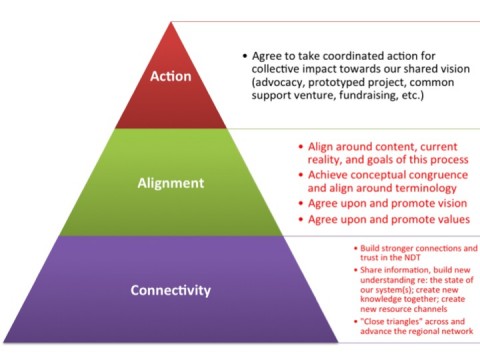 I recently had an email exchange with someone who was reflecting on the difficulty of bridging the divides in a nascent network in the southern United States that is trying to tackle the local food system. Trying to reconcile differences (owing to diversity in functional lens, experience, generational perspective, social location, etc.) around a topic this vast can be very challenging. And I think this is precisely why networks are especially good mechanisms, and why adopting the “network mindset” is an excellent approach, moving forward, especially when borrowing from the framework above (adapted from Plastrik and Taylor’s work, 20o6). Read More
February 28, 2013
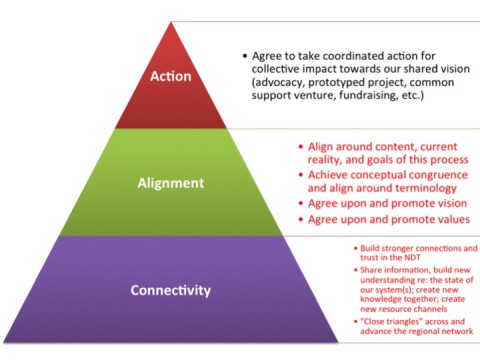 While doing some research on network evaluation techniques, I stumbled on a very helpful and interesting resource entitled “Network Evaluation: Cultivating Healthy Networks for Social Change” by Eli Malinsky and Chad Lubelsky (respectively for the Centre for Social Innovation and the Canada Millenium Scholarship Foundation). While it dates back to 2008 (5 years seeming like eons these days), the paper does a nice job of raising some of the inherent and necessary tensions and balancing acts of engaging in “net work.” I lifted a number of quotes from the paper as a preface to some thoughts about network value, which I laid out according to a framework that I developed (see above) using the work of Peter Plastrik and Madeleine Taylor in their seminal “Net Gains: A Handbook for Network Builders Seeking Social Change.”
Read More