I attended a powerful, short workshop led by Adrienne Maree Brown (abbreviated from longer trainings she offers) and Invincible on how to facilitate high tension and/or high conflict conversations at the Making Money Make Change conference. Weeks later, ideas and exercises from that workshop are still sticking with me.
Adrienne calls herself a “facilitation evangelist,” because she believes that the world would be transformed if we all practiced facilitation intentionally and were prepared with the tools to do so. I agree with her. And this reminded me of something so basic – facilitation isn’t just for meetings! I hadn’t thought about practicing facilitation in tense conversations with family members, for example, but Adrienne pointed out that facilitation in these and other everyday situations, whether the role is explicit or practiced silently within oneself, can have a profound impact on peoples’ experiences – turning what could be explosive into something more productive.
Yesterday, I was honored to lead a workshop on Facilitative Leadership for 500 women at the 5th Annual Massachusetts Conference for Women. Hosted by the MA Commission on the Status of Women, this mega-gathering attracted over 5,000 diverse women from corporate, government, non-profit, and social change sectors. The vibe was electric and eclectic – with a mix of executives, teachers, job-seekers, entrepreneurs, students, philanthropists, stay-at-home moms and many others. It was a day of focus on issues “that matter most to women, including personal finance, business, entrepreneurship, health and work/life balance”.
My 60 minute session, “The Practice of Facilitative Leadership”, was what we at IISC would call an “experience” of our flagship, 3-day, course. Up front, we acknowledged that, in this shifting socio-historical global context — anyone who claims to lead is merely improvising her way through unprecedented waters along with the rest of us.
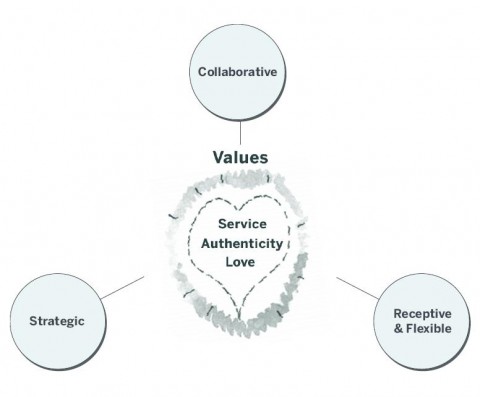
“What’s love got to do with it?” This is a question that gets raised with increasing frequency in our work at IISC. Recently, while training a group of health care reformers from around the state of Maine, I presented what we call our “Profile of a Collaborative Change Agent,” which outlines the core attributes of those who, in our experience, are able to maintain a win-win outlook even in the most trying of circumstances. Sitting conspicuously at the heart of the Profile (see below) is “the L word.” Nodding heads and knowing smiles, in Maine and elsewhere, are an indication of the growing willingness to seriously consider the role of love in social change work. Read More
The Interaction Institute for Social Change is a vibrant place, a real learning community; we are always seeking to be on our learning edge. Our internal strategic process has led us to wonder how to define ourselves for this new era without necessarily losing our 16 years of experience and the power of our proven collaborative methodology. A couple of things have become even more clear through this process. It is clear to us, to our clients and partners in the work of social transformation that collaboration is what we do.
We might be working with a single organization or a group of organizations, we may be designing a learning event, a high level facilitation or a citywide change process, but whatever it is that we are doing – collaboration is at its core. We help people come together and work together.
Remember this old song? I don’t. But I heard Garnet Rogers doing a version the other day on WUMB. The timing was quite something, as I was in the car on my way to the office and my return from parental leave, trying to hold on to the reality of my situation. And it’s been on my mind as I get ready to embrace and ease into another transition (just remember, 40 is the new 30). Click to listen to Guy Clark’s rendition.
When I was a young man my daddy told me
A lesson he learned, it was a long time ago
If you want to have someone to hold onto
You’re gonna have to learn to let go
You gotta sing like you don’t need the money
Love like you’ll never get hurt
You got to dance like nobody’s watchin’
It’s gotta come from the heart if you want it to work
Last week I had the privilege of working with my colleague Daryl Campbell in offering IISC’s Pathway to Change workshop for the first time to the general public. Overall it was a very positive experience, and seemed to confirm our suspicions that the course is timely given the growing demand and desire for working collaboratively. That said, as we were wrapping up we heard a few comments that are not so unfamiliar. “This is wonderful, it’s just what we need, and it’s a lot!” “There’s so much to absorb. I need time to sort it out.” There were a few suggestions to slow down the pace next time, or to space out the days to give time for both absorption and application. At the same time, people recognized that the three consecutive days had a certain power and punch to them, both with respect to connecting content and creating community in the room.
Sitting with this conundrum, it occurred to me that it just may be unavoidable. As we like to say, it’s important to meet complexity with complexity. What we were addressing in the room was the need to work with complex social and environmental issues by bringing more people and ideas to the table, with a variety of tools at one’s disposal. Indeed, it is a lot to take in and apply. And the point certainly is not to overwhelm folk, but rather to help them eventually reach what our colleague Cynthia Parker calls “the simplicity the other side of complexity.” In other words, there is necessary work and wrestling to be done before reaching mastery.
That said, I made an effort in the workshop before we closed to offer some consoling words. Underlying all of the various concepts and tools we discussed, there seem to be a few core ideas for guiding one’s work as an effective collaborative leader/change agent:
Awareness – Everything we talked about pointed to the need to be attentive to the various situations we face as well as our own interior condition. Being aware of what circumstances might call for and not acting on impulse are critical steps in helping to ensure that we are more “in tune” with reality.
Intention – Another theme that emerges is the importance of acting with some forethought, being plan-full in light of the unique situations in which we find ourselves. The basic idea is that we act as an extension of our awareness.
Balance – Collaboration is not about working with everyone all the time or only working through consensus. It comes down to balance – knowing when to make more unilateral decisions and when to be more inclusive; holding results, process, and relationship in dynamic tension as dimensions of collaborative success. Problems arise not so much when we make a wrong call (which we can correct) but when we make the same call over and over again.
Wisdom – It is important to remember that the models we teach are based on practice. Somewhere, someone was doing something effectively and the models capture this success. In a sense, there is something very intuitive about what we teach, and so as important as learning the skills may be, there is also work to be done around getting in touch with our inner knowing, and grounding all of our actions in an ethic of service, authenticity and love.