November 21, 2014

It probably goes without saying that learning requires reflection. This holds true for individuals and groups, and yet what I find is that many collaborative efforts can fail to build adequate reflection time into their work. Often it seems that reflection can be cast aside in favor of “getting stuff done” and because, “There is so much to do!” And ironically, what can ensue is an overall and ongoing sense of impatience and frustration that “we aren’t doing anything or enough.” Experience shows that when people in networks and collaborative change work do pause to reflect, there is much value to be gained.
The other day I worked with the core team of a regional network focused on food system change, and we took time to reflect on what the past couple of years of work have yielded at individual, collective and systemic levels. People offered up their own reflections, as well as those garnered from informal interviews with others in the network. The result was eye-opening, affirming and provided a collective boost. What we agreed is that considerable and important development has occurred over time, including: Read More
October 29, 2014
“Our success is built on partnership, sharing success and sharing credit.”
– Sec. Chuck Ross

“The mojo is in the motto.” With these words, Secretary of Agriculture Chuck Ross opened the doors and conversation on the fourth annual Vermont Farm to Plate Network convening last Thursday in Killington. Each of the past four years Secretary Ross has brought some critical words of encouragement and motivation to this fall convening, and by invoking the state motto – “Freedom and Unity” – at this year’s opening he seemed to hit the right chords at a critical moment in the evolution of the network.
In 2011, Farm to Plate launched to great excitement and some anxiety as it positioned itself as a cross-sector collaborative network to carry out a strategic plan to double local food production in Vermont in 10 years time, contributing to job and economic growth as well as food access in a state that sees high rates of poverty. Since then, as both Ellen Kahler of the Vermont Sustainable Jobs Fund (the backbone organization for Farm to Plate) observed and remarked through a plenary retrospective, it has managed to find its collaborative footing and grow significantly in numbers (more than 300 organizations strong). And importantly, it has seen real results in terms of direct, indirect and induced job growth resulting in 9,000 new jobs in the agricultural and food sector in Vermont. Furthermore, success is evident in individual members using network goals to inform and align their organizational goals. Read More
October 22, 2014
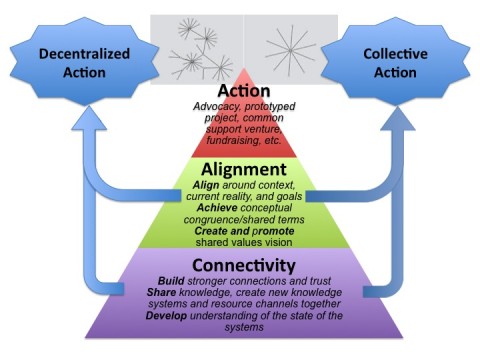 The above graphic is something that I recently created, borrowing heavily from the good work of Peter Plastrik and Madeleine Taylor, to help convey what is meant by engaging in “network strategy.” One of the challenges we’ve encountered in working with different networks is helping people to understand the difference between strategy development and network development. I try to meet this challenge, in part, by showing how they are not so different, or at least, that they are intimately connected. The diagram is also designed to help people get beyond some of the either/or thinking that we encounter. For example, it’s not that we have to choose between decentralized self-organized action and more formally coordinated collective action. It can be both!
So here’s what the graphic is meant to convey. First of all, network strategy is grounded at a fundamental level in creating (strategic) connectivity, by building linkages and trust between key stakeholders and perhaps unusual bedfellows. This can be done by convening people; sharing stories, data and other forms of information; co-creating knowledge; learning together, etc. Part of the value of this connectivity is that it can lead to orthogonal thinking and bolster individual network participants’ efforts in the shared domain where the network is focused. What also may ensue is self-organized action between those who are meeting one another for the first time or getting to know one another better (see the arrow to the left side of the triangle). This is all well and good and is something that networks should try to track. Read More
October 21, 2014
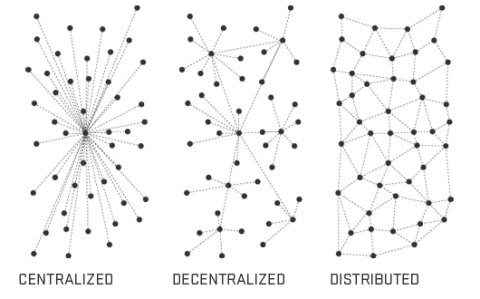
Readers of this blog know how much promise we at IISC see in networks to bring about greater depth and breadth of change in our country and communities. At the same time, we do not see networks as a panacea. In fact, there are good reasons to be vigilant about “net work” to ensure that it does not exacerbate the very conditions we are trying to remedy, especially when it comes to social inequities.
We have previously referenced the report from the Aspen Institute, The Power Curve Society, which considers the broad implications of a globally networked economy that allows greater ease of transactions. In this technologically accelerated economy, the report states, wealth increasingly and problematically concentrates in the hands of a few rather than spreading itself out across the larger population. This seems to be a natural emergent phenomenon of not just the unchecked networked economy but of many networks. As Kim Taipale notes, this is a paradoxical result of “network effects,” –
“Freedom results in inequality. That is, the more freedom there is in a system, the more unequal the outcomes become.”
This is because of something known as the “power-law distribution” that takes hold on open platforms, as wealth flows to the “super-nodes,” a phenomenon sometimes called “preferential attachment.” Read More
October 8, 2014

In recent work with a couple of different leadership development programs, I shared a few stories about organizations that failed to recognize the value of informal networks within and beyond their formal boundaries by choosing to see themselves primarily through the lens of the “org chart” and fixed roles/job descriptions (what I sometimes call the “stay in your lane” approach). In these cases what was lost was the ability to access greater organizational potential and intelligence. If we think of organizations as living entities, then our connections within and beyond those cellular walls might be thought of as vital nerves or sensors. When we fail to acknowledge or even cut these connections within, which often represent the pathways through which work actually gets done, we may stymie or destroy critical flows and functioning. And when we fail to see and leverage how people in all roles are connected beyond the organization, then we reduce not only the potential contribution of each individual, but the overall surface area of the organization that might otherwise attune it and help it to respond to larger systemic opportunities or threats. Which is why increasingly people are seeing mechanistic and fixed organizational roles as “irresponsible” – they do not allow people, individually and collectively, to effectively respond to circumstances and activate around that about which they care most. So the invitation is to think and act more like a living network. What are you doing to build greater sensitivity and surface area in your organization or change effort?
October 2, 2014
At this point a couple of networks with which I am working have reached or are reaching the three year mark in their formalized existence. By many accounts, this is a milestone and inflection point worth noting, as these initiatives have built significant connectivity (depth and breadth) and alignment (shared sense of common identity and direction) among key and diverse actors. Furthermore, there has been a real proven capacity of these networks to meet individual self/ organizational interests in terms of learning, new partnerships, and a broader community/marketplace of support. And there is a growing appetite for and interest in how this all adds up to significant system change. Another way of framing this is people are wondering how they can activate the next level of the system to bring all of their interactions to a place where there is greater abundance, opportunity, and impact. Read More
September 30, 2014
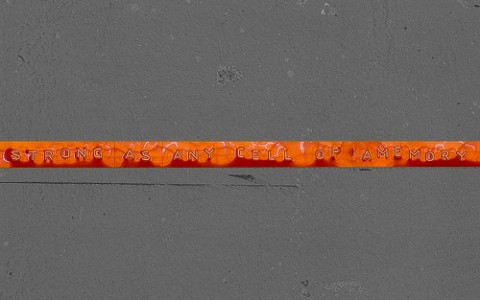
I have a practice in most of the networks and collective impact efforts I support, which is to offer poetry at the opening and closing of convenings. I’m struck by how impactful and important people have said this can be for them. In fact, just recently a very well-respected member of the public health community was compelled to say that this is exactly what is missing from the movement, more poetry and artistic expression!
“Poems come out of wonder, not out of knowing.”
-Lucille Clifton
Read More
September 25, 2014
“You have to remember that any boundary is a useful fiction.”
-Buckminster Fuller

Photo by Fady Habib
As the story is told, a crucial element in the breaking of the genetic code was when physicists moved into the field of biology. These scientists, including Max Delbruck, Francis Crick, Maurice Wilkins, and Erwin Schrodinger, brought with them a new perspective and new methods that changed genetic research. As Fritjof Capra and Pier Luigi Luisi note in A System View of Life, it was Schrodinger in particular who suggested that “the gene could be viewed as an information carrier whose physical structure corresponds to a succession of elements in a hereditary code script.” This story illustrates how innovation and evolution occur at the meeting of fields. This is the promise of orthogonal thinking.
Orthogonal thinking draws from a variety of, and perhaps seemingly unrelated, perspectives to achieve new insights. It is the even momentary blurring of boundaries to see what might emerge. A while back I provided a portrait of a “facilitative leader,” neurophysiologist Erich Jarvis, who understands the power of thinking and doing orthogonally and has used this to create research breakthroughs around avian vocalizations and human speech. Another relevant story is WaterCredit, a model that has developed to address the needs of the nearly 1 billion people on the planet without access to safe drinking water. Through WaterCredit, micro-finance institutions provide micro-loans to individuals to finance their own water and sanitation solutions. The program resulted from the intentional pulling together of diverse private sector, public sector, and financing institutions.
The benefits of orthogonal thinking speak to the importance of diversity in supporting collective intelligence and resilience. A recent Scientific American article by Kathleen Phillips of Columbia University highlights a number of studies showing how racial diversity creates greater complexity in and broadness of thinking. The same holds true for gender and ideological diversity. As Phillips notes:
Being with similar people makes us think we all hold the same data and perspective, which stops us from processing and fully sharing information.
Bottom line: it may behoove us in our social change work to create spaces in which people and ideas that might not otherwise bump into one another, can interact. Are you getting orthogonal enough?
September 24, 2014

Photo by Jenny Downing
Every now and then we get the question about what is the best way to structure a social change network, to which the most frequent response is, “It depends.” Case in point, in a past post, I offered examples of three different network forms growing out of the same region (New England) in a similar field (food systems). These forms that have evolved in three states have largely depended upon the initial framing question for the change effort (how to tackle food insecurity vs. how to grow the agricultural economy vs. how to achieve food justice), contextual factors (political dynamics, what already exists, who is engaged), and resources (not just funding, but certainly funding) available. And since the writing of that post, each has evolved, more or less significantly, in line with new challenges and opportunities. Some of the take-aways from this align with the lessons of moving from a more mechanistic to a regenerative outlook –
- start where you are with what actually is,
- avoid buying into “best practices,” and
- expect and even desire it to change as you go.
Read More
September 10, 2014

Photo by Guy Renard 25
My friend Joel Glanzberg is a constant source of provocation and insight. The way he sees the world, through a living systems and pattern-seeking lens, is not only refreshing but unnerving in that it is evident how simultaneously critical and rare his perspective is. Joel is great at helping me and others to see beyond objects and structures to underlying patterns and processes, and how these are what animate living systems. Read More
September 3, 2014

Photo by Tela Chhe
One mantra I have for working with groups is, “If you’ve seen one group, you’ve seen one group.” Part of the welcome and challenging nature of collaboration is that in each instance we are dealing with a unique organism or constellation of human beings coming together to get something done. As complex living systems, groups of people are not prone to simple “best practices” for getting them working in a prescribed way. There certainly are some “promising practices,” including what we teach at IISC in our Facilitative Leadership for Social Change courses. Still collaboration, including the practice of group facilitation, is a heuristic undertaking – an experience-based approach to problem solving, learning, and discovery that suggests solutions which are not guaranteed to be optimal. Read More
August 20, 2014

Photo by Ron Cogswell
Following the recent New England Food Summit, my IISC colleague Cynthia Silva Parker and I turned to one another and essentially said, “Now the real work begins.” We had wrapped up co-facilitating a two day gathering of over 150 delegates from around the region with one 0f the goals being to bring everyone in attendance to a common understanding of how racism exists in our food system. In a debrief by the core team for the effort about a week later, the comment was made to nodding heads that a strong hope going forward is that white people become much more ardent and active throughout the region raising the question of how race and racism are operating in the systems of which we are a part.
Two months later, this hope is both challenged and echoed by recent events and in an article that appeared in the St. Louis Post-Dispatch following the killing of Michael Brown in Ferguson, Missouri. Washington University Professor of Law John D. Inazu makes an appeal to not make what is unfolding in Ferguson “a black thing.” More pointedly, he asks white friends and colleagues to spend more time getting to know the real and tragic dynamics of racism in this country. While the article is directed primarily at residents of greater St. Louis, it’s message speaks to all. It is well worth the read, and here I’d like to rift on Inazu’s entreaty . . .
In conversations about racial inequity, I am increasingly approached by agitated white colleagues asking what they can do. Here is a response (and know that I am also talking to myself here): Read More