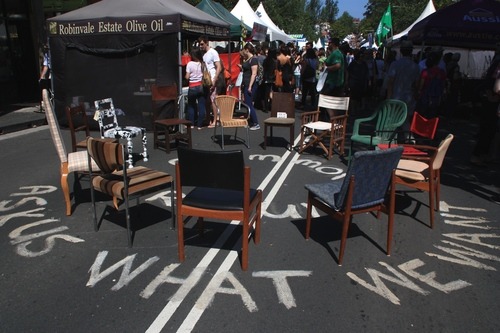
“A beautiful question is an ambitious yet actionable question that can begin to shift the way we perceive or think about something – and that might serve as a catalyst to bring about change.”
– Warren Berger
One of my favorite reads of the past six months is Warren Berger’s A More Beautiful Question: The Power of Inquiry to Spark Breakthrough Ideas. It strikes me as being an important read for any social change agent. Early on, Berger begins with the following provocative statement, that rings true to personal experience:
“Well meaning people are often trying to solve a problem by answering the wrong question.”
In some cases this is because they have not paused long enough, if at all, to consider the underlying question their efforts are trying to solve. Or, as my colleague Cynthia Parker has said, they are “solving for solution,” essentially promoting and/or fighting over their own preferred approaches. And so they continue to offer the same old, ineffective and outdated, approaches or products. This is especially problematic in a time of such change and flux, when we can’t fall back reliably on what we already know. Read More
Every now and then we get the question about what is the best way to structure a social change network, to which the most frequent response is, “It depends.” Case in point, in a past post, I offered examples of three different network forms growing out of the same region (New England) in a similar field (food systems). These forms that have evolved in three states have largely depended upon the initial framing question for the change effort (how to tackle food insecurity vs. how to grow the agricultural economy vs. how to achieve food justice), contextual factors (political dynamics, what already exists, who is engaged), and resources (not just funding, but certainly funding) available. And since the writing of that post, each has evolved, more or less significantly, in line with new challenges and opportunities. Some of the take-aways from this align with the lessons of moving from a more mechanistic to a regenerative outlook –
You probably know this challenge. Start with 3 rows of 3 dots in the form of a square. Now using only three or four straight lines, connect all of the dots without lifting your pen or pencil from the paper (see answers above). I was reminded of this exercise by some of the participants in the Tillotson Fund Community Practitioners Network (CPN). They used it as a metaphor during a presentation about a multi-functional collaborative platform they are proposing to connect a rather vast and disparate region of New Hampshire’s northern most county, including parts of western Vermont, southern Quebec, and eastern Maine. The vision for the platform is that it would help to build connectivity and alignment around a core set of regional values that would also inspire action for community and economic development. Read More
Last week’s New England Food Summit was a unique opportunity to bring a conversation that had begun in the northern more production-oriented parts of the region to a place where access, equity and urban ag are leading edges of the conversation. Food Solutions New England (FSNE) is leading a charge that challenges the imagination of people in six states to see and work together for a day in 2060 when we are able to produce (farm and fish) at least 50% of what is consumed here. This challenge takes on unique dimensions in different parts and communities of the region. In Rhode Island, where this year’s Summit was held, this means working with the highest unemployment rate in the country, an ever more diverse population and the reality of very limited space in which to place new food operations.
But as Ken Payne, member of the Rhode Island delegation and chair of the Rhode Island Food Policy Council, reminded Summit attendees, a central call is to creatively go about the work of “repurposing space” – physical, moral and economic.
This past weekend’s CommonBound Conference was quite the experience. It was inspiring to be with the more than 600 participants from around North America talking about and sharing examples of what it might take to evolve a just and sustainable economy. I found the event’s closing plenary, an interview of and conversation between Adrienne Maree Brown, Gar Alperovitz, and Gopal Dayaneni, to be particularly stirring. For those who missed it, here is a smattering of what was buzzing in the Twittersphere . . . Read More
Very much looking forward to joining my IISC colleague Andrea Nagel while facilitating at this weekend’s CommonBound Conference, hosted by the New Economy Coalition. The proceedings will feature Ed Whitfield from the Fund for Democratic Communities. Whitfield is a long time social justice activist, who has been involved in labor, community organizing and peace work since the late 1960‘s . He was the chairman of the Greensboro Redevelopment Commission for 9 years and formerly board chairman of Greensboro’s Triad Minority Development Corporation. In the short video clip above Whitfield speaks to the fallacy of the “teach a man to fish parable” noting that to know how to fish is one thing, “having access to fishing poles and water holes” is another. His message is very much in alignment with our commitment at IISC around lifting up issues and dynamics of power, equity and inclusion.
If you are interested in following CommonBound on-line, you can check out this link. Or follow along on Twitter via #CommonBound. Read More
In my current work with the Cancer Free Economy Network, I have the opportunity to partner with a very skilled team of consultants, including Joe Hsueh from Second Muse. Joe’s core offering to this initiative is system mapping and helping people to hold systemic complexity. The short video above, taken by another team member, Eugene Kim, features some of Joe’s thinking about what it takes to gain “strategic clarity” when striving to evolve a complex system.
One of the many things I appreciate about Joe is his holistic approach to system mapping which renders it much less mechanistic than I’ve seen from other practitioners. In fact, as this great article in The Guardian about Joe and his work illustrates, he comes from a very deep, some might call it spiritual, place. As the article quotes him, “Systems mapping, system modeling – all these scientific tools and methods – these are not ends in themselves. For me, they are tools for us to create a space where we open our minds, open our hearts and open our will.” In this sense, the (system) map is not the territory in more ways than one.
I will admit to being a bit dubious when I read articles about “scaling social impact.” A fair number of these pieces come from rather privileged places and can smack top-down solutions that perpetuate existing and problematic power dynamics and largely ignore the specifics of local realities. I am also concerned that many continue to hold an industrial/mechanistic/extractive view that renders “scaling up” simply more of the same old damaging same old.
So I have been heartened to hear different takes on scale this past month in a few conversations about evolving a more regenerative, “human scale”, and equitable economy. Read More
A question I find myself asking quite a bit of those with whom I am doing network building and collaborative change consulting is some version of, “So whose party is this?” A change or developmental initiative may be born in the mind of a single person or small group of people. And she/he/they invite others to that party, her/his/their party. Then over time, the idea may arise on the part of the invitees that this isn’t just “your” party, but “ours” (collectively). This may not come up so much as a direct statement but through questions about and behavior around power dynamics, how the effort is framed, who to engage, etc. Now what? Depending upon the goal, sometimes your party needs to stay your party, and sometimes it needs to shift, through the emergence of a better question or opportunity. Of course, people may make the decision for you by taking the party with them. Or maybe there are two (or more) parties that ensue, in which case, the question becomes, if you are still welcome, “So whose party am I at right now?” The question is not simply meant to be about ownership, but intent, transparency and equity, and how people can show up in value-adding ways.
“A great many people think they are thinking when they are merely rearranging their prejudices.”
― David Bohm
By Vincepal
I have learned a tremendous amount over the last several years from practitioners associated with the Regenesis Group – Carol Sanford, Bill Reed, Joel Glanzsberg, and Pamela Mang. Specifically, they have pushed my own thinking about my own thinking, and how this kind of awareness is key to supporting successful system change. I recommend all readers of this blog to check out the wealth of resources on the Regenesis website. And I want to highlight a blog post from Pamela Mang, a segment of which I have included below, that points to how our dominant ways of thinking can undercut our stated aims. The full post can be found here on the edge:Regenerate site.
“The way we think is shaped by patterns that we’ve been taught or picked up over the course of our lives, patterns that are deeply embedded in our culture and institutions. Over time, these patterns have become increasingly interdependent and self-reinforcing and, most problematic, increasingly habitual because they are invisible to us. If we want to change how we think, the first step must be to make visible the patterns that currently shape our thinking. Only then can we decide which are useful when, and which condemn us to degenerative outcomes. . . . Read More
In a number of the social change networks that I am supporting there is very active and interesting conversation, and experimentation, going on around what I would call the process-action tension. As I have written elsewhere, I see this as a bit of a false and often unhelpful dichotomy, and I have certainly seen and been part of networks that have gotten bogged down in some version of analysis paralysis and never-ending consensus building. Increasingly there is a leaning towards getting out there sooner than later and trying things, learning from experiments and actions, readjusting, etc., which is all well and good. At the same time, I see it as part of my role to raise questions about how the embrace of “do-acracy” might have unintended consequences around long-term alignment as well as sustained and truly systemic impact. Read More
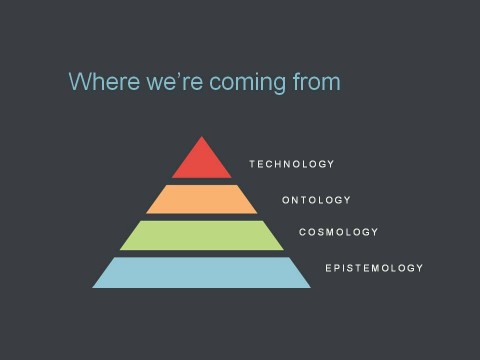
Last week I had the privilege of being part of faculty for the launch of the Presidio Institute’s Cross-Sector Leadership Program in San Francisco. My role in representing IISC was to lead conversation around core concepts and frameworks related to the design and facilitation of complex multi-stakeholder changeprocesses. The last day I partnered with Jennifer Splansky Juster from the Collective Impact Forum to do a deeper dive around collaborative process design, with Jen offering more guidance around the specifics of taking a “collective impact” approach. During this session, I invited Fellows to step back and take a deeper view of their cross-sector change work by reflecting on the framework above, the essence of which I have inherited from the thinking and work of Carol Sanford.
This framework offers that our chosen change methods are always grounded in an underlying belief system about what we hold to be true about humanity, the world and what constitutes “knowing.” Not being aware of or transparent about this can get us into difficulty when it leads to mixing and matching techniques/methods that may contradict one another, or when we are not operating from the same system of beliefs as others. Here are some questions I offered the CSL Fellows in consideration of their cross-sector work: Read More
Make Change Stick Beyond the MeetingTurn ideas into agreements that stick, and keep change going after the meeting ends. Perfect for teams stuck in “great conversation, little action.”