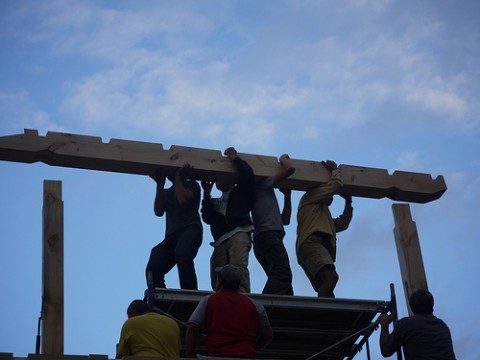
|Photo by AnneMarie Laureys|http://www.flickr.com/photos/45358908@N06/4168069265/in/photostream|
A few months ago I posted a piece entitled “Negativity and Self-Limiting Advocacy,” which seemed to get a lot of play in the 2.0 sphere. The gist of the entry was that negative mindsets limit our view of possibilities and can wall us off into tried and not so trustworthy ways of being and doing on the social change front. John Hagel, author of The Power of Pull, posted the entry below on his Edge Perspective site this week, which extends this conversation to thinking about how our responses to the prevalent uncertainty surrounding us have a lot to say about our future economic and ecological well-being.I really appreciate his focus on narrative, especially on the heels of attending New Ventures West’s introductory course on integral coaching, and I am excited to think more about how we can co-create new and liberating narratives and “platforms” that bring into being the regenerative future that is waiting to emerge more fully. I would also add to Hagel’s assessment at the end by suggesting that beyond young people, there is much hope and wisdom to be found in those who have been most marginalized by the dominant culture and yet have found ways to walk in and hold onto two worlds, to survive and to thrive. And to take note of and learn from the wisdom of life.
We live in a world of increasing pressure and uncertainty, driven in large part by digital technology infrastructures. These marvelous infrastructures bring us unprecedented connectivity and opportunities to better ourselves. Read More
Sauces for jianbing 煎饼. Jen Leung. https://www.flickr.com/photos/jennikokodesu/4459697786/ is licensed under CC BY-NC-ND 2.0.
“I just wanted to tell all of you that I feel truly honored to have played even a small part in what transpired today. In fact, I would go so far as to say you are the best, most fun, most highly evolved group of humans I have ever worked with.”
This is not the kind of email you get everyday. It comes from one of the participants in the process design group of a state-wide food system building effort with which I have been involved for the past year and for which I am the lead designer and facilitator. To be clear, the purpose of this post is not to blow my own horn. It would be outrageous for me to take credit for something the size and complexity of which goes well beyond my individual talents and contributions. Rather, I am very eager to explore what stands behind this comment, as it reflects a commonly held feeling that something special has been going on with this initiative and group since it was initiated and led up to the launch of a Food Policy Council last week.
“We can only have honest, effective hope if the frame through which we see is an accurate representation of how the world works.”
– Frances Moore Lappe
|Photo by Jim Bahn|http://www.flickr.com/photos/gcwest/6142854588|
With a warm welcome and opening offering of D.H. Lawrence’s poem “Escape,” Danny Martin and I launched into our session last week at the Bioneers by the Bay Conference entitled, “Belonging and Becoming: Practices for Regenerative Leadership.” The framing of our 90 minutes was the call to connect more deeply with the ways of complex living systems, to align ourselves more fully with life so that we might thrive as a human community.
During the first half of our session we took the poet’s suggestion to escape the “glass bottles of our egos” and access “unlying life” by engaging in some paired storytelling focused on the values that have guided us in our lives. This was our effort to cultivate a deeper sense of belonging in the room, and we were amazed to hear how much people took from listening to one another for even 10 minutes. Read More
The following is a post from my friend and colleague Danny Martin, that appeared on his web page on Monday, following our joint workshop at Connecting for Change, a Bioneers Conference. Tomorrow I will extend this reflection with more details about our session and regenerative leadership practice.
So much to say this week but it all turns on the same theme of how to access the wisdom we need to move forward together into a more sustainable and just society. In a recent article about what he calls The New Economy Movement, Gar Alperovitz, a Professor of Political Economy in the University of Maryland, says that, instead of feeling confined to the binary paths of reforming the broken economic system or revolting to overthrow it, citizens are opting to create something new that will replace the current economic regime, making the old system obsolete in the process. He calls this third way ‘evolutionary reconstruction.’ Read More
If you have not had occasion to visit our Boston offices, the video above gives you a glimpse of this beautifully designed space that supports the work of IISC and our sister organization Interaction Associates in pursuing our collective collaboration for change missions. Come see us some time, either by signing up for one of our public trainings, or if you’re in the neighborhood . . .
“We seem to have been living for a long time on the assumption that we can safely deal with parts, leaving the whole to take care of itself. But now the news from everywhere is that we have to begin gathering up the scattered pieces, figuring out where they belong, and putting them back together. For the parts can be reconciled to one another only within the pattern of the whole thing to which they belong.”
Throughout the past few years readers of this blog have seen some discussion about the tensions that exist between those working on individual behavior/spiritual change and those striving for structural transformation. Read More
For the third year in a row, I am looking forward to presenting at the Connecting for Change conference, also known as Bioneers by the Bay, sponsored by the Marion Institute. The community of New Bedford, Massachusetts becomes the host and scenic back-drop to some amazing speakers, well known and not so well known, as well as presentations by an incredible array of people doing important work in our New England region. Read More
“Networks are not just about sharing the pie. They are about growing the pie.”
– Ellen Kahler, VSJF
It has been a privilege and an inspiration to spend the past two days working with my colleague Beth Tener and the amazing team at the Vermont Sustainable Jobs Fund (VSJF) to help launch the Farm to Plate Network. Over 150 people came together to connect and take the conversation deeper around how they want to work together to double local food production in the state over the next 10 years, as a way of boosting economic development, increasing jobs, and ensuring that every resident has access to healthy food. A big rallying cry has been the devastation that Tropical Storm Irene wrought on the farming community. And as we learned from former Secretary of Agriculture Roger Allbee during a very enlightening presentation about the Great Flood of 1927, once again Vermonters responded in ways that have impressed those (including the American Red Cross) who came to help, with their self-organizing and neighborly efforts to get one another back on track.
In an encouraging speech to launch the proceedings, Governor Shumlin highlighted the challenges and opportunities that stem from the changing climate that is predicted to increase precipitation 20% in the state in years to come. “Our best days are ahead of us if we can pull together,” he said. Read More
|Photo by grongar|http://www.flickr.com/photos/grongar/4965343939|
Building on yesterday’s post of the video about sociocracy, and inspired by the work of John Buck and Sharon Villines that I mentioned there, I’ve been pulling together a list of ways that leaders at all levels in organizations and networks might encourage more collective self-organizing, self-correcting, resilient and adaptive behavior. Here’s a start and I invite readers to please add: Read More
Make Change Stick Beyond the MeetingTurn ideas into agreements that stick, and keep change going after the meeting ends. Perfect for teams stuck in “great conversation, little action.”