Given my interest in living systems theory and practice, I’ve been very excited to learn more recently about sociocracy. I was tipped off by Beth Tener of New Direction Collaborative who passed along a book suggestion in We the People: Consenting to a Deeper Democracy by John Buck and Sharon Villines, which serves as a guide to sociocratic principles and methods. A unique method of governance, sociocracy applies scientific understandings of how the world works through open systems thinking and complexity to creating more self-organizing, self-correcting, inclusive and efficient organizations. Read More
|Photo by Marcin Kargol|http://www.flickr.com/photos/powazny/6155572181|
“Making our world fit for our children and grandchildren is a task for marathoners – not sprinters. It is a complex and long-term struggle that must be pursued with both urgency and persistence. The playwright Bertold Brecht said: ‘There are those who struggle for a day and they are good. There are those who struggle for a year and they are better. There are those who struggle many years, and they are better still. But there are those who struggle all their lives: These are the indispensable ones.’ Be an indispensable one for our children’s and our world’s sake.”
David brings particular skill and experience in teaching about and mapping systemic dynamics as they play out at different levels. In June, he gave a wonderful overview of systems thinking to the System Design Team, which included an introduction to the iceberg diagram (see below) that helps people get from more superficial and tactical questions to deeper systemic points of leverage, including awareness of one’s own unwitting contribution to dynamics that yield outcomes that are undesirable or in some sense not optimal. Part of the shift we experienced over the course of these conversations was the understanding that “the system” is not out there, but as Yaneer Bar-Yam says, is “the way we work together.” Read More
“In a sense, it’s not a system until it’s working for the people on the front-line, and above all the parents who need services for their children.”
-David Nee, Executive Director, WCGMF
|Photo by jfinnirwin|http://www.flickr.com/photos/jfinnirwin/5248114004/in/photostream|
Last November I blogged about the launch of a bold and exciting initiative in Connecticut, spear-headed by the William Caspar Graustein Memorial Fund based in Hamden. My colleague Melinda Weekes and I were engaged to assist the Memorial Fund as it answered a community-based call to step into a convening role to bring relevant stakeholders together from around the state to re-imagine and build an early childhood system “that is accessible and effective in all settings and in all communities for Connecticut’s children and families regardless of race, abilities and income.” This initiative has since been dubbed Right from the Start, a name that has turned out to be quite prescient in light of U.S. Secretary of Education Arne Duncan’s recent comments. Right from the Start builds upon 10 years of work by the Memorial Fund in supporting community-based efforts to promote development and learning for all children. Melinda and I are proud to have been able to make a contribution over the past four years by providing Facilitative Leadership training and collaborative capacity building to more than 200 individuals from the 57 Discovery Collaboratives around the state. Read More
“The very least you can do in your life is figure out what you hope for. And the most you can do is live inside that hope. Not admire it from a distance, but live right in it, under its roof.”
― Barbara Kingsolver
|Photo by Pol Sifter|http://www.flickr.com/photos/polsifter/4047982682|
A mentor of mine says that one of the most important disciplines we can individually and collectively engage in is to repeatedly ask and attempt to answer the question, “Where am I/we now?” This is something of a daunting task when it comes to our global climate, and yet embracing this current reality is key to creating the future we would want to see inherited by generations to come. In this spirit, we are all invited to join The Climate Reality Project to hear more of the truth about climate change from those who are experiencing its impacts around the world, and watch the live stream here starting at 7pm CT today (September 14).
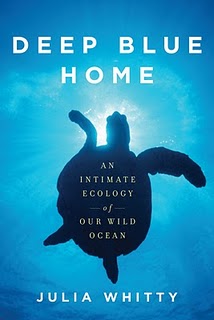
My wife and I have been enjoying spending some of our evenings reading to one another from Julia Whitty’s book Deep Blue Home: An Intimate Ecology of Our Wild Ocean. Whitty, a scientist, documentary filmmaker and correspondent, writes about her years of exploration and discovery of the World Ocean, the three dimensional current circling the globe that profoundly controls the planet’s climate and has a tremendous impact on all life. In one chapter, Whitty references the Census of Marine Life, an amazing 10 year collaboration of over 2,700 scientists from more than 80 nations to assess the diversity, distribution, and abundance of marine life.
As awe-inspiring as the undertaking itself has been, the results are simply mind-blowing and speak to the insights and intelligence available through thoughtful collaboration, including a deepening understanding of our own place in the larger scheme and a nudge to get us off center stage. Here is how Whitty captures some of it: Read More
|Image from NASA Goddard Photo and Video|http://www.flickr.com/photos/gsfc/6096549427|
Labor Day weekend took on a new twist this year in the state of Vermont where people came together to clean up, comfort one another, and rebuild after Tropical Storm Irene’s devastation. I was visiting my in-laws in Chester, VT when the storm hit last Sunday. Chester, as it turned out, made national headlines as a few local residents’ homes were swept away. This is how The New York Times painted the scene the day after: “With roughly 250 roads and several bridges closed off, many residents remained stranded in their neighborhoods; others could not get to grocery stores, hospitals or work.” Other parts of the state suffered as well, including Waterbury, where state offices were washed out, even forcing the state’s Emergency Management command post to evacuate. Three people are known to have lost their lives as a result of the storm. Read More
Three years ago I had the privilege of helping to design and facilitate a convening of people in Maine interested in the power of networks for social change. The day featured many interesting presenters, including Michael Edwards who gave a provocative concluding talk entitled “Love and Networking.” His words have been coming back to mind of late, as I do work in different systems where networks are all the rage and we struggle to balance the more formal structural elements with the animating consciousness and connectivity that are the transformational juice. During this Labor Day holiday, I invite you to consider Michael’s inspiring words, excerpted from the fuller presentation, and add your own thoughts and reactions:Read More
|Photo by Richard-G|http://www.flickr.com/photos/richard-g/3573703421|
It’s been my pleasure to partner with Beth Tener of New Directions Collaborative these past few weeks in support of the Vermont Farm-to-Plate Network as it evolves a governing structure to support its goal of boosting local food production by 5% in the next 10 years. As part of our work, Beth and I are designing and facilitating two convenings that feature stories of successful networks, tips for doing “net work,” and robust conversation about what will work best in support of Farm to Plate. One resource to which we’ve turned is the Working Wikily blog, which featured a post in May that offers additional insights into what stands behind the successes of the much lauded RE-AMP Network. In a discussion featuring convenor Jenny Curtis of the Garfield Foundation and consultants Rick Reed and Heather McLeod Grant, a number of points are made that resonate and merit consideration for leveraging the power of networks. Read More
|Photo by Shykh Seraj|http://www.flickr.com/photos/51937229@N05/5648441691|
Perhaps feeling wistful in these late summer weeks as we lean towards fall, I seem to have a penchant for all things poetic. Who better to read then, than my friend and colleague Danny Martin, who blogs at a site entitled, “The Art of Working WITH Life.” Danny wonderfully and naturally spouts poetry, his own and others’, as he reflects on what it means to live and lead sustainably. In a recent post on relationships, he writes, “sustainability is about learning to work with differences in a way that will allow us to address the challenges of everyday living and also thereby deepen the relationship with the world we live in.” In other words, it is about learning to love, or as Humberto Maturana has defined it, “respecting the other as a legitimate other.” I have noted that the whole notion of love resonates more and more deeply with people in leadership trainings. The mention of the word does not lead to the same kinds of winces, embarrassed grins, and occasional rolling of the eyes as it did even 3 years ago. What’s love got to do with it? “Everything!” a couple of people shouted in my most recent training in Connecticut. As we discuss it, we revolve around the many different splendors and interpretations, but at the end of the day most everyone agrees that while it may be difficult to define love, we know when it’s absent. And we know we suffer for its loss.
So with thanks to Danny for drawing my attention to them, I pass along these poetic ponderings of Czeslow Milosz, and invite you to consider the link between love and sustainability: Read More
|Photo by Joost J. Baaker IJmuiden|http://www.flickr.com/photos/joost-ijmuiden/5502646252|
I am coming to really see the deep connection between the iron hold on ego and the unwillingness to let go of institutions that no longer serve us. As facades crumble, there seems to be a hunkering down going on all around, fueled by anxiety and resulting in futile and rancorous efforts to control an outcome that is so much larger than any of us. Forces are telling us to side with the way of Life, and to reach out. Will we listen? Will we stretch? Read More
Make Change Stick Beyond the MeetingTurn ideas into agreements that stick, and keep change going after the meeting ends. Perfect for teams stuck in “great conversation, little action.”