Archives
November 25, 2010
Wishing you all a restful and nourishing Thanksgiving, along with reminders of the bounty that may be closer than we think.
The Wild Geese
Horseback on Sunday morning,
harvest over, we taste persimmon
and wild grape, sharp sweet
of summer’s end. In time’s maze
over fall fields, we name names
that went west from here, names
that rest on graves. We open
a persimmon seed to find the tree
that stands in promise,
pale, in the seed’s marrow.
Geese appear high over us,
pass, and the sky closes. Abandon,
as in love or sleep, holds
them to their way, clear,
in the ancient faith: what we need
is here. And we pray, not
for new earth or heaven, but to be
quiet in heart, and in eye
clear. What we need is here.
From Selected Poems of Wendell Berry, by Wendell Berry. Copyright 1998 by Wendell Berry.
November 24, 2010
Just coming off the second public offering of Whole Measures: Transforming Communities by Measuring What Matters Most, IISC’s joint venture with the Center for Whole Communities. I have to say, the workshop experience keeps getting better and better. More is yet to come (next stop, New Jersey in March), and I wanted to offer these words as a way of summarizing our evolving co-creation.
What we talk about is what we see,
so must convene conversations that matter.
What we see is what we measure,
so we must see the whole (system).
What we measure is what gets done,
so we must measure what matters.
What must be done cannot be done alone,
so we must design and facilitate collaborative processes.
We cannot do any of this by transaction or command and control,
so we must embody transformational leadership.
November 22, 2010
I had the pleasure of meeting Jennifer Sertl on the Twitter sphere. Together with Koby Huberman, they have written a book that seems to touch on many of the aspects of this paradigm shift that I spend so much time writing about. It looks like in writing Strategy, Leadership and the Soul, Sertl and Huberman are articulating a series of powerful responses to the changes our organizations are experiencing. I see a lot of alignment between the principles outlined in this 3-minute video and the work we do here at IISC. We are moving forward; see what you think.
November 19, 2010
Web of Change from Web of Change on Vimeo.
November 18, 2010
Sometimes it takes science a little time to catch up with the world’s wisdom traditions. Recent research findings from a couple of Harvard psychologists, Matthew Killingsworth and Daniel Gilbert, confirm what meditation and mindfulness practitioners have long known – our ability to stay focused in the present has a strong correlation with contentment. Using data collected from a specially designed iPhone application, the researchers report that people spend nearly 47 percent of their waking hours thinking about something other than what’s happening in front of them. Furthermore, they find that, “Mind-wandering is an excellent predictor of people’s happiness. How often our minds leave the present, and where they tend to go, is a better predictor of our happiness than the activities in which we are engaged.” You still with me?
My colleague Gibran Rivera has recently been blogging about Otto Scharmer’s Theory U, and the power of collective presence this framework promotes. Essentially, Scharmer affirms that how we attend and the quality of our individual and shared attention and intention affects what emerges. We know this from the simple and yet profound experience of listening to someone in a fully engaged way and or when we cultivate and participate in sacred spaces and rituals. In other words, “presencing” is not just about happiness, but ultimately new ways of seeing, being and doing. Knowing all of this, can we more boldly accept the invitation of mystics and poets in the midst of our otherwise mundane and muddled lives?
For Presence
Awaken to the mystery of being here
and enter the quiet immensity of your own presence.
Have joy and peace in the temple of your senses.
Receive encouragement when new frontiers beckon.
Respond to the call of your gift and the courage to
follow its path.
Let the flame of anger free you of all falsity.
May warmth of heart keep your presence aflame.
May anxiety never linger about you.
May your outer dignity mirror an inner dignity of
soul.
Take time to celebrate the quiet miracles that seek
no attention.
Be consoled in the secret symmetry of your soul.
May you experience each day as a sacred gift woven
around the heart of wonder.
– John O’Donohue
November 17, 2010
Last week I attended Pegasus Communications’ annual Systems Thinking in Action Conference in Boston and had the privilege of meeting and hearing from extraordinary people from around the country and globe, all interested in helping others to better see and work with wholes. From systems mappers and modelers to complex facilitation practitioners to researchers and preachers, my teachers were many. I was one of many tweeters spreading the wealth of wisdom cycling through that dynamic event and system. Here are some of my favorite take-aways in the form of quotes heard, read, and spiritually imbibed:
- We have seen the system, and it is us! – overall theme
- “There is a big difference between trying to be the best organization IN the world and the best organization FOR the world.” – Art of Hosting workshop participant
- “Love, allowing the other to be a legitimate other, is the only emotion that expands intelligence.” –Humberto Maturana
- “Collective will is the attractor that allows form to emerge from chaos.” -Tracy Huston, from her book Inside Out
- “Trying to be right is a learning disability.” – Ray Jorgensen
- “There are three conditions PROVEN to bring out the best in us – the ongoing dispersion of power, transparency, and mutual accountability.” – Frances Moore Lappe
- Why vision matters – “You can solve all of your problems and still not have what you want.” – Robert Fritz
- The good news – “We are once again learning what life is and what consciousness is.” – Peter Senge
- Key question – “How can we each own our own fatalism, which continues to support systems that no longer serve us?” – closing plenary audience comment
- And another one – “How do we make more visible and accessible the many promising changes and good news happening around the world?”
November 16, 2010
Click here to see the 1st proposition
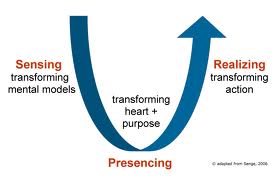
The 2nd proposition of Theory U reads:
(1) The leadership process requires three movements: (1) establishing the horizontal connection (“observe, observe, observe”), (2) establishing the vertical connection (“connecting to Source”), and (3) acting from what emerges in the Now (“acting in an instant”).
Read More
November 11, 2010
 Tomorrow my colleague Melinda and I officially launch an exciting endeavor with the William Caspar Graustein Memorial Fund in Connecticut, as we meet for the first time with a Process Team that will begin designing a state-wide early childhood systems building initiative. The Memorial Fund is stepping boldly into its leadership as a convenor, at the urging of its grantees and the many communities with whom it has cultivated deep trust. In its sights is a process that ultimately yields a broadly shared and community-rooted vision for providing high quality and equitable care and education for all of the Connecticut’s youngest children, as well as policies and structures that support greater community-state collaboration towards this vision. Read More
November 10, 2010
“How do you do that? How do you step back and get perspective?” The question came from a table mate in an Art of Hosting workshop at this week’s Systems Thinking in Action conference. The earnest and wide-eyed inquisitor silently suggested the qualifier, “And how do you do this when there is so little time?” The question hung in the air in the midst of our World Café-inspired conversation about the kinds of change that are being called for in our respective communities, however we choose to define them.
My first response was to laugh. How indeed? As parents of three small children under the age of five, my wife and I often scratch our heads at how we can create more breathing space in general. Frankly, the notion of stepping back often feels like a luxury we can’t afford. And I know there are others in the same space with a variety of unremitting demands. My laugh was surely an acknowledgment of this seemingly impossible situation. And in the context of this rich albeit brief cafe conversation it also became something else, thanks to the careful attending of my colleagues.
Many of us have read about the power of presence, of being more attentive to the reality which faces us in any given moment. We also know about the amazing experience of flow, when we have been deeply connected to whatever we happen to be doing, whether playing a sport, creating art, having a conversation. I will admit that this is something with which I struggled with our first child, trying to be present for some of the seemingly mundane moments. For some reason, since our twins have come along, this has really shifted. I find myself much more in the moment, perhaps because it is abundantly clear that there is nowhere else to go. Escape is just not an option.
The result has actually been quite profound – greater enjoyment for sure and, I now realize, insights that speak to a deeper truth underlying events. Settling into the moment, I have become more aware of patterns and dynamics, both in the personalities and behaviors of my little ones and our family as a whole, that have helped me to understand better how we work as a system. This has inspired greater compassion, curiosity and an ability to be more adaptively responsive as a father and husband. So interestingly, it has been by leaning in to events that I have ended up in a place that I thought was beyond my grasp.
A couples counselor once gave my wife and me the following advice – “Have what you have.” I think I now have a greater appreciation for the wisdom of this statement. Having what we have is not settling for or giving up. It can be a gateway to abundance that we thought was “out there” and the perspective we thought only resided on the mountain top. I left our Cafe conversation with these words in my head – “Slow down, come inside, stay a while.”
November 9, 2010
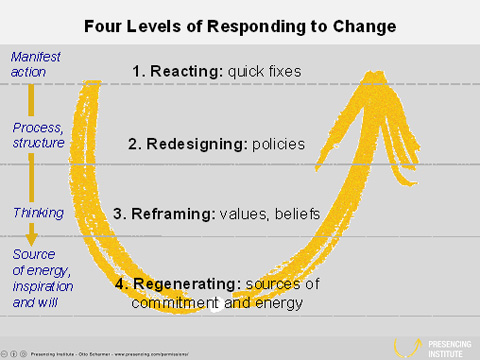
I am a huge fan of C. Otto Scharmer’s Theory U. It is one of the most powerful frameworks for understanding the essential shifts we need to make as we step into this paradigm shift. Scharmer sums up his Theory U with seven propositions, I’m going to write a series of blog posts taking a closer look at each of them: Read More
November 8, 2010
“Everyone today has to be an artisan and bring something extra to their jobs.” This says Thomas Friedman in the New York Times. I’m not sure I like where he is coming from, it sounds a little bit like adding obscure features to a DVD player. But I do like the point. I like this idea of being artisans, of engaging our work as a craft, adding meaning to our tasks by putting our own signature on what we do.
Somewhere beyond Friedman’s capitalistic “do more,” in places outside the yupified fields of trendy taste, there is significant power to the work of an artisan. For example, the work of social change has become so professionalized that it is often disconnected from the depths of purpose that could unleash transformation. But by thinking of ourselves as artisans our own self-expression can actually serve connection, it can bring us closer to that place where hearts can meet.
Consider the purpose of your work, then think of what you do every day… how much more of yourself could you bring to this field where we toil? What’s your craft? What is it that you can create?
November 4, 2010
|Image from Pegasus Communications|http://www.pegasuscom.com/course_preview/gettingstarted/whyiceberg.htm|
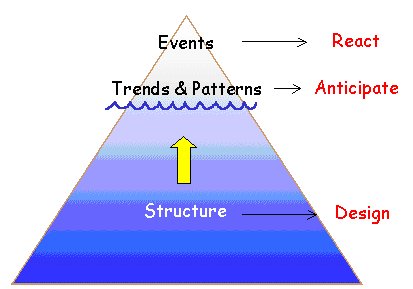
Systems thinking is in the air. This past weekend I was delighted to have the opportunity to teach an introductory course on the topic with John McGah of Give Us Your Poor. Together we took 17 graduate students in the UMass-Boston MSPA program through an intensive and interactive look at the world through the systems lens. Even before we got things rolling on Saturday morning, the pre-reading (Donella Meadows’ Thinking in Systems) had provoked two people to say that they were already seeing the world differently (and more clearly). By the end of our 36 hour romp, which included guest presentations by David Peter Stroh and Paul Plotczyk, students were saying that all public sector employees, nay EVERYONE, should be required to take a systems thinking course. All of this enthusiasm comes just a week in advance of Pegasus Communications’ annual systems thinking conference here in Boston, which has a focus on “Fueling New Cycles of Success.” I am very excited to attend, and look forward to building upon the wisdom I’ve gleaned thus far about surfacing and living with systems (human and otherwsie), which includes these gems: Read More
