Last week I had the privilege of co-leading a three day Facilitative Leadership for Social Change training for a group of health equity advocates in Springfield, Massachusetts. It had been a while since I had done a training of that length, and it was a nice opportunity to not only cover more material, but to deepen the conversation and practice. Along the way there were many good questions about what to do around various challenges when one is co-leading a collaborative change effort. And a common response was, “It depends.”
Every group is different, every circumstance is different, and while it might make sense to take some cues from what has been successful in other situations, the caution is not to assume that it will work, or work in the same way, in other situations. This is one reason that I personally do not like the phrase “best practice” when talking about collaborative and facilitative change work. Given the complexity of people and social systems, I find it more helpful to think about “promising practices.”
That said, a promising practice that came up time and time again in our three day training, was the practice or practicing, of ongoing devotion to muscle-building in leadership skills such as process design, facilitation, coaching (leading with listening and inquiry), systems thinking, visioning/imagining, mutual learning and collaborative decision-making/governance. And in undertaking such practice, we at IISC would suggest this is not about achieving perfection. The humbling and exciting thing about collaborative leadership, in my humble opinion, is that it is a life-long learning pursuit and an endless opportunity to deepen understanding of ourselves, others and living systems. For this reason, one of my mantras is:
Practice for presence, not for perfection.
That is, practice can help practitioners get beyond being caught up in simply “learning the scales” of collaborative leadership, in trying to get the skills “right.” Practice at its best can contribute to a state ofbeing more fully present to what is happening in any given situation and being able to work with that in powerfully improvisational ways.
Furthermore, over the past year, there has been a clear call for practice and practices that are explicitly about cultivating spaces to hold difference and tension and trauma. That may be another order of presence characterized by a deeper tuning in and movement away from more transactional processes to ones that are emergent, co-created and geared towards supporting moral courage and imagination. What that can require is vulnerability and a humble sense of “being with.” What it stands to make possible, as opposed to business-as-usual, is growth and real movement forward, together.
“The most robust and resilient networks are those that create additional value for each participant while strengthening a community or ecosystem as a whole.”
Return-on-investment (ROI) is not a term that I love, especially given how militantly utilitarian and narrowly it is often considered and applied. My friend, mentor, business consultant and holistic thinker Carol Sanford refers to ROI as “the future increase in value that is expected when the initial capital contribution is made.” Carol is quick to point out that capital can take many forms (financial, intellectual, social, spiritual, natural, etc.), and for network participants (or let’s call them “co-creators”) this often takes the form of investments of time, money, knowledge, creativity, and social connections.
Why would co-creators in networks take the time and risk to make such an investment? What is the expected return? Presumably, when we are talking about networks for social change, the principle driver is the desire to make a meaningful difference for people, places and purposes they care about and that they sense will be more positively impacted through network activity. Co-creators are also “kept in the network game” if participation enhances their own capabilities, grows and deepens their connections, and gives them increased opportunities to be creative, and perhaps even find a place of belonging!Read More
“At times our own light goes out and is rekindled by a spark from another person. Each of us has cause to think with deep gratitude of those who have lighted the flame within us.”
During virtual meetings with the groups and networks we support at IISC, a regular practice is to begin each call with a personal check-in and often an offering of some kind (poem, quote, video). We do this to set a tone for our meetings, to hear and honor each and everyone’s voice, and to move beyond “business as usual,” which can take the form of a certain kind of doing (“getting down to business”) that may not make room for relationship-building and tapping into other sources of support and inspiration for collective and long-term work.
On a recent IISC staff call, a few of us noted that in recent months many of those with whom we work seem to really crave these check-in times and are willing and even eager to spend more time there, hearing from one another and soaking in the exchange. I was particularly struck by a call last week with the leadership team of a national advocacy network and both the quality of and appreciation for what was shared. Our check-in question was “What did you get from your break that you are bringing into 2018?” As each person shared, there was a palpable sense of tuning in to and gratitude for one another. I had taken notes of the check-ins as they were happening and was contemplating what might be done with them beyond that time of sharing when one of the team members shared the following poem via email, comprised of a mash-up of the various answers:
Uncompromising fierce love of babies
Glittering opportunities for happy hospitality
Calling things what they are
Seeking power out of loss
Listening with attention
Fighting back with sincerity and strength
Focused energy and collective emotional health for real change
Prompting rest and relaxation and playfulness
As I read these lines, I was reminded of the poet Elizabeth Alexander’s observation that what many of us crave in these challenging times is nothing short of “radiance,” “words that shimmer,” and “light in the spiritual darkness.” It was inspiring to see how this light was shared, passed from one to another and grew during our call.
We know we are not alone at IISC when we say that 2017 left many of us a bit exhausted and breathless, if not somewhat dumbfounded. What occasionally felt like the wheels coming off of our country’s management and morality caught us by varying degrees of surprise, which is not to say that the underlying frustration and ongoing dynamics of “othering” were necessarily shocking. Rather, the unabashed in-your-face tenor of it all got to points where it was all I could do to stay even minimally tuned in to have at least a fingernail on the pulse of things (but really, there were few places to hide!).
I am grateful that as an organization we take a break at the end of the year to rest, restore and reflect. And while some of us may feel like we could use another week (or two), I for one feel ready and resolved to step boldly into 2018 with an open heart and humble sense of not knowing (what will happen, what is in others’ hearts and minds, what the answers are). I would characterize this as a stance of love or loving kindness. Read More
“Innovation is as much a function of the right kind of relationships as it is of a particular kind of individual vision.”
-Carter Phipps
The following is a slightly edited post from a couple of years ago. In many ways it feels more pertinent to me now …
Among other reads, I’ve been revisiting the book Evolutionariesby Carter Phipps. Phipps is the editor of EnlighteNextmagazine and enthusiastic about what we calls “the evolutionary worldview” and how it is showing up in many different fields, from biology to sociology to philosophy and theology. He sees this perspective as transforming one’s understanding of just about everything.
“The debate about our origins is also a cultural referendum on our future.”
The book is in part retrospective, looking at the history of “the evolutionary perspective” that shook up perceptions of “a fixed world” when it suggested that creation is not static, but ever-changing. This realization is still making waves and sinking in. Phipps writes – “As the fog of fixity lifts, we are finding ourselves much more than observers and witnesses to life’s unfolding drama.” In other words, the view of an evolving world is associated with a sense of movement, possibility, engagement, and response-ability (an ability to respond).Read More
Image created by Claudio Nichele, shared with permission of the artist and available through Flickr.
I mentioned in a previous post how much I love Twitter, for a variety of reasons, including how it helps me to see networks at work and can help create a variety of great network effects. Well I have reason to yet again appreciate it, as a recent blog post I put up inspired Claudio Nichele, who is located in Brussels, Belgium and works at the European Commission, to create the great sketch above of the network principles I wrote about (see below).
Just like that, an unexpected gift and enhanced visual value! I asked for Claudio’s permission to post, which he granted, and we both agree it is a wonderful example of what happens when you work out loud (see principle #9 below). Enjoy, and please feel free to rift on these images and the principles below, and if you do, let both of us know what you create. Read More
A couple of weeks ago I was in Michigan to do a presentation and discussion with representatives from a number of inspiring networks focused on local food production, food access and public health. I was invited by my gracious hosts at the Center for Regional Food Systems at Michigan State University to share a bit of network theory, tell a few stories and cover key concepts around network thinking and action to help advance and cohere some of the good work happening around the state.
Towards the end of that morning session, a couple of the participants mentioned that their heads were swimming and a few acknowledged that along with their excitement, they were struggling with how complex and difficult “net work” can be.
I felt their pain and was moved by their honesty, and offered something along these lines, with a bit of post-event embellishment. … Read More
“We know that there is no help for us but from one another, that no hand will save us if we do not reach out our hand.”
– URSULA K. Le GUIN
Image by Stephen Bowler, shared under provisions of Creative Commons Attribution license 2.0.
A note on the quotes below (and the Le Guin quote above): I am grateful for the beautiful piece by Evan Bissel, “Frames for Life, Liberation and Belonging,” which appears in the Othering and Belonging Journal. This piece lifts up some central elements of an emerging and humanizing narrative for our times, with focus on themes such as transition, liberation, belonging, commons, interconnection, abundance, sacred, curiosity, play, and place. I strongly encourage readers to check it out, to sit with the piece and let it soak in, and to share it.
This post follows the thread of a conversation that has been evolving across events I have been involved with the past few months, and a bigger and broader conversation that is clearly informing it. This is certainly not a new conversation, but there seems to be a renewed or perhaps more public vigor to it, at least in multi-racial and multi-generational social change groups and initiatives with which I have been involved.
It has cropped up in a network leadership program where a discussion about the difference between working for equity and working for justice pointed in the direction of the need to pursue liberation, and not simply inclusion and accommodation in fundamentally harmful systems. Read More
“Where is the wisdom we have lost in knowledge. Where is the knowledge we have lost in information.”
– T.S. Eliot
For the past few weeks I have been re-reading the book Designing Regenerative Cultures by Daniel Christian Wahl. I am deeply grateful for Daniel’s gift, a rich distillation of his PhD thesis that points in the direction of a more sane, hopeful and health-promoting future. Regenerative development is a broad body of study and practice that informs much of my own thinking about and practice around social change. A fundamental recognition of the regenerative lens is that in order to live we harvest from the larger living systems (communities, ecosystems) of which we are a part in such a way that can weaken them, and can put us at risk. Regenerative thinking and practice then asks:
What might we do not simply to wreck less havoc or do less harm, but to leverage the natural connections we have with living systems to contribute to the integrity, resilience and long-term viability of people, places, and ecosystems?
“We cannot live for ourselves alone. Our lives are connected by a thousand invisible threads, and along those sympathetic fibers, our actions run as causes and return to us as results.”
– Herman Melville
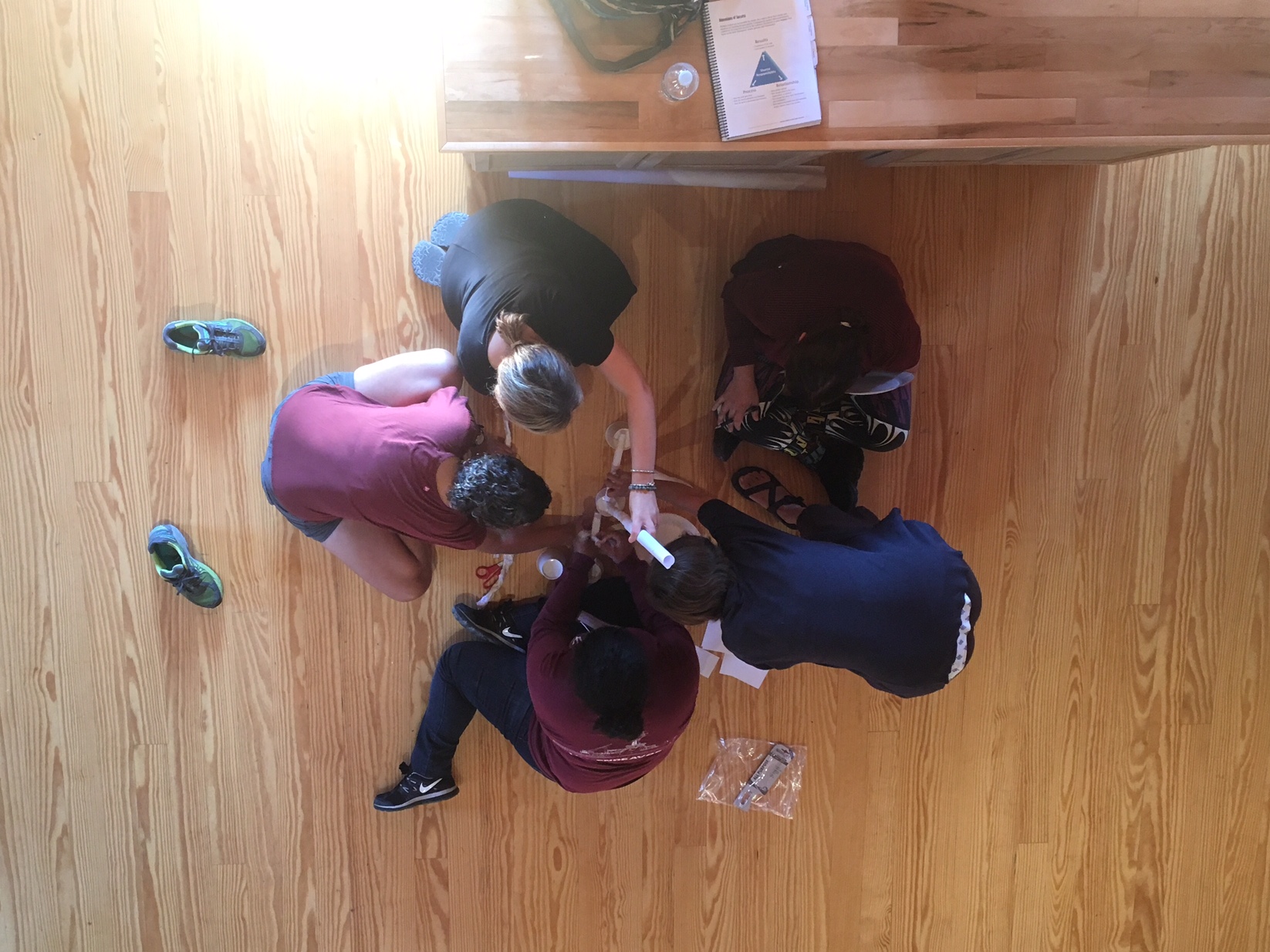
2017-2018 NLI cohort members engage in a team building exercise focused on the dimensions of collaborative success.
Last week I worked with the Backbone Team of Food Solutions New England to launch the second cohort of the Network Leadership Institute (NLI) at Ohana Camp in Fairlee, Vermont. This initiative has grown out of FSNE’s commitment to cultivating both thought leadership and network leadership“to support the emergence and viability of a New England food system that is a driver of healthy food for all, racial equity, sustainable farming and fishing, and thriving communities.” Another impetus for the NLI was a year spent doing system mapping and analysis that revealed four leverage areas for advancing a just, sustainable and democratically-owned and operated regional food system, including cultivating and connecting leadership (see image below). Read More
“It’s great that I’m learning all of these practical leadership and facilitation skills, but what happens when I’m not the one leading or facilitating?”
How can we keep things rolling when we aren’t formally in charge and when formal leadership is perhaps not so skillful? My answer: There’s usually some opportunity to lead, ask good questions, and to facilitate from the chair! Read More
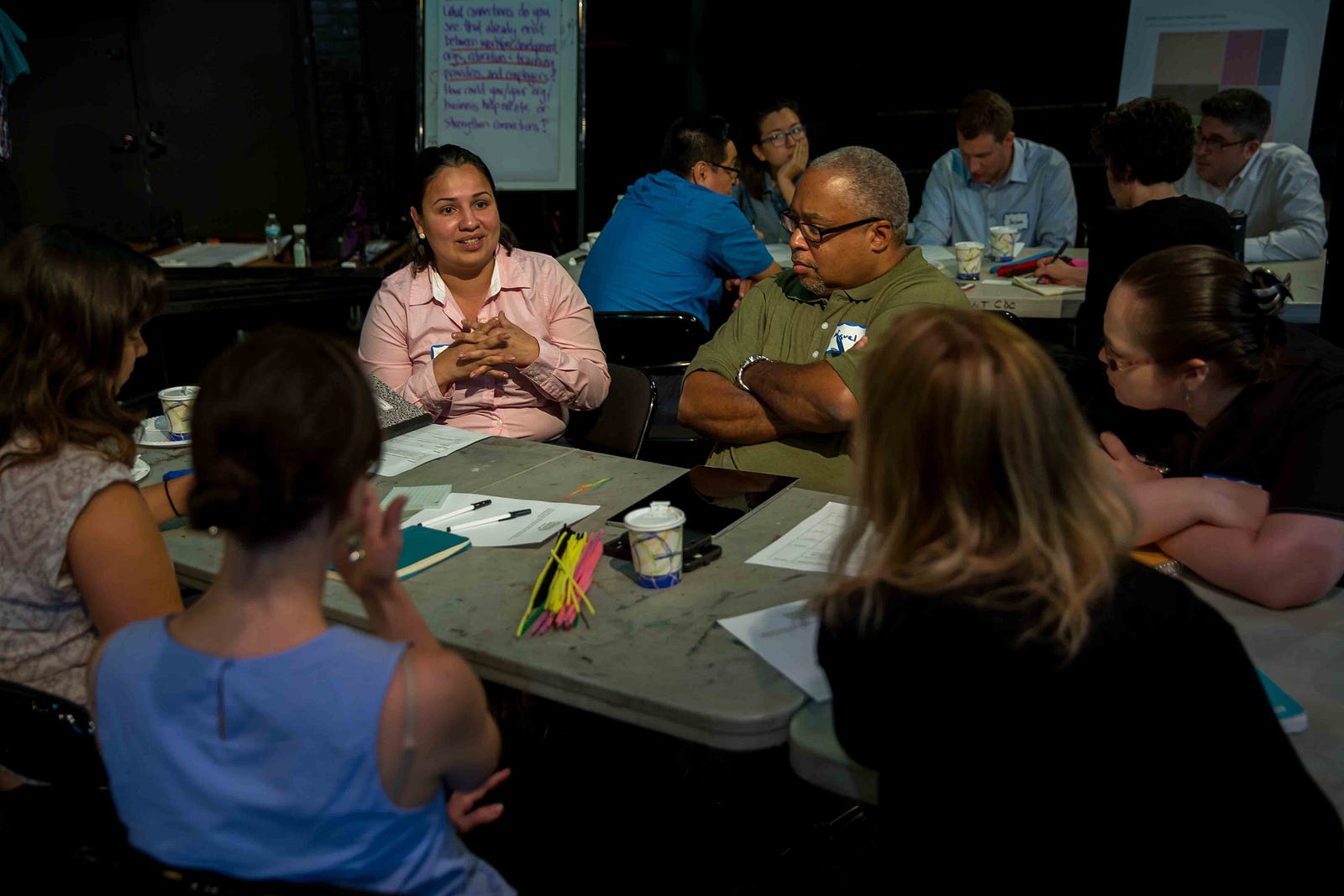
Collaboration Lab participants discuss social and economic resiliency at The Point CDC.
The following post and pictures appeared recently on the Hunts Point Resiliency website. Since 2015, a team of us at IISC have been working with the New York Economic Development Corporation (EDC) and the Mayor’s Office of Recovery and Resilience (ORR) to design and facilitate a robust public engagement process around a HUD-funded resiliency planning effort in the Hunts Point community of the South Bronx.
The Hunts Point Resiliency Project builds off of Hunts Point Lifelines, one of six winning proposals from the U.S. Department of Housing and Urban Development (HUD) Rebuild by Design competition in 2013. The City has $45 million of Community Development Block Grant Disaster Recovery (CDBG-DR) funding to advance resiliency in Hunts Point through further study and implementation of a pilot project. In March 2016, the City selected HDR, Inc. to lead two feasibility studies for energy resiliency and flood risk reduction, as well as conceptual design and environmental review for a resilient energy pilot project. IISC has taken the lead in designing an engagement structure and process for community organizations, business owners, elected officials, City agencies, and local residents to identify resiliency priorities, do public eduction outreach, and provide feedback that informs the project.
The Collaboration Lab was designed in partnership with The Point CDC to help deepen these conversations, looking at resiliency in more holistic terms (economic, social, cultural) and also strengthen connections between community members and organizations and City agencies.
Make Change Stick Beyond the MeetingTurn ideas into agreements that stick, and keep change going after the meeting ends. Perfect for teams stuck in “great conversation, little action.”