February 11, 2019

Image by Clearly Ambiguous, “Solar System,” shared under provision of Creative Commons Attribution License 2.0.
Last week, I was invited to a convening held by the Social Impact Exchange to do some work with funders who are considering and/or investing in systems change (as opposed to say programmatic) strategies. The invitation was to kick the convening off by helping to “open minds and hearts to new ways of thinking and doing.”
At IISC, we have been playing with what it means to “think,” given what can tend to predominate in many maintstream settings is highly analytical, disembodied and heart-dismissing approaches. Our belief is that we need to (re)claim the fullness of our intelligence in order to create the more beautiful world we know is possible. As our friends at Management Assistance Group have written:
“Too often, we stay in generalized and practical knowing, rarely dipping into foundational knowing or artistic knowing in meaningful ways. By not intentionally drawing on these, our theories and action plans are often disconnected from our values and beliefs, and the bedrock experiences of our lives.
Moreover, privileging one way of knowing over others marginalizes and ignores other truths that people bring from other ways of knowing. This marginalization often lies at the core of conflicts, systemic barriers to change, and inequity.”
To support people in this direction of more holistic knowing, we are creating more space to explore our individual and collective interiors, sit in and with spaciousness and silence, explore reality and possibility in more embodied ways (movement!) as well as engage in deeply relational interactions that can be heart and soul expanding.
At one point during our opening, I offered a collection of systems-oriented quotes and sayings and invited people to do a self-organized group read of them (whoever felt so moved to speak, though only one quote to a person). People were asked to pay attention to what moved inside of them as they read and heard these quotes. This was done, in part, to help dislodge people from unexamined thought patters. I was explicit about this and introduced the exercise with these words from quantum physicist David Bohm:
“A great many people think they are thinking when they are merely rearranging their prejudices.”
When the group was over, and after a moment of silence, people were invited to share with a partner what they were most struck by and why. You are invited to do the same with the words below, to read in silence or aloud, to share any reactions and resonance and also to offer other systems-focused quotes/sayings that you have found to help open and expand some aspect of your thinking.

Image by Matthias Ripp, “Planetary System,” shared under provision of Creative Commons Attribution License 2.0.
“A system cannot fail those it was never intended to protect.”
– W.E.B. DuBois
“The problem with problem-solving is the idea that a solution is an endpoint.”
“We act as if simple cause and effect is at work. We push to find the one simple reason things have gone wrong. We look for the one action, or the one person, that created this mess. As soon as we find someone to blame, we act as if we’ve solved the problem.”
– Margaret J. Wheatley
“For every complex problem there is an answer that is clear, simple, and wrong.”
– H. L. Mencken
January 22, 2019
“The rush and pressure of modern life are a form, perhaps the most common form, of its innate violence. To allow oneself to be carried away by a multitude of conflicting concerns, to surrender to too many demands, to commit oneself to too many projects, to want to help everyone in everything, is to succumb to violence.”
The quote above has been cited every now and then over the past dozen years or so that I have been with IISC, including a later line – “The frenzy of our activism neutralizes our work for peace.” Some combination of these words seem to come to mind and lips more frequently as many of the organizations and networks with which we work are are dealing with oppressive dynamics of overwork and urgency, whether they identify as activist or not.
These dynamics are increasingly recognized as an aspect of white dominant and supremacist culture and hyper-capitalist fervor that reduces many people to “producers” in the workplace and extracts as much labor as they can give. In our race equity and social change work, we see this as part and parcel of the structures that must be named and addressed for justice, liberation and sustainability to be realized.
In a recent workshop with an organization we are supporting through a two-year race, equity and inclusion transformation process, we invited the predominantly white staff into a dialogue circle to unpack their self-identified culture of overwork and urgency, to look more deeply at what they are gaining from this (and who in particular gains most), what they are losing (and who loses most), and what it would take to do commit to creating something different. Here is some of what we have heard, aspects of which are being echoed in various other organizations, networks and communities (curious to know what resonates): Read More
January 15, 2019
“We are the living conduit to all life. When we contemplate the vastness of the interwoven network that we are tied to, our individual threads of life seem far less fragile.”

Photo by Marie Voegtli, “network” shared under provisions of Creative Commons Attribution License 2.0.
Last week, we wrapped up the third annual Food Solutions New England Network Leadership Institute. For three years, we have been partnering with FSNE to cultivate and connect people in this region where IISC is based, who are committed to supporting the emergence of just, sustainable, collaboratively stewarded and self-determined food futures for all who live here. This network and leadership development initiative grew out of system mapping that FSNE undertook to identify four main areas of leverage to shift extractive, oppressive, oligarchic and life-depleting patterns of the dominant food system.
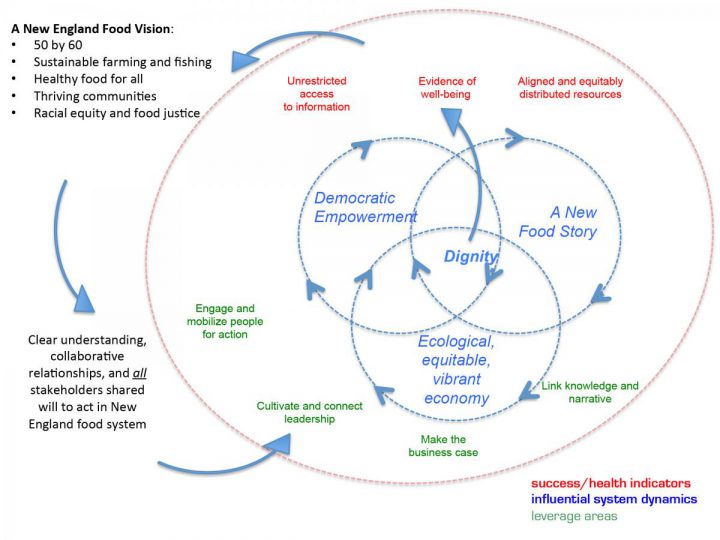
From the start, we and our partners at FSNE (including the backbone team at the University of New Hampshire Sustainability Institute, the FSNE Ambassadors, and members of the FSNE Process Team) knew that the main value of any kind of leadership development program would be in the people that came together and the relationships they built with one another. From there, we were interested in creating opportunities for those involved in the program to cultivate connections with other values-aligned change agents in the region. In addition, we looked at giving people an experience of different and diverse places in our region (rural, urban, coastal) and to see their work in a regional context. Lastly, we wanted to offer an opportunity for participants to hone their skills as collaborative/network leaders and equity champions.
Here is our working and ever-evolving definition of network leadership:
Network leadership operates from the understanding that connection and flow is fundamental to life and liveliness and that the nature and pattern of connection in a system underlie its state of health (including justice, shared prosperity and resilience). Network leadership strives to understand, shift and strengthen connectivity; facilitate alignment and resource flows; and create conditions for coordinated and emergent action in the direction of greater health and belonging at different systemic levels.
Read More
January 7, 2019
“That which counts, can rarely be counted.”
-Albert Einstein

Image by garlandcannon, used under provisions of Creative Commons Attribution License 2.0.
In a couple of articles that have been re-cycling in different social circles, the reminder is offered that tipping points for social change do not need anywhere close to a majority of actors.
A few years ago, scientists at Rensselaer Polytechnic Institute explored what it takes for an idea to spread from few to many, for a minority opinion to become the majority belief. According to their study, the RPI researchers said that the answer is 10%. When one in ten people adopt a stance, eventually it will become the dominant opinion of the entire group, they say. What is required is commitment.
More recently, researchers from the University of Pennsylvania and the University of London conducted an experiment that suggests that for activists to achieve a tipping point around change, 25% of a given population is required. They published their study in the journal Science.
Of course there are complicating factors, including the fact that there are often competing factions each vying for their own 10-25% and with social media and disinformation campaigns, confusion can rein and commitment may require an additional degree of diligence. Nonetheless, we might take more heart in the power of the few.
And this is clearly not just about numbers and counting.
Read More
December 27, 2018
“I need love
Not some sentimental prison
I need god
Not the political church
I need fire
To melt the frozen sea inside me
I need love.”
– Sam Phillips
I started this year with a post focused on love, and this idea that 2018 would be the year of love. This thinking wasn’t offered through rose-colored glasses, but from a shared sense and conviction that love would be required to see the year through. And not just any kind of love. In that original post there were a few definitions and quotes that we have been playing with at IISC, including these:
“All awakening to love is spiritual awakening… All the great social movements for freedom and justice in our society have promoted a love ethic.”
– bell hooks
“Justice is what love looks like in public.”
– Cornel West
“To show compassion for an individual without showing concern for the structures of society that make him [sic] an object of compassion is to be sentimental rather than loving.”
– William Sloane Coffin
“Love is seeing the other as a legitimate other.”
– Humberto Maturana
“The ultimate act of love is allowing ourselves and others to be complex.”
– Nora Bateson
Well, all I can say is that I had no idea what I was getting myself into. Turns out that the writing of that post was a step into a full-bodied exploration of what love really is. And it has been profound.
Around about mid-February, the bottom fell out for me personally, both emotionally and spiritually. My head could no longer protect my heart and soul from what continues to unfold and be revealed around us, and I was taken into a world that I did not remember having experienced before (but that I now know I have known very intimately) – fear/terror, grief, guilt, overwhelm. I was fortunate (very fortunate) to be able to engage some skillful supports that, rather than lift me up, took me deeper, into old and age-old wounds.
I was reintroduced to the wisdom of the body and feeling. I took a hard look at damaging dynamics of internalized individualism, defensiveness, hyper-productivity and over-work. I was invited to take seriously the importance of self-care, and perhaps more importantly, community care. As I got more courageous to share with others what was happening, I found the unexpected grace of support and resonance in friends, near and far, seen and (previously) unseen.
And I met amazing contemplative teachers, including Father Richard Rohr, whose writings (including his book Falling Upward – thank you, Melinda Weekes-Laidlow) consistently call on seekers of spiritual maturity to follow a path of “descent” into the shadows, the “false and small self,” the fuller truth of historical and present suffering and injustice. With that came new awareness and experiences of trans-generational and vicarious trauma. Little seemed solid or certain or assured anymore. Following that, staying with that, held and witnessed in that, I have been guided to feel some glimmers of a deeper underlying ground. It’s hard to name it exactly (The Growing Edge. God. Creation. Life Itself.) though I know it has everything to do with love. And it’s still revealing itself, step down by step down.
What it has required is an excruciating letting go of what I thought sustained me, survival skills for a different time and me. It has also required an opening to others that I didn’t know was possible. And at this point and from this place, love has less to do with words and thinking and so much more to do with being.
“True love is radical because it requires us to see ourselves in all people.”
– Alexandria Ocasio-Cortez
I am grateful for the amazing leadership and modeling of my colleagues at IISC, which has invited us as a collective over this past year to lean more boldly into spaces of feeling, of honesty, of vulnerability, of slowness, of spaciousness (see Kelly Bates’ recent post on why creating space is crucial to the work of justice), of love (see Miriam Messinger’s post on how we have been bringing love to work). And we are not alone!
At the recent Facing Race conference in Detroit, Michigan, racial equity OD practitioners collectively articulated a need to practice courageous and fierce love in these times and around our work for equity. So 2019 is bound to be a further venture into love as it relates to racial and other forms of justice, to sustainability, to regeneration, to well-being and to what it means to be human in the best sense and as a species worthy of survival.
Thanks to Jen Willsea for turning me onto the following prayer from Reverend angel Kyodo Williams. Pass it along:
Warrior-Spirit Prayer of Awakening
May all beings be granted with the strength, determination and wisdom to extinguish anger and reject violence as a way.
May all suffering cease and may I seek, find and fully realize the love and compassion that already lives within me and allow them to inspire and permeate my every action.
May I exercise the precious gift of choice and the power to change that which makes me uniquely human and is the only true path to liberation.
May I swiftly reach complete, effortless freedom so that my fearless, unhindered action be a benefit to all.
May I lead the life of a warrior.
(From Radical Dharma p.93-94)
December 17, 2018

Image by Graylight, used under provisions of Creative Commons Attribution license 2.0.
As I was just starting work at IISC, back in 2005, our founding Executive Director Marianne Hughes, introduced the staff to the work of John Paul Lederach, and specifically his book The Moral Imagination. As I recall, she did this as a result of a sabbatical during which she explored the power of networks and of art in social change. These two things show up centrally in Lederach’s work. Lederach has spent years doing peace and reconciliation work in some of the most intense and entrenched conflicts in the world. And he writes not really as a master technician, but as a poet, which is very much by intention.
I thought of The Moral Imagination a couple of months ago, when I began to realize how starved many people I meet seem to be for alternatives to what we currently have as mainstream systems in this country. Many are speaking up against and resisting what is not working, has long been unjust, and is fundamentally sustainable, which is crucial. And in the absence of clear alternatives (see “reimagine” and “recreate” in Spirit in Action’s image below), what can ensue is … conflict. Entrenched conflict, with no creative point of release.

I also thought of Lederach’s book, because he writes how central networks, human webs, and authentic human connection is to the work of peacebuilding and reconciliation. Up until recently I had thought about peacebuilding as a field as having more to do with what goes on in “other places” like Ireland, Sudan, Colombia, Tajikistan. If nothing else, these past couple of years have provided a need to adjust that understanding – peacebuilding is needed at home.
So I’ve been scouring Lederach’s writings, and there is a lot that resonates. Lederach was recently featured on a powerful program of On Being with actress and activist America Ferrera (no doubt another reason he has been on my mind). There is much to say about The Moral Imagination, but for now I am offering some passages and quotes that struck a chord and I’m curious to hear what reactions those reading have … Read More
December 10, 2018
What makes a fire burn
is space between the logs,
a breathing space.
Too much of a good thing,
too many logs
packed in too tight
can douse the flames
almost as surely
as a pail of water would.
So building fires
requires attention
to the spaces in between,
as much as to the wood.
When we are able to build
open spaces
in the same way
we have learned
to pile on the logs,
then we can come to see how
it is fuel, and absence of the fuel
together, that make fire possible. …
A fire
grows
simply because the space is there,
with openings
in which the flame
that knows just how it wants to burn
can find its way.
– “Fire,” Judy Sorum Brown

Change does not tend to happen through piling on, through simply adding to what we are already doing or whatever heap we have in front of us.
Change happens, say scientists and sages, through some kind of release, through letting go. Not of everything, but of something. Something that will create enough space for creativity (something else!) to happen.
Changing the way we do work, behave, and treat one another and the planet doesn’t mean dumping new techniques on top of old ways of working. It means carving out creative niches that are given space for the breath of life to reach them. So they can grow. So that they can find their way.
Change does not tend to happen in isolation (the proof of re-treat is ultimately in re-engagement). It happens through connection, through webs (no one is an island). It happens through collective care and nurturing. Too much space – distance, disconnection – can kill the spark of change.
Sharon Salzberg and Ethan Nichtern ask an important question –
“What are we holding onto about this system [ways of doing and being] that, if we trusted the other people around us, we actually could practice letting go of?”
Connection, deep connection, also helps us to let go. … And to let something else come.
Connect. Let go. Create space. Connect. Let come.
Like breathing.
How are you connecting (and to what and to whom) in order to let go of what no longer serves?
What are you letting go of in order to create spaces for the new and desperately needed?
What new connections (and old) are you making to fuel the fires of possibility?
December 3, 2018
“Scarcity alters how we look at things; it makes us choose differently; … our single-mindedness leads us to neglect things we actually value.”
-Sendhil Mullainathan and Eldar Shafir, Scarcity: The New Science of Having Less and How It Defines Our Lives

Image by geckzilla, shared under provisions of Creative Commons Attribution License 2.0.
A few weeks ago, the inimitable Seth Godin wrote a blog post about “the magnetic generosity of the network effect.” In the post, he talks about how a “scarcity mindset” can impact our willingness to share ideas. This can happen, says Seth, when we treat ideas as if we were sharing a pizza. But ideas are not pizza slices. Ideas can grow, inspire, flourish. Ideas when offered freely can give birth to innovation; in dialogue they can create even better ideas. The exchange of ideas can grow energy and enthusiasm among sharers and recipients. This is central to the notion of “network effect” – as a network grows, so does the potential of the network. It’s potential grows. Having connections is only as good as what gets shared through those connections, and in which directions. In other words, networks are made valuable not just through connectivity, but through generosity and mutuality.
I work with some groups, aspiring to be networks for change, that struggle with what I would call an “organizational mindset” in their work. Their tendency is to want to immediately put structure and boundaries on what they are doing – who is in, who is out; how we will make decisions; what committees need to be formed, who has what kind of power, etc. This is not necessarily a bad thing, except when it is driven by a scarcity mindset, an overly protectionist stance that can result in the hoarding and unwillingness to share things that are not scarce – ideas, appreciation, a skill, gratitude, love, an image, a tune – and whose sharing can create the richness of emergence and greater abundance. Read More
November 6, 2018
“Community exists when people who are interdependent struggle with the traditions that bind them and the interests that separate them so they can realize a future that is an equitable improvement on the past.”
-Carl Moore (quoted by Dr. Ceasar McDowell)

A couple of weeks ago I attended a gathering of network thinkers and doers pulled together by Steve Waddell and Diane J. Johnson, on behalf of the Emerging Network Governance Initiative. Our time together was designed for us to (1) get to know one another better and our respective work (because that’s what network weavers do) and (2) explore possibilities for collaboration to bring different network processes and forms of governance to bear at various scales in the face of the struggle/failure of traditional government to hold and do justice to demographic complexity and address a variety of social and environmental issues.
We spent some time early on unpacking the words “emergent,” “network” and “governance.” While we did not come to final agreement on set definitions, here is some of what I took from those conversations.
Emergent and emergence refer to the dynamic in networks and in life in general through which novelty arises in seemingly unexpected ways.
What is emergent is not planned per se, but rather surfaces through complex interactions between parts of or participants in systems.
Read More
October 9, 2018

The following post originally appeared on the IISC site four years ago. It has been slightly revised and is offered here to help those focused on leveraging “network efforts” with their change efforts to consider how they might shift and align their thinking and actions.
This post builds on another focused on the power of asking “beautiful questions” and inspired by a staff challenge to articulate lines of inquiry stemming from IISC’s collaborative change lens, It distills some of the underlying questions that adopting a “network lens” inspires for social change work. Please add, adjust, edit, and rift!
- How does your organization/network/change initiative strive to add value to (rather than duplicate) existing efforts? What do you do best, and how might you then connect to the rest?
- What are you doing to support and strengthen connections and alignment within and beyond your organization/network/change initiative?
- What current patterns of connection characterize your organization/network/change effort? How do these further or inhibit the change that you are trying to be and to bring about?
- What current resource flows characterize your organization/network/change effort? How do these further or inhibit the change that you are trying to be and to bring about?
- What current definitions of value (determinations of what and who matters) characterize your organization/network/change effort? How do these align with the change that you are trying to bring about?
- Who sits at the core of (decision-making, communication, coordination) in your network/ change initiative? Who is more peripheral? How does this arrangement help to bring about (or not) the kind of change you hope to see?
- What would happen if you drew in or out to those currently on the periphery? How might this happen?
- How do you currently engage with one another in your organization/network/change initiative? What constitutes “legitimate” modes of knowing, sharing, and interacting? What does this make possible? What does prevent?
- How might you engage with one another in your organization/network/change initiative to facilitate the best of what everyone has to offer?
- How are you balancing collaboration and cooperation in your organization/network/ change initiative? When is it most strategic for all or most participants to coordinate (collaborate) around a given action? When and around what is it best to keep things diffuse and self-directed (sometimes defined as cooperation)?
- How have you created opportunities for mutual and continuous exchange in your organization/network/change initiative?
- What is the role of empathy in your organization/network/change initiative? What are you doing to nurture deeper understanding, connection, and trust?
- What is the role of gratitude and generosity in your work? What are you doing to nurture and encourage greater appreciation and abundance?
- How are you creating space for people to articulate requests and offers and to match these?
- What structures (governance, decision-making, communication) support the focus and functions of your network/change initiative?
October 2, 2018

I have been working with a national environmental health and justice network for the past few years, and at a recent retreat, the core leadership team wrestled with a set of criteria for guiding the creation of equity-grounded, whole network-mobilizing and systems-shifting strategies. This is where we landed:
Required
- If successful, the strategy will move us towards our long-term systemic goal.
- The strategy is fundamentally collaborative in nature.
- The strategy is consistent with network’s values.
- The strategy does not advance the network at the expense of other key constituencies, partners, or social justice movements.
- The strategy is worth the expenditure of time, resources and opportunity costs of pursuing it.
- The strategy aligns with the Jemez Principles for Democratic Organizing.
Strongly preferred
- The strategy connects to a clear pathway on our systems map.
- The strategy plays to the strengths and capacities of current network members.
- The strategy broadens and deepens connections with impacted communities and constituencies.
- The strategy will build leadership within the network, with a particular emphasis on building leadership among the most directly impacted communities and constituencies.
- The strategy is likely to bring new funding and capacity around the network’s goals.
- The strategy will increase our learning and understanding of promising practices for systems-based collaborative networks.
Bonus points
- The strategy is likely to attract media attention to network members and/or advance our network narrative.
- The strategy would leave the network better positioned to move forward future initiatives.
- The strategy will increase the network’s reputation for innovation and/or effectiveness.
- The strategy will increase the network’s standing with key thought leaders and/or policymakers.
- The strategy presents an opportunity to collaborate with desirable new partners.
What resonates? What would you add that you have used as criteria for determining systemic strategies for collaborative networks?
September 12, 2018

Image from Sharon Mollerus, shared under provisions of Creative Commons Attribution License 2.0.
As I’ve worked with a variety of social change networks to launch or transition from one stage to another, I’ve been guided by the following formula:
Form follows function follows focus
My experience is that many groups and initiatives can get very concerned about structure – How will we make decisions? Who will be members? What is expected of them? What do they get in return? These are important questions, and they deserve a fair amount of time tending to them. What can bog many groups down at this stage, however, is that they have not sufficiently sorted out the functions of the network, how it creates value, if you will, which has important implications for form. And if the group is not clear on its focus (purpose, animating goal, mission), this can be that much more perplexing.
So I’m spending more and more time with networks sorting out their core “jobs,” with a few additional guiding mantras, including:
Do what you do best and connect to the rest.
The value proposition of change networks in my mind is that they add value to a broader landscape of activity, not that they come in and try to take over. Even if this is not the intent, groups can spend little time figuring out what already exists “out there,” what efforts are underway, what other collective efforts are operating. This lack of awareness risks creating unnecessary and unhelpful duplication and competition. Read More