Author Archives for IISC
February 4, 2020
As IISC Senior Associate Curtis Ogden was scrolling through Twitter, he came across a post from Adam Kahane of Reos Partners who shared five practices for breakthrough facilitation. IISC enjoys teaching the tools of facilitation through our signature workshops. We offered additional ideas using our lens of equity to build on his ideas.
See
how our team responded:
@adamkahane tweeted on Jan 7, 2020
Five simple (but not easy) practices for Breakthrough Facilitation from Adam Kahane
1. Listening – beyond providing expertise
2.
Cultivating – beyond producing an agreement
3.
Accompanying – beyond directing
4.
Pivoting – beyond following a roadmap
5.
Partnering – beyond standing apart or above
Cynthia Sliver Parker, IISC Senior Associate, added:
- Unmasking – shining a light on
power, inequity, and dynamics in the room
- Reframing – challenging
unnamed assumptions, insisting on a systems analysis of the issues being
discussed rather than blaming individuals
- Centering – putting the
experiences, wisdom, needs, and aspirations of people suffering the effects of
racism, sexism, and other forms of oppression first
Melinda Weekes-Laidlow, IISC Affiliate Consultant, added:
- Surfacing (beyond politeness, or
emergence)
- Sensing what is being experienced
or felt but not acknowledged, named or legitimated
Kelly Bates, IISC President, added:
- Sensing and surfacing the unnamed
- Bringing out voice of those at the
margins
- Holding all people and
complexities
- Creating intentional and brave
space
- Raising up authenticity and
transformative vulnerability
- Modeling challenging power in the
room
July 16, 2018

This is a repost of a third in a series of posts on power, facilitation and collaborative process that former IISC Senior Associate Linda Guinee wrote back in 2010. Last week we reposted Linda’s piece “What is Power Anyway?,” which followed a new post by a few of us on power and meetings. Enjoy!
More about power and group processes. There have been a mountain of books written about the “bases of power” and the “types of power”. I’ve done some work to try to boil it down – and find thinking about this very useful in moving forward the conversation about how to address power issues in group processes.
In the 1950s, French and Raven put out a proposal about five “bases” of power, which others added to. Bases of power are what gives a person or group power. French and Raven came up with these five:
- Reward Power – power that comes from the ability to reward the other party for complying
- Coercive Power – power that comes from the ability to punish the other party if they do not comply
- Legitimate or Normative Power – power that comes from accepted group, community or societal norms or values which are generally viewed as “legitimate”
- Referent Power – power that comes from being identified with a person or group (for example, so and so gains power by being friends with X or being a member of Y group)
- Expert Power – power that comes from the perception that the person or group has knowledge
Morton Deutsch later added a sixth:
- Ecological Power – power that comes from being able to control one’s social or physical environmental in such a way that the modified environment induces a desired behavior or prevents an undesired behavior.
Read More
April 19, 2018
IISC is pleased to offer the following three opportunities.
- Senior Associate
- People Operations Coordinator
- Training Coordinator
This search is being led by Imagine Consulting, a talent and recruitment firm specializing in supporting nonprofit organizations in securing an equitable and antiracist future for our world. Interested candidates should click here to apply. If you have questions or need support completing the application, please reach out to our team at careers@imagineimpactllc.com.
IISC’s Values
Our values are as important as the skills you will provide to our organization. These values guide IISC in our work internally and externally:
- We believe that social change is possible when three key elements are attended to: shared power and equity, network building, and love as a force for social change
- We believe that transformative leadership is the kind of leadership we need in the 21st century
- We believe in people’s right to be involved in the decisions that affect them so that they have influence over the quality of their lives
- We believe in the dignity of all human beings and in taking care of our planet so that we can all live healthy lives and our communities can thrive
Senior Associate
The Senior Associate works with organizations, networks, government agencies and communities to produce and deliver services that are committed to transformational, long-term change for racial equity. The Senior Associate also contributes to our evolving methodology and strategy, committed to peer learning, and contributes to IISC’s staff goals as we strengthen our equitable workplace. We currently have two openings for this role, with one of the positions will be focused on training and developing new curriculum and innovations.
Learn more and apply by 4/17.
People Operations Coordinator
Position Summary:
The People Operations Coordinator is responsible for overseeing the administrative tasks related to the HR, benefits, and operations functions of an organization. The position serves as a project manager for hiring coordination and preparation, manages the onboarding and offboarding processes, maintains employee records, tracks employee training, and ensures compliance with legal and regulatory agencies. The ideal candidate will be motivated by supporting staff of a mission-driven organization in advancing racial equity and social justice, while maintaining internal processes that align with the organization’s values and culture.
Learn more and apply by 4/7.
Training Coordinator
Position Summary:
The Training Coordinator is responsible for providing logistical support for public offerings and training sessions, ensuring successful, high-quality experiences for clients, staff, and participants. Their duties include assisting before and during sessions, answering questions, managing registration through an event ticketing system, and organizing data for reporting. They should be confident in providing support for both online training sessions using Zoom features as well as in-person public workshops. The ideal candidate is a well-rounded individual who can coordinate with all stakeholders to handle the finer details of training experiences, ensuring the successful completion of workshops for all involved.
Learn more and apply by 4/7.
IISC is an Equal Opportunity Employer.
November 29, 2017
Increasingly, social sector organizations are applying collaborative change frameworks and tools to engage in racial equity transformation. In a pattern reflective of the broader movement for racial justice, employees, often women of color in particular, are challenging organizational commitment to racial equity internally and programmatically. Often people who are ready to take action want to know what they can do to create space for the conversations needed to catalyze racial equity transformation.
The list of strategies below was generated by Marlon Williams, Ratna Gill, Madeline Burke and Kimberly Dumont, during our Fundamentals of Facilitation for Racial Justice Work workshop held in NYC earlier this month.
- Data: Use data to identify and initiate a conversation about inequities
- Training: Invest resources in training to staff to learn about racial equity and create the space for them to bring insights back to the organization
- Elevate Voices: Look for expertise throughout the organization’s hierarchy and give power to those with the capacity to lead, regardless of position.
- Personal Capital: Leadership and those with significant person capital can use if in service of prioritizing conversations about equity.
- Crisis: Incidents in the news that highlight the impact of our racial disparities can serve as a call to action.
- Personal Ownership: A commitment to racial equity should be owned by specific individuals throughout the organization’s structure.
- Outside Voices: Bring in outside voices to validate the need and urgency for having a focus on racial equity.
- Highlight the Loss: Identify the the risks or potential loss of not having a focus on racial equity.
Have you tried any of these strategies? Is your organization embarking on a journey of racial equity transformation? We can help.
June 21, 2017
On behalf of the Board of Directors of IISC, I am delighted to announce that Kelly Bates has been appointed president of the Interaction Institute for Social Change effective June 15, 2017.
Since assuming the role of interim president in October 2016, Kelly has successfully led IISC with a sure hand through a time of significant organizational change, working effectively with the Board and staff to strengthen our organization. More recently, Kelly has pivoted to addressing IISC’s future direction and vision, launching and leading a joint Board-Staff strategy team and coordinating this with a comprehensive re-examination of IISC’s business model.
For those of you who do not yet know Kelly well, her appointment as our permanent president will draw on her 20+ years leading advocacy, racial justice, and women’s organizations. Prior to IISC, Kelly was the founding executive director of the Elma Lewis Center for Civic Engagement, Learning, and Research at Emerson College. She also served as the executive director of Access Strategies Fund, a social justice foundation funding organizations to expand democracy in communities of color and low-income communities. For ten years, Kelly led a consulting and training practice specializing in working with social change organizations and other institutions in the United States around issues of power, diversity, and organizational development. Read Kelly’s full bio here.
As we approach our twenty-fifth anniversary under Kelly’s leadership, the Board looks forward with great excitement to further strengthening IISC and – along with IISC’s talented and committed staff and our valued partners and affiliates – to shaping the next chapter in IISC’s future. Please visit our website to learn about our current work and services. And stay tuned as we roll out our new racial justice organizational training and announce plans for the celebration of our 25th anniversary!
Very best wishes,
Frank Robinson
Chair of the Board, IISC
June 7, 2017
A couple of weeks ago, IISC was invited to offer a post-conference session at the Collective Impact Forum Conference in Boston. The title of this 8 hour session spread over two days was “Advancing Racial Justice Through and Within Collective Impact.” This was an opportunity for Cynthia Silva Parker and Curtis Ogden to formalize our ongoing efforts to bring IISC’s core collaborative methods, frameworks and a variety of racial justice content and tools to the different elements of the Collective Impact framework.
We were heartened to see and hear the many conversations about racial equity during the main conference proceedings, and noted good and challenging questions and exploration about the fit between the Collective Impact model, such as it has been formally presented and understood, and community organizing and power building work. These conversations continued in some form or fashion during our session. Read More
February 25, 2016

Ikeda Center Podcast Episode 5: Ceasar McDowell – On the Evolving Nature of Community
Here is Part 3 of The Ikeda Center Podcast’s interview series with Ceasar McDowell.
In this final segment of our three part interview, Dr. Ceasar McDowell introduces some early experiences that have inspired his work in community development. He also discusses the evolution of how we organize ourselves as human beings in community. He comments that while in the past we were born into specific communities or chose communities that were local and familiar, now “all of that has changed.” He adds that “we often find ourselves in places where we can’t then build an integrated community, so we look at how do we then take care of that other part of ourselves, which we can say is spiritual, relational, whatever it may be…For some people, they start to do it around work, or they do it around their habits, or they do it around church…All of that still keeps us separate, because now you’re holding this multiplicity of the places where you’re finding your identity and yourself and your connection, and it ends up being fragmented in some ways.” Dr. McDowell continues by exploring this new space that we find ourselves in, one of transition and change.
February 3, 2016
Here is Part 2 of The Ikeda Center Podcast’s interview series with Ceasar McDowell.
In the second of this three part interview, Dr. Ceasar McDowell details his vision for democracy as an ongoing process of interaction and engagement. He shares that the work of democracy is “how people come to know and understand both each other, the issues that are important to them, and how they want to make meaning together.” He adds that his current work is focused on the idea of Big democracy which he describes as, “an aspiration. And at the core of this aspiration is the belief that the public is fully capable of working together to create sustainable, just, and equitable communities. But to do so the public must have ongoing, peaceful ways to interact around traditions that bind them, and interests that separate them, so they can realize a future that is an equitable improvement on the past.”
February 2, 2016
Since the origins of this country we have been embedded in a belief about the hierarchy of human value, a belief that some lives are more important than others. Two examples of this clearly expressed are racism and sexism. As long as this belief system persists, it will undermine democracy. One way it shows up is as microaggressions, those little bitty acts that say to someone, “you don’t belong, you can’t be trusted, you’re less-than”. It’s a message a black man gets crossing the street in front of a car when people lock their doors. Or the catcalls a woman gets walking down the street. Brain scientists are teaching us that these types of aggressions are deeply wired in our brain and to change them we actually have to change the experiences that people have.
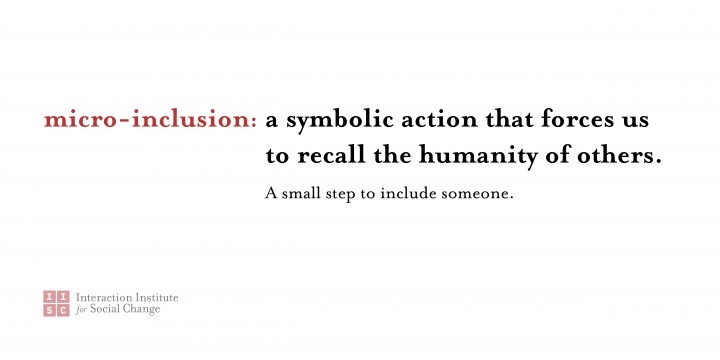
An antidote to microaggressions are micro-inclusions. These are little symbolic actions that force us to recall our humanity. They’re acts of humanity that signal to those at the margins they are included.
Read More
January 13, 2016
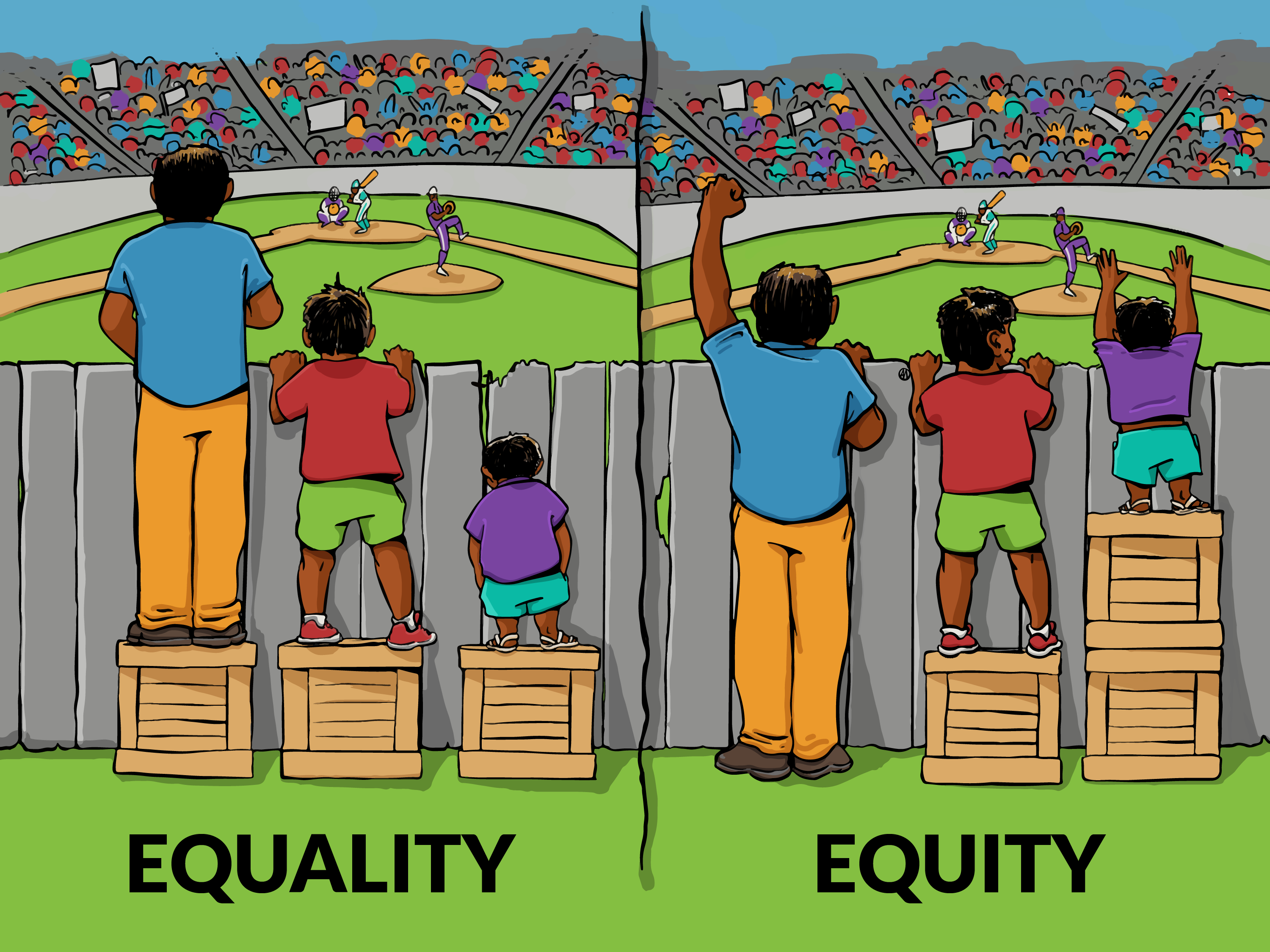
ATTENTION FRIENDS! Can you use the equality vs equity illustration in your book/video/presentation/etc?
Yes! You do not need written permission to reproduce the work. Read below for information on the license under which the illustrations are released.
IISC has long believed that this image, illustrating the difference between equality and equity, is worth a thousand words. As a gift to the world of equity practitioners, IISC engaged artist Angus Maguire to draw a new version of an old favorite (since we could only find pixelated versions of the original). Please feel free to download the high-resolution image and use in your presentations.
Would you like to use this image somewhere?
This image is free to use with attribution: “Interaction Institute for Social Change | Artist: Angus Maguire.” For online use please provide links: interactioninstitute.org and madewithangus.com.
We love hearing stories about how the image is being used so please get in touch with us and let us know how you used it. We especially enjoy hearing about how this image helps to start conversations about equity and equality. We’re on social media and email (comms@interactioninstitute.org and angus@madewithangus.com).
Updates since this article was first published:
20 May 2016: We were notified via Twitter that the original creator of the original graphic wrote a piece cataloging the evolution of the meme. Here’s the piece. It even encompasses our version and a few riffs on it, including our followup collaboration with the Center for Story-Based Strategy & Angus, #the4thbox.
Read More
December 21, 2015
IISC welcomes Kelly Bates to our organization as Chief of Staff and Democracy Strategy. Kelly brings excitement to our work in Big Democracy and public engagement, especially as we seek to engage people from all walks of life. She has spent the past twenty years running social change organizations, and consulting and training around political engagement, anti-oppression, and diversity.
“I am thrilled that Kelly has joined IISC,” said IISC President Ceasar McDowell. “She is bringing her experience leading organizations and deep understanding of democracy and racial equity to IISC.”
Kelly is the recipient of leadership awards from Boston NAACP, Boston University School of Law and, in 2013, she was awarded the Women of Color Changing Our World Award. Kelly credits IISC with shaping her style as a facilitator and leader, very early in her career. “I have deeply respected IISC for years,” she said. “I have hired IISC, been through public trainings, and worked with the team here. IISC facilitation is powerful, meaningful, and extremely well-executed.”

December 17, 2015
Sustainable City Network publishes about best practices for Leaders in Government, Education, and Healthcare. Recently they featured IISC Senior Associate Cynthia Sila Parker, reflecting on Rhode Island’s 2-year planning process, which incorporates equity goals. Read More