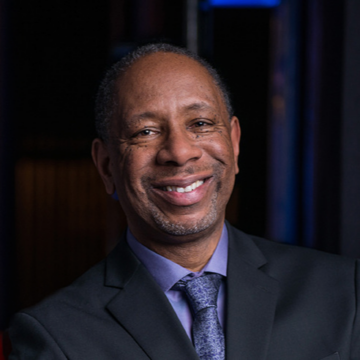
In the second of this three part interview, Dr. Ceasar McDowell details his vision for democracy as an ongoing process of interaction and engagement. He shares that the work of democracy is “how people come to know and understand both each other, the issues that are important to them, and how they want to make meaning together.” He adds that his current work is focused on the idea of Big democracy which he describes as, “an aspiration. And at the core of this aspiration is the belief that the public is fully capable of working together to create sustainable, just, and equitable communities. But to do so the public must have ongoing, peaceful ways to interact around traditions that bind them, and interests that separate them, so they can realize a future that is an equitable improvement on the past.”
Since the origins of this country we have been embedded in a belief about the hierarchy of human value, a belief that some lives are more important than others. Two examples of this clearly expressed are racism and sexism. As long as this belief system persists, it will undermine democracy. One way it shows up is as microaggressions, those little bitty acts that say to someone, “you don’t belong, you can’t be trusted, you’re less-than”. It’s a message a black man gets crossing the street in front of a car when people lock their doors. Or the catcalls a woman gets walking down the street. Brain scientists are teaching us that these types of aggressions are deeply wired in our brain and to change them we actually have to change the experiences that people have.
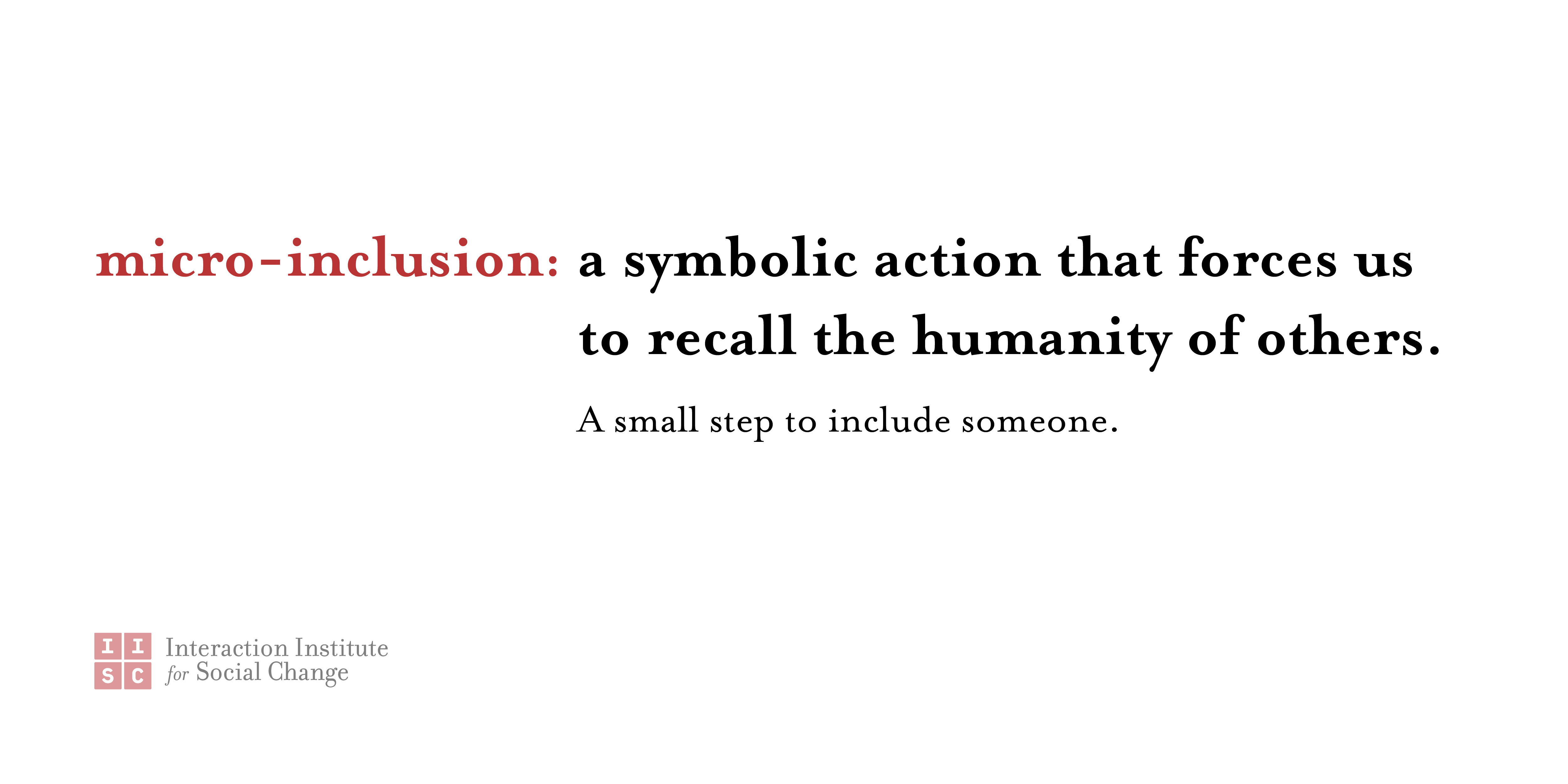
An antidote to microaggressions are micro-inclusions. These are little symbolic actions that force us to recall our humanity. They’re acts of humanity that signal to those at the margins they are included.
What’s the difference between equality and equity? This illustration offers a simple way to start the conversation.
Created for IISC by artist Angus Maguire in 2016, this widely shared illustration (based on the original from Craig Froehle) shows how giving everyone the same resources can produce very different outcomes, and how an equity approach considers what people need to participate more fully.
IISC also collaborated with the Center for Story-Based Strategy and Angus Maguire on #the4thbox, a related exploration of the illustration’s ideas.
Download the illustration
Download the high-resolution illustration to use in presentations, workshops, classrooms, social media, publications, and other educational settings.
The downloadable package includes JPG, PNG, PDF, and AI files.
Using the illustration
You’re welcome to reproduce and share this illustration. No written permission is required.
This image is free to use with attribution: “Interaction Institute for Social Change | Artist: Angus Maguire.” For online use, please provide links to interactioninstitute.org and beclouded.net
If you use the illustration, we’d love to hear about it! We especially enjoy hearing how it helps start conversations about equality, equity, and social change. You can reach us at info@interactioninstitute.org or on LinkedIn and Facebook.
Equality and equity
Equality means providing everyone with the same resources or opportunities. Equity recognizes that people may have different circumstances and may need different resources or approaches to have a fair opportunity to participate and thrive.
The distinction can be a useful starting point for a deeper conversation about access, power, systems, and the conditions that shape people’s experiences and opportunities. Read more about equity from IISC Senior Associate Cynthia Silva Parker in this blog post.
Keep exploring
Want to go deeper? Explore our Resource Hub for practical tools and resources for social change, or learn with us through our trainings, workshops, and recordings.
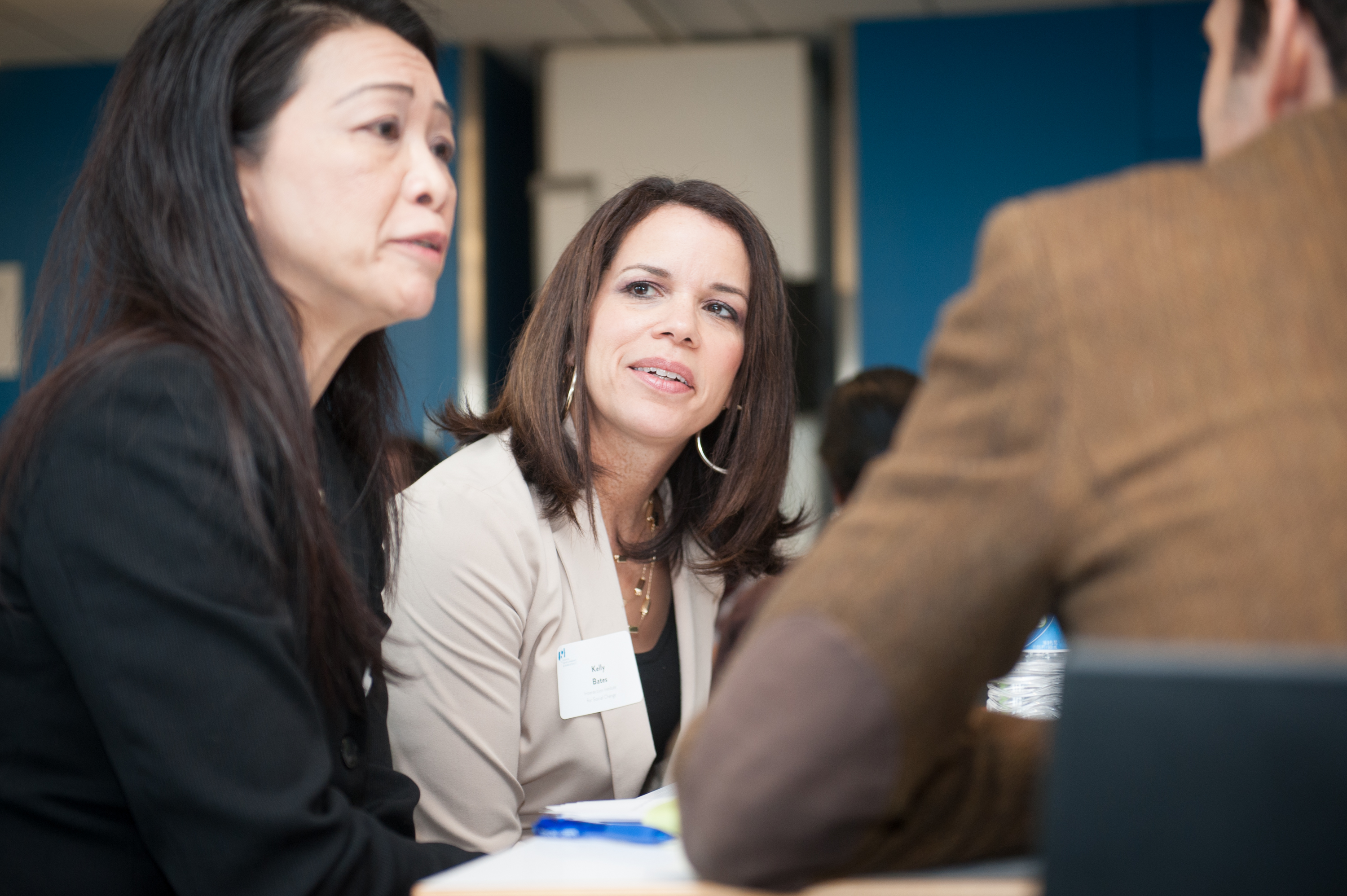
IISC welcomes Kelly Frances Bates to our organization as Chief of Staff and Democracy Strategy. Kelly brings excitement to our work in Big Democracy and public engagement, especially as we seek to engage people from all walks of life. She has spent the past twenty years running social change organizations, and consulting and training around political engagement, anti-oppression, and diversity.
“I am thrilled that Kelly has joined IISC,” said IISC President Ceasar McDowell. “She is bringing her experience leading organizations and deep understanding of democracy and racial equity to IISC.”
Kelly is the recipient of leadership awards from Boston NAACP, Boston University School of Law and, in 2013, she was awarded the Women of Color Changing Our World Award. Kelly credits IISC with shaping her style as a facilitator and leader, very early in her career. “I have deeply respected IISC for years,” she said. “I have hired IISC, been through public trainings, and worked with the team here. IISC facilitation is powerful, meaningful, and extremely well-executed.”
Sustainable City Network publishes about best practices for Leaders in Government, Education, and Healthcare. Recently they featured IISC Senior Associate Cynthia Sila Parker, reflecting on Rhode Island’s 2-year planning process, which incorporates equity goals. Read More
We are thankful for the thousands of people taking to the streets in Chicago in protest of the murder (and attempted cover-up) of Laquan McDonald. We are thankful for the thousands of activists demanding #JusticeforJamar in Minneapolis at the #4thPrecinctShutdown who have endured gun violence at the hands of white supremacists, desperate to stop the growing Movement for Black Lives.
We are grateful that this country is beginning to comprehend that racism is still a deep and persistent problem. A nationwide poll released by CNN and the Kaiser Family Foundation shows that roughly half of Americans — 49% — say racism is “a big problem” in society today. In, 2011 it was only 28%.
The unexplained shootings and deaths of Black men and women, the racially charged rhetoric of the Presidential race, and the increasing number of conversations around race in social and mainstream media have now affected our psyche in powerful and profound ways.
And yet, we’re desperately concerned that we’re not moving fast enough and working as deeply as we need to be.
These civilian shootings represent a terrifying moment, but also a learning moment that we need new strategies to interrupt narratives that normalize violence and racism. The current ways of eliminating racism aren’t working or we wouldn’t see both the “protectors” (the police) and violent racists shooting Black people at the same time.
Let’s embrace this moment to stand together, heal, and use everything we possess to interrupt racism and racist violent backlash. The US is settling into the reality of racism. It’s the right time for a global conversation around race and violence that leads to world changes promoting peace and equity. Interaction Institute for Social Change is incubating ideas for how to deepen and spread this dialogue and we hope you will join us.
Hamilton College has produced a TedX to remember, with speakers united under the theme “Curiosity and Creativity Uninhibited.” It was an honor for IISC President Ceasar McDowell to be invited, and supported by Hamilton student Chidera Onyeiziri.
Ceasar’s talk is entitled, “Big Democracy: A Fundamental Shift.” See him open with the vastness of wonder that exists in the universe, literally displaying a photographic representation of the Big Bang. He then presents the comparison to the Human Universe with its constellation of different races, ethnicities, languages, sexual orientations, and belief systems. So while the complexity of the universe inspires, the complexity of the Human Universe feels daunting.”
His answer to help us see and understand the complexity of the human universe is Big Democracy. Ceasar describes the artifacts democracy produces and interactions needed for an equitable society. He invites we frame our collective agenda using inquiry, explores why we need to design for the margins, and shares his latest idea for inter-personal change: micro-inclusions.
The talk calls on the audience to acknowledge the choice-point we are at as a society, and to imagine a new series of actions and interactions for social change.
The European Foundation Centre (EFC) is an international membership association of foundations and corporate funders working to strengthen the philanthropic sector in Europe and further afield. It is currently creating a new strategy for 2016 and onwards. IISC staff based in Belfast are supporting the EFC with the design and facilitation of this process. In developing the strategy EFC really wants to engage with a wide range of stakeholders so that the plan will be aligned closely with the needs, interests and aspirations of foundations and corporate funders in Europe and the wider world.
From Louise O’Meara, Regional Director of IISC Ireland: “We are delighted to be working on this project. The future of philanthropy in Europe and beyond is hugely important in addressing issues of social justice. Across the planet people are looking for new ways to have a greater say in the decisions that affect their lives. Philanthropy is central in enabling this and the European Foundation Centre has an important role in helping foundations and others to maximise their impact”.
IISC has worked with the Board of EFC and its staff in the early stages of the planning process and is now reaching out to its wider membership, seeking their views and wisdom, to inform the new strategy. A key mechanism for this is EFC’s Annual General Assembly and Conference, this year being held in Milan, Italy. IISC and EFC staff members will be hosting strategy workshops, conducting one to one conversations and employing a ‘strategy booth’ where participants can post ideas on where EFC should be heading in the future. They will all be donning super sized ‘strategy spectacles’ during the conference to help promote the strategy process and encourage people to get involved – even if at risk of looking a little bit silly!
It is hopefully a sign of things to come. Last night, a multiracial, multigenerational crowd of 3,000 – 5,000 took to the streets of Boston, shutting down parts of the city as part of a protest organized by #BlackLivesMatter Boston (@BLM_Boston). Read More
Boston has a “new gold standard in public engagement”
IISC leads public engagement for Boston’s transportation future
“Go Boston 2030 is a City of Boston initiative to envision a bold transportation future for Boston for the next 5, 10 and 15 years. The plan will develop a far-reaching vision that proposes transformative policies and projects to improve transportation for the city’s residents, businesses, and visitors. The two-year process will be driven by data and steered through an unprecedented and inclusive public engagement process.”
IISC designed this process so that the public framed the vision and was involved in ideation. See the story of public participation. This project is still underway.
In the News
Boston’s transportation planning can be fun, Boston Globe
Boston planners tap commuters to shape ideas for 2030, New Boston Post
Go Boston 2030 truck solicits commuter questions, Boston Metro
“The City of Boston launched Go Boston 2030 to better understand the public’s aspirations for transportation throughout the city and to build a bold, innovative transportation future based on an unprecedented level of public engagement,” said Mayor Walsh. “Our transportation Action Plan will lay out an ambitious roadmap to address inequities in underserved neighborhoods, connect our workforce to job opportunities, and prepare our systems for climate change.”
“The Go Boston 2030 initiative is using the latest technology and real grass roots activity to achieve an unprecedented level of community engagement. We’re hearing directly from a broad group of people about what their needs and hopes are for Boston’s transportation future,” said Mayor Walsh. “Together, through this initiative, the public and city officials will build a bold and innovative plan that will improve mobility for residents, commuters, and visitors.”
IISC Designs and Delivers Public Engagement Process
IISC President Ceasar McDowell described the process during a keynote at Grantmakers for Effective Organizations (GEO), reflecting on city planning as an opportunity to build democracy.
Senior Associate Andrea Nagel reflects on IISC Blog about the process.
Question Campaign and Question Review Session
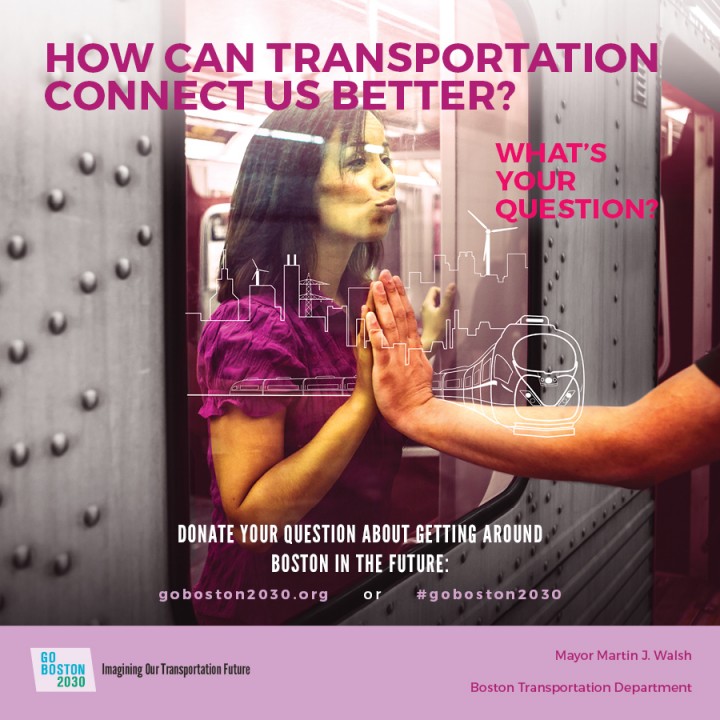
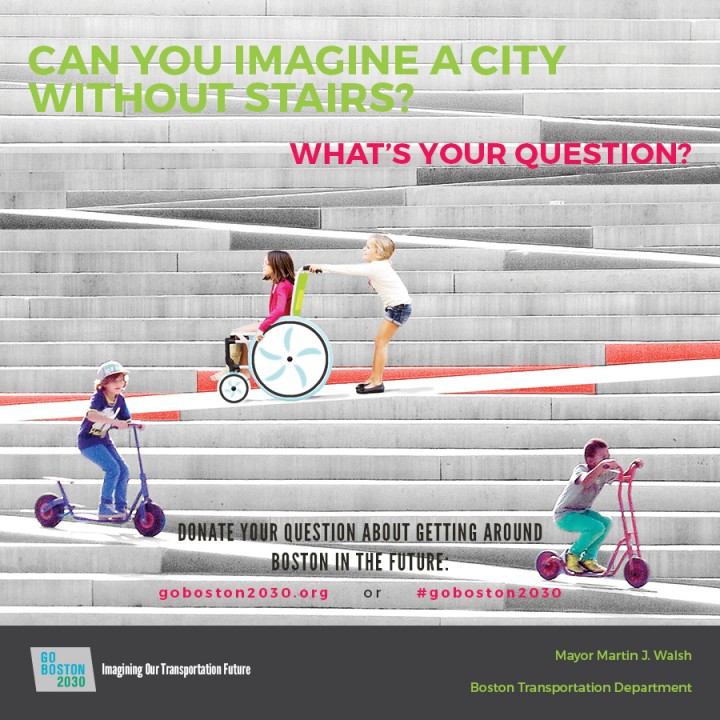
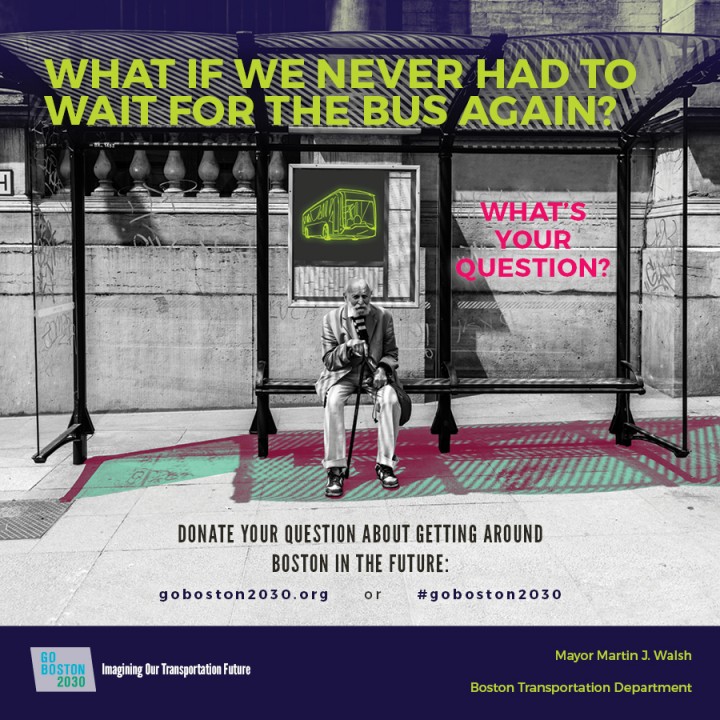
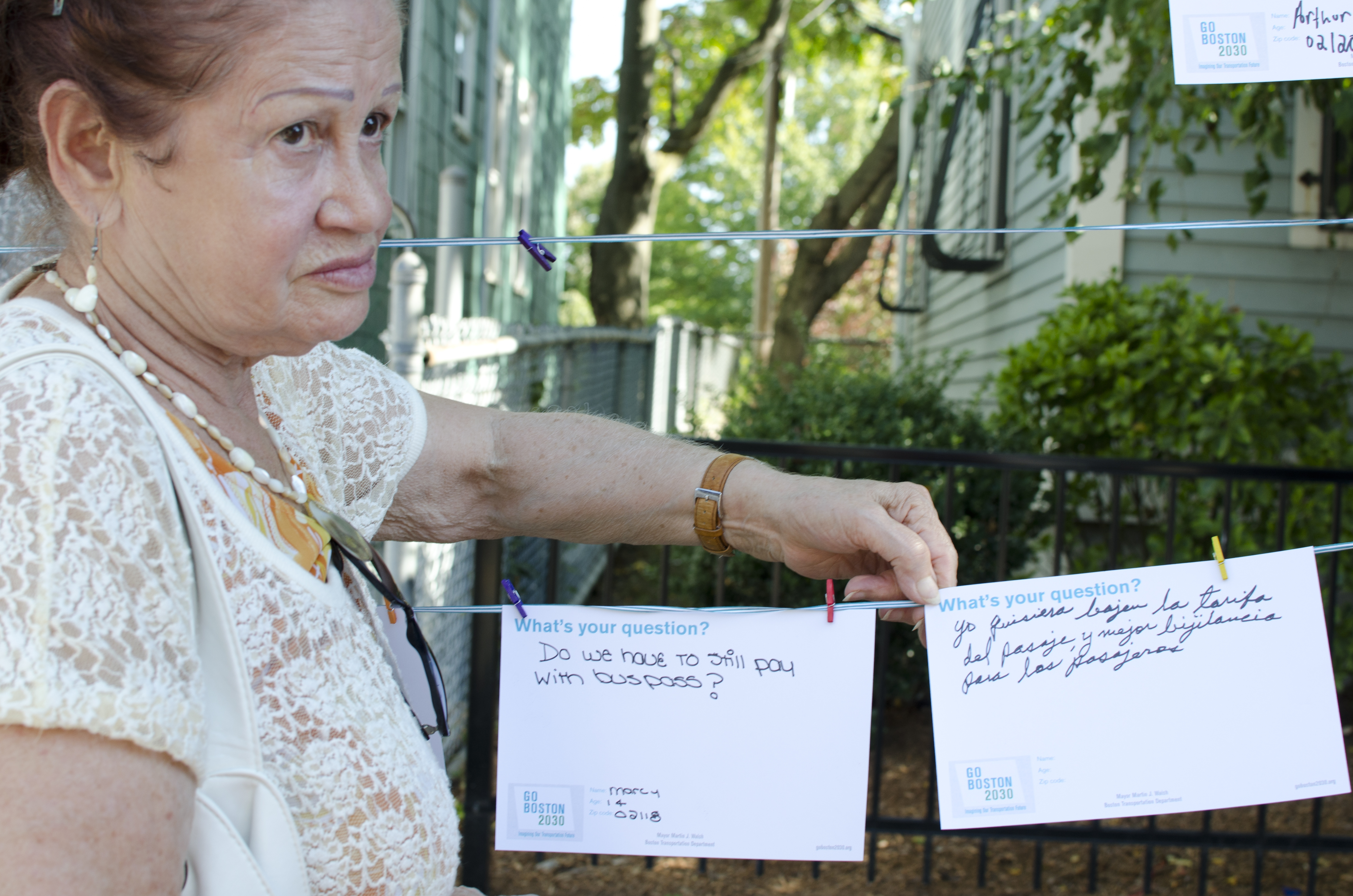
IISC and the city collected over 5,000 questions and touched every neighborhood in Boston. We did this by letting people submit a question in a way that makes sense to them and meeting people where they are.
For example:
People could submit questions via text, email, handwritten cards, Tweet, Instagram, Facebook, and other ways.
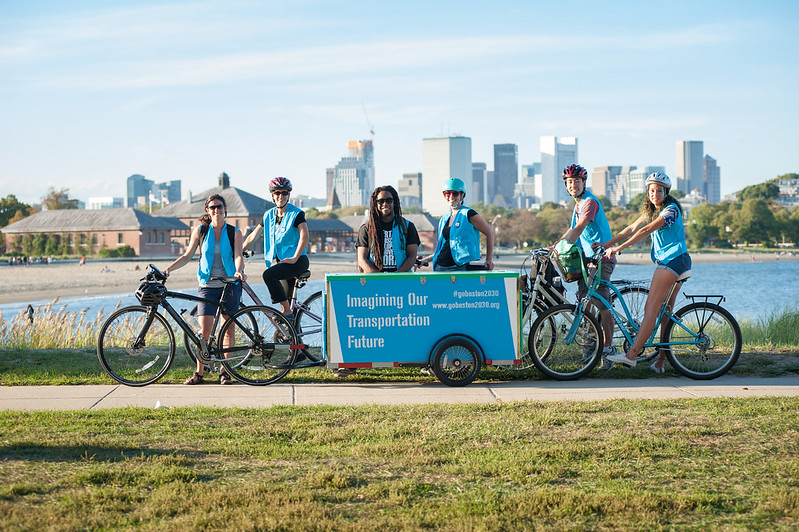
We designed an interactive glass truck that went to 15 neighborhoods.
We used digital media to publicize on the city’s social media pages, built a following, and attracted thousands of questions.
We had over 80 partners from city agencies to grassroots organizations committed to bringing their networks into the campaign.
We participated in existing events all over the city.
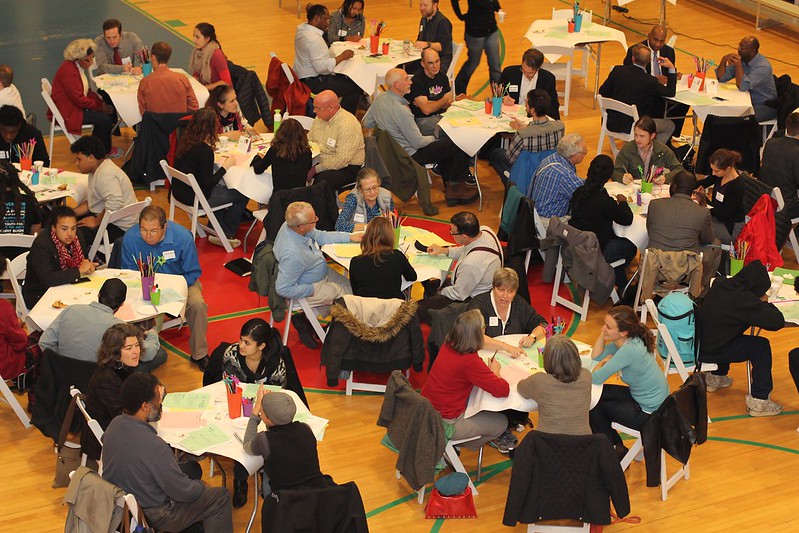
As the questions came in, they were organized by emerging themes and zip code, and made available for viewing on the website. But how do you move from 5,000 questions to something people can anchor around and build a vision? The Question Review Session was a half-day convening of city officials and community leaders who reviewed all of the questions and worked together to understand and articulate what the public was saying. Participants identified sets of questions that best represented what was most recurrent, provocative, and visionary amongst everything people had said.
Visioning Lab
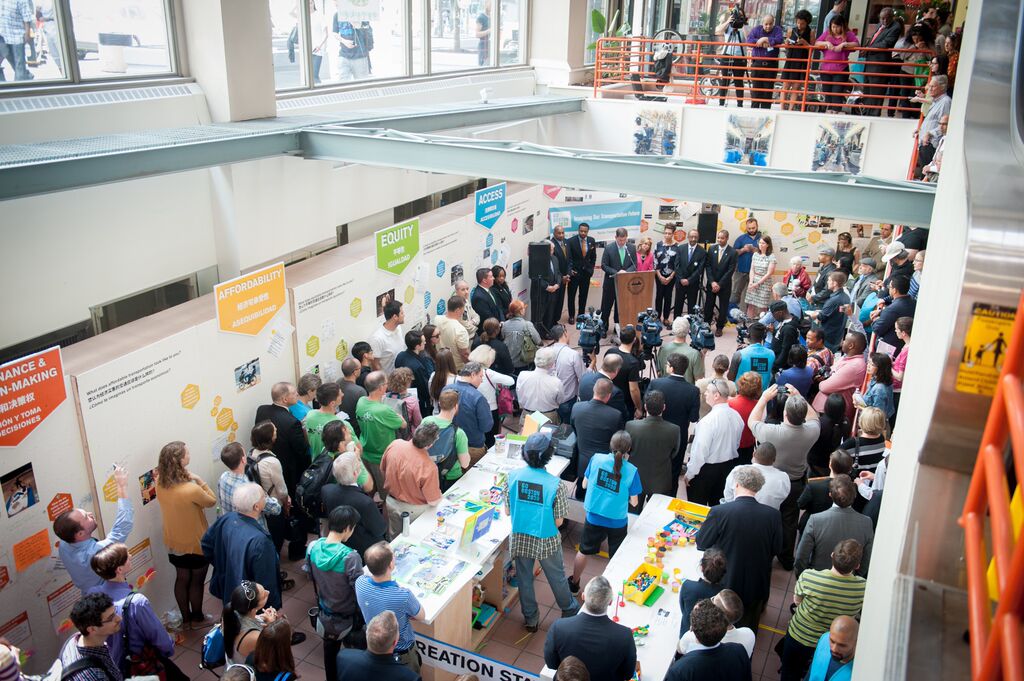
Next came the Visioning Lab, a place for people to share their vision of our transportation future. It was designed to test the resonance of the themes, questions, and vision ideas that emerged from the Question Campaign and Question Review Session. People were invited to answer some of the key questions and to articulate how they imagine seeing each vision idea come to life.
The Go Boston 2030 Visioning Lab took place on May 8 and 9, 2016 at the China Trade Center. Building on the Question Campaign, we asked the public to help us to develop a big vision for the future of mobility. The event was free and open to the public. What people wrote on the walls, designed at the Creation Station, and “liked” with stickers and tokens was used to guide the development of goals and targets for the Vision Report.
Results from this process are published in the draft report, which is available for download at Go Boston 2030.org.
Share Your Trip
“Share Your Trip with BTD” is a part of the Go Boston 2030 initiative that pairs people who work for the Boston Transportation Department with people who live and work in Boston who have volunteered to tell their stories about getting around the City. Combined with project and policy ideas collected this fall at “Ideas on the Street” pop-ups as well as data analysis about future demand, these stories are designed to form the narrative backbone of the Action Plan phase.
Ideas on the Street
The Ideas on the Street pop-up visited 31 neighborhood locations between September 19 and October 21, 2015. The expandable bike trailer collected project and policy ideas on paper maps and Members of the street team talked with people at events, square, and T stations across the city. An online platform also allowed people to share their project and policy ideas with words and maps using the smart phones or computers. Over 2000 ideas were collected.
Idea Roundtables
On November 10, November 14, and November 19, Go Boston 2030 hosted three interactive conversations about the future of transportation. Participants sat with people from other neighborhoods and discussed possible ways to address the challenges facing our transportation systems.
Ads will run on public transit and in neighborhoods, in addition to on-the-ground question collection by staff and network partners.
Take a look at some of the groups, initiatives, and blogs that are catching our attention these days!
Center for Whole Communities is a land-based leadership development organization that nurtures multi-disciplinary responses to challenges such as climate change and building economically competitive and equitable communities. at the same time, CWC’s leadership programs directly confront the fragmentation that exists in American society around politics, race, class and privilege.
The nationally recognized Rockwood Leadership Institute specializes in delivering the best practices and methodologies in leadership development to the nonprofit community. Rockwood has a vision of thousands of inspired social change agents trained in partnership, communication, conflict resolution, team building, planning and producing powerful results; and thousands of nonprofit organizations endowed with the skill and heart to bring out the best in their people, collaborate effectively with allies of all kinds and produce lasting change.
The Kirwan Institute partners with people, communities, and institutions worldwide to think about, talk about, and engage issues of race and ethnicity in ways that create and expand opportunity for all. Through interdisciplinary research and other working partnerships, the Institute aims to deepen the understanding of the causes and consequences of racial and ethnic disparities, in order to stimulate change to bring about a society that is fair and just for all people.
Movement Strategy Center. Throughout history, social movements have brought about the most significant changes for racial, economic and gender justice. It has been the actions of people most impacted by injustice that transformed our society’s systems and institutions, as well as our hearts and minds. Today, new ways of building power and creating deep change are unfolding across the country. The Movement Strategy Center works to strengthen these emerging efforts and build the progressive social justice movement by supporting individuals, organizations, alliances and sectors to be more strategic, collaborative and sustainable.
Race Forward: The Center for Racial Justice Innovationadvances racial justice through research, media, and practice. Founded in 1981, Race Forward brings systematic analysis and an innovative approach to complex race issues to help people take effective action toward racial equity. Race Forward was formerly known as the Applied Research Center (ARC).
Colorlines is Race Forward’s daily news site “where race matters.” It is produced by a multiracial team of writers who cover stories from the perspective of community, rather than through the lens of power brokers. Folks at Colorlines.com believe that instead of being defined and divided by racism, we can become uplifted and united by racial justice by confronting explicitly the racism that is so often at the core of our society’s challenges.
We all have people we love who are at risk of losing the support they need to live with dignity. Caring Across Generations is building a movement to defend what we have and create what we need for future generations so we can be a nation that takes care of one another across generations.
Rebuild the Dream. The American Dream Movement is growing stronger by the day, and it’s not going away until Americans can find jobs, afford to go to college, retire with dignity, and secure a future for their children and their communities. Rebuild the Dream is a way to join and support that movement.
Seth Godin has written fourteen books that have been translated into more than thirty languages. Every one has been a bestseller. He writes about the post-industrial revolution, the way ideas spread, marketing, quitting, leadership, and most of all, changing everything. We particularly like his blog.
Our partner organization: Interaction Associates founded IISC in 1993 as an expression of its commitment to social change and as a way of bringing its collaborative methodologies into the social sector. IA literally wrote the books on group process, facilitation, and building collaborative cultures:How to Make Meetings Work by our co-founders David Straus and Michael Doyle; and How to Make Collaboration Work by David Straus. IA’s legacy of innovation continues today in the development of collaborative approaches to coaching, leadership and team development, and change management.