Blog
December 17, 2009
It was at this time a year ago that I made the trip to Keene, New Hampshire to teach my final weekend Change Models class of the semester at Antioch New England. Just a few days prior, the entire region had been rocked by an ice storm for the ages. When the storm hit I was in Maine. Driving home the next day I heard reports about the worst damage being concentrated in western Massachusetts and southern New Hampshire. All that had slipped my mind when I got up early on Sunday morning to drive to Keene. It came rushing back when I got off of Route 2 heading north and the world turned dark and quiet. Everything in sight was cocooned in ice. Trees sagged. Homes along the roadside for miles were without lights. Businesses were shuttered. The awesome force of nature really began to sink in.
Read More
December 16, 2009
In the wee hours of the morning, I came across an amazing new project Seth Godin‘s been working on.? He pulled together 60 thinkers from around the world to answer the question “What Matters Now?” and created an e-book with their responses. Each person took a single word (sleep, re-capitalism, enrichment, nobody, meaning, ease, etc.) and used it to frame a short piece describing what they’re thinking about and working on for the coming year. And he’s hoping it will spread far and wide.
I thought I’d pass along a few short excerpts from this amazing piece.
One thing Elizabeth Gilbert describes in writing on the topic of ease:
“My radical suggestion? Cease participation, if only for one day this year – if only to make sure that we don’t lose forever the rare and vanishing human talent of appreciating ease.”
Read More
December 15, 2009
Part 3 of Three Lenses for Collaboration
The second lens through which the Interaction Institute for Social Change looks at collaboration is the lens of networks. I think about this as one of the most important interventions on the sector, the shift from an organization centric paradigm to a network paradigm. The good news is that this shift is already happening; the even better news is that this shift calls for stronger and deeper forms of collaboration.
In the recent Convergence report, LaPiana consulting identifies the fact that “networks enable work to be organized in new ways” as one of five converging trends that will redefine the social sector. It is important to understand that while there is a close relationship between new social technology and our capacity to work in networks, the shift to a network paradigm is not just a technological shift – it is a different way of organizing how we work together, a different paradigm for collaboration.
Read More
December 11, 2009
Yesterday, I was honored to lead a workshop on Facilitative Leadership for 500 women at the 5th Annual Massachusetts Conference for Women. Hosted by the MA Commission on the Status of Women, this mega-gathering attracted over 5,000 diverse women from corporate, government, non-profit, and social change sectors. The vibe was electric and eclectic – with a mix of executives, teachers, job-seekers, entrepreneurs, students, philanthropists, stay-at-home moms and many others. It was a day of focus on issues “that matter most to women, including personal finance, business, entrepreneurship, health and work/life balance”.
My 60 minute session, “The Practice of Facilitative Leadership”, was what we at IISC would call an “experience” of our flagship, 3-day, course. Up front, we acknowledged that, in this shifting socio-historical global context — anyone who claims to lead is merely improvising her way through unprecedented waters along with the rest of us.
Read More
December 10, 2009
In the abyss I saw how love held bound
Into one volume all the lives whose flight
Is scattered through the universe around.
–Dante Alighieri, from The Divine Comedy
“What’s love got to do with it?” This is a question that gets raised with increasing frequency in our work at IISC. Recently, while training a group of health care reformers from around the state of Maine, I presented what we call our “Profile of a Collaborative Change Agent,” which outlines the core attributes of those who, in our experience, are able to maintain a win-win outlook even in the most trying of circumstances. Sitting conspicuously at the heart of the Profile (see below) is “the L word.” Nodding heads and knowing smiles, in Maine and elsewhere, are an indication of the growing willingness to seriously consider the role of love in social change work. 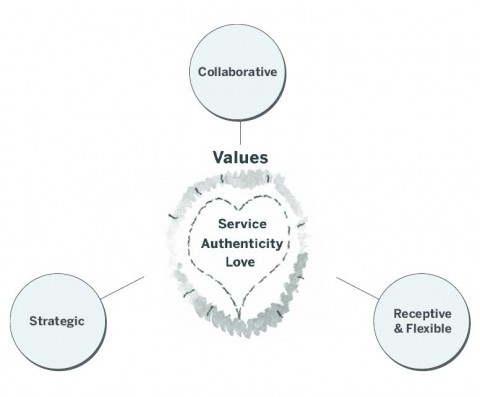 Read More
December 9, 2009
Fred Hampton, a charismatic African American activist and leader in the Illinois Chapter of the Black Panther Party, was killed in his sleep 40 years ago December 4th by the combined forces of the FBI, Chicago Police Department and Cook County, IL State’s Attorney’s Office. There have been some great articles written about him over the past week in Racewire and the Huffington Post.
In the days before he was killed, my dad met with Hampton and others from the Party to talk about the Free Breakfast Program the Black Panther Party had started to feed children going to school with empty stomachs. My dad was hoping to connect the food company he worked for with the Chicago program to get donations of breakfast cereal for the program. I was with my dad on the anniversary of Hampton’s death this year – and asked him to retell the story, hoping Alzheimer’s hadn’t taken this memory, though I’ve heard the story many times. Read More
December 8, 2009
Part 2 of Three Lenses for Collaboration
Last week I started writing about the Interaction Institute for Social Change and our three lenses of collaboration. We are talking about the sort of collaboration that is needed if we are to address the evolutionary challenges that define this historical moment. We are talking about collaboration that catalyzes our collective wisdom and capacity to think new thoughts, the sort of collaboration that allows us to maximize our shared resources while inviting us to live ourselves into the world we are trying to build. This is why I call this the lens of democracy, because it is the lens through which we define the best possible ways of being-with. Read More
December 7, 2009
 It is our tradition at IISC at the beginning of every year to send out one of our “classic” postcards to all of our constituents reflecting on the year past and the year to come as well as to announce our upcoming training schedule. As I was writing the introductory paragraph for this years’ I happened to stumble across what I had written last year. With the exception of last years’ reference to “renewed hope for reinvigorating civil society” (this was before the inauguration), I was struck by the similarities and the focus on the ultimate paradox. Read More
December 4, 2009
Fatigued?
Delighted yet dazed by 68 degrees in December… in New England?
Feeling a sense of a long stretch until year’s end?
Counting the days before another holiday break? Read More
December 3, 2009
“What does Twitter do to our relationship with Creation?” This was the final question in a wonderful conversation the other day with Liz Parsons, Co-Director of Contextual Education at the Boston University School of Theology. Our free-ranging dialogue ended on this note as we were exploring potential win-win formats for field placements for BU students at social change agencies. What would be in it for the agencies? Stating my belief that many students bring with them more natural collaborative inclinations and social media savvy than “seasoned’ social change leaders, I posited this as a value proposition inherent in members of the younger generation. Which got us firmly down the Twitter path . . .
When Liz’s provocative question popped, my mind split. On the one hand, I could see the case being made that Twitter and other Web 2.0 tools provide an additional and unhelpful buffer between us and the world. Too much reliance on the technology can, as essayist Bill Holm writes, “separate and deracinate us from nature and one another” removing “any sense of from-ness or connection.” The question looms whether we need any more mediation of our experience when so much suffering seemingly stems from disconnection. In a follow-up message, Liz mentioned that when her husband purchased a laptop, it came with an ongoing slide show of nature photos. “As if we have to be reminded,” she wrote, taking the words out of my mouth.
Read More
December 2, 2009
Come meander with me!
I’m reflecting on World AIDS Day.? The World Health Organization established World AIDS Day in 1988, and it’s been observed on December 1st ever since to raise awareness and focus attention on the global AIDS epidemic. In the early years, some museums would have “A Day Without Art,” shrouding artwork to demonstrate the impact of the epidemic.? And there were many other ways of observing – e.g., candlelight marches, displays of the NAMES Project AIDS Memorial Quilt, local awareness-raising or fundraising events around the globe. Read More