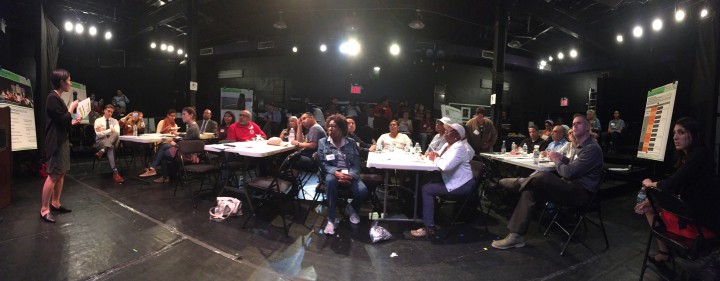
A team of us at IISC are partnering with an engineering firm to work on a climate change resiliency planning initiative in a vulnerable neighborhood in New York City. Our role is to lead the creation and implementation of a “stakeholder engagement plan” for broad-based input into project deliverables, including a fully funded infrastructure project and a feasibility study.
In developing our proposal for this initiative, we were guided by the notion that resiliency can and should be a core feature of social structures and processes. That is, threats to resiliency are found not simply in conditions such as low lying coastal communities or lack of back-up energy generation, but also in social disconnection and impaired flows of key resources. We were already aware of some of the vulnerabilities of this particular community, as well as its strengths in that it is well-organized and has a considerable density of social services and community organizations. That said, even when there are such assets in a neighborhood, there are many examples of municipally-sponsored projects that by-pass or fail to fully honor existing assets and networks in a community, with results ranging from missed opportunities to actually leaching resources (including time and trust). Read More
I can’t remember exactly where I saw the phrase recently, but I latched onto it. “Connections change what is connected.” So true. And this is a reason to seriously consider the power and promise of building networks for social change.
In our mainstream culture it seems that many people tend to look at things in isolation, without appreciating that context and relationship have so much to say about the nature of … well, everything. Think about the following examples: Read More
In light of a recent conversation with Jana Carp, an academic who has studied the underlying principles of the “slow movement” and how they connect to sustainability, place-making and livabily, I am revisiting, revising and reposting the piece below. Jana and I were connected by a mutual colleague with the Fire Adapted Communities Learning Network, given our mutual interests in public engagement, community-building and sustainability (inclusive of justice), and had an interesting conversation about slowness and networks.
At one point, the question came up as to whether networks might cut against slowness, especially when the emphasis is on rapid growth, diffusion, and trans-local connections. My thought at the time was that this certainly could be the case, and that is why it is important to think about both the breadth and depth dimensions of networks, as well linking different scaled networks (local, regional, global). The importance of networks for social change can certainly reside in their reach and rapid scaling. Their potential also resides in the nature and quality of connection, how deep the ties that bind are and what they help to create and circulate. And this brought me back to these reflections on how to think about “social velocity” in networks and collaborative work …
My friend Joel Glanzberg is a constant source of provocation and insight. The way he sees the world, through a living systems and pattern-seeking lens, is not only refreshing but unnerving in that it is evident how simultaneously critical and rare his perspective is. Joel is great at helping me and others to see beyond objects and structures to underlying patterns and processes, and how these are what animate living systems. Read More
It’s not too late for us to create a world that is better for future generations using collaborative change. To do this, we need everyday leaders who shift power dynamics towards justice, weave vibrant networks, and magnify love.
Our fate is shared and ALL voices must be empowered to realize our collective genius. Collaborative Change Agents ask, who is not here? What perspectives are missing?
Diversity and difference strengthen solutions. Collaborative change agents work skillfully with and through networks to make change.
Collaborative Change Agents practice treating themselves and those around them with dignity, respect, and the love that every person deserves.
Collaborative change increases trust. People can come together, resolve conflicts, and make the world a better place for all.
Through its myriad nodes and links, as well as the ongoing addition of participants and new pathways, a dense and intricate network can expand quickly and broadly. This can be critical for spreading information and other resources and mobilizing actors in ways that organizations simply cannot achieve.
Small World Reach
As a network adds connections, between and beyond organizations, and those connections in turn add their own connections, the overall reach of the network can easily shrink geographic and other forms of distance and separation. The subsequent ability of participants to discover and work with one another across expanses and barriers means that new partnerships and ideological convergences can happen, leading to greater efficiency, shared intelligence, and innovation.
Resilience
Provided a network (including a community or social movement) is not overly centralized and dependent upon a limited number of larger hubs (holding most of the connections to other nodes), it can stand up to certain pressures, including the loss of some of its nodes and links as it reorganizes around disruptions or bottlenecks. Furthermore, redundancy of and overlapping functions and knowledge enhance a network’s ability to absorb shocks without collapsing.
Adaptive Capacity
To the extent that it is intricately connected, diversely composed, with free flowing information, not to mention nimble/able to self-organize, a network can respond quickly to environmental shifts, assembling a variety of capacities/responses and disassembling them as needed.
Systemic Change
Though implied above, it is important to note that in a network it is not just the number and pattern of links that matter, but the quality and depth of the connections and what these can facilitate in terms of what flows through the various channels. Furthermore, it matters who is connected to whom, and what resources flow between these actors. As patterns of connection shift and strengthen and flows of resources are enhanced in different ways to different parts of a network, this can add up to systemic change.
“Systems change when new networks supplant the old.”
Create and use platforms (in-person convening and virtual sites) that allow people to find one another, create new connections, match interests and needs/offers and needs, and share information freely
Curate information/data to make it more accessible, attractive and digestible
“A good solution solves more than one problem, and it does not make new problems.”
– Wendell Berry
An essay that I return to now and then, including over these past summer months, is Wendell Berry‘s “Solving for Pattern.” Published in 1981, the piece essentially considers systemic approaches to more “sustainable “agriculture, though the concept alluded to in the title has wider application. The phrase “solving for pattern” isan invitation to take a larger and longer view of “problem-solving,” to think about interventions that serve a bigger picture in more sustained and multiply beneficial ways.
Solving for pattern, according to Berry, runs counter to reductionist and mechanical solutions, which lend themselves to more predictable and relatively contained situations. When reductionist solutions are applied to more complex and systemic situations, they are more prone to failure and to exacerbating negative aspects. Real-life examples include:
So many great podcasts, so little time to talk about them with friends. Have a listening party!
Generation Listen invited IISC’s Senior Associate Cynthia Silva Parker to share some facilitation tips for conversations about racism and racial identity. The activities are tailored to help listeners unpack episodes of the cutting-edge podcast Code Switch. Right now, people across the country are hosting “listening parties” where the podcast is paired with a conversation.
In numerous social change networks that we support at IISC, racial equity has been put at the center of the work, whether or not that was the initial impetus for coming together. This is not seen as ancillary to the change effort, but now understood as foundational, in that systemic inequity around race is part and parcel of the water in which we swim. In a few of these networks where there is a majority of white participants, increasing numbers of people are asking what they can do about structural racism, and one response is that there is important work to be done around whiteness and white privilege. As Gita Gulati-Partee and Maggie Potapchuk point out, this is often a critical missing link in racial equity work. Read More
Networks, or webs, are core to living systems. Thinking and looking through a network lens can help people to understand the patterns and quality of connection that either make life possible and enable liveliness or threaten life and livelihood.
“The world as we know it emerges out of the way we relate to each other and the wider natural process.”
In other words, according to Maturana and Varela, it is through connecting and relating that “a world is brought forward.” The quality and qualities of that world depend, in large part, upon how people and other elements of living systems connect and relate to one another. Read More
Social change networks are complex, compared with other human organizational forms; they are not so easily controlled, directed or predicted. And that is as it should be, especially when dealing with real life diversity and uncertainty. This can cause some anxiety on the part of those who would like to be able to better control for outcome and process and may not be very comfortable with emergence and self-organization. But these are the life blood of complex networks, part of their intelligence and effectiveness, even as people may struggle to wrap their heads around the full picture of what is happening. That’s the way life works.
That said, experience suggests that there is an important effort to be made and role to be played in tracking (even if imperfectly and incompletely) the unfolding story of a social change network over time. This is especially important for those in pursuit of hard evidence of effectiveness and/or some kind of guarantee that there is return on one’s investment of time and other resources. I have noted previously and continue to be struck by the fact that seeing signs of network impact can indeed be difficult, perhaps because of a kind of conditioning around what constitutes “action” and “success.” Furthermore, the pace of life can cut against an appreciation for what is moving right before one’s eyes in fairly nuanced and perhaps more measured ways. Read More
Watching intermittent coverage of the Democratic National Convention my heart softened when I heard New Jersey Senator Corey Booker remind those listening that “Patriotism is the love of country, but you can’t love your country if you don’t love your countrymen.” He went on to define love as ‘being there for each other…empowering each other…finding common ground…and building bridges across differences…’ in pursuit of a common goal. He articulated a beautiful and hopeful vision of a nation of love as a free people, living interdependently. Later on during the convention, Broadway stars gathered on stage to sing the American classic, “What the World Needs Now is Love.”
It gave me a feeling of hope, not necessarily in the Party per se, but in the power of love to captivate the collective imaginations of millions of people who believe that another world is possible, and we can make it a better one for all of us.
I recently re-read portions of Limits to Growth: The 30 Year Update by Donella Meadows, Jorgen Randers and Dennis Meadows. This second update to the original 1972 report from the Club of Rome affirms that current business-as-usual resource usage globally has our socioeconomic systems headed toward collapse shortly after the year 2050. The update reiterates the necessity of taking the impending crisis seriously and mobilizing quickly to adopt strategies such as:
While all of this serves as a strong wake-up (or stay awake) call, what most caught my attention was the concluding chapter, where the authors move from discussion of the technical fixes required to get us on the right track to a serious appeal to more adaptive approaches.Read More

 In light of a recent conversation with