Part of the underlying and deeper change potential of taking a network approach is the notion that we lead withcontribution before credential. This means being open to the idea, for example, that a 15-year-old high schooler or home schooler might have as much to offer a given conversation as someone with a PhD, that lived experience can be as valuable if not more so than formal education, that those on the so-called “margins” often have a clearer view of what’s going on than those who sit at the center.
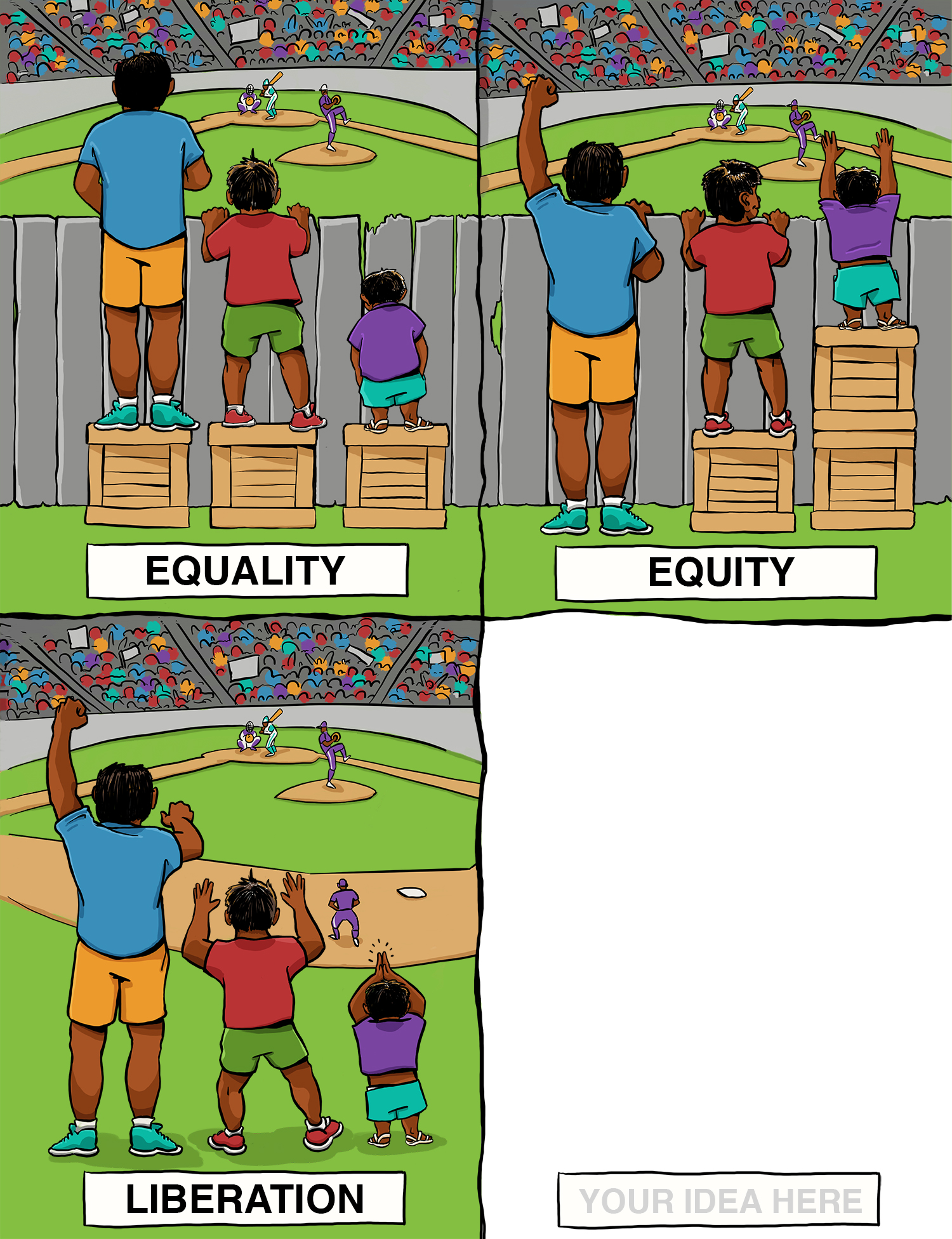
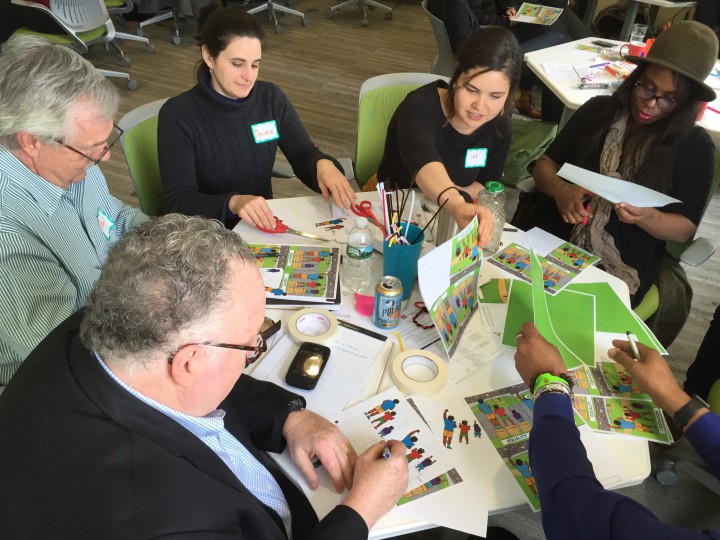
Recently our staff and board came together for an annual meeting. Part of the day was spent exploring racial equity projects happening across the organization. That was the first time we tried a prototype of the Cut-out Edition of #the4thbox. It opened up conversations on everything from analyzing “the isms” to creative ideas to create the liberated, equitable world we want.
We hope that you find this helpful, as you support people to have these conversations and imagine a better world.
Cut out the various pieces in this kit, and rearrange them to illustrate a new idea related to equity and social justice.
Tape or glue them to the last sheet in the kit.
Snap a photo and tweet or FaceBook it using #the4thbox!
TIPS
Draw and add additional objects to extend the metaphor.
Draw your own people to address. questions of identity and difference
Draw a new setting on a blank piece of paper.
Explore the meanings of each element of the metaphor as you think about your own vision.
From IISC’s Facilitators
“Working for racial equity is a whole-person, whole-organization experience. We have to work on our own hearts and minds; our hands (skills and behaviors); AND our organizational policies, structures, and processes. We have to be flexible and focus on multiple dimensions at the same time.” – Cynthia Silva Parker
“It is so easy to identify and analyze and work on elements of injustice and inequity. For many of us, it is hard to envision liberation or freedom–What does it look like? How does it feel? Try asking a group to imagine a moment they have felt free and to crystallize that in #the4thbox.” – Miriam Messinger
“The bad news about unconscious bias is that it is wired deeply into the structure of our brains. And that wiring influences our conscious decision making and action in ways we don’t perceive. (That’s what makes it unconscious!) The good news is that with commitment, strategies, and a little help from our friends and colleagues, we can rewire our brains and reduce our biases.” – Cynthia Silva Parker
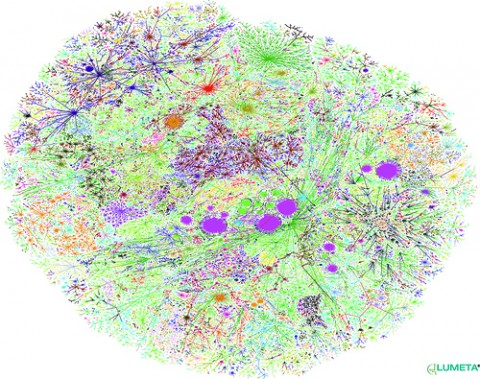
In many rooms where networks are the topic of conversation, a typical question of interest is “Who is connected to whom?” This is an important question, often the focus of social network analysis (SNA), and can lead to important and strategic information about things like hubs, gatekeepers, strong and weak ties, etc. And this is not the full extent of useful inquiry when thinking about social change.
Another important question is, “What is flowing?” That is, what kinds of value are flowing through these connections with respect to information, natural capital, money, cultural expression, etc. This is the focus of value network analysis (VNA) and is important to help understand the overall vitality and health of a network or system. Read More
Much of the work we do at IISC includes some element of helping to develop networks for social change. This entails working with diverse groups of individuals and/or organizations to come together and create a common vision and clear pathway to collective action and impact. I’ve been reflecting on how important it can be to not simply focus on creating or developing networks “out there” and across traditional boundaries, but also “in here,” within different recognized borders.
“When a living system is suffering from ill health, the remedy is found by connecting with more of itself.”
– Francisco Varela
The notion that part of the process of healing living systems entails connecting them to more of themselves is derived, in part, from the work of Francisco Varela, the Chilean biologist, philosopher and neuroscientist. As Varela and others have surmised, living systems are networks, including individual people, groups, organizations, and larger social systems. Furthermore, they have noted that when a living system is faltering, the solution will likely be discovered from within it if more and better connections are created. In other words, as Margaret Wheatley puts it,
“A failing system [or network] needs to start talking to itself, especially to those it didn’t know were even part of itself.”
I find it interesting in the context of social change work to consider how the process of re-connecting at and within different systemic levels can be beneficial to those levels and initiatives as wholes.
I almost wept as I listened to the story of Dylan Siegel. At age six, he learned that his friend Jonah Pournazarian had a rare, incurable, and fatal illness. He rejected mom’s ideas about a bake sale and decided to write a book, So Chocolate Bar, (his word for awesome) and raise a million dollars to support medical research. And he did it! Now at age nine, his efforts are funding research that just wouldn’t have happened otherwise. The disease affects so few people that there was no incentive for drug companies or researchers to pay attention. This little guy thought that was unfair and decided to do something about it. How would you change the world if the life of someone you loved depended on it? How far would you reach if the possibility of failing never crossed your mind?
Remixers and meme-makers, we have a tool for you. We are pleased to be partnered with the Center for Story-based Strategy in the release of an illustration kit, which can be found at www.storybasedstrategy.org/tools-resources.
Imagery is a huge factor in framing the terms of a conversation. This kit is meant to inspire imagery that provokes new interactions between people. We believe these interactions will help open up imagination towards the liberated, equitable society we want.
On April 10, 2016, Food Solutions New England (FSNE) launches the 21-Day Racial Equity Habit Building Challenge with more than 600 participants who want to normalize the conversation about race and racism. IISC is a co-sponsor because we agree that skill building and conversations are key for collective capacity to identify and address the different manifestations of racism, whether internalized, interpersonal, institutional, or structural.
IISC Senior Associate Curtis Ogden has been helping to weave FSNE’s network for over five years. He is a member of this year’s Racial Equity Habit Building team, which will include blogging about racial equity and promoting the conversation on social media. Additionally, IISC’s communications team, Lawrence Barriner II and Danielle Coates-Connor, have been supporting this year’s Racial Equity Habit Building Challenge with communications and engagement strategy.
“If you don’t know the kind of person I am and I don’t know the kind of person you are a pattern that others made may prevail in the world and following the wrong god home we may miss our star.”
– William Stafford, From “A Ritual to Read to Each Another”
A couple of weeks ago I was a participant in a SSIR webinar on network leadership. I spent my air time talking about Food Solutions New England as an example of a social change network that has been leveraging authenticity, generosity and trust to address issues of racial inequity in the food system. In telling the story, I realized that much of it amounts to a gradual process of shedding layers and “making the invisible visible.” Specifically, it has been about making visible power and privilege, connection and disconnection, tacit knowledge and diverse ways of knowing, and complex system dynamics. As a result, many in the network sense we are now in a better position to build from what we have in common, and that it is more likely that the vision of a vibrant, equitable and eco-logical food system will be realized. Read More
What does it really take to catalyze diverse groups of people, within organizations or across sectors, to build trust, take action, and work together to achieve uncommon results? This is the question driving a panel hosted by Stanford Social Innovation Review on “The Network Leader.” The panel will take place on Tuesday, March 22 at 2PM EST.
IISC Senior Associate Curtis Ogden will reflect on the unfolding story of Food Solutions New England, a network he has been involved with for about five years.
“We are seeing people drawn to the network because of this commitment to justice and authenticity,” says Ogden. “We are seeing other organizations take up internal work around power and privilege. This network is more impactful because it sees more fully and clearly what is going on and what must be done.”
Not long ago, at a gathering of the Food Solutions New England Network Team, one member, Dorn Cox, told the story of a farmer who has become renowned for the health of his soil. Remarkably, the soil health consistently increases, due to on-farm practices created over years of close observation and experimentation. This is significant as it has boosted the quality of the farm’s produce, reduced the need for and cost of inputs (helping to increase revenues), increased the soil’s ability to handle extreme precipitation and dry conditions brought on by climate change, and mitigates carbon release.
This accomplished practitioner has subsequently been sought out by academics and has served as lead author on numerous peer reviewed academic articles about his soil health practices. Dorn then relayed that the farmer recently reported that because of academic protocols he cannot get access to the very articles he has co-authored. Dorn punctuated his story with the lesson that:
To support learning, equity and resilience, knowledge wants and needs to be free and accessible.
This is a key principle for leveraging networks to make change. In the old world, knowledge was owned and proprietary. But in this increasingly volatile world,to help people be adaptive to change, there is need for robust flows of information that are equitably generated and accessible. This was a lesson learned by professor Anil K. Gupta, before he started the Honey Bee Network in India.
By his own admission, Dr. Gupta had been engaged in the practice of extracting information from people that served his own or purely academic purposes, without ensuring that the information made it back into the hands and minds of practitioners. He realized that “on efficiency and ethical grounds,” this could not continue.
“Minds on the margin are not marginal minds.”
– Anil K. Gupta
Dr. Gupta co-founded the Honey Bee Network on the core principle that in order for a knowledge system to become sustainable and create more widespread value, it must be authentic, accountable and fair. That meant that it was important to acknowledge the sources of knowledge. Furthermore,it was important to connect both knowledge and knowledge providers. Over the last 25 years or so, the Network has created a database of traditional knowledge and grassroots innovations, in seven different Indian languages, documenting and documenting more than 1 million ideas and practices.
Despite exciting innovations like the Honey Bee Network, in many places, knowledge and other valuable resources are held up and denied by existing structures. So how do we unlock this potential? A key step is to see human societies as living systems, as “ecosystems” held together by flows of information through communication and education.
Robust and distributed flows of information are critical for the creativity, resilience and development of human communities.
As Sally J. Goerner of the Capital Institute writes, human systems “are the most intelligent [and healthy] when they are integrative, inclusive and egalitarian.” A constant threat to social health is rigidity, hoarding, disconnection and exclusion.
Furthermore, it is important to understand that sometimes certain forms of knowledge may be held unknowingly by knowledge holders. Identification and transfer of “tacit knowledge” generally requires personal contact, interactionand trust for people to codify what they know from experience. Formal and informal communities of practice in networks are important in this regard.
In other cases, people may not see themselves as being resource-full, either because what is typically framed as a resource does not allow for certain kinds of valuation, or because they do not see in their own niche what might be excess capacity for another. To identify and free up resources, a few steps might help:
Think more broadly about what constitutes a valuable resource.Permaculturalist Ethan Roland and others are working to expand how “wealth” is understood. For example, Roland names eight different forms of capital: intellectual, spiritual, material, cultural, material, social, living, and experiential. Write Looby MacNamara adds health and well-being capital to these. The point is to see wealth and assets from a whole systems perspective and to help people see their own resource-full-ness in a different light, not defined by others and more narrow understandings.
Spread understanding of the concept of “excess capacity.” The sharing economy is helping people to see abundance around them that might be repurposed or shared with others. Examples abound (see Robin Chase’s book Peers, Inc. as a helpful primer): knowledge, creativity, passive sunlight, bandwidth, underutilized spaces such as parking lots, items that might be converted to other uses (old sweaters), etc.
Encourage a culture of making requests and offers. In certain places, people may be reluctant to articulate needs or put forth offers. This can stem the flow of valuable resources. In order to nurture a culture of abundance Lawrence CommunityWorks has cultivated what they call “The Marketplace,” whereby community members identify and exchange assets as a part of daily operations.
Create venues and platforms for people to connect and share.Value continues to be latent until it is actually exchanged. Whether in-person or virtual, it is important that there be places for people to find one another with relative ease and make exchanges of one kind or another.
Constantly pay attention to and work on power, access and equity. A lot has been and is being written about how networks can exacerbate inequality and inequity if left unchecked. The antidote is awareness (and self-awareness) and a commitment to equitable network building. What this means exactly is very much a work in progress, but educating ourselves about the dynamics of power, privilege and injustice and committing to work for broader systemic health is certainly fundamental. See also the following:
There is a difference between being a network by default and being one by intention. Sometimes that can be a big difference. I encounter a fair number of networks that are networks in name and in standing, at least in that they are connected entities. But that is pretty much it. Experience shows there are any number of different ways to structure a network, and name it for that matter.
And what I find is most important is the underlying intention to maximize network effects, including: speeding the spread of resources, ensuring resources reach everyone in the network, ensuring everyone has the opportunity to share resources, growing the overall pie of resources, strengthening adaptive capacity and collective intelligence, growing abundance and equity in many different ways.
What this boils down to is a set of network ethics, which I would summarize (certainly incompletely, and to which I invite additions and alterations) in the following way: Read More
In an article in Fast Company, entitled “The Secrets of Generation Flux,” Robert Safian writes that in these uncertain times, there is no single recipe for success. Safian profiles a number of leaders who have been relatively successful at riding the waves in different ways, and notes that they are all relatively comfortable with chaos, trying a variety of approaches, and to a certain degree letting go of control. This resonates with our experiences at IISC helping people to design multi-stakeholder networks for social change. For example, even in a common field (food systems) and geography (New England) we witness different forms emerge that suit themselves to different contexts, and at the same time there are certain commonalities underlying all of them.
The three networks with which we’ve worked that I want to profile here exhibit varying degrees of formality, coordination, and structure. All are driven by a core set of individuals who are passionate about strengthening local food systems to create greater access and sustainable development in the face of growing inequality and climate destabilization. They vary from being more production/economic growth oriented to being more access/justice oriented, though all see the issues of local production and equitable access as being fundamentally linked and necessary considerations in the work.
Vermont Farm to Plate Network
The Farm to Plate (F2P) Initiative, was approved at the end of the 2009 Vermont legislative session and directed by the Vermont Sustainable Jobs Fund, in consultation with the Sustainable Agriculture Council and other stakeholders. Its initial charge was to develop a 10-year strategic plan to strengthen Vermont’s food system. This was done over a 2-year period with input from hundreds of stakeholders from around the state. The Farm to Plate Network officially launched in 2011, borrowing heavily from the structure of the RE-AMP Network in the Midwest, an effort to address climate change.
The structure was fairly well defined in advance, given F2P’s mandate from state government to double production and the clear need for coordination around the Network’s robust strategic plan and 25 goals. It currently features standing Working Groups (WG) organized around associated pieces of the strategic plan with flexibility to add and adjust. Working Groups may form any number of Task Forces (TF) in order to implement various strategies and high impact action projects, at the ground level. Pre-existing multi-stakeholder groups may serve as logical TFs within a given Working Group. TFs meet as needed and are created and disbanded as needed. In addition there are Cross-Cutting Teams (CCT) focused on topics such as Food Access, Policy, and Research and Funding.
It is at the WG and CCT level where most of the “action” happens, taken from a 15,000 foot view to help coordinate and fill gaps on the ground. A Steering Committee comprised of members of the Working Groups and others “holds the whole” from more of a 30,000 perspective, trying to maintain as broad a view of the food system as possible. There are a few paid staff who support the Network through weaving, communications, coordination and the like. The Network has also launched a “Food System Atlas” showcasing stories, videos, job listings, news, events, resources, the Strategic Plan and organizations that are strengthening Vermont’s food system.
Rhode Island Food Policy Council
The story of the Rhode Island Food Policy Council revolves largely around the Southside Community Land Trust, an urban land trust that has been an agent for community food security, providing land, education, tools, and support for people to grow food for themselves in greater Providence. SCLT applied for and received funding from a few local foundations to facilitate the collaborative efforts of a multi-stakeholder Design Committee to develop a vision and mission for the future RI Food Policy Council (RIFPC) and determine the Council’s structure, membership and by-laws.
Unlike the process in Vermont, the Design Committee refrained from engaging in a full-fledged strategic plan and instead enlisted the services of Karp Resources to conduct a comprehensive Community Food Assessment of Rhode Island to provide a baseline description of the state’s food system and identify priorities for the RIFPC and other stakeholders working to increase community food security. The decision was also made to formally remain separate from any state entity, while building connections to the Agricultural Partnership and recently formed Interagency Food and Nutrition Policy Advisory Council.
With an eye towards inclusiveness and nimbleness, the Design Committee created a structure that now features, five Work Groups focused on the core visionary goals of the RIFPC: Access, Economy, Environment, Health, and Production. These Work Groups were launched in a very open public meeting, with people essentially voting with their passions, and they have continued to welcome newcomers. No formally established goals or strategies were handed over to the Work Groups, so as to let them find their own footing and interests under the overarching visionary goals. The core elected group of Council members has as part of its role to provide support and high level guidance to these Work Groups. Part-time paid staff support exists for a network coordinator and communications expert, both of whom help to maintain an evolving website.
The Council is trying to balance the need for more of a centralized function around advocating in a timely way for policies impacting the food system, with an ongoing openness and fluidity to its public meetings and Work Group activity. A key feature of its public engagement is a series of ongoing community meals and discussions about the food system.
Connecticut Food System Alliance
The Connecticut Food System Alliance was created by food system advocates from around the state coming together from time to time to discuss and share information. Gradually, desire grew to have more than just an annual gathering. With limited funding, a core “design team” came together to think about how to create more grassroots momentum that would complement the Governor’s Council for Agricultural Development, which is spear-headed by the Commissioner of Agriculture and is broader in scope than food systems and security. Over the past couple of years, this design team has pulled together a number of large and diverse convenings of people from around the state to get to know one another, to “close triangles”, share insights and talk about how to create more significant and shared value. This has taken the form of an “alignment network,” uniting under what is now a shared vision and guiding values, and connected by a listserv.
Through the use of Open Space participants in CFSA have identified key areas of inquiry and action they want to pursue. Examples include a pilot project tackling food insecurity in one town to strengthening farm-to-institution efforts to growing and diversifying network membership, to exploring the root causes of what ails the food system. Volunteer facilitators have stepped up to lead “sub-networks” and the volunteer design team has morphed into a larger Steering Committee to provide support to these teams and organize future gatherings. The Steering Committee has initiated a program for giving mini-grants (maximum $1000) for the purpose of network-building among Connecticut’s food system stakeholders.
The entire process of CFSA to date has been very emergent, aptly described by Adrienne Maree Brown’s words in a blog post:
“Emergence is the way complex systems and patterns arise out of a multiplicity of relatively simple interactions. Rather than laying out big strategic plans for our work, many of us have been coming together in community, in authentic relationships, and seeing what emerges from our conversations, visions and needs.”
Common Ground
None of this is to say that any of these approaches is more “right” than the other. Each has its benefits and challenges, and each fits its particular circumstances. All are open to changing as context demands. From one perspective we might see the VT Farm to Plate Network as the most formal and structured with the CT Food System Alliance as the most fluid and emergent, and the RI Food Policy Council as lying somewhere in-between. The differences are important to note, as are some of the likely underlying contributing factors such as funding, location, partnerships, tangibility or simplicity of outcomes, diversity of stakeholders, and the existing eco-system of actors and initiatives in the system.
At the same time it is also important to note that underlying all of these network forms is an important network ethic, or way of thinking, that I would summarize in the following way:
There is an awareness that to the extent that there is a network “center” it is about being in service of and helping to connect the whole, as well as bring in the “periphery;” there is an emphasis on contribution and creating value over deferring to credentials and the usual suspects; people lead with a spirit of openness; and there is an overall effort towards growing the pie, not just carving it up into smaller pieces.
And there is certainly a developmental trajectory to engaging in net work, as evidenced in these and all network initiatives we’ve supported, such that trust-building, transparency, and generosity are always works in progress. This is what forms the intangible and enriching ground of these and other forms that will hopefully help create real and necessary change.




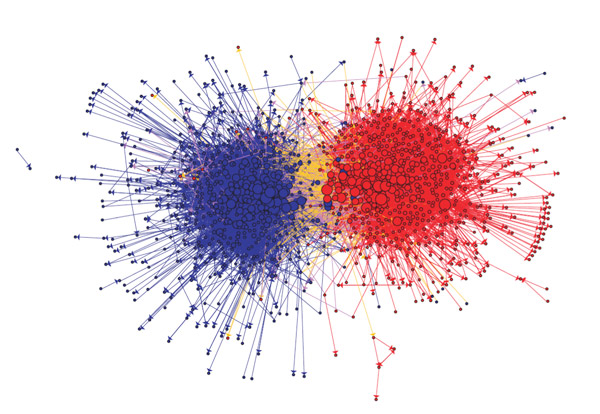 In many rooms where networks are the topic of conversation, a typical question of interest is “Who is connected to whom?” This is an important question, often the focus of