First things first: shoutout to Coretta Scott King for founding the King Center in 1968. Without this institution, we would not have a national holiday celebrating her husband’s life and work.
For the past few years, in honor of Coretta’s wishes and Martin, I’ve been doing a little bit of self-education on Martin Luther King, Jr. Day. Last year, I discovered his speeches were on Spotify so I listened to about 4 hours worth. This year, I’m taking a long look at his Letter from a Birmingham Jail. (Coincidentally, the Letter has always been important to me because he wrote it on my birthday). Read More
“We can create a public that includes us all, and together bring in a new form of democracy.” -Ceasar McDowell #BigDemocracy
FOR IMMEDIATE RELEASE
IISC President Ceasar McDowell brought Big Democracy to TEDx Indiana University on November 13, 2015. The talk explores how disconnections in narrative, communications, and design stand in the way of democracy and what today’s global social movements are doing to repair these connections. McDowell articulates that we are in a new era called Big Democracy, one which can hold the diversity and complexity of people in the world.
McDowell calls on the audience of 4,000 to begin the change today by practicing a micro-inclusion, or small way to show someone “you’re included, I can see you’re there.”
The talk closed a powerful evening of speakers around the theme “Eyes on the Stars, Feet on the Ground.” Thanks to everyone at TEDx Indiana University for the invitation to speak and for an incredibly well-produced event.
What’s the difference between equality and equity? This illustration offers a simple way to start the conversation.
Created for IISC by artist Angus Maguire in 2016, this widely shared illustration (based on the original from Craig Froehle) shows how giving everyone the same resources can produce very different outcomes, and how an equity approach considers what people need to participate more fully.
IISC also collaborated with the Center for Story-Based Strategy and Angus Maguire on #the4thbox, a related exploration of the illustration’s ideas.
Download the illustration
Download the high-resolution illustration to use in presentations, workshops, classrooms, social media, publications, and other educational settings.
The downloadable package includes JPG, PNG, PDF, and AI files.
Using the illustration
You’re welcome to reproduce and share this illustration. No written permission is required.
This image is free to use with attribution: “Interaction Institute for Social Change | Artist: Angus Maguire.” For online use, please provide links to interactioninstitute.org and beclouded.net
If you use the illustration, we’d love to hear about it! We especially enjoy hearing how it helps start conversations about equality, equity, and social change. You can reach us at info@interactioninstitute.org or on LinkedIn and Facebook.
Equality and equity
Equality means providing everyone with the same resources or opportunities. Equity recognizes that people may have different circumstances and may need different resources or approaches to have a fair opportunity to participate and thrive.
The distinction can be a useful starting point for a deeper conversation about access, power, systems, and the conditions that shape people’s experiences and opportunities. Read more about equity from IISC Senior Associate Cynthia Silva Parker in this blog post.
Keep exploring
Want to go deeper? Explore our Resource Hub for practical tools and resources for social change, or learn with us through our trainings, workshops, and recordings.
In the first of this three part interview with Dr. Ceasar McDowell, he describes the central focus of his work in the development of community knowledge systems and civic engagement. He also shares some examples of how that focus has manifested. In his words, “I can boil it down to one thing. My work, my research interests, my life, is about voice. And particularly how people—and specifically the people who are at the margins of society–are able to both name their experience in the world, have that naming be recognized, and also open themselves up to the experience of others.”
The following is a slightly edited re-post of something I wrote in early 2014. Since writing this, I continue to see the need to be vigilant around not privileging extroversion in groups, to provide more opportunities to tap a range of cognitive styles to leverage fuller potential in networks.
Having read Susan Cain’s book Quiet: The Power of Introverts in a World That Won’t Stop Talking, I feel both validated (as someone of more introverted tendencies as the years pass) and able to see with new eyes. IMHO, the book is well worth the read, and if the thought of tackling the 300 pages is daunting, you might enjoy a taste via Cain’s TED Talk.
Here I want to reflect on some of the insights Cain’s work has to offer collaboration and “net work” for change. Essentially, Cain reminds us of an important element of diversity that we should not overlook in our change efforts –different cognitive processing styles and ways of responding to social stimulation.
First of all, what is introversion? Introversion is not shyness or asocial behavior. People who are introverted can certainly be shy or socially awkward, but introversion is first and foremost a response to social stimulation. Relative to those who are more extroverted, those who are introverted prefer less stimulation and tend to work more slowly and deliberately. Introversion tends to favor intimacy, listening, and some time alone.
According to Susan Cain’s assessment of the research,one third to one half of people in this country are introverted, while many can display extroverted tendencies. Well-known introverts include the likes of Mahatma Gandhi, Eleanor Roosevelt, Albert Einstein, Rosa Parks, Pablo Picasso, and Steve Wozniak.
“There’s zero correlation between being the best talker and having the best ideas.”
In a fascinating historical review, Cain traces a mainstream cultural trend in the United States that shifted preference from what she calls “the culture of character” to “a culture of personality,” where public performance and gregariousness became equated with success and strong leadership (think Dale Carnegie and his books How to Win Friends and Influence People and Public Speaking and Influencing Men in Business). To this day, in many workplaces, schools, and families, Cain suggests that there is a preference for extroverted ways of thinking and being. This flies in the face of data suggesting that introverted styles can equate with stronger academic performance and deeper knowledge in given fields.
And yet there continue to be significant shifts toward open concept workplaces and group-oriented classrooms that privilege extroversion and create painful experiences for those who are more introverted, not allowing them to shine or bring their gifts to the relatively raucous table. The result is that we risk losing the gifts and talents of “quiet leadership” and creativity.
So what to do, especially in collective change efforts? A few thoughts:
Pay attention to who speaks and does not speak up in meetings/groups and don’t immediately assume that the quiet people are aloof or uncaring.
Think carefully before opening physical spaces and group processes too much or too often. Introversion thrives in settings where there is more personal space and opportunity to reflect alone and in small groups.
Understand that brainstorming as it is often done (in person and through whole group discussion from the get-go) privileges extroversion, and that research shows it leads less to innovation and more to group bonding (not a bad thing). Make space for people to work and think alone before bringing a group and their ideas together.
Leverage social media and virtual collaborative platforms as a way of helping to maintain autonomy and avenues for creativity that can fuel innovation and allow introversion to shine.
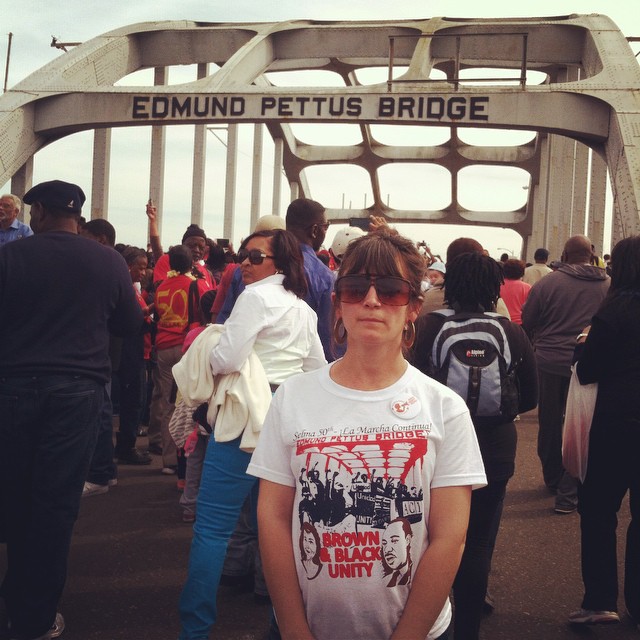
Jen Willsea at the Edmund Pettus Bridge for the 50th anniversary of Bloody Sunday in Selma, Alabama. March 2015.
I am angry that the murder of Tamir Rice is being explained away as a “perfect storm of error”[1] in Cleveland, that Sandra Bland is being blamed for her own death in Texas, and that police in Chicago chose to “shoot first and ask questions later,”[2] killing two more unarmed African Americans the day after Christmas.
When will we stop recycling, reinventing, and reinforcing American racism—the same old oppression in new forms? Why have we allowed it to persist for so long and why do we continue to explain it away, denying the magnitude and depth of racism as it manifests the 21st century while wary of the ways our past is actually impacting the present? Read More
A couple of years ago, I was turned on to the work of Louise Diamond. Diamond has been bringing insights from the dynamics of complex systems to peace building work for many years. Her efforts connect to a growing number of practitioners and thinkers who see the need to approach social change with an ecological and evolutionary mindset. In one of her papers, she extracts some of the “simple rules” that yield core practices for working in this way. Here I have adapted and adjusted some of them in application to network building for change and resilience in food systems. Read More
“As long as it remains invisible, it is guaranteed to remain insoluble.”
Margaret Heffernan, from Willful Blindness
The following is a slighted edited re-post of a piece that appeared at this time last year on our site . . .
As I look back on this past year through the lens of the work we have done at IISCsupporting networks and movements for social change, one of the most significant themes from my perspective is the value and importance of “making the invisible visible.” Over the past twelve months, we’ve facilitated many reflection sessions with diverse groups to gauge the development and impact they observe from our work together. I tend to ask people how they seechange happening at different levels: self, group, larger systems (organization, neighborhood, community, state, region, etc.). I also like to ask them to reflect via the use of stories to capture and convey significant development.
What has surfaced from this sharing is that even though some of the big goals around equity and sustainability are still ahead of us, there has been movement and part of this development comes down to seeing and being able to work with what had previously been unseen. While the methods for getting to this recognition have varied – from system mapping and analysis to network mapping to structural and power analysis to learning journeys to dialogue and tackling difficult conversations– by creating space to see, share and explore, there has been significant deepening of relationships (to self, other, the work), understanding and commitment.
So what is being made visible?
What our mental models are and how they align (or do not) with our intentions.
The power of shared values and narratives despite differing starting points and perspectives.
An understanding of how our successes do and must connect.
And why does this matter?
In her book, Willful Blindness, Margaret Heffernan shares examples of people seemingly choosing to remain oblivious to damaging conditions – in banks that sold mortgages to people who could not afford them, in the run up to unjustified wars, in communities that accept toxic conditions as a trade-off for economic gain, in poor health care or educational environments. in our country as we overlook racial disparities and socio-economic inequality. In unconscious and conscious ways, we build walls and draw lines, and even those who are aware of the existence and dangers of these can choose to be silent.
“Silence is the language of inertia.”
Margaret Heffernan
And then there are those who choose to break the silence, who choose to see or look more closely, including looking at their own contexts and chosen approaches with greater scrutiny, as well as being open to the perspectives and legitimacy of others. This is the choice of movement, of development, of breaking inertia. Making the invisible visible is not simply some airy fairy notion of “consciousness raising,” it is about achieving greater strategic and moral courage, connection and clarity. And I am hearing that it is what is giving many in the efforts of which we at IISC are a part hope that we are getting somewhere.
Here’s to more care-full seeing, compassionate listening, bolder action and significant movement and #results in the coming year.
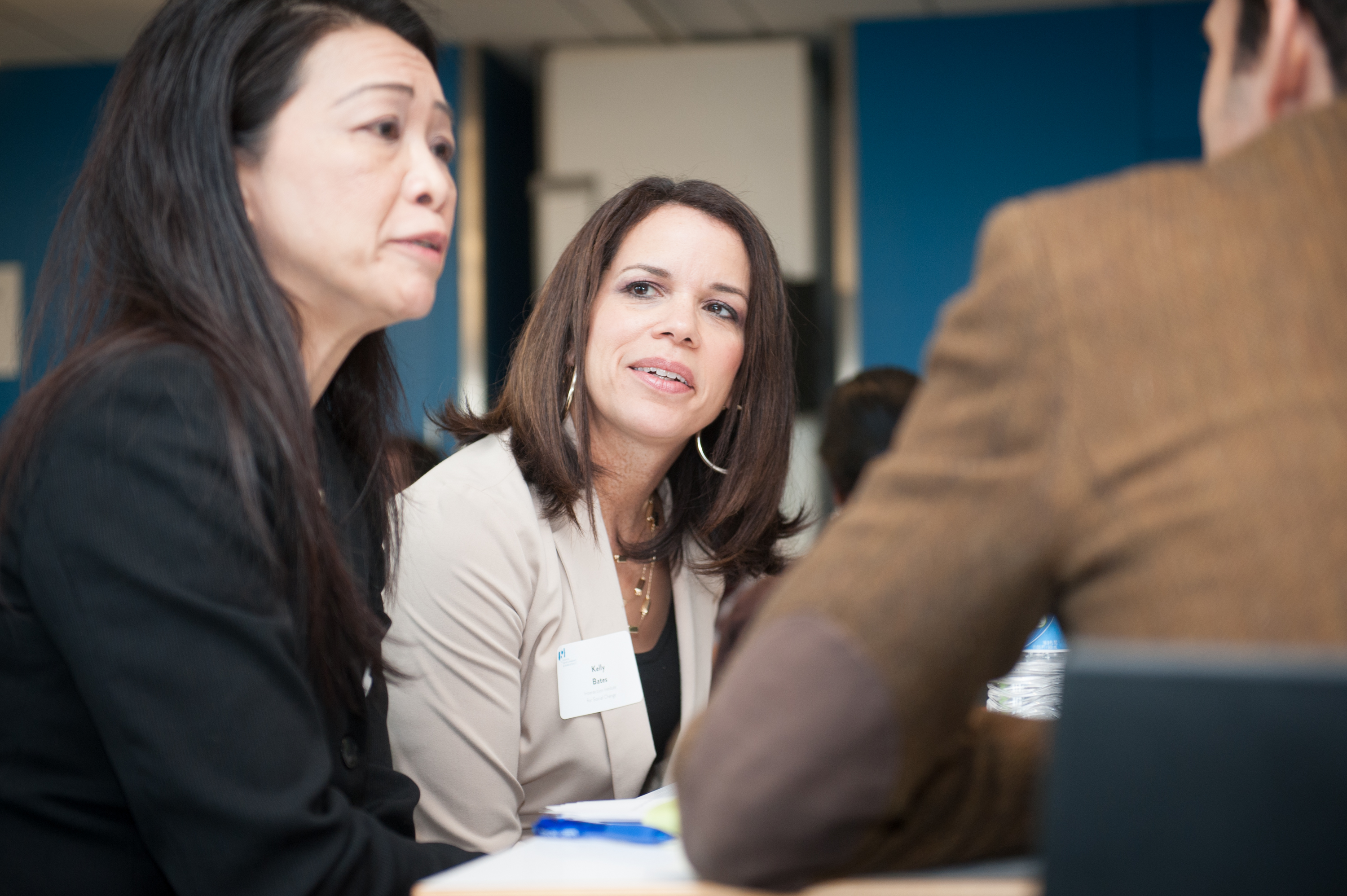
IISC welcomes Kelly Frances Bates to our organization as Chief of Staff and Democracy Strategy. Kelly brings excitement to our work in Big Democracy and public engagement, especially as we seek to engage people from all walks of life. She has spent the past twenty years running social change organizations, and consulting and training around political engagement, anti-oppression, and diversity.
“I am thrilled that Kelly has joined IISC,” said IISC President Ceasar McDowell. “She is bringing her experience leading organizations and deep understanding of democracy and racial equity to IISC.”
Kelly is the recipient of leadership awards from Boston NAACP, Boston University School of Law and, in 2013, she was awarded the Women of Color Changing Our World Award. Kelly credits IISC with shaping her style as a facilitator and leader, very early in her career. “I have deeply respected IISC for years,” she said. “I have hired IISC, been through public trainings, and worked with the team here. IISC facilitation is powerful, meaningful, and extremely well-executed.”
Sustainable City Network publishes about best practices for Leaders in Government, Education, and Healthcare. Recently they featured IISC Senior Associate Cynthia Sila Parker, reflecting on Rhode Island’s 2-year planning process, which incorporates equity goals. Read More
Our eyes met and locked a split second after we noticed the feet of two young men sitting next to each other in the circle – both had a pant leg rolled up to show an ankle monitor. In the same circle, sat two sheriffs with guns and tasers strapped to their hips and covered by their untucked shirts. It was day three of our training, Moving Forward in Addressing Race, Power and Privilege, and we were now harvesting the fruits of many hours of challenging mental, emotional and spiritual work.
“I have learned to see that not all police officers are rude and mean,” shared a 14 year-old Latina girl. “I have learned that some officers care about me and want to be fair; this is the first time I’ve been in a space where I felt heard by adults (in the system).”
Having law enforcement at the table with an openness to change is important. Systems are made up of individuals. Individuals centered on equity values and skilled in moving policy forward, in partnership with multi-sector networks towards common goals, can create long term change.
“I have gained sight and vision where before I was blind,” shared a white male law enforcement officer, “and I am willing to give what ever it takes personally and professionally to our cause.”
This same individual had entered into the circle two days before carefully monitoring his every word, letting us know that he was stretching to understand what others were saying. This man’s perspective was literally transformed over the course of three days; it was an amazing shift to witness. Lifting the veil that usually hides the ways in which white people have benefitted from racism and other forms of oppression, as well as the ways that white people unintentionally reinforce discrimination and mistreatment can be shocking.
Why does confronting racism in the juvenile justice system matter?
The U.S. stands out in its use of youth incarceration. We incarcerate youth at higher rates than anywhere in the world: five times the rate of South Africa; 15 times the rate of Germany and 30 times the rate of Italy. With more than 75 percent of youth locked up for non-violent offenses, the U.S does not have an alarming crime problem; we have an alarming incarceration problem. And it’s a problem primarily for youth of color. We know that our current youth justice system is not equitable, excellent, or used sparingly and appropriately. Nearly 55,000 youth were incarcerated on any given night in 2013, most (87 percent) for non-violent offenses. The majority (66 percent) were youth of color. Nationwide, youth of color are significantly more likely to be incarcerated than White youth. In 2013:
Black youth were 4.6 times as likely;
Native American youth were 3.3 times as likely; and
An adolescent who has spent time in secure detention is far less likely to attain a high school diploma or consistently participate in the labor force in the future.[2]
When the youth of color created and performed a skit to illustrate the everyday harassment they face at the hands of police in this room full of adults, some of whom have a role in incarcerating them, all involved were transformed. The unfair treatment of people of color and at the hands of law enforcement is and has always been a life or death issue, and while public outcry lifting up this issue is important, finding ways to build bridges across this divide is even more crucial.
In our circle sat law enforcement, juvenile justice system-involved youth and parents, detention center and juvenile probation staff, non-profit leaders, leaders in the school district and staff from the district attorney’s office. We were all there with a single purpose, to decrease the disproportionate level of incarceration of African American, Native American and Latino youth. This was a crucial moment: a group of 30 people living and working in the same county with a rich diversity of perspectives, roles in the community and life experiences spent three whole days learning about the history and current manifestations of racism, listening to each other’s stories, and beginning to build a deeper level of trust.
“I hadn’t wanted to build relationships with the people in this group. I thought I could do the work with you and not necessarily like you. Many of us came to this table thinking that we were not playing a part in the negative impact we were having on youth. My biggest learning is that we need to have a level of trust and if we do not allow the education and vulnerability, we will not be open to own the part that each of us is playing in the dynamics of racial disparities. Without the relationship building and trust we can not move the work forward.” – Committee Chair
Nine months before this day, we met this group because they were in the midst of an intense racialized conflict between two leaders at this table, and the group’s long-time work had come to a halt. Years of tensions bubbling between “community” folks and “systems” people, between white folks and people of color, had risen to the point of ugly accusations and deep hurts. People who had been leading this work were seriously considering walking away.
How did the group get to this point? Years before, community stakeholders in this county formed a committee to address the overrepresentation of youth of color in their county’s juvenile justice system. New partners were asked to be part of that committee, including community stakeholders who had never been included in justice system reform. Traditional meeting locations and times at the courthouse were changed, and Judges, public defenders, prosecutors, juvenile probation and detention staff began going to meetings in the community, sometimes in the evenings, with youth and families who were directly impacted by the justice system. Although the disproportion of youth of color in the system was acknowledged by all, the initial strategies developed by the subcommittee for reducing that overrepresentation had limited impact and fell apart quickly. Furthermore, a lack of a common understanding of racial and ethnic disparities or agreed upon manner to communicate through hard conversations about racism had caused a divide between system stakeholders and community partners.
The dramatic shifts we saw the group take were rooted in the hard work by many people at this table and those that had supported them in the past. For five years they learned to work together as well as build cooperation across sectors. We supported the group to take a step back, rethink assumptions, account for the impact of their actions, and recommit to repairing relationships and backing up each others’ integrity and leadership. The stakeholders now have a renewed capacity to honor their commitment to the youth in their community, address institutional and structural racism together, and are in the process of implementing new practices within their Juvenile Probation Department informed by young people themselves.
“We talk about restorative justice for young people, but we also went through a restorative justice process ourselves. We are more able to have the difficult conversations about racism and I think this has shifted the power in the group. I feel I can bring my full self to the space now.” – Committee Chair
We, the trainers in this scenario, are two people who have devoted our lives to holding space for people to do the deep, challenging, and life-affirming work of understanding how racism operates and of actualizing a commitment to racial equity. As we led this training, it was not lost on us the vast differences we too were bridging. One of us is a formally undocumented immigrant who grew up in poverty and has been deeply targeted by oppression, and the other is a white person whose ancestors migrated to the U.S. with legal privileges from various parts of Europe in the 1600-1800s and has benefited from countless race and class-based advantages.
We are trained in different methodologies for leadership, collaboration and racial equity. One of us is a VISIONS Inc. trainer who has learned how to manage and support individuals to process and shift at personal and interpersonal levels while at the same time shift the culture and structure that lead to disparate racial outcomes. The other is a consultant and trainer at the Interaction Institute for Social Change who has supported groups that have a desire to do racial equity work but are unsure how to make it real. Many such groups have gone through an anti-racism training and then get stuck in a soup of spiraling emotions and an inability to translate the learning into action. Others have made some progress toward reducing racial disparities and are coming up against the roadblocks of cultural clashes that prevent a deeper level of cross-sector collaboration and change. Bringing the sets of tools both organizations have developed to a group that was ready to take their work to a new level of depth was the magic sauce that allowed for the incredible learning and shifts people experienced at this training.
“And now it’s time to get real again and roll up our sleeves, because [even though we have been working on this together for years already] this is just the beginning. There is still a tremendous lack of accountability in our system, a lack of consistency and practice. There are a few people in the entire system that get it – and so we got a long way to go. It is so refreshing and healing to be where we are now and we can take that medicine to keep going. The truth is that young people in our state are being mistreated. I am not going anywhere and neither is the institution we are trying to reconstruct. Language development, protocol, procedure, culture — all of that needs to be a continuous part of the work going forward.” – Committee Chair
During these three days, a few lessons about what it takes for this work to be successful became clear to us:
Break out of our silos – people from all parts of a system need to be at the table, including a critical mass of those most affected by the inequities (in this case that meant having more than one or two system-involved youth of color participate)
Take the time to build a shared understanding of what racism is, and how it operates at the internalized, interpersonal, institutional, structural and cultural levels as well as at the intersection of these
Make room for people to share their stories, and to show up as complex human beings (beyond job titles)
Create a space that allows people to show up with their minds, bodies, and spirits (an interactive learning environment that requires everyone to show up with vulnerability and openness is required; lectures and surface level activities don’t cut it)
Lean into disagreements and misunderstandings in order to build trust and a deeper level of collaboration, which makes the real work possible
Commit to the long-term nature of this work
In our country, images of young people of color being killed or harassed by law enforcement are commonplace. Growing numbers of youth and men of color in prison continue to skyrocket. As the Movement for Black Lives grows across the country, racial tensions simmer. People of color are afraid for their lives. White people are afraid to acknowledge the ways racism continues to define our country and to courageously and non-defensively do their part to undo racism. Bringing young people together with adults who work in the juvenile justice system and other adults that are part of extended ecosystems of support and contact is crucial to address the racial divide that has continued to divide our country and that has maintained the disparities that ultimately hurt us all.
What does it take for people of color, adults and youth to feel safe to fully speak about the negative impact of racism on their lives and for white folks and adults to hear this with out reacting defensively and sinking into guilt? What will it take for young people of color, those most affected by the juvenile justice system, to be seen as experts about the way racism plays out in the current system and about how to create a system where young people of color are not unduly punished for their mistakes, but treated like human beings?
About the Interaction Institute for Social Change: IISC increases the collaborative capacity of individuals, organizations, and institutions so they can find solutions to social problems. Over the past 25 years, we have developed a lens through which we facilitate social change and we bring it to every engagement. IISC invites groups and leaders to shift power dynamics, focus on building networks, and magnify love as a force for social change. Using this collaborative change lens, we see leaders overcome challenges and have astound-ing impact.
Never before have people with such varied histories been so intimately connected, whether because they live in a densely populated urban area or because they are linked online. Communities are struggling together with immense complex problems, from childcare to climate change. This makes being willing and able to facilitate meaningful discussions across differences one of the most important leadership skills of the 21st century.
Solving complex problems means understanding they have a systemic nature. Powerful leaders offer ways to investigate the root causes, in order to look for high leverage solutions and engage non-traditional allies.
IISC is building Big Democracy, the collaborative infrastructure to facilitate sustained engagement by leaders in their organizations and cities.
About VISIONS Inc: Founded in 1984, VISIONS, Inc. (www.visions-inc.org) is a non-profit training and consulting organization, specializing in diversity and inclusion. We have offices in Dorchester, MA; Rocky Mount, NC; and Fresno, CA; and are supported by our highly skilled and diverse team of consultants located throughout the United States and abroad. VISIONS mission is to:
equip individuals, organizations, and communities with the tools needed to thrive in a diverse world.
remove structural and cultural barriers that prevent full and equitable participation.
help create environments where differences are recognized, understood, appreciated, and utilized for the benefit of all.
We realize this mission by implementing a time-tested, insight-driven, process model of consulting and training that supports our clients in becoming catalysts for change and effectively engages all people in the deep, challenging, and rewarding work of authentic inclusion, personally and within their organizations and communities.
[1] The W. Haywood Burns Institute for Juvenile Justice Fairness and Equity, http://data.burnsinstitute.org/about
“Networks are present everywhere. All we need is an eye for them.”
Albert-László Barabási
You may have heard a version of this story before:
There was a man who had worked at a factory for twenty years. Every night when he left the plant, he would push a wheelbarrow full of straw to the guard at the gate. The guard would look through the straw, and find nothing and pass the man through.
On the day of his retirement the man came to the guard as usual but without the wheelbarrow. Having become friends over the years, the guard asked him, “I’ve seen you walk out of here every night for twenty years. I know you’ve been stealing something. Now that you’re retired, please tell me what it is. It’s driving me crazy.”
The man smiled and replied, “Okay, wheelbarrows.”
This tale about not seeing something in plain sight reminds me of a dynamic that can ensue in network gatherings where at some point anxiety is expressed about not getting to “concrete” outcomes. This happened recently at a large convening of a national network attempting to set systemic change strategies. Read More