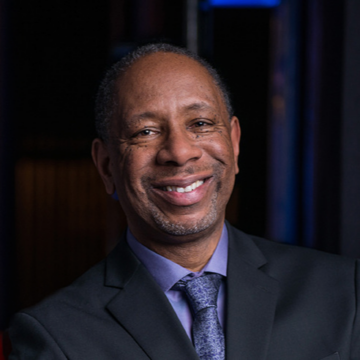
Hamilton College has produced a TedX to remember, with speakers united under the theme “Curiosity and Creativity Uninhibited.” It was an honor for IISC President Ceasar McDowell to be invited, and supported by Hamilton student Chidera Onyeiziri.
Ceasar’s talk is entitled, “Big Democracy: A Fundamental Shift.” See him open with the vastness of wonder that exists in the universe, literally displaying a photographic representation of the Big Bang. He then presents the comparison to the Human Universe with its constellation of different races, ethnicities, languages, sexual orientations, and belief systems. So while the complexity of the universe inspires, the complexity of the Human Universe feels daunting.”
His answer to help us see and understand the complexity of the human universe is Big Democracy. Ceasar describes the artifacts democracy produces and interactions needed for an equitable society. He invites we frame our collective agenda using inquiry, explores why we need to design for the margins, and shares his latest idea for inter-personal change: micro-inclusions.
The talk calls on the audience to acknowledge the choice-point we are at as a society, and to imagine a new series of actions and interactions for social change.
This week we lost Dr. Grace Lee Boggs. She was 100 years old. The long-time Detroit political and labor activist, author, and philosopher was a source of inspiration for many of us at IISC and in activist circles around the country and world. Dr. Boggs’ life and work is the focus of a documentary film called American Revolutionary, which POV is streaming for free until November 4.
A recent report out of the University of Michigan and Michigan State University highlights a number of food systems change efforts that have adopted a collective impact approach. Two of these are initiatives that IISC supports – Food Solutions New England and Vermont Farm to Plate Network. The report distills common and helpful lessons across eight state-wide and regional efforts. Here I want to summarize and elaborate on some of the article’s core points, which I believe have applicability to virtually all collaborative networks for social change.
First off, the authors note the importance of context. They quote Margaret Adamek from the Minnesota Food Charter, who points out that “borrowing from other states and initiatives only goes so far as ‘the unique features of each place are what dictate the strategy.'” At IISC, we could not agree more. Complex systems suggest that we cannot bring a cookie cutter approach to change. As such, there is not one single appropriate model for food systems change. That said, the authors discuss common practices that can undergird a diversity of approaches.
Investing time – It always takes longer than you think or want. While this may not be the best marketing pitch for collective impact and network building, it is good to manage people’s expectations. This work is a marathon, not a sprint. Undoing and shifting years of practices, layers of institutional structures and fixed mindsets does not happen over-night. Furthermore, it takes time to build alignment among key players.
Building trust – A recent blog post in the Stanford Social Innovations Review says it all – “In our research and experience, the single most important factor behind all successful collaborations is trust-based relationships among participants. Many collaborative efforts ultimately fail to reach their full potential because they lack a strong relational foundation.” Trust is what binds the efforts together and creates longer-term and more emergent potential.
Change begins and ends with relationships, and a big part of systems change is rewiring and bringing greater depth (trust) to existing patterns of relationships.
Being strategic about communication – Communication really is the lifeblood of networks. It’s what contributes to transparency, trust, social learning and adaptive capacity. Communication is not simply about one-way or one-to-many channels. Having myriad ways for people to connect and find one another helps to deliver value to more people in more ways.
Using stories as strategy and evaluation – In complex systems, stories become an avenue for sense-making as well as a means of capturing diverse human experiences in a system. Stories can also provide qualitative data about how systems are changing, and they tend to have stickiness and staying power that can keep people motivated and coming back.
Powerful stories are like enriched compost that can be fed back into the network to nurture new growth.
Tracking economic impact and other metrics – Arguably, economics underlies every kind of social change needed in this country. What I mean by this is that access to/ownership of resources of various kinds is key to power and self-determination, and affecting every system is the concentration and consolidation of power in ever fewer elite hands. Without tracking whether resources are growing in local communities and flowing and owned in more equitable ways, it is hard to say that we are making truly systemic change.
Engaging diverse stakeholders – Another underlying factor in every systemic issue in this country is the growing crisis of democracy. From small towns to big cities, the composition of the public is becoming increasingly complex. At IISC, we see all of our work as striving in some way, shape or form to answer the question: “How can we build the will and develop the skill of the diverse public to collectively create just and sustainable societies?” We see a future in which we are “all in;” all in providing the information and knowledge needed to understand the issues that affect us; all in making decisions that impact us; all in, and especially those who are most often left out and are most negatively impacted. This push for more inclusive processes and structures is what we call Big Democracy. In this sense, engaging diverse stakeholders is not simply a means but an end in and of itself.
“A generous heart is always open, always ready to receive our going and coming.”
– bell hooks
For the past month I’ve been in conversation with David Nee, former Executive Director of the William Caspar Graustein Memorial Fund, to reflect on some of our shared experiences in advancing the Memorial Fund’s collaborative work for equity in the early childhood system in Connecticut. The impetus for these reflections was an invitation to co-author a blog post for a series on “network entrepreneurship” in the Stanford Social Innovation Review. The introductory post, written by Jane Wei-Skillern, David Ehrlichman and David Sawyer, is entitled “The Most Impactful Leaders You’ve Never Heard Of.” While it is true that many of the leaders featured are not necessarily household names, this does not preclude focus on those with formal authority who are visible in their own respective domains. That said, emphasis is on what people often don’t see or appreciate about what these “network entrepreneurs” do, including making space for others (see this post for some of the key network and collaborative leadership roles that are not always appreciated).
As David and I have worked on our piece, I’ve been thinking about four different positional leaders with whom I’ve partnered over the last few years in building networks for social change, all of whom we at IISC would call “facilitative leaders.” These four individuals are collectively diverse with respect to race, gender, age, change focus (civil rights, food system resilience, education reform, ecosystem sustainability) and, to a certain extent, personality. Beyond these differences, it strikes me that they all bring a common ability to navigate between being directive when needed but generally very open, inclusive and eager to follow the lead of the committed crowd in question. Even more striking is what I and others see these four embodying as a core ethic in their approach to the work. This was named by a participant in a recent network assessment interview as “generosity of spirit.” Yes, I thought when I heard it said, that is precisely a core and critical commonality. Generosity. And it can be such a difference maker.
“In our research and experience, the single most important factor behind all successful collaborations is trust-based relationships among participants. Many collaborative efforts ultimately fail to reach their full potential because they lack a strong relational foundation.”
– Jane Wei-Skillern, David Ehrlichman and David Sawyer
In my experience, in some collaborative/network building efforts, especially as they launch, there can be something I call “folded arms syndrome.” This occurs when people come to the table and there is (for good and not so good reasons) an overall air of standoffishness. People tend to be cautious and/or skeptical, they want proof that this is going to be worth the time. While some kicking of the tires is understandable, the truth of the matter is that when it comes to networks, people will see the value they want to see only when they invest themselves. Seemingly knowing this, these four leaders, or “network guardians” as June Holley might call them, do not wait for others to make the first move. They authentically reach out, adopting an invitational, hosting and appreciative stance. And they continue to model generosity that over time becomes generative. That is, it helps to contribute to “net effects” and greater abundance (see this study on h0w generosity can cascade in social networks). Their offerings include, but are not limited to:
Courage – bringing vulnerability, willingness to take risks and leap of faith, often in the very form and process of emergent network building
Space – literally creating space to host others, helping others feel at home and also being clear that the network building endeavor is very much a shared one, honoring others’ experiences, opinions and knowledge
Doubt and resolve – saying “I don’t know (the answer, how to do this … ), but I’m willing to work hard with you to figure this out”
Attention – seeing others, showing interest in them, making time to get to know them
Resources – access to money, yes, as well as other supports to maintain and protect the collective space for relationship-building, deliberation, creating alignment and taking action
Truth – being authentic, and demonstrating a willingness to name “real issues” (elitism, racism, inequality, climate change) and in so doing inviting others to do the same
Clearly these individuals cannot and do not do it alone. They are surrounded by other facilitative leaders and network guardians. That said, as visible champions for the network building prospect, the way in which these leaders show up matters and can help set a tone for generativity and re-generativity which is one of the core promises of “net work” for social change.
“True generosity consists precisely in fighting to destroy the causes which nurture false charity.”
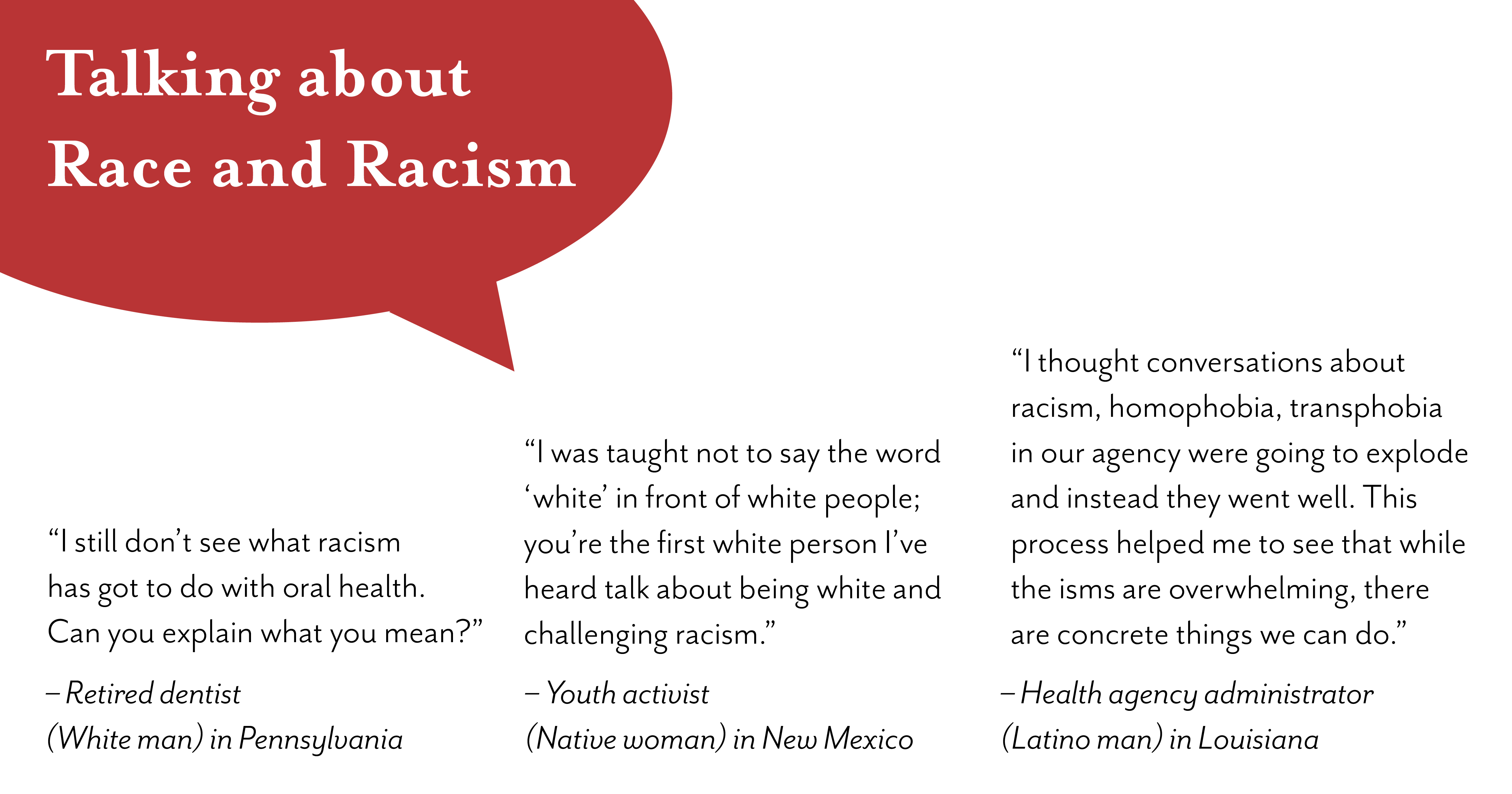
These three moments with these three individuals in recent months have stuck with me. Each of them is part of a multicultural group of folks working to integrate racial equity in their work – whether it be for youth in the juvenile justice system, for children and adults to get quality and affordable dental health care, or for people with HIV. They got me reflecting about what it takes to move racial equity work forward in multiracial, mostly white, collaboratives and institutions. And about how much I love the challenge of moving this work forward in settings where talking about race and racism is NOT the norm.
“I was taught not to say the word ‘white’ in front of white people; you’re the first white person I’ve heard talk about being white and challenging racism.” — Youth activist (Native woman) in New Mexico
Earlier this year I had the opportunity to sit in on a session in Detroit with Adrienne Maree Brown, writer, editor, facilitator and consultant to social movement organizations. Adrienne’s offering was on the potential of “radical science fiction” to realize empowering visions of a just and sustainable future. After sharing some of her own writing, she encouraged participants to play with a sense of imagination grounded in realistic projections of current social and environmental conditions and trends.
For example, while acknowledging the reality of ecosystem-depleting capitalism, mass incarceration and climate change, we were invited to think about reality-based characters with “special powers” who might help yield more desirable means and ends. The intent was, as Adrienne explains, “to create innovative ways of understanding the world around us, paint visions of new worlds that could be, and teach us new ways of interacting with one another.” It is this impulse that led her and co-editor Walidah Imarisha to organize Octavia’s Brood (in honor of science fiction writer Octavia E. Butler), “the first book to explore deeply the connections between … ‘visionary fiction,” and movements for social change through the vehicle of short stories.” The collection features a number of short stories by artists and activists.
Since that session, I’ve continued thinking about the practice of creatively reimagining futures that hover between dystopian (depressing, undesirable) and utopian (impossible, also undesirable) views. Then last week an article appeared in Nautilus entitled “An Astro-Biologist Asks a Sci-Fi Novelist How to Survive the Anthropocene,” in which astrobiologist David Grinspoon interviews Kim Stanley Robinson, science fiction and political novelist. Robinson’s recent book, 2312, “permits humans to survive near-extinction and populate the solar system over the course of 300 years.” In their discussion, Grinspoon asks Robinson what he sees as being keys to humanity getting through mounting social and environmental challenges. His answer struck me as sensible and breaks down more or less into the following:
Work continuously for universal justice and education
Grinspoon and Robinson also talk briefly about the Fermi Paradox, which points to the contradiction between the high probability of intelligent life existing beyond our planet and the fact that we have yet to see any confirmed evidence. One explanation offered for the paradox is that intelligent civilizations tend to destroy themselves, done in by the technologies and practices that contribute (at least for some time) to their so-called “advancement.” This suggestion should have us taking a hard look in the mirror and the facts, then, perhaps dusting off our visionary imaginations to push beyond the strictures of current thinking that seem to have us on a precarious path.
Embrace diversity Unite– or be divided, robbed, ruled, killed By those who see you as prey. Embrace diversity Or be destroyed.
From Octavia Butler’s “Earthseed: The Books of the Living,”Parable of the Sower.
A couple of weeks ago I joined a panel of presenters on a webinar hosted by Johns Hopkins’ Center for a Livable Future focused on collective impact and network building for food policy councils. Other panelists included Ellen Kahler from Vermont Farm to Plate Network, Jennifer Obadia from Health Care Without Harm, and Whitney Fields from Indianapolis Food Council. My role was to provide an overview of collective impact, giving credit to FSG and the Collective Impact Forum for codifying and advancing research and practice in this arena, as well as network building principles as applied to collaborative efforts to realize more local, just and sustainable food production, distribution and access. Read More
“Innovation is as much a function of the right kind of relationships as it is of a particular kind of individual vision.”
-Carter Phipps
I generally cap off the summer with a post about some of my summer reading. I am still working on something to capture take-aways from one of my favorite reads – The New Science of Sustainability: Building a Foundation for Great Change – and am offering here a revised post from a few years back that focuses on a still very timely book.
I ended my summer reading with what was for me a fascinating book – Evolutionariesby Carter Phipps. Phipps is the editor of EnlighteNextmagazine and enthusiastic about what we calls “the evolutionary worldview” and how it is showing up in many different fields, from biology to sociology to philosophy and theology. He sees this perspective as transforming understandings of just about everything. Evolutionaries does a great service by deepening and broadening as well as bringing much more nuance to what I see as a very important perspective for the work of social change. Read More
The following is a slighted edited version of a post that first appeared on this site about three years ago. IMHO, its core question remains essential to work for social change.
“Are you a sophist?” This remains a very live question for me, ever since Carol Sanford offered it to me. Carol points out how many in the “helping professions” fall into the habit of trying to provide well-intended inspiration and advice to others at the expense of diminishing their capability. She likes to tell the story of Socrates’ awakening. Socrates observed what often happened to those in Athens who listened to the Sophists preach. Members of the audience would often leave full of wisdom and inspiration, and they kept coming back for more. At a certain point, however, many of these “followers,” after seeing no further progress in their lives, became demoralized and convinced that they would never be able to reach the heights that were suggested in the speeches they heard. Watching this, Socrates took a different tack. He sought to help others grow by asking questions that helped them to move and take control of their own development and destiny. Read More
IISC is honored to have been a finalist in the bid for Imagine Boston 2030, the first city-wide plan in 50 years. The RFP was inspired by public engagement efforts already underway, including Mayor Walsh and the Boston Transportation Department’s Go Boston 2030 initiative, for which IISC is leading the way to new standards of participation.
IISC submitted a proposal to bring these methods to Imagine Boston 2030 with Sasaki Associates and Inkhouse, emphasizing the importance of both design and democracy for a unified, bold future vision. We call this Big Democracy, or building new infrastructure for people to participate in city-wide decisions and increasing the capacity of leaders to harness public feedback. This missing infrastructure for democratic decision-making will change how cities develop in the 21st century, inspiring investment by people in the place where they live.
Highlights of our proposal include an emphasis on equity and tapping already existing networks for participation. For city-wide engagement to take hold, all feedback must be considered expert feedback, whether from lived or professional experience. Efforts must also directly address complicated racial dynamics in productive, direct, and honest ways. We know that public engagement must be fun to overcome planning fatigue and bring out unusual participants.
Mike Ross celebrated Go Boston 2030’s creative thinking and public input in the Boston Globe, noting: “Gone are the days when a city engineer slapped a traffic counter on a road and made infrastructure decisions that would affect several generations of residents.”
Imagine Boston 2030 signals a new era of public engagement in the city. We applaud the Boston Redevelopment Authority (BRA) and Mayor Walsh for leading this two-year process. This will have major consequence for everyone who lives, works or plays in the city and we encourage all partners to join us in supporting this effort.
Interaction Institute for Social Change (IISC) calls the new infrastructure and processes for civic involvement Big Democracy. This fall, IISC President Ceasar McDowell will deliver two Ted X talks on pressing Big Democracy issues and design solutions for cities. IISC is also co-convening national thought leaders on design and democracy. Media inquiries for Dr. McDowell and thought leaders at IISC, please contact Danielle Coates-Connor: 617-535-7159
“Narratives can create a very different world, one where pressure evolves from a source of stress to a source of excitement, calling us to achieve even more of our potential, both as individuals and collectively.”
– John Hagel
What follows is a slightly edited version of a post from a little over a year ago. It remains timely in terms of conversations I am currently having with a few different networks about the interest in engaging in not just communications work, but in changing consciousness. As abstract as it may seem to some, the power of robustly connected and distributed networks to create and promote new stories of who “we” are and what we might become can be critical to the work of social change.
Today’s post gives a tip of the hat and bow of gratitude to John Hagel for his work on narrative, which I believe has much to offer networks for social change. First a little story . . .
A regional network with which I have been working has been wrestling with what has to this point been called “a vision” for the region’s future. Part of this struggle owes to attempts to create something that can speak to a verydiverse and complex range of interests. And part of the struggle, from my perspective, stems from what I see as the need to parse out and accentuate different elements that to this point have fallen under the rather broad heading of “vision.” Read More
Just coming off of co-delivering a 2 day Pathway to Change public workshop at IISC with Maanav Thakore, and I’m continuing to think about how important context is to the work of social change. In particular, I’m thinking about how seeing the foundation of all change efforts as being fundamentally networked can yield new possibilities throughout the work. There is the change we plan for, and the change that we don’t plan for and perhaps cannot even imagine – emergence. This is the stuff of networks, of living systems, of decentralized and self-organized activity, which can be encouraged and supported but not often predicted or controlled. And that’s not necessarily a bad thing.