“We are actually waiting for civilization both to learn and reorganize itself with more intricacy, more collaborative coherence and greater social intelligence.”
Two weeks ago I wrapped up Harold Jarche’s on-line course on social learning and am committing to practicing some of what I learned through blogging as “learning out loud.” This is not an entirely unusual practice for me, but Harold has helped me to better appreciate the value of turning off the critic and putting “rough draft thinking” out there, as a way of crystalizing and mastering my own knowledge but also (possibly) connecting it to others who may be on the same wavelength/ have similar lines of inquiry and (perhaps) contributing to social change. Preposterous? Maybe.
But consider how our understanding of how the world works is shifting through our ability to see connections, appreciate the social creation of knowledge and grasp the emergent nature of change. Seeing reality through a living systems lens helps us to understand ideas as seeds, expression as sowing, interaction as fertilizer and social networks as the metabolic infrastructure to bring new things fully to fruition.
“The fact that so many of us are writing — sharing our ideas, good and bad, for the world to see — has changed the way we think.”
This then is accelerating the creation of new ideas and the advancement of knowledge, in a growing number of spheres globally.
One of Harold’s refrains is that in this age of increasing complexity and disruption “the work is learning and learning is the work.” In both organizational and trans-organizational contexts, it is important to more intentionally practice social learning to stay afloat, abreast and ahead. My particular interest here is to explore how social learning relates to the work of social change, and specifically work for greater social equity and sustainability.
“The web metaphor does not fully capture the essence of today’s change. The real story here is learning.”
– Sally J. Goerner
In her exploration of “the new science of sustainability,” Sally J. Goerner notes the primacy of learning in maintaining cultural “fit-ness” amidst dynamic conditions. As systems evolve in their complexity, one of the keys to resilience is to keep energy (communication, resources) moving through all of its “parts.” Failure to do so can lead to atrophy in some parts and risks the health of the whole. Indications are that mechanical-industrial era ways of thinking and operating have rendered “mainstream” society unfit for the planet. Furthermore, the rise of oligarchy (elite hoarding of power) is benefitting the very (and largely white) few at the long-term expense of the whole.
Part of the answer to this situation is to create more intricate, decentralized, distributed, life and earth-honoring processes and structures that can help to feed the whole, with one of the core nutrients being real time social learning. As conditions change unpredictably, it is important to be able to circulate information from a variety of sources more rapidly, and create “processing venues” for people to make collective sense of what they are taking in. What Goerner and others suggest be done to “organize society” to be more fit for long-term survival includes many of the goals for social change of those with whom IISC partners – preserving diversity, creating equitable access, supporting healthy connections and self-expression.
Key to this kind of organizing work is some of what Harold Jarche mentions as being critical to the practice of social learning – transparency, openness/acceptance, sensitivity to other perspectives and the world around us. And all of this can contribute to a fundamental sense of community, common fate, and belongingnecessary to make deep social change.
So the next time you do some thinking or work, consider doing it out loud, via a blog (internal or external) or social media. Sow – put your ideas and narration out there for the seeing and the rifting. Water and fertilize others. It’s not simply self-indulgent. It can help things stick, and it may even contribute to evolution.
“In times of change learners inherit the earth; while the learn-ed find themselves beautifully equipped to deal with a world that no longer exists.”
I posted the following about five years ago on this site, and have been actively thinking about and experimenting with its core lessons ever since. I have only become more compelled by the need to bring a living systems orientation to work for social change. Curious to hear reactions and what you are already doing to apply insights from and living systems.
Part 1
Last week I was in the presence of a master. For more than 25 years, Lauren Chase-Rowell has skillfully and intuitively cultivated the land around her house in Nottingham, NH to the point that it exists in great harmony with the beautiful farm house, people and fauna occupying that space. Lauren is an ecological landscaper, organic farmer, and permaculture design teacher. Her home, Dalton’s Pasture Farm, is a vibrant classroom and testament to the possibility of practicing “earth-centered living.”
Last week I had an interesting conversation with an evaluator who was curious about some of the networks for food system development we’ve been supporting through IISC. We got to talking about “metrics,” which led into consideration of the role of story in not simply gauging network effectiveness, but also in stimulating network evolution. Communication and social learning are part of the life-blood of human networks. This is something that we’re coming to understand at a more profound level amidst the complexity of food system transformation work at all levels.
As we try to identify “leverage points” to shift regional food system dynamics in New England in the direction of increased local production, food security, economic development, resiliency and equity across the board, we are realizing that more robust connectivity and sharing across boundaries of many kinds is a significant strategy and form of structural change that can allow for critical self-organization and adaptation. Stories become one of the critical nutrients in this work.
For example, as much as we have begun to share data, and importantly disaggregated data, across the region, we have found that stories often have more stickiness and staying power. The stories that were shared at last year’s Food Solutions New England (FSNE) Food Summit about racial equity and white privilege have been referenced for their impact in creating an environment of genuineness, that have spurred others to speak up and take up the conversation about the reality of structural racism in our food system. This has in turn brought more trust and diversity to the network, which has helped to create a more comprehensive understanding of the food system and possibilities for decentralized and more formally coordinated network action.
Furthermore, we have begun to solicit stories of success and innovation around embracing the FSNE Vision (of 50% self-sufficiency with regards to regional food production by the year 2060) and racial equity commitment. And coming out of this year’s Summit, there is interest in sharing stories of how people are working towards “fair price” across the food chain, in such a way that food workers, producers of varying scales, distributers and consumers have living wages and access to health-promoting and culturally diverse food. The curation of these stories we see as beginning to change the underlying economic narrative.
Stories then become fuel in many ways, providing different points of access, connection, inspiration, education, and meaning-making. Stories are like enriched compost that can be fed back into the network to nurture new growth. Our work as a Network Team, as network gardeners, is to “close the resource loop,” encourage and support more equitable channels for expression, more cross-fertilization, more interest in diverse (and concealed) stories and “processing venues” for these (virtual and in-person).
How are you using story to feed your net work forward?
“A beautiful question is an ambitious yet actionable question that can begin to shift the way we perceive or think about something – and that might serve as a catalyst to bring about change.”
– Warren Berger
Photo by Duncan Hull
One of my favorite reads of the past couple of years is Warren Berger’s A More Beautiful Question: The Power of Inquiry to Spark Breakthrough Ideas. It continues to strike me as being an important book for any social change agent. Early on, Berger begins with the following provocative statement, that rings true to personal experience:
“Well meaning people are often trying to solve a problem by answering the wrong question.”
In some cases this is because they have not paused long enough, if at all, to consider the underlying question their efforts are trying to solve (risking “active laziness” which I blogged about a couple of weeks ago). Or, as my colleague Cynthia Silva Parker has said, they are “solving for solution,” essentially promoting and/or fighting over their own preferred approaches. And so they continue to offer the same old, ineffective and outdated, approaches or products. This is especially problematic in a time of such change and flux, when we can’t fall back reliably on what we already know. Read More
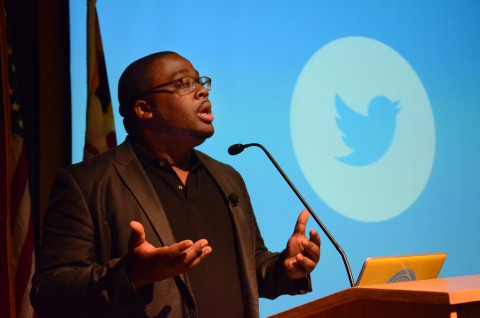
Keynote at Grantmakers for Effective Organizations Conference on June 11, 2015.
Direct Experience
This story begins for me when I was in Central America and had terrible fall and I could hardly walk. I was medi-vaced back to the US where doctors gave me x-rays, bone scans, and cat scans, but they were unable to discover what was wrong. Everything changed for me when I visited a holistic doctor. She laid me on the table and proceeded to touch my body all over.
What I realized at that point was that up until then, doctors were trying to understand me by looking mainly at representations of my body. It was not until someone engaged my body physically that the missing information was included that led to a pathway to health. This experience of representative data failing and direct experience finding a solution to a problem left a lasting impression on me—literally. As you can see, I am moving and healthy now. It helped me understand that what we know how to measure is not all we need to know in order to understand.
Thank you for the opportunity to talk with and have a conversation with you about community knowledge and voice. One thing I have learned is that this topic is not just a concern for grant makers. It is also the core issue for building a just and inclusive democracy.
To illustrate this and open a dialogue on the implications for grant making, I am going to tell you about an innovative approach to bring community knowledge and voice to a central public policy issue going on right now here in Boston.
All In
I have spent my life practicing and innovating what it takes to bring community knowledge to how we build equitable and just societies; or, as I like to say, for us all to be all in. All in framing issues. All in providing the information and knowledge needed to understand the issues that affect us. All in making decisions that impact us all. All in, especially those who are most often always left out.
In this and many other countries, we do not have the infrastructure nor process in place that will allow us to be all in, and to bring the full force of what we know to inform our understanding of the world.
And so we are left wondering—How can we build the will and develop the skill of the diverse public to collectively create a just society? How can people live in peace on a healthy planet, balancing their individual interests and complex differences? I call this quest to create a new infrastructure and process to bring us all in BIG DEMOCRACY.
Right now, in Boston, we are using transportation planning to demonstrate that Big Democracy is possible. And we can do this because it’s a new day in Boston with a new Mayor, Marty Walsh, who has a desire to hear more voices than ever before. Go Boston 2030 is a project of the Mayor’s Office, the Boston Transportation Department, and the Barr Foundation to develop a vision for Boston’s transportation future that is defined by the diverse Boston public.
There are four components to this effort:
Creating a new context for public participation
Using questions to engage the public
Making meaning of public knowledge
Creating a shared vision
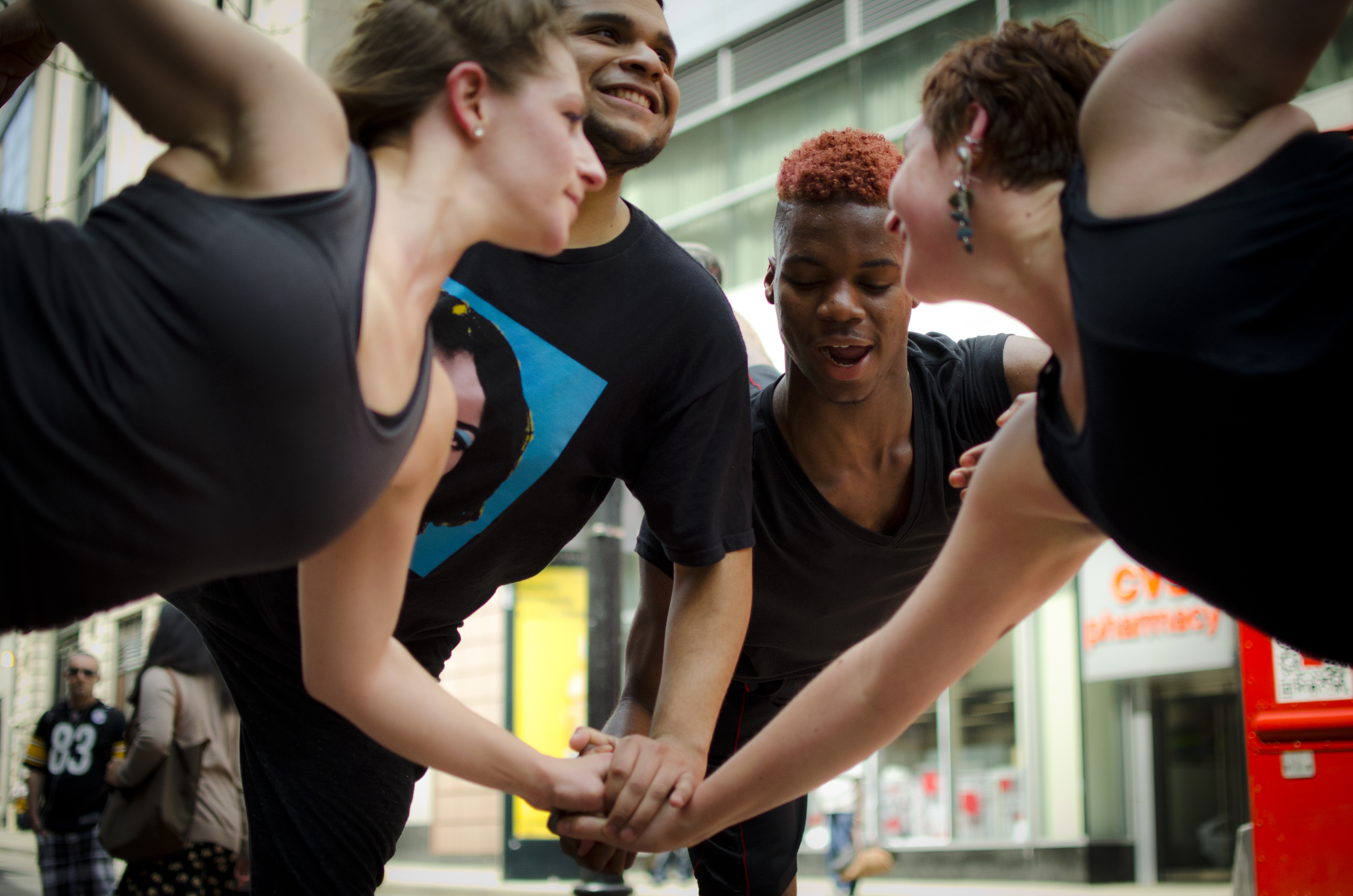
Present Day Dance Theater performs outside the Go Boston 2030 Visioning Lab on May 9, 2015. Photo by Rafael Feliciano Cumbas.
Creating a New Context
For it to truly be a new day in Boston, we had to let the public know we were serious about letting them frame the transportation vision for Boston. We used our Question Campaign technique to get people who live, work, and visit Boston to donate their answer to the following question—”What’s your question about getting around Boston in the future?” We started with a blank canvas and asked the public to fill it in from its own experience.
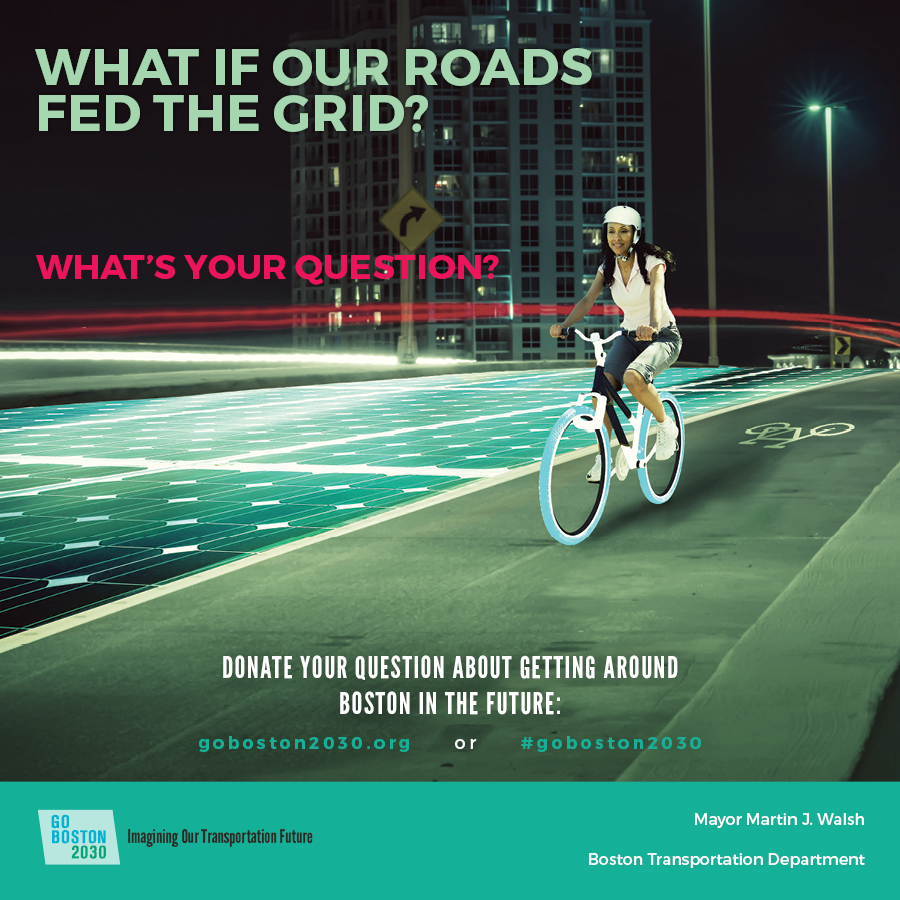
To let the public know the city was serious about hearing from everyone, we created an ad campaign designed to let the public know they were being invited into something different. If this was January, you would have already encountered ads, as they were all over the public transportation, digital billboards, even the trash cans in the city had ads.
The ads were designed to be provocative and to get people thinking about what’s possible beyond their current reality. The ads were also designed to elicit an affective response, to touch people, because we believe that to engage people, we need to engage both their hearts and minds. The ads are also designed to let them know what they needed to do to participate; and all of this because we want to tap into the creative energy and deep knowledge of the public.
What we understand about democracy is that most people have opted out. They believe it is impossible for the demographically complex and diverse public of this country to work together. The counter intuitive action is that, to bring people together, you first create the opportunity for each person to speak for themselves, and, over time, with each other.
Advertisement by Ad Hoc Industries.
Using Questions To Engage The Public
We put our ads throughout the city to demonstrate that anyone can have a question even if they don’t see themselves as an expert in transportation planning. All anyone had to do to participate was donate a question. We use the word donate purposefully to let people know that we recognize their question has value.
To engage people in the process of democracy, you have to lower the barrier to participation. And what we have found is that asking people what their question is about something allows anyone, regardless of age and language, to participate. Even the six-year-old boy who asked the question, “Will dinosaurs be a source of transportation in the future?”
Listening to people’s questions is a way to understand what the breadth of the issue is, what people’s diverse experiences are, and what they most value. Because we believe it is critical for people to see themselves and their reality in the ads, we used our digital channels to reflect back to the public images of people with their questions. We do this to present a counter to the general narrative that is out there that the public is not smart.
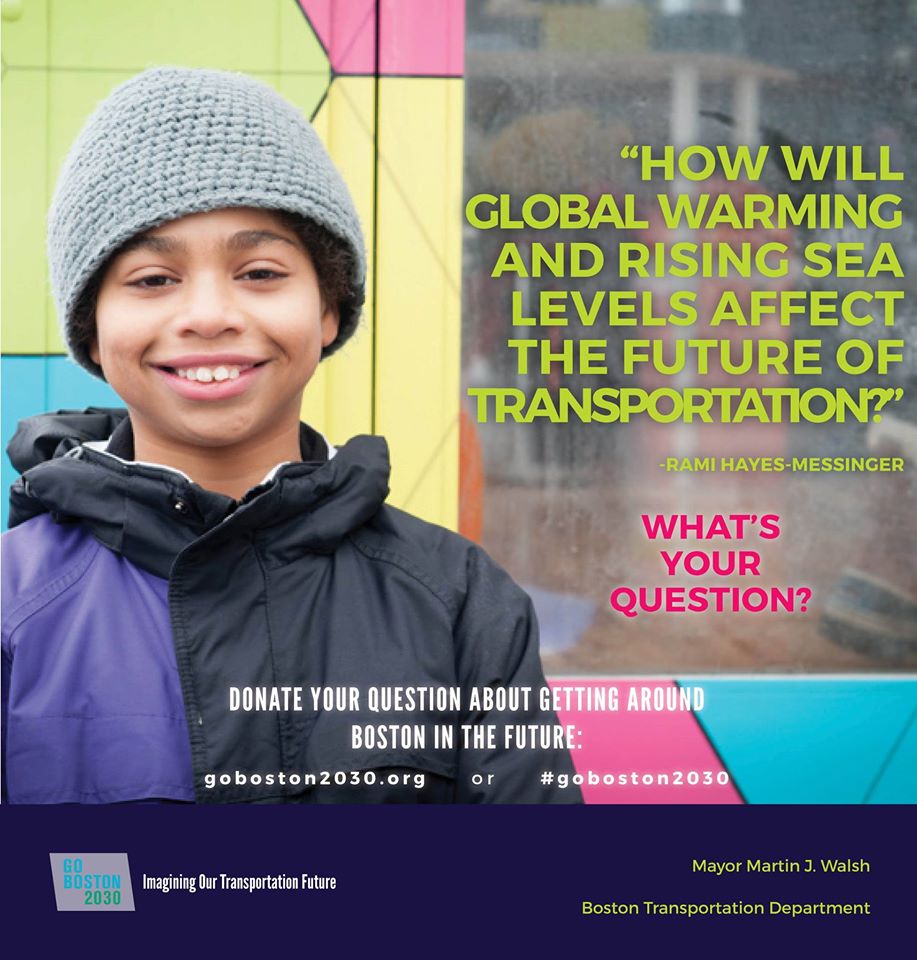
In one ad, Rami an 11 year old African-American boy is pictured with the words from his question. “How will global warming and rising sea levels affect the future of transportation?” Knowing that this is the kind of question that he has, how does this change what you think he needs and what’s important in his life?
Big Democracy requires us to shift our thinking and to realize that people, no matter where they are or what their station in life, actually have valuable knowledge to contribute. We learn to value The Other.
Rami Hayes-Messinger quoted in Dudley Square at the What’s Your Question Truck. Photo by Leise Jones.
We collected over 5,000 questions and touched every neighborhood in Boston. We did this by letting people submit a question in a way that makes sense to them and meeting people where they are.
For example:
People could submit questions via text, email, handwritten cards, Tweet, Instagram, Facebook, and other ways.
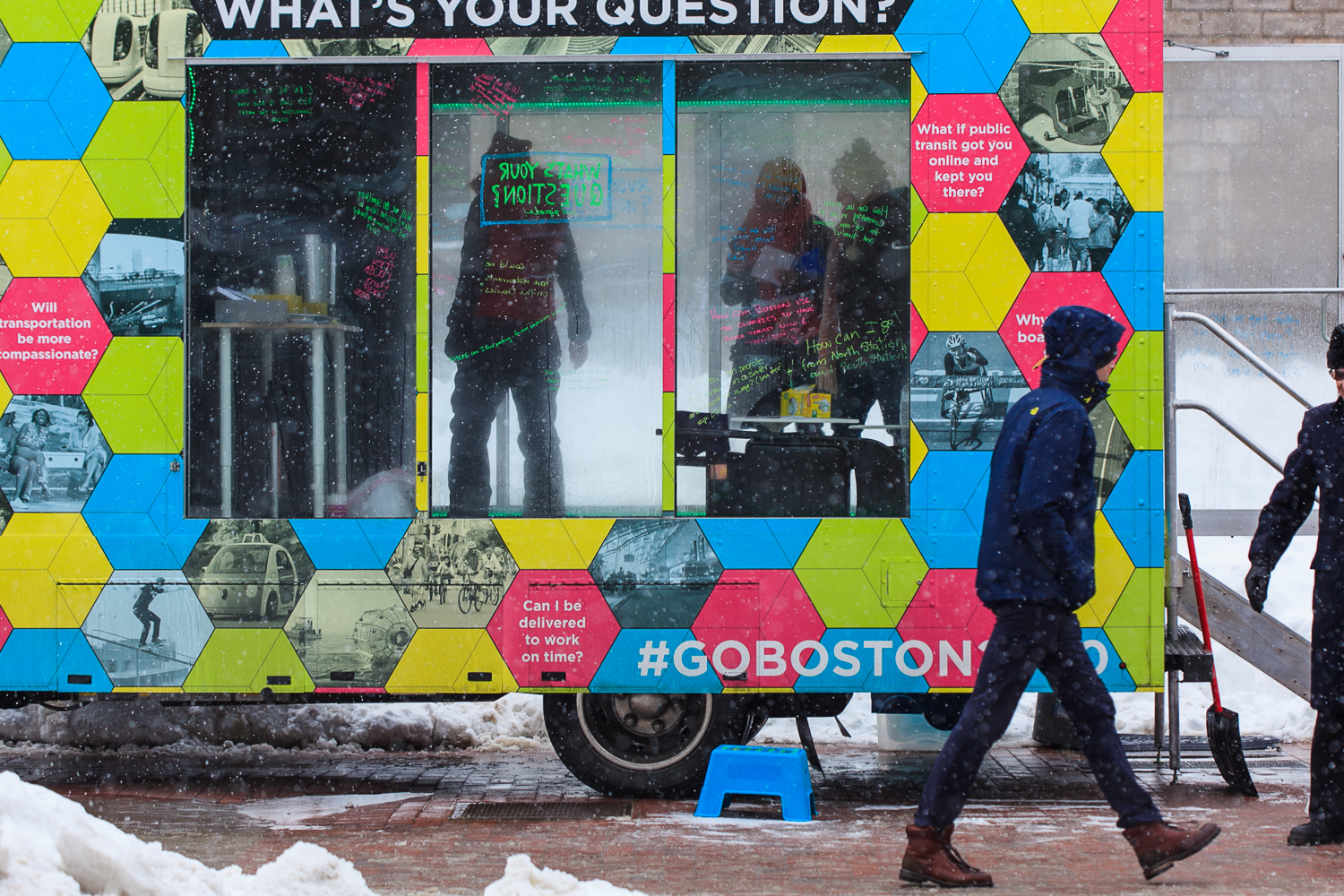
We designed an interactive glass truck that went to 15 neighborhoods.
We used digital media to publicize on the city’s social media pages, built a following, and attracted thousands of questions.
We had over 80 partners from city agencies to grassroots organizations committed to bringing their networks into the campaign.
We participated in existing events all over the city.
We knew it was working because we’d show up at a non-transportation event in the city and get asked for questions. This is something we were part of starting, but the public owned it.
In democracy, in order to solicit the knowledge that the public has, you have to ask people in the form they’re used to having conversations in, and you have to show up where they are. The opportunities for participation have to exist within the normal flow of ones daily life. This doesn’t necessarily mean you, but you have to create the opportunity for the request to show up.
Videos shot and edited by Oluwaseun Ajewole.
What’s Your Question Truck parks in neighborhoods to collect questions. Photo by Allana Tarranto
Making Meaning of Public Knowledge
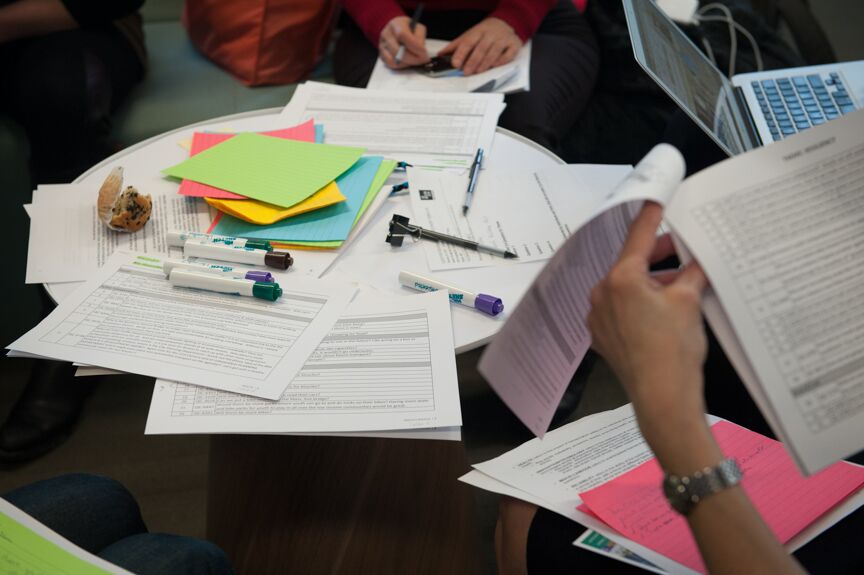
As the questions came in, they were organized by emerging themes and zip code, and made available for viewing on the website. But how do you move from 5,000 questions to something people can anchor around and build a vision? The Question Review Session was a half-day convening of city officials and community leaders who reviewed all of the questions and worked together to understand and articulate what the public was saying. Participants identified sets of questions that best represented what was most recurrent, provocative, and visionary amongst everything people had said.
What is important to note here is that the primary responsibility we ask is that of discernment. They had a responsibility to weigh each question the same and try to discern the shared meaning emerging from what the public had to offer—and they took it seriously. What they produced was later verified by the public at the Visioning Lab. The public will work hard to support open and inclusive democratic processes, and if you are transparent, the public will actually trust the process.
Democracy requires that we have open, transparent processes so when community knowledge is refined by others, it is not set in stone. Once refined, it requires a process of affirmation from the public again.
Every question was read at The Go Boston 2030 Question Review Session on February 24, 2015. Photo by Leise Jones.
Creating a Shared Vision
The Visioning Lab was a place for people to share their vision of our transportation future. It was designed to test the resonance of the themes, questions, and vision ideas that emerged from the Question Campaign and Question Review Session. People were invited to answer some of the key questions and to articulate how they imagine seeing each vision idea come to life.
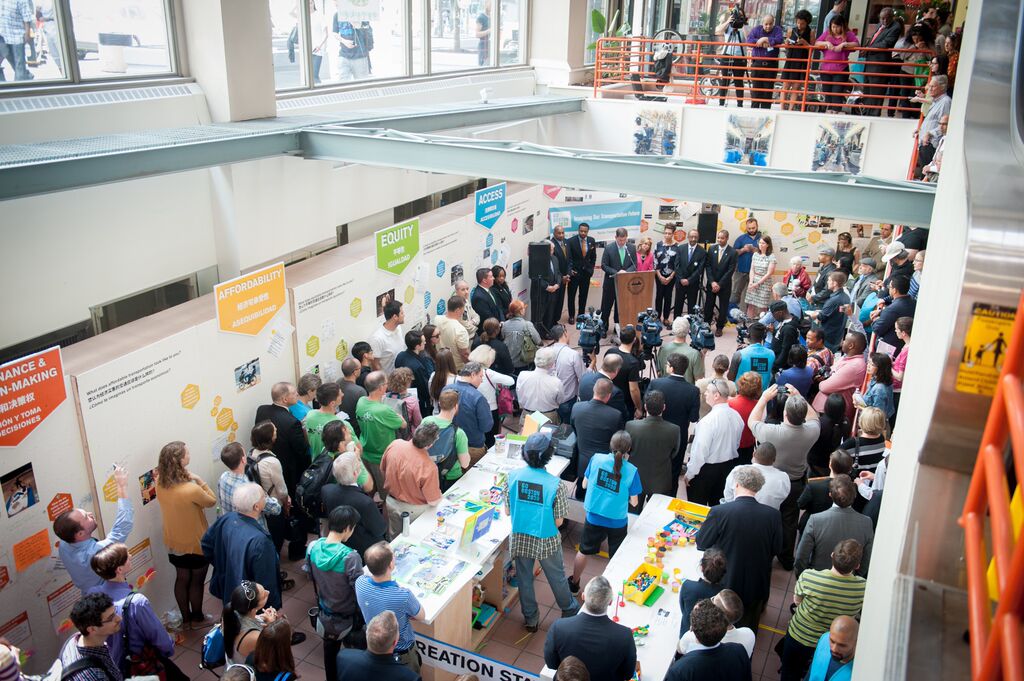
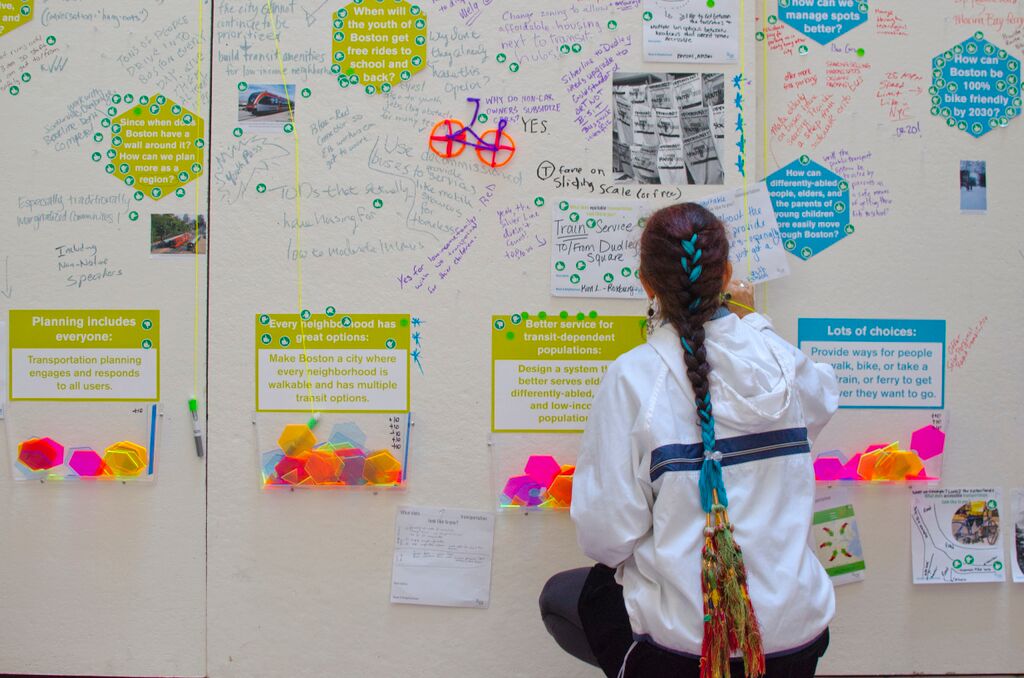
The 2-day event was highly interactive. Large, multi-lingual walls were created for each theme that emerged from the Question Campaign. Participants could offer their own vision through words or images, build on other people’s ideas, and indicate what content most resonated with them. The walls also included images that were submitted from the public online via the website. In the same area were info graphics drawn from multiple data sets showing how people get around Boston. This input became the basis for informing the goals and targets of the transportation plan.
Mayor Walsh opens Go Boston 2030 Visioning Lab at China Trade Center on May 8, 2015. Photo by Leise Jones.
The vision lab reveals an important point of Big Democracy. If you were to look at one of the theme panels you would notice that at the top is the theme, below are the framing questions, then people’s ideas represented in different forms, and, at the very bottom, a place to vote. In Big Democracy, voting is an artifact of democracy because the real work of democracy is creating the opportunities for people to lift up their knowledge and make meaning together. This is the opposite of where we currently place our emphasis in supporting democracy. As the next presidential election comes into focus, funders will begin to prioritize much needed Get Out the Vote campaigns. However, if we understood voting as an artifact of democracy, we would also be supporting efforts to have the public frame and discuss the key issues that inform the presidential election.
Right now all the information from the Visioning Lab is being pulled together to set the goals and targets for Boston’s transportation plan, and those votes that people cast have actually set the priorities of the themes. They are informed decisions. In January 2016, the city will start designing projects to meet these goals and targets, and open a new process to engage the public in that phase of the work. Interaction Institute for Social Change is in the process of continuing the public engagement in that effort, continuing to help build the public’s muscle for democracy. The questions that have been collected have been organized and coded in such a way that, as projects are identified, we can call up the questions connected to that project and use them to define effective solutions.
Go Boston 2030 Visioning Lab participant. Photo by Rafael Feliciano Cumbas.
Interventions in Democracy
I started out this talk by lifting up the distinction between Big Data and community knowledge. We live in an information economy and data will always be an important part of what we need to consider in making decisions. However, if we want to strengthen democracy, data alone is not sufficient. We need more robust interventions in democracy.
Like the holistic doctor who figured out what was wrong with my back by touching it, we need to reach out and understand communities. We need interventions in democracy. That holistic doctor has a deep knowledge system in place that allows her to do that. We need to work to develop a knowledge system for working with the public.
Just as we are creating the infrastructure to both lift up a holistic approach to health and integrate it with traditional medicine, we need to do the same thing with building democracy. We need to intentionally build an infrastructure that is going to support community knowledge to sit with data. Holistic medicine is growing. It’s widening. It’s deepening. It’s integrating with and becoming part of how we think of traditional medicine. Just as we’re getting more conscious about holistic health, we’re also valuing and getting better at traditional forms of health and data.
So what does this tell us? It tells us that the public is hungry for Big Democracy, but for it to work, every institution that touches the public must take on the responsibility of building the democratic muscle of the public. Every institution that touches the public has the possibility of building the democratic muscle of the public.
To do so we need to:
Design processes that allow the public to bring their knowledge into the conversation.
Create imaginative ways to let people know they are being invited into something different.
Invite conversations that honor what people already know.
Refine what comes out of public process openly, checked by the public.
Structure accountability methods into the implementation phase.
Much of what I have presented here is about what structural things we need to create in support of democracy, but the path is not all structural. There is a simple step that each of use can take every day to make sure that, through our actions, we are creating a world in which everyone is in. Just as we know that to undo structural racism we have to attend to the micro-aggressions that happen every day. In building a democracy where everyone is in, we have to create micro-inclusions—daily actions that signal to a person that they are included. We have to build Big Democracy and demonstrate that it is possible for the public to be all in.
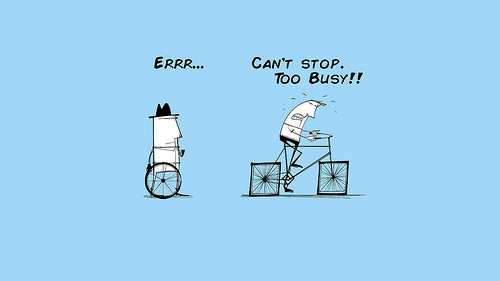
My friend Adam Pattantyus recently reminded me of the concept of “active laziness”, attributed specifically to the writings of Sogyal Rinpoche. This reminder came at a very opportune moment. It is no secret that there is, at least in a number of circles in which we at IISC operate, a burgeoning culture of busy-ness. Many people seem increasingly pressed for time, and move between the temporal equivalent of sound bites throughout their days. The ensuing “frenzy” and exhaustion, while perhaps seen as necessary (or by some as a status symbol), is also being called out for its dysfunctional nature, including how it detracts from efforts to create positive and lasting social change. This is what Rinpoche calls “active laziness,” the compulsive cramming of our lives with activity that leaves no time to confront “real issues.”Read More
I sometimes use the metaphor of “fire tending” when talking aboutFacilitative Leadership™, the approach to leadership and social change we here at IISC practice, model and teach. Facilitative Leadership is grounded in theethic of“creating and inspiring conditions for self-empowerment so that people can work together on a common goal.”It is a form of leadership, rooted ina series of connected and reinforcing practices, that increasing numbers of people, organizations and networks seem to be drawn to in this ever more complex, uncertain and dynamically interconnected world.
Thanks in part to the following inspiration from poet and professorJudy Sorum Brown, I invoke “playing with fire” as a way to think about ways of creating optimal conditions for collaborative change.
Fire
What makes a fire burn is space between the logs, a breathing space. Too much of a good thing, too many logs packed in too tight can douse the flames almost as surely as a pail of water would.
So building fires requires attention to the spaces in between, as much as to the wood.
When we are able to build open spaces in the same way we have learned to pile on the logs, then we can come to see how it is fuel, and absence of the fuel together, that make fire possible.
We only need to lay a log lightly from time to time. A fire grows simply because the space is there, with openings in which the flame that knows just how it wants to burn can find its way.
I love this imagery, and the invitation to mastery around not simply “piling on the logs,” but intentionally creating or leaving space (what we as facilitators and trainers often call strategic use of “form and void”) for individual and collective emergence. There is also an invitation here to not be afraid of fire, but to embrace it as a powerful force. Of course, fire can be damaging and destructive, and it can also be used to warm, to heal, to inspire.
“Cool fires” can also be used to help build resilience and regenerativity into living systems, feeding and encouraging new growth and diversity.I want to pick up on this theme in a subsequent post about regenerative networks. And curious to hear how you are strategically playing with fire.
“By forces seemingly antagonistic and destructive Nature accomplishes her beneficent designs – now a flood of fire, now a flood of ice, now a flood of water; and again in the fullness of time an outburst of organic life … “
Those who see networks as a fad likely see them only as a tactic, as opposed to a fundamental way of being.
Not long ago, Scientific American published a guest blog looking at the revolution in human thought that is being inspired by a network perspective. In the post, co-authors John Edward Terrell, Termeh Shafie and Mark Golitko write about how modern research in the natural and social sciences increasingly shows how the world does not revolve around people as individuals:
“Instead, what we are like as individuals critically depends on how we are linked socially and emotionally with others in relational networks reaching far and wide.”
The European Foundation Centre (EFC) is an international membership association of foundations and corporate funders working to strengthen the philanthropic sector in Europe and further afield. It is currently creating a new strategy for 2016 and onwards. IISC staff based in Belfast are supporting the EFC with the design and facilitation of this process. In developing the strategy EFC really wants to engage with a wide range of stakeholders so that the plan will be aligned closely with the needs, interests and aspirations of foundations and corporate funders in Europe and the wider world.
From Louise O’Meara, Regional Director of IISC Ireland: “We are delighted to be working on this project. The future of philanthropy in Europe and beyond is hugely important in addressing issues of social justice. Across the planet people are looking for new ways to have a greater say in the decisions that affect their lives. Philanthropy is central in enabling this and the European Foundation Centre has an important role in helping foundations and others to maximise their impact”.
IISC has worked with the Board of EFC and its staff in the early stages of the planning process and is now reaching out to its wider membership, seeking their views and wisdom, to inform the new strategy. A key mechanism for this is EFC’s Annual General Assembly and Conference, this year being held in Milan, Italy. IISC and EFC staff members will be hosting strategy workshops, conducting one to one conversations and employing a ‘strategy booth’ where participants can post ideas on where EFC should be heading in the future. They will all be donning super sized ‘strategy spectacles’ during the conference to help promote the strategy process and encourage people to get involved – even if at risk of looking a little bit silly!
“Out on the edge you see all the kinds of things you can’t see from the center.”
~Kurt Vonnegut
Last week while having a discussion with a group about food system economics, I was reminded that the word “externalities” does not always refer to something bad. An externality can also be something beneficial that is not formally accounted for by “the market.” This had me reflecting on what can happen in networks, really any collaborative endeavor, where some of the real “goods” remain out of sight, on the edges of peripheral vision, at least with respect to where people typically tend to concentrate focus. Read More