Mayor Walsh opens Go Boston 2030 Visioning Lab Friday at noon.
Boston is making (future) history May 8-9 at the China Trade Center. Led by Mayor Walsh and the Boston Transportation Department, the Go Boston 2030 Visioning Lab will inspire people in Boston to think big, another chapter in an unprecedented public planning process for the city.
The event will open with remarks by Mayor Marty Walsh. “Boston is a city of innovation, diversity and collaboration – a city where creativity and imagination are some of our most powerful assets,” said Mayor Walsh in a recent press release.
Go Boston 2030 spent the fall and winter collecting over 5000 questions from residents, workers and visitors across the city about getting around Boston in the future. Now these questions will be turned into a public vision at the two-day event. Read More
A few weeks ago I had the opportunity to facilitate some of Farm to Institution New England‘s (or FINE’s) Summit at UMass-Amherst. Specifically I was asked to offer a bit of thinking, a few prompts and guide conversation here and there around the potential of further developing the Farm to College network, as represented in the room that day by students, faculty, college administrators, community organizers, institutional procurement professionals, farmers, funders and others from the so-called “value chain.”
I told the story that has been passed on to me by Beth Tener about her work with the Barr Foundation around the Green and Healthy Buildings Network in Boston. This is a well documented example of the power of mapping and connecting agents in related but otherwise separate fields for mutual benefit and greater impact. We used this as a jumping off point at the Summit to encourage people to be more curious about existing and potential connectivity in the room.
As we invited people to consider their connections and close triangles throughout the day, I offered the following questions for reflection that I find useful when helping participants in networks become more aware and intentional regarding their potential:
Who is here and who is not here and how does that matter?
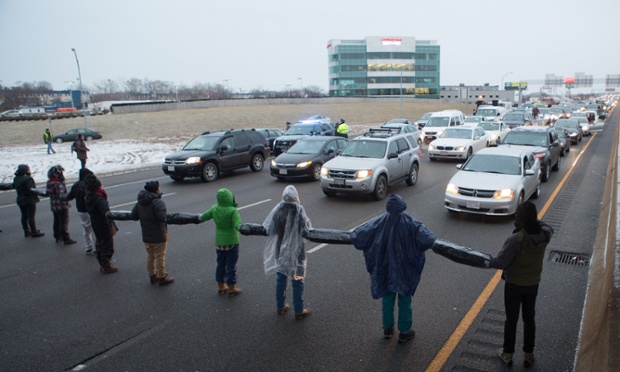
We’ve heard this call and response chant echo down boulevards from St Louis to Baltimore as the #BlackLivesMatter movement takes to the streets. This is what democracy looks like, when the people most affected by a situation organize for change. They call out to us from the streets to remind us that democracy is not about the mechanics for voting for representation.
We don’t all have to march in the streets to use our power and privilege to push for a more just society. I received a copy of a wonderful letter last night. A friend who lives in Baltimore was deeply disturbed by a video that appears to show a Baltimore city police officer violently assaulting a man from behind, even though his hands are raised in surrender. Read More
For Interview with Dr. McDowell Contact: Danielle Coates-Connor | 413-246-0524 | dconnor (at) interactioninstitute.org
MA Governor Charlie Baker and Interaction Institute for Social Change President (IISC), Dr. Ceasar McDowell make remarks at Urban Edge Annual Meeting. Emcee Karen Holmes Ward.
Image by Judy Gallagher, used under provision of the Creative Commons Attribution License 2.0.
The following is a slightly modified post from a little over a year ago. In recent months, the notion of puttingcare at the center of “net work” – to ground it, make it real and people accountable – has surfaced a number of times and strengthened. The original post included the phrase “the empathic turn.” Since that time I’ve come to see “caring” as a more appropriate word, rather than “empathy,” as it evokes for me not simply feeling but action. This re-post is inspired by the activists and thought leaders who are about to gather in Oakland, CA for the “Othering and Belonging” Conference, hosted by the Haas Institute for a Fair and Inclusive Society.
In an essay that I continue to revisit, the poet/essayist/novelist/farmer/ conservationist and champion of sanity, Wendell Berry, talks about what he calls “the turn towards affection.” Having spent many years reflecting on and pushing back against the unfortunate demonstrated human capacity to despoil landscapes and demonize “the other,” he takes a strong stand for both deep rooted connection and . . . imagination:
“For humans to have a responsible relationship to the world, they must imagine their places in it. To have a place, to live and belong in a place, to live from a place without destroying it, we must imagine it. By imagination we see it illuminated by its own unique character and by our love for it.”
In other words, by his assessment, imagination thrives on contact, on an intimate form of knowing that is not simply intellectual, but intimate and holistic. For Berry it is only this kind of knowing that can lead to truly “responsible” action.
Others, past and present, hold the truth and power of this kind of fuller bodied knowing to be self-evident, in environmental conservation and social justice efforts and in what it means to be a responsible human. Professor john a. powell writes in his book Racing to Justice:
“There is a need for an alternative vision, a beloved community where being connected to the other is seen as the foundation of a healthy self, not its destruction, and where the racial other is seen not as the infinite other, but rather as the other that is always and already a part of us.”
“Look well to the growing edge. All around us worlds are dying and new worlds are being born; all around us life is dying and life is being born. The fruit ripens on the tree, the roots are silently at work in the darkness of the earth against a time when there shall be new leaves, fresh blossoms, green fruit. Such is the growing edge.”
Spring seems to have finally arrived in New England after a long and very hard winter. For me this brings with it gratitude and utter amazement at the regenerative power of life. To have seen the mounds of snow and ice only a month ago, and along with it many frozen hearts and souls, I find it amazing as I watch the colors and sounds and spirit of this new season come forward with what almost feels like reckless abandon. Such is life and its regenerative nature, the ever present “growing edge.”
This is cause for me to reground in the teachings of mentors I’ve had who have introduced me to the power of “regenerative thinking,” an approach that aligns with a living systems view of life. Regenerative thinking can stand in contrast to mechanical approaches, which assume a rather linear, predictable and controlled environment. The very notion of regeneration is an invitation to examine some of the underlying assumptions of our actions, to lift up for closer inspection how our thinking may or may not be in alignment with what we are really after, what we are trying to bring to life, in the realm of social change. Read More
“Too many of us … feel pressure to be experts. But the most valuable thing you can do is to express vulnerability, to listen to people working things out.”
“Expertise” is one of those concepts that seems to get vetted every now and then, and in the current climate of complexity, collective impact and networked approaches to change, there is certainly good cause for this. Mark Twain once quipped that what made the expert an expert is being from someplace else. There may be some truth and value to this view when a set of “outside” eyes can lend new perspective to a situation. And certainly it has often been the case that deference is given to this manifestation at the expense of local and other sources of knowledge. Read More
I have had many conversations recently about network form and transition, all of which have me thinking of what we often talk about in our practice at IISC: balancing acts. The core approach that informs our work in the world is Facilitative Leadership, which strives to create and inspire the conditions for collaborative and net workthat yields greater, more sustainable and equitable change. In co-creating these conditions, as process designers, facilitators, trainers and coaches, we invoke a variety of practices and frameworks, each of which has its own dynamic range of considerations. Read More
Here is the fact: one segment of the population suffers daily humiliation from the sanctioned authorities. These humiliations too often lead to the most tragic of outcomes – murder by police. Another segment of the population, a much larger and dominant segment, does not have any direct experience of this sort of injustice. So they deny that it exists or that really matters that much. And here is where we find ourselves. Read More
I’ve long said that the ways in which work and organizational life are changing should be advantageous to those of us committed to social movements. Our organizational imperatives should never supersede our movement’s imperative. We should be willingly able to discard any organizational structure that does not serve our ultimate purpose. Read More
This week I was in a conversation with someone who asked me what the difference is between “networking” and “network building.” I’ve been asked this before, and certainly do not purport to have the right answer, but it became an opportunity to deepen the conversation that has been evolving in my work and head about what it means to develop potential through and in networks. Here is what popped to mind as a response, actually in the form of a series of questions