Today community activists, designers, planners, and public officials convene for a day-long event, Design, Development, and Democracy. They are called to imagine connected, democratically-driven design and development processes that can expand and deepen our democracy.
“It is important that we recognize city planning decisions as democracy opportunities,” said IISC President, Ceasar McDowell. “These decisions are not now, and never have been, separate from political matters.”
Cities are complex places where competing interests influence quality of life. To build just and resilient cities, people across sectors—not only planners—must influence decisions related to the built environment, community health and interconnected social issues.
That is why IISC has joined with Sasaki Associates, MIT’s Dept. of Urban Studies and Planning, the Boston Society of Architects, and Harvard University Graduate school of Design to host Design, Development, and Democracy (DDD) at the Bruce C. Bolling building in Roxbury.
I spend a lot of time pondering the above questions [see post] as well, and appreciate your thoughts here. It’s very helpful.
Re: ‘going beyond abstraction to interaction’, Yes! And even further than interaction – in the past year or so, I’ve developed a deep appreciation for something June Holley said to me awhile back – ‘I always say – start with micro-collaborations.’Read More
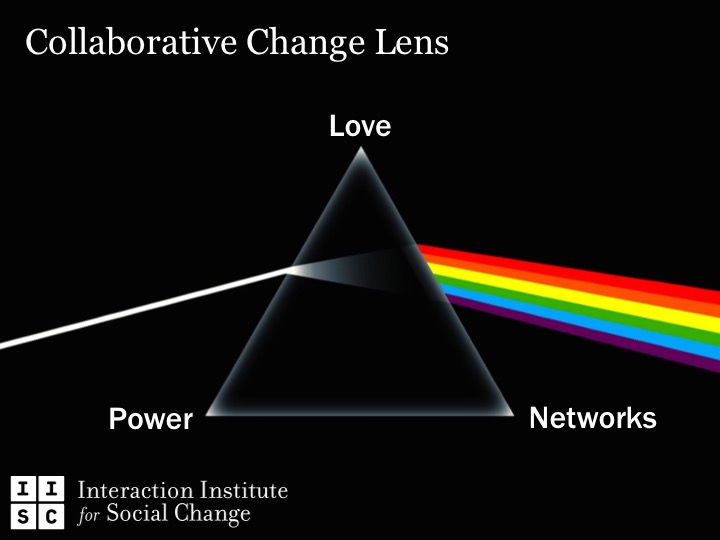
Last week, we held an internal learning session for staff and affiliates entitled “Advancing Equitable Networks.” IISC Affiliate Kiara Nagel and I presented some thoughts about our ever evolving practice of supporting network development for social change, including situating our current approach in IISC’s mission and vision, and our collaborative change lens (see above), which lifts up the importance of understanding and shifting power dynamics for equitable outcomes, embracing love as a force for social transformation and seeing networks as the underlying infrastructure of change.
We then elicited and shared some questions that are at the growing edge of our network consulting practice, including these three:
Today marks my last day at the Interaction Institute for Social Change. This has been my professional home for the last 10 years. IISC is the community that has shaped me and my capacity to fulfill my life’s purpose. I am eternally indebted to this place. This is the platform that has allowed me to make my contribution to our quest for liberation. I leave with love, appreciation and commitment to our evolving relationship. Read More
We are thankful for the thousands of people taking to the streets in Chicago in protest of the murder (and attempted cover-up) of Laquan McDonald. We are thankful for the thousands of activists demanding #JusticeforJamar in Minneapolis at the #4thPrecinctShutdown who have endured gun violence at the hands of white supremacists, desperate to stop the growing Movement for Black Lives.
We are grateful that this country is beginning to comprehend that racism is still a deep and persistent problem. A nationwide poll released by CNN and the Kaiser Family Foundation shows that roughly half of Americans — 49% — say racism is “a big problem” in society today. In, 2011 it was only 28%.
The unexplained shootings and deaths of Black men and women, the racially charged rhetoric of the Presidential race, and the increasing number of conversations around race in social and mainstream media have now affected our psyche in powerful and profound ways.
And yet, we’re desperately concerned that we’re not moving fast enough and working as deeply as we need to be.
These civilian shootings represent a terrifying moment, but also a learning moment that we need new strategies to interrupt narratives that normalize violence and racism. The current ways of eliminating racism aren’t working or we wouldn’t see both the “protectors” (the police) and violent racists shooting Black people at the same time.
Let’s embrace this moment to stand together, heal, and use everything we possess to interrupt racism and racist violent backlash. The US is settling into the reality of racism. It’s the right time for a global conversation around race and violence that leads to world changes promoting peace and equity. Interaction Institute for Social Change is incubating ideas for how to deepen and spread this dialogue and we hope you will join us.
This is the fourth of a four part series, sharing some of the lessons IISC and Horsley Witten Group learned in our efforts to support RhodeMap RI in weaving social equity into its regional planning process, and particularly our facilitation of the project’s Social Equity Advisory Committee.
Lesson 4: Lead boldly, collaboratively, authentically
Finally, working in this kind of collaborative partnership is unfamiliar for many planners and also for many community residents. It requires everyone to do their best to embrace the discomfort and awkwardness that comes with learning and develop both attitudes and habits that support collaboration. IISC has found that several key values and attributes are important for collaborative change agents to be well-positioned to support this way of working. The attributes include demonstrating a collaborative mindset, strategic thinking and a receptive and flexible skillset for facilitating collaboration. Core values include mutuality and service, authenticity, and love – a deep regard for the well-being of others. Read More
This is the third of a four part series, sharing some of the lessons IISC and Horsley Witten Group learned in our efforts to support RhodeMap RI in weaving social equity into its regional planning process, and particularly our facilitation of the project’s Social Equity Advisory Committee.
Lesson 3. Build the capacity and culture within public planning institutions to focus on equity and to facilitate broad-based public engagement.
Most planning agencies, regulators, and planning consultants are not well equipped to take on the challenge of seriously engaging communities that chronically experience social inequities. As a planning agency prepares to launch a planning process, it needs to build both a culture and capacity that welcomes and supports engaging community members. This often begins with acknowledging the expertise that comes from lived experience, and the awareness that the agency may not have all the knowledge and skill it needs to take equity seriously. Read More
This is the second of a four part series, sharing some of the lessons IISC and Horsley Witten Group learned in our efforts to support RhodeMap RI in weaving social equity into its regional planning process, and particularly our facilitation of the project’s Social Equity Advisory Committee.
Lesson 2. Design the process for maximum and meaningful involvement, particularly of those who are most directly affected by the inequities, and build the community’s capacity and infrastructure to participate in the process.
This is the first of a four part series, sharing some of the lessons IISC and Horsley Witten Group learned in our efforts to support RhodeMap RI in weaving social equity into its regional planning process, and particularly our facilitation of the project’s Social Equity Advisory Committee.
Lesson 1: Weave equity into the planning process AND the content of the resulting plans.
As you heard from the participants in the video above, if you really want a plan for housing, economic development, land use (or anything else, really!) that results in more equitable outcomes, the process needs to reflect a commitment to equity, and the plans need to include elements that explicitly aim for greater equity. Before we go any further, a working definition: By “equity,” we mean a situation where all groups have access to the resources and opportunities necessary to improve the quality of their lives (that’s the process part!) and differences in life outcomes cannot be predicted on the basis of race, class, or other dimensions of identity (that’s the outcomes part!). It’s pretty hard to imagine achieving greater equity in both senses without being intentional about how the process is designed and the ideas that are included in the plans.
We worked with the Horsley Witten Group to facilitate the work of RhodeMap RI’s Social Equity Advisory Committee (SEAC), which focused specifically on social equity. SEAC was charged with offering input and feedback into planning activities and contributing to the housing and economic development plans. SEAC developed a set of Guiding Principles to guide the planning process and implementation of the resulting plans. These principles have relevance well beyond RI.
Principles related to the planning process included:
Do not shy away from frank discussions. Get comfortable with words we don’t like to use, such as segregation and racism. Be explicit about the role that race and ethnicity play in the distribution of benefits and burdens in Rhode Island.
Listen to the voices of those who have historically been excluded from planning decisions and create opportunities for lasting involvement in planning decisions by members of communities of color.
Engage and involve community residents during implementation.
Make sure meetings and materials are accessible.
Principles related to the content of the housing and economic development plans included:
State clearly that the goal of all of these plans is to eliminate disparities along race, class, gender, and other dimensions of diversity. Prioritize efforts to improve the housing and economic conditions of those who are struggling the most.
Make sure that [economic and housing] development is focused on the needs of people.
Use public funds for public good, particularly marginalized populations in the community, not private profits.
Be clear, specific and direct so that outcomes can be measurable and there can be accountability for outcomes. Mandate accountability in the implementation plans.
Make sure that plans for housing, economic development and transportation are integrated because the issues are connected.
While not a perfect process, participants from communities, government, and organizations credit SEAC with making strong contributions to the plans, as well as providing important feedback about the process. You can check out the economic development plan yourself and look for evidence of SEAC’s thinking woven throughout. Stay tuned. In upcoming posts, we will explore three other lessons learned:
“The goal is not so much to see that which no one has seen, but to see that which everyone else sees in a totally different way.”
– Arthur Schopenhauer
I just finished reading The New Science of Sustainability:Building a Foundation for Great Change, which added depth and nuance to my understanding of the importance of thinking and working in networked ways to create social change. Lead author Sally J. Goerner isScience Advisor to the Capital Institute and lectures worldwide on how the science of “energy networks” can provide measures and an overall narrative for supporting social, economic, and ecological sustainability. Read More
I’m working with a social change network that is evolving its structure to make better use of existing resources, and we have talked about how aligning more explicitly with network principles, both in its structural design and operations, might help with this. Culling through a variety of principles from other networks with which I’ve worked, I’ve come up with the following dozen examples:
Always make opportunities to build connections/relationships/trust
“If you have come here to help me, you are wasting your time. But if you have come because your liberation is bound up with mine, then let us work together.”
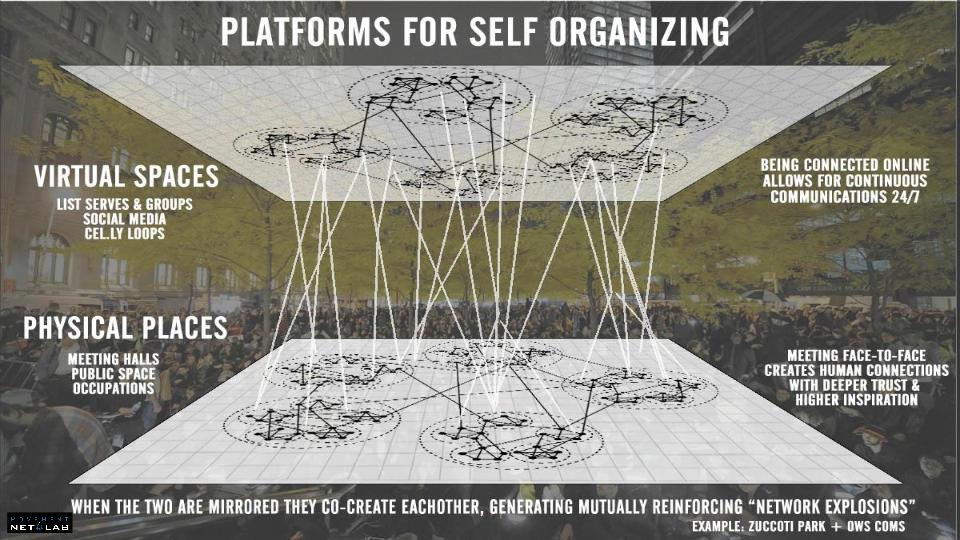
Last week I attended a gathering of network funders and practitioners in Oakland, CA hosted by Leadership Learning Community. Surrounded by so many bright lights, it was hard to get enough of any given individual or conversation. That said, one interaction that continues to stick out for me occurred with Allen Kwabena Frimpong and June Holley of Movement Netlab. Allen, June and I share an interest in supporting collaborative platforms (virtual and in-person) that can help to facilitate resource movement and exchanges of all kinds among diverse actors for the benefit of structural change. Read More