I just read a helpful Upmarket blog post on the distinction between strategy and tactic. It was almost a relief to know that the business sector also struggles with the distinction. Confusing these two terms has led to a lot of trouble in our work for social change.
You’ve heard that “it takes a village to raise a child.” It also takes a village to make an IISC engagement happen. I want to raise up a shout out and express my grateful for the excellence with which our colleagues do the detailed behind-the-scenes work that makes IISC’s practice possible.
We are delighted to share an article with you that was just published in the Stanford Social Innovation Review this week. The article, Networking a City, tells the story of the evolution of the Barr Fellows Network, launched by the Barr Foundation, and its impact on the City of Boston.
|Photo by Martin Pettitt|http://www.flickr.com/photos/mdpettitt/454595511|
A Cherokee Legend . . .
An old man is teaching his grandson about life. “A fight is going on inside me,” he says to the boy.
“It is a terrible fight and it is between two wolves. One is evil – he is anger, envy, sorrow, regret, greed, arrogance, self-pity, guilt, resentment, inferiority, lies, false pride, superiority, and ego.” He continued, “The other is good – he is joy, peace, love, hope, serenity, humility, kindness, benevolence, empathy, generosity, truth, compassion, and faith. The same fight is going on inside you – and inside every other person, too.”
The grandson thought about it for a minute and then asked his grandfather, “Which wolf will win?”
The old man simply replied, “The one you feed.”Read More
|Photo by Brad Coy|http://www.flickr.com/photos/bradfordcoy/3284527566|
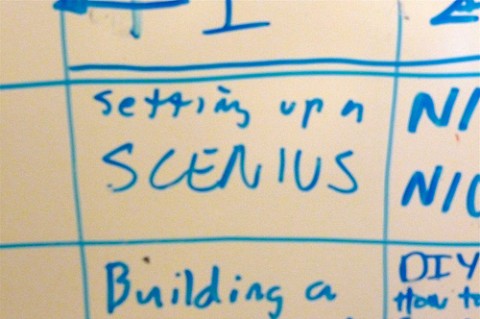
This post is a slightly edited email message from Bart Westdijk of the New England Grassroots Environment Fund (NEGEF). NEGEF has 16 years experience resourcing the grassroots, thousands of citizen-led environmental and civic engagement initiatives around New England. Bart spearheads some of the amazing work the Fund is doing in the virtual and social media spheres to better connect grantees, add value in new ways, and create a larger sense of movement. Exciting new ventures include an emerging crowdfunding initative with ioby and a grassroots leadership skills building academy. Keeping in the spirit of NEGEF’s emphasis on collaboration, networks, and partnership for social change, Bart sheds some light on the concept of scenius . . . Read More
They say being a change agent is an inside job. This summer, we invite you to sharpen your tools and rejuvenate your capacity for leadership through a values-based professional development opportunity in a beautiful retreat setting! Center for Whole Communities (CWC) and Interaction Institute for Social Change (IISC) are collaborating to offer a four-day residential Whole Measures Workshop July 10 – 13, at CWC’s retreat center at beautiful Knoll Farm in Fayston, VT. Read More
It’s been my pleasure over the last few years to have been of service to and learned from Antioch New England students and staff. The video above is the product of Antioch graduate student Emily Read Daniels, who has been in some of our discussions about networks.
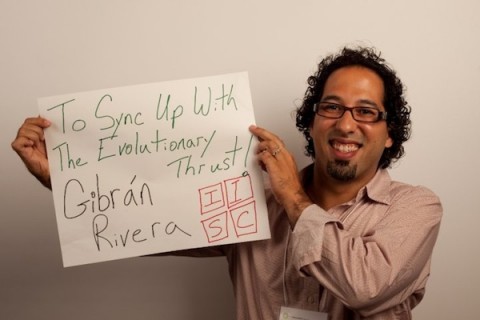
I am so proud of my colleague, Gibran Rivera, for the due recognition that he has received lately in various quarters for his deep thinking and transformative work. And I am grateful for how eloquently he captures the nature and intention of our collective work the Interaction Institute for Social Change in a recent interview:
“IISC seeks to make the invisible visible. When we are successful, people find themselves working in ways that are life-giving, generative, and unlike most of their experiences of working together. We achieve this by paying close attention to process. Process works best when everyone knows what it is and where we are [in] it. But process is not enough. We seek to create spaces and conditions that foster connectivity at the level of authentic relationship. When we are working in authentic relationship with one another, when we learn to connect to each other in the place where our shared purpose meets, then it can feel like the work is happening all by itself. But these spaces have to be designed; they have to be held and they have to be tended to. This is where we come in. And this is how interconnectedness becomes palpable.”
After nearly twenty years leading the Interaction Institute for Social Change (IISC)—and loving every minute of it—I will be transitioning from my role as IISC’s executive director as of July of this year. After a couple of months off, I will return as an independent consultant to continue doing this work that I love so much—both on my own and on behalf of IISC.
It has been an honor and a privilege to work shoulder to shoulder with people like you—extraordinary change agents who labor every day to make the world a better place.
IISC is now in search of someone to take what might be one of the best jobs on earth—leading IISC as it partners with organizations, communities and networks to move from shared vision to collective action toward building a more just and sustainable world. Please pass the word along. View the job listing here.
|Photo by Amani Hasan|http://www.flickr.com/photos/amani1306/2357549928|
A blog post on the Management Innovation Exchange site has got me thinking. In a post entitled, “Forget Empowerment – Aim for Exhilaration,” Polly LaBarre profiles Ricardo Semler of Brazil’s Semco Group. Semco is noted for its dramatic turnaround as a business, and for its unusual way of managing itself under Semler’s leadership, as noted by LaBarre -“no organizational chart, no fixed offices or working hours, no fixed CEO, no HR department, no five-year plan (or two- or one-year-plan), no job descriptions or permanent positions, no approvals necessary.” All of this is geared towards increasing individual autonomy and agency, participation at every level, and trust. The results are reported to be quite astounding with respect to business outcomes as well as employee fulfillment, with a long line of interested prospects at the door. Semler himself has even freed himself up to pursue interests in the realm of helping to reform primary education and the legal system! So how can I not help but be curious about some of what I/we might bring into our organizational life and work at IISC? Read More
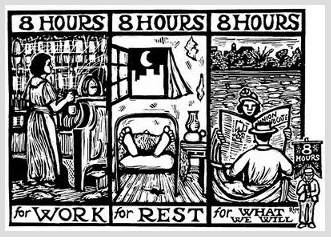
Today is May Day. A few weeks ago I had the unique opportunity to share some ideas about working with complexity with a group of funders who are committed to social justice. It was quite an honor to sit in the same panel as the great Frances Fox Piven and the amazing Ai-Jen Poo.
Ai-Jen was recently named among Time magazine’s 100 most influential people in the world. I’ve been following her work for a while and I can tell you that the mention is well deserved. Frances has influenced, informed and inspired thousands of people who have committed their life to this work.
In the presence of such an elder and a luminary anyone would be a fool not to take notes. I thought I would share some highlights from Frances’ talk with you: Read More
We often focus on the understanding of power as a process and as a social construct. As Beth Roy says, “power is not something you have; it’s something you do.” I was struck by a contrast as I listened to a brief story this morning about Lyndon B. Johnson.
Biographer Robert Caro described Johnson as having “no power” as Vice President because the Kennedy’s didn’t want him to have any. When President Kennedy was assassinated, he suddenly had all the power conferred by that office. Read More
Make Change Stick Beyond the MeetingTurn ideas into agreements that stick, and keep change going after the meeting ends. Perfect for teams stuck in “great conversation, little action.”