Posted in Uncategorized
June 18, 2012

For those of you who follow our blog or know IISC, you know that our founding Executive Director, Marianne Hughes, will soon transition out of her role. Today is our last staff meeting together with Marianne. We will mark the moment with ritual, celebration and a meal. We will invite our whole selves into the experience, just as we have been invited to bring our whole selves to IISC’s community and work over the years.
Read More
June 14, 2012

|Image by Seth Waite|http://www.flickr.com/photos/28674126@N02/4316157064|
“Society, community, and family are all conserving institutions. They try to maintain stability and to prevent, or at least to slow, change. But the modern organization is a de-stabilizer. It must be organized for innovation and innovation, as the great Austro-American economist Joseph Schumpeter said, is “creative destruction.” And it must be organized for the systematic abandonment of whatever is established, customary, familiar, and comfortable, whether that is a product, service, or process; a set of skills; human and social relationships; or the organization itself. In short, it must be organized for constant change.”
-Peter Drucker, “The New Society of Organizations” (1992)
June 13, 2012
After attending the recent “Strategies for a New Economy” 2012 Conference hosted by the New Economics Institute, Cheryl King Fischer, Executive Director of the New England Grassroots Environment Fund, alerted me to this upcoming event and ongoing campaign . . . As they say, “There are places right now in America where communities are fixing the future. Across the country, people have found new ways to work, new ways to create jobs…and new ways to be sensible about using the earth’s resources. Fixing the Future is a journey of discovery, finding communities which are thriving in these difficult times.”
June 12, 2012

I’m a big fan of “Open Space,” I like trusting people who have passion. I believe in the power of connection through self-organization. It is too often that the most interesting conversations at the conference actually happen at the break or at the bar or at the after-party. Let’s move what matters to the center! Here is a helpful reflection by my friend Chad Jones.
Open space is a way to break up the mundane, old ways of conferences. Just as we are realizing that rote memorization does not work in the classroom, and education needs to be shaken up. Our meetings and multi-day conferences need strong winds of new ideas and currents of new ways.
Read More
June 8, 2012

The following is a letter by Akaya Windwood, President of the Rockwood Leadership Institute and member of the IISC Board of Directors.
Kim and I planted the garden a couple of weeks ago, and this year I decided to start from seed. What a miraculous thing! When I spied the first little green shoots poking up through the soil, I stood in awe and wonderment. How could it be that a tiny dry speck, when put in the ground and watered becomes a green and living thing in a matter of days? Wow!
Read More
June 7, 2012

|Photo by Qoncept|http://www.flickr.com/photos/37418570@N03/4488784822|
Fresh off of an offering of Pathway to Change to a group of leaders from across sectors in southern Massachusetts, and with another 3 day workshop on the horizon in San Francisco (July 24-26), I’ve been considering how the theme of fear often comes up in discussions about impediments and challenges to effective collaborative change work – fear of failure, fear of losing something, fear of the unknown. And I’ve been more and more convinced by how important intentional, creative, and strategic process design is in building pathways through this fear. This notion has been validated in the writing of Chip and Dan Heath, most recently in their book Switch: How to Change Things When Change is Hard. In a one page summary, the Heath brothers highlight the important three steps of: (1) directing our rational selves (what exactly are we trying to accomplish?), (2) motivating our emotional selves (what’s so compelling about that future destination? why can’t the current conditions continue?), and creating a clear path between where we are now and where we want to be. Read More
June 6, 2012

The Three Goals
The first goal is to see the thing in itself
in and for itself, to see it simply and clearly
for what it is.
No symbolism, please.
Read More
June 5, 2012

Last week we started to take a look at Kevin Kelly’s take on the benefits of swarm systems. We are wondering what are the implications for movement builders. We looked at how important it is for us to be adaptable.
Kelly also says that swarm systems are evolvable. He says that these are:
Read More
June 4, 2012
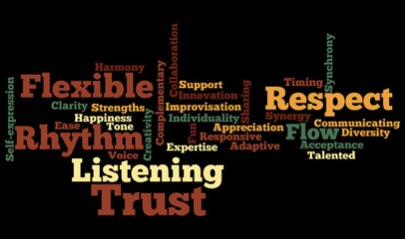
This is a re-blog of a newsletter article by Brian Fraser of JazzThink. I was particularly struck by the invitation to consider how we “manage our voice” in conversations.
“Fatima Amarshi, Executive Director of the Coastal Jazz and Blues Society that runs the TD Vancouver International Jazz Festival, began her spring appeal letter with this wonderful quote from jazz guitarist.
Read More
May 29, 2012

I’m a huge fan of Kevin Kelly. I really think of him as the prophet of the digital age. He has done lots around complexity. And he has spent time looking at swarms. In “Bootstrapping Comlexity,” Andrea Lloyd’s “remix” of Kelly’s book “Out of Control” we find a useful list of benefits and apparent disadvantages of swarm systems.
Read More
May 25, 2012

The following post is from IISC’s Founder and Board Chair, Thomas Rice, he writes in response to Gibran’s recent post on Strategy and Tactics.
Gibran,
This is a timely conversation to focus on, important on a number of dimensions. But you wisely place strategy in the context of the larger matrix: going macro toward mission, vision and values; going micro toward tactics.
But, first of all, to the definitions. Intuitively, we all know the centrality of strategy, whether we define it or not. The Obama administration is being blamed for “a failed strategy” in pulling us out of the recession; Apple lost the initial technology battle to Microsoft because they had a “flawed strategy”( failure to see the leverage of licensing the product). So, what is this thing we all claim to know so much about?
The word strategy is derived from the Greek(isn’t everything!) strategia, meaning “generalship”, itself a compound of two words–stratos (army) and agein (to lead). Note the implicit connection between strategy and leadership.
Read More
May 24, 2012

|Photo by Paul Downey|http://www.flickr.com/photos/psd/506328659/|
The following post was written by Adam Pattantyus, VP for Development of EASE (Environmental Accountability for a Sustainable Earth) and friend of IISC. Adam and his colleagues are thought leaders around integrated systems for supporting and augmenting large-scale social change. They are also purveyors of a collaborative on-line stakeholder engagement tool that incorporates financial exchange to leverage the power of purchasing to fund community initiatives. Here Adam reflects on some of the shortcomings of social change efforts with respect to integration and recapturing and reshaping the marketplace for community and civil society benefit, for which his work with EASE is meant to provide an answer. He also speaks to the importance of engaging cross-sectoral work in the pursuit of lasting change.
As a participant and leader in change and social change over the past 20 years, here are some typical blind spots that I see as holding back social change efforts: Read More
