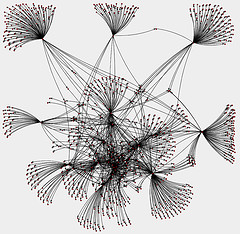
The following post originally appeared on the IISC site four years ago. It has been slightly revised and is offered here to help those focused on leveraging “network efforts” with their change efforts to consider how they might shift and align their thinking and actions.
This post builds on another focused on the power of asking “beautiful questions” and inspired by a staff challenge to articulate lines of inquiry stemming from IISC’s collaborative change lens, It distills some of the underlying questions that adopting a “network lens” inspires for social change work. Please add, adjust, edit, and rift!
How does your organization/network/change initiative strive to add value to (rather than duplicate) existing efforts? What do you do best, and how might you then connect to the rest?
What are you doing to support and strengthen connections and alignment within and beyond your organization/network/change initiative?
What current patterns of connection characterize your organization/network/change effort? How do these further or inhibit the change that you are trying to be and to bring about?
What current resource flows characterize your organization/network/change effort? How do these further or inhibit the change that you are trying to be and to bring about?
What current definitions of value (determinations of what and who matters) characterize your organization/network/change effort? How do these align with the change that you are trying to bring about?
Who sits at the core of (decision-making, communication, coordination) in your network/ change initiative? Who is more peripheral? How does this arrangement help to bring about (or not) the kind of change you hope to see?
What would happen if you drew in or out to those currently onthe periphery? How might this happen?
How do you currently engage with one another in your organization/network/change initiative? What constitutes “legitimate” modes of knowing, sharing, and interacting? What does this make possible? What does prevent?
How might you engage with one another in your organization/network/change initiative to facilitate thebest of what everyone has to offer?
How are you balancing collaboration and cooperation in your organization/network/ change initiative? When is it most strategic for all or most participants to coordinate (collaborate) around a given action? When and around what is it best to keep things diffuse and self-directed (sometimes defined as cooperation)?
How have you created opportunities for mutual and continuous exchange in your organization/network/change initiative?
What is the role ofempathy in your organization/network/change initiative? What are you doing to nurture deeper understanding, connection, and trust?
What is the role ofgratitude and generosity in your work? What are you doing to nurture and encourage greater appreciation and abundance?
How are you creating space for people to articulate requests and offersand to match these?
What structures (governance, decision-making, communication) support the focus and functions of your network/change initiative?
There is growing awareness that current organizational structures can breed irresponsibility. That is, arrangements are created where people are less able to be responsive in helpful ways. This happens, for example, when accountability is bottlenecked in hierarchies and decision-making is distanced from where the action is most timely and relevant. Read More
Picking up on the spirit of yesterday’s post about asking “beautiful questions” and inspired by a staff challenge to articulate lines of inquiry stemming from IISC’s core lenses, I offer this post. It distills some of the underlying questions that adopting a “network lens” inspires for social change work. Please add, adjust, edit, and rift!
How does your organization/network/change initiative strive to add value to (rather than duplicate) existing efforts? What do you do best, and how might you then connect to the rest?
What are you doing to support and strengthen connections and alignment within and beyond your organization/network/change initiative?
Check out the ways that love of her many identities frees up spoken word artist Jamila Lyiscott to be her full self. She reminds us that a full, loving embrace of yourself and your cultures enables others to see you more fully and embrace all of your cultures, while it makes space for others to do the same for themselves. That’s change making at a personal level that can radiate outward to the entire community. Read More
The settlement of the case of the Central Park 5 is a great day for the five individuals, add a great day for the cause of racial justice. The case of Antron McCray, Raymond Santana Jr., Kevin Richardson, Yusef Salaam and Kharey Wise is a textbook case of structural racism: implicit bias, coupled with strong-arm institutional police practices used against young men of color, and a media too eager to believe the hype, leading to the conviction of five innocent young black men for a horrendous crime. The documentary about these young men, by Ken Burns, captures the intense impact of the wrongful accusation and imprisonment on the lives of the five young men and their families. Read More
A few different experiences last week reinforced my conviction that storytelling can constitute significant “action” and advancement, including work done in networks for (and as) change. The first was during a session that I co-delivered on behalf of IISC with the Graustein Memorial Fund and The Color of Words, about our work with an early childhood system change effort in Connecticut called Right From the Start. During the conference session we emphasized that one of the biggest leverage points for system change is at the level of narrative and belief systems.
Surfacing the dominant implicit and explicit stories about what is and should be, analyzing the degree to which they align with our values and intentions, and countering/reframing them if and as necessary has been part of the work of Right From the Start (RFTS). Read More
“In principle, empathy can override every rule about how to treat others.”
-Frans de Waal
Photo by Vamsi Krishna
Yesterday’s post considered the importance and power of the empathic turn in networks-as-change, to ground people in deep connection with living realities, for the sake of greater imagination, justice, resilience and responsibility. Taking cues from experience and the work and studies of others, here are some thoughts for how to cultivate radical “affection” (to quote Wendell Berry) in networks:
Go beyond abstraction to interaction – go to and meet in real places, explore them, consider how life happens there (see for example Story of Place and Heart and Soul)
In “networks-as-change,” effectiveness is grounded in affectiveness.
In an essay that I continue to revisit, the poet/essayist/novelist/farmer/ conservationist and champion of overall sanity, Wendell Berry, talks about what he calls “the turn towards affection.” Having spent many years reflecting on and pushing back against the unfortunate demonstrated human tendency to despoil landscapes and “the other,” he takes a strong stand for both deep rooted connection and . . . imagination: Read More
This past week we have featured a couple of posts on empathy (see “Empathy + Equity –> Justice” and “Empathy Connect, Sympathy Disconnects”). In light of these and also on the heels of recent powerful experiences in a couple networks for change around the use of storytelling to deepen connectivity and commitment, I found the video above to be instructive. It is featured in a blog post entitled “How Stories Change the Brain” through the Greater Good Science Center.
Adam Grant is a professor at the Wharton School of Business whose research focuses on “motivation, prosocial giving and helping behaviors, initiative and proactivity.” His work and writing, including his book Give and Take: A Revolutionary Approach to Success, seem to have something to offer those interested in and engaged in developing networks for social change, as much of it points to data showing that organizations of all kinds benefit from fostering cultures of giving. Read More
With thanks to Jeffrey Cufaude from Idea Architects, who I met on Twitter and from whom I learned about this video, I wanted to pass along this reminder of the power of empathy and the fact that the shoes of another are often our own.


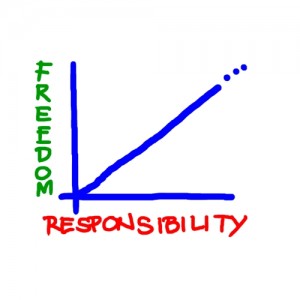 There is growing awareness that current organizational structures can breed irresponsibility. That is, arrangements are created where people are less able to be responsive in helpful ways. This happens, for example, when accountability is bottlenecked in hierarchies and decision-making is distanced from where the action is most timely and relevant.