Blog
September 10, 2014

Photo by Guy Renard 25
My friend Joel Glanzberg is a constant source of provocation and insight. The way he sees the world, through a living systems and pattern-seeking lens, is not only refreshing but unnerving in that it is evident how simultaneously critical and rare his perspective is. Joel is great at helping me and others to see beyond objects and structures to underlying patterns and processes, and how these are what animate living systems. Read More
September 3, 2014
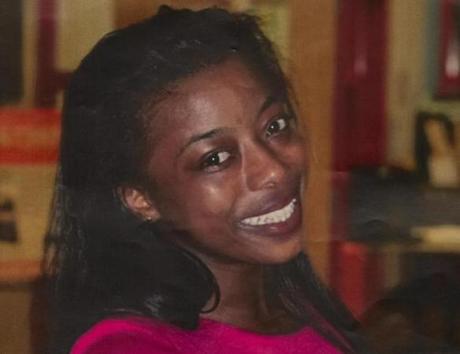
Photo credit: Boston Globe
Sadly, I am writing yet another memorial post, in a summer that has seen too much tragedy. This weekend, Boston laid to rest Dawnn Jaffier. By all accounts, she was a remarkable young woman who lived a life of service and love. Over the past several days, many young people have testified to Dawnn’s positive influence on their lives and many promised to continue to live as she lived, investing in the lives of young people. This time, death came at the hands of an 18 year-old young black man, allegedly bent on retaliation. Jaffier was innocently caught in the crossfire. While some are calling for an end to the festival and parade that provided the backdrop for this tragedy, I think her death cries out for renewed efforts to intervene in the complex system of internalized oppression – a system that cultivates within black people ourselves a belief in the marginal value of black life – and in a system of structural racism that allows gun trafficking to flourish despite the costs and continues to lock too many men of color out of the kinds of opportunities that could compete with the call of the streets. Dealing with either side of the equation without the other seems a fruitless endeavor.
September 3, 2014
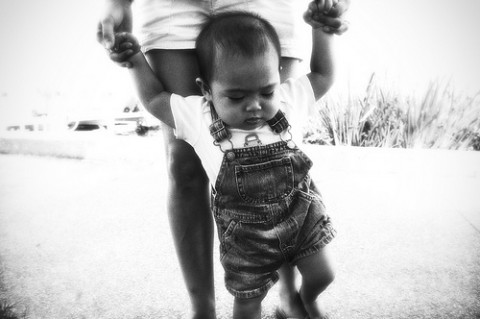
Photo by Tela Chhe
One mantra I have for working with groups is, “If you’ve seen one group, you’ve seen one group.” Part of the welcome and challenging nature of collaboration is that in each instance we are dealing with a unique organism or constellation of human beings coming together to get something done. As complex living systems, groups of people are not prone to simple “best practices” for getting them working in a prescribed way. There certainly are some “promising practices,” including what we teach at IISC in our Facilitative Leadership for Social Change courses. Still collaboration, including the practice of group facilitation, is a heuristic undertaking – an experience-based approach to problem solving, learning, and discovery that suggests solutions which are not guaranteed to be optimal. Read More
September 2, 2014
This post is a continuation of “We are in the midst of a crisis in this country.”
Over the last few days, Black activists from cities across the U.S. joined the Black Life Matters Ride, traveling to convene for a historic weekend in Ferguson, Missouri as part of a national call to end state sanctioned violence against Black people. We have a lot to learn from what’s going on in Ferguson right now and it seems that a window of opportunity is opening for the moment to become a movement, one that is about Michael Brown’s death at the hands of a white police officer and that also about so much more. We need to get to the root of these problems if we are going to end state sanctioned violence against Black people once and for all, rather than end up with yet another version of Jim Crow era state-sanctioned lynching.
If we could only eliminate police officers with racist attitudes from police forces, wouldn’t that take care of this problem? I am afraid it would not.
What will it truly take to end state sanctioned violence against Black people?
First, we need to start collecting national data on police stops and use of force and thankfully there are folks working on that.
Second, we must uproot much more than explicit racial prejudice. Some of the most illuminating research about police violence I know of is being done by Dr. Philip Goff, president of the Center for Policing Equity. Goff reminds us that attitudes only predict 10% of behaviors. Behaviors are actually much more heavily influenced by unconscious brain activity and biases. I’ve heard Goff present his research a couple of times at the W.K. Kellogg Foundation America Healing Conference and I was surprised to learn that explicit racial prejudice is not the biggest predictor of police officers’ use of deadly force. Instead, over 80% of incidents that involved police use of deadly force were preceded by threats to the officers’ masculinity. Masculinity threat is a more reliable predictor of a police officer pulling the trigger than racist beliefs. In the U.S., men of color are stereotyped as hyper-masculine, so it is impossible to separate masculinity threat from conscious and unconscious racial biases.
As a white person, I am challenging myself not to demonize or otherize white police officers who are committing violent acts against men of color. Why? Because we need to ask what is going on in the minds and hearts of people like Darren Wilson, the officer who killed Michael Brown, and Johannes Mehserle, the former San Francisco BART police officer who killed Oscar Grant. The moment I distance myself from white people like them, I am in danger of reinforcing the notion that racist violence is something I can blame someone else for, thus extricating myself from both the problem and the solution. White brothers and sisters, none of us is free from this haze of fear and disillusionment until all of us is free from it. We have got to have conversations about both the conscious and unconscious dimensions of racism, and about the interdependency of white supremacy and patriarchy. We white folks have got to take responsibility for engaging other white folks in these conversations. And we have to do this until we no longer hear things on the mainstream news like “You know who talks about race? Racists.”
August 25, 2014
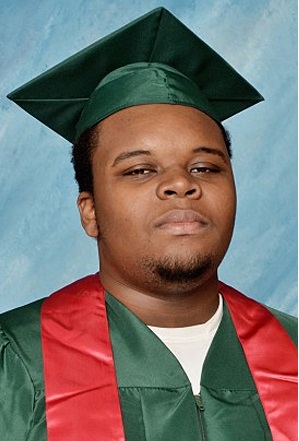
This morning, Michael Brown is being remembered. The country’s attention is shifting for the moment from the caustic, racially charged circumstances that led to his death, to a celebration of his life. You can watch it live right now via Colorlines.
Read More
August 20, 2014
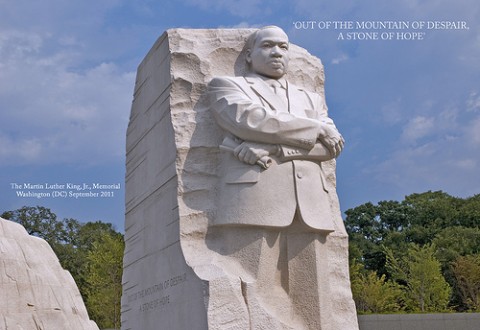
Photo by Ron Cogswell
Following the recent New England Food Summit, my IISC colleague Cynthia Silva Parker and I turned to one another and essentially said, “Now the real work begins.” We had wrapped up co-facilitating a two day gathering of over 150 delegates from around the region with one 0f the goals being to bring everyone in attendance to a common understanding of how racism exists in our food system. In a debrief by the core team for the effort about a week later, the comment was made to nodding heads that a strong hope going forward is that white people become much more ardent and active throughout the region raising the question of how race and racism are operating in the systems of which we are a part.
Two months later, this hope is both challenged and echoed by recent events and in an article that appeared in the St. Louis Post-Dispatch following the killing of Michael Brown in Ferguson, Missouri. Washington University Professor of Law John D. Inazu makes an appeal to not make what is unfolding in Ferguson “a black thing.” More pointedly, he asks white friends and colleagues to spend more time getting to know the real and tragic dynamics of racism in this country. While the article is directed primarily at residents of greater St. Louis, it’s message speaks to all. It is well worth the read, and here I’d like to rift on Inazu’s entreaty . . .
In conversations about racial inequity, I am increasingly approached by agitated white colleagues asking what they can do. Here is a response (and know that I am also talking to myself here): Read More
August 20, 2014
Photo by Ron Cogswell
Following the recent New England Food Summit, my IISC colleague Cynthia Silva Parker and I turned to one another and essentially said, “Now the real work begins.” We had wrapped up co-facilitating a two day gathering of over 150 delegates from around the region with one 0f the goals being to bring everyone in attendance to a common understanding of how racism exists in our food system. In a debrief by the core team for the effort about a week later, the comment was made to nodding heads that a strong hope going forward is that white people become much more ardent and active throughout the region raising the question of how race and racism are operating in the systems of which we are a part.
Two months later, this hope is both challenged and echoed by recent events and in an article that appeared in the St. Louis Post-Dispatch following the killing of Michael Brown in Ferguson, Missouri. Washington University Professor of Law John D. Inazu makes an appeal to not make what is unfolding in Ferguson “a black thing.” More pointedly, he asks white friends and colleagues to spend more time getting to know the real and tragic dynamics of racism in this country. While the article is directed primarily at residents of greater St. Louis, it’s message speaks to all. It is well worth the read, and here I’d like to rift on Inazu’s entreaty . . .
In conversations about racial inequity, I am increasingly approached by agitated white colleagues asking what they can do. Here is a response (and know that I am also talking to myself here): Read More
August 18, 2014
I tend to believe that nonviolent direct action is a more effective strategy for attaining justice than asymmetrical warfare. That being said, it seems ludicrous to stand on the sidelines and ask the people who are most directly impacted by injustice to calm down, be patient and be peaceful.
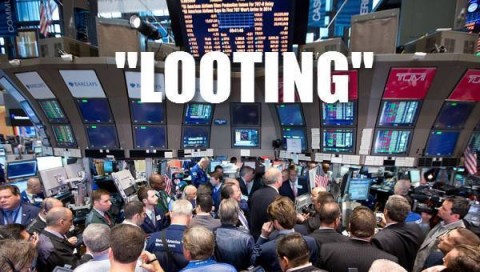
Image credit: US Uncut
If you believe that nonviolent direct action is the path to justice in places like Ferguson, Missouri then you take nonviolent direct action in solidarity with the people of Ferguson. Please don’t stand on the sidelines and ask people to calm down when government-sanctioned authorities are shooting their children.
Read More
August 15, 2014
We are in the midst of a crisis in this country. When a split second decision by one person results in multiple wounds or death for a young man or young woman. Because he didn’t get off the sidewalk quickly enough? Because his music was too loud? Because she knocked on your door? No, these are not the reasons. All of these young people happen to be black. This is not a coincidence.
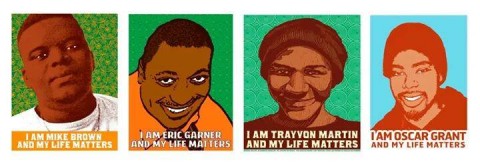
Image credit: Dignidad Rebelde
Read More
August 12, 2014
In my early days many of my friends called me too serious because of comments I would make about the racism and sexism in a Disney film or the rampant misogyny and conspicuous consumption in popular music. My kids still think so. But having come to see systems of oppression, it’s hard for me to “un-see” them when I turn to entertainment. Spoken word poet Madiha Bhatti puts out a powerful message. Much better to listen to the whole thing, but check out the refrain to whet your appetite!
Read More
August 11, 2014

Photo by Synopia
A number of readings I’ve come across lately reference the important consideration of organizational structure and how it encourages or discourages collaboration. In a post from last week, I highlighted the book Reinventing Organizations by Frederic Laloux, which focuses on “evolutionary (Teal) organizations” that embrace an ethic of self-organization to facilitate more purpose-driven, holistic and responsible engagement on the part of organizational members. In order to encourage self-organization and intrinsic motivation, these entities adopt less formally hierarchical and fixed-role structures in favor of fluidity and networked leadership. According to Laloux, this brings more timeliness and relevance to the inner workings and responsiveness of these organizations. Read More
August 1, 2014
University of California researcher, Paul Piff, and his colleagues have been studying privilege.
In one study, they set up a rigged game of monopoly. The players who had been randomly assigned to get more money and other advantages began to demonstrate some disturbing differences from the other players. They began to move their pieces around the board more loudly, displayed “signs of dominance and nonverbal displays of power and celebration,” ate more pretzels, and came “ruder, less and less sensitive to the plight of the poor players, and more likely to showcase how well they were doing.” After the game, the rich players attributed their success to their skills and strategy, not the systematic advantages they had over the other player, even though they knew the advantages were real and were randomly assigned.
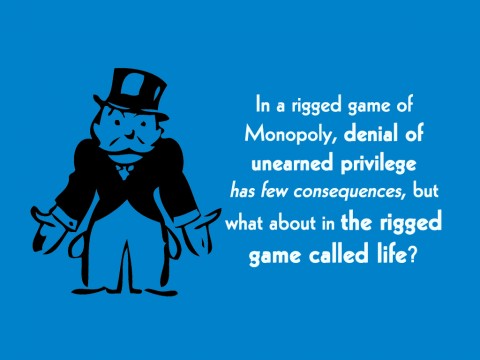
In a rigged game of Monopoly, denial of unearned privilege has few consequences, but what about in the rigged game called life?
Read More