I have the privilege of being part of the team that support the Rockwood’s Leading from the Inside Out Leadership Network (LIONetwork). I share our latest communication for two reasons: first, it serves as a brief survey of how the professionalized social sector is responding to #occupywallstreet. Second, it serves as an example of our team’s effort to increase the network’s self-awareness by reflecting it back to itself while also offering an opportunity for deeper connection and discussion. The e-mail follows:
My wife and I have been enjoying spending some of our evenings reading to one another from Julia Whitty’s book Deep Blue Home: An Intimate Ecology of Our Wild Ocean. Whitty, a scientist, documentary filmmaker and correspondent, writes about her years of exploration and discovery of the World Ocean, the three dimensional current circling the globe that profoundly controls the planet’s climate and has a tremendous impact on all life. In one chapter, Whitty references the Census of Marine Life, an amazing 10 year collaboration of over 2,700 scientists from more than 80 nations to assess the diversity, distribution, and abundance of marine life.
As awe-inspiring as the undertaking itself has been, the results are simply mind-blowing and speak to the insights and intelligence available through thoughtful collaboration, including a deepening understanding of our own place in the larger scheme and a nudge to get us off center stage. Here is how Whitty captures some of it: Read More
Shivers advises: “When you say no to most things, you leave room in your life to throw yourself completely into that rare thing that makes you say ‘hell, yeah!’ ” Sounds a lot easier to me than it actually is. What’s your experience?
|Photo by http2007|http://www.flickr.com/photos/http2007/2204187170|
In this week’s public Pathway to Change workshop in San Francisco, participants engaged in a practice meeting facilitated by some of their colleagues that focused on effective means of building power in collaborative change efforts to enhance their overall effectiveness to realize more just ends. The assumptions going into the conversation were that power is defined as the capacity to influence people and one’s environment, create change, address needs, pursue desires, and/or protect interests. Furthermore we suggested that power is not a fixed asset that people possess. Rather, it is socially constructed, understood, and legitimized through social relationships among individuals and groups of people. Given that it is not fixed, it can also grow or be grown.
So here is the list of ideas that surfaced for ways to build power and we certainly invite your reactions and additions (items in bold ended up being given higher priority by the group): Read More
Here at IISC we are fond of quoting Bill O’Brien’s adage that “the success of an intervention is directly proportional to the interior condition of the intervener.” Personally, I strive to turn this quote into a way of life.
I believe that this also holds true at other levels, that the success of an organization, its effectiveness in the world, is directly proportional to that organization’s interior condition. This Monday and Tuesday, the Interaction Institute for Social Change will be tending to its own interior condition.
I am proud to say that all of our staff will be working with Gita Gulati-Partee of Open Source Leadership and with Maggie Potapchuk of MP Associates on Power, Privilege and how these play out in our organization.
|Photo by Robert Higgins|http://www.flickr.com/photos/37893534@N07/4779016818|
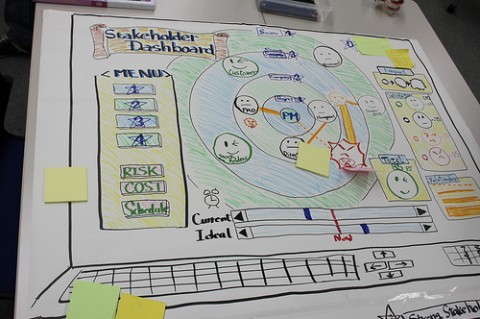
“Stakeholder” is a big word in our practice at IISC. When it comes to our collaborative change work, we take stakeholder analysis very seriously, in certain situations spending a few days to complete this critical task. The aim is generally to surface the names of those groups and individuals who as a sum total will help to ensure that we have the system represented in the room. What this means is pushing people, at times, into uncomfortable places to consider typically unheard voices and those they have outright resisted inviting to the table but without whom they could not hope to make the kind of change to which they aspire.
Typically we engage in a conversation with our clients and partners that asks them identify, in the context of some given change effort, those whose stakes are defined in the following ways: Read More
|Photo by scalespeeder|http://www.flickr.com/photos/scalespeeder/2652863086|
We are big believers here, at IISC, in pulling on all of the senses and our full selves to create engaging experiences that bring out the best that people individually and collectively have to offer for the sake of social change. Often meetings and convenings only scratch the surface of our many sensibilities, as if we were simply brains on sticks, without bodies, without hearts. Subsequently much is lost that we may not even be aware of. As Kare Anderson writes, “Even apparently small physical experiences make a big emotional and even learning difference.”
|Photo by Irargerich|http://www.flickr.com/photos/lrargerich/3029485203|
While designing a board retreat with a client a number of weeks ago, I got some push-back when I suggested that we break into smaller groups at a certain point in the agenda. “That seems a bit contrived,” was the comment. I responded that having a group of more than 15 people discuss matters as a large group for several hours was not going to be an enjoyable or productive experience for everyone. “Plus,” I added, “people will get a chance to know one another better.” My rationale was accepted, but how I wished I had a much more snappy and scientific response at that moment in time. I know intuitively when it makes sense to keep people together or break them up, and of course there are myriad options for organizing people. So what are some practical guidelines for choosing how to segment wholes? Read More
Tsunamis. Unemployment. Volcanoes. Cote d’Ivoire. Homelessness. The Middle East. The Midwest. Pirates. Earthquakes. Drug and human trafficking. Union busting. Collapsing economies. Dropout rates. Nuclear fallout. Foreclosures. Floods.
Just wrapped up a public Pathway to Change workshop this week in Boston, during which I spent some of our time talking with participants about the importance of process design teams in collaborative change work. These “little engines that can” become the backbone of our complex multi-stakeholder work as they hold the stake for creating an environment and a pathway that brings out the best in the many people attempting to realize a new reality around a given issue or issues. To this end, a spirit of risk-taking, thinking outside of the box, engaging in iterative work, and maintaining a willingness to prototype as “social architects” can be vital to long-term success. I thank Tom Wujec for helping me to make the marshmallow tower-inspired point and ask what his message means for your teamwork.
Over a year ago, during a network building community of practice meeting, future IISC board member, Idelisse Malave, suggested that I take a look at the RE-AMP Energy Network as a successful example of a multi-organizational network. I made some initial calls to their coordinator and ended up dropping the ball (oh look, a squirrel). Then a few weeks ago I was alerted to a new case study from the Monitor Institute about that very network. And so we have Transformer: How to build a network to change a system, a wonderful report about what has contributed to the successes of a regional network that has been making great headway in reducing greenhouse gas reductions in the Midwest over the past six years. Lead author, Heather McLeod Grant, a past participant in our network building community of practice, renders a great service in elucidating six key and contributing principles to RE-AMP’s success, many of which have great resonance with our experiences at IISC around designing and facilitating complex and collaborative multi-stakeholder change efforts. Read More