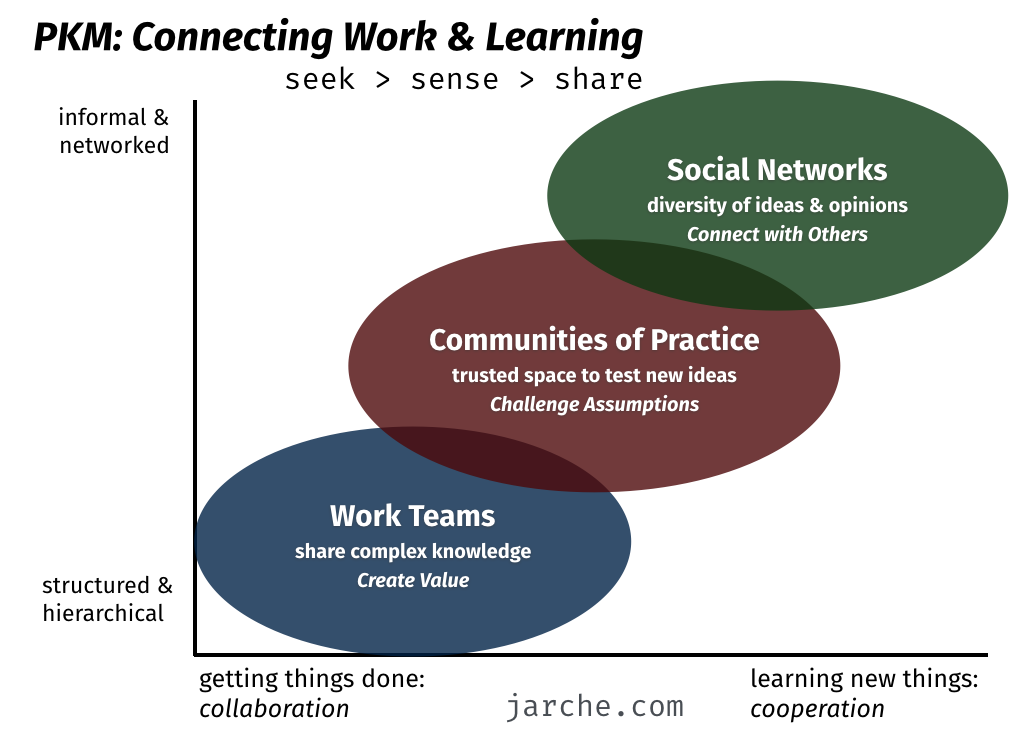
Ever since I started working formally with networks of various kinds, some 17 years ago, and started blogging on a regular basis, about 11 years ago, Harold Jarche has been a teacher and an inspiration. Both the content and method of his writings have helped me to better appreciate the importance of living into uncertainty and playing with networked ways of thinking, learning and doing.
I had the pleasure of taking Harold’s Personal Knowledge Mastery course several years ago, and just finished savoring Perpetual Beta 2020, a collection of his writings generated through 2019 and 2020. As Harold says in the forward to his book, “Now we need to connect, adapt, and find our new normal.” In the spirit of working and learning out loud, and Harold’s Friday’s Finds that he offers on his blog, I am sharing some of the nuggets of wisdom I took from my reading of Perpetual Beta 2020 over the past month, in the form of 20 of Harold’s quotes and 4 quotes from others he references, and certainly invite readers to check out Harold’s work in more of its fullness.
“The great work of our time is to design, build and test new organizational models that reflect our democratic values and can function in an interconnected world.”
“Radical innovation only comes from networks with large structural holes, which are more diverse.”
“It will only be through our collective desire to learn with others and build networked organizations that we can build a better world.”
“Intrinsic, not extrinsic, motivation is necessary for complex and creative work.”
“The primary perspective in social networks should be empathetic. … From this perspective of trying to understand others, our actions in these networks should be driven by curiosity.”
“So it is important to understand that there is no one-size-fits-all philosophy in terms of successful innovation. The one constant is that you able to be open to change and new points of view.”
– Shaun Coffey
“Social networks provide a fertile environment to share ideas. But we need a safer place to test ideas, so we turn to our trust communities of practice.”
“In the network era, learning and working are tightly interconnected.”
“Organizations need to understand complexity instead of adding more complication.”
“Trust emerges over time through transparency and authenticity, practiced by people working out loud. Credibility is earned through collective intelligence, developed through an active questioning of all assumptions. Finally, a focus on results is enabled through both collaboration and cooperation, and is further enhanced by subsidiarity- the promotion of the furthest possible distribution of all authority.”
“Learning faster is not about taking more courses or consuming more information. It’s about having better connections.”
“We are innately a friendly species, but we need environments which allow us to optimally express our inclination to be friendly.”
– Nicholas Christakis
“In networks, it is best not to inflict too much power on individuals and instead learn how to distributed power to help the whole network make better decisions.”
“The more diverse our networks, the more diverse our thinking can be.”
“You know you are in a community of practice when it changes your practice.”
“With increasing chaos, creativity is becoming even more important. Look for the misfits and find a way to work with them.”
“As individuals, there is one thing we can all do, without anybody’s permission. We can become better learners.”
“How can we listen to tomorrow if we have yet to clarify what belongs to yesterday? We don’t just need new maps that order the world in the same old ways. New vision is required. New ontologies reshape the map and reshape us. So we should listen to the future. Whose voices do we hear? [Ursula] Le Guin writes, ‘which is farther from us, farther out of reach, more silent – the dead, or the unborn?’ To listen, we must first be present.”
“Not everything that is faced can be changed, but nothing can be changed until it is faced.”
-James Baldwin
“Things are not getting worse. They are getting uncovered. We must hold each other tight and continue to pull back the veil.”
-adrienne maree brown
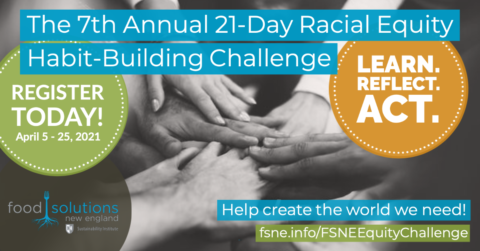
On April 5, 2021, the 7th Annual Food Solutions New England (FSNE) Racial Equity Habit Building Challenge will launch. IISC is excited to continue our partnership with FSNE in offering the Challenge as an initiative for advancing the conversation about and action towards undoing racism and white supremacy in our food and related systems.
The FSNE Challenge is an enhanced and more sector-specific form of an exercise created by Dr. Eddie Moore (founder of the Privilege Institute), Debbie Irving (author of Waking Up White), and Dr. Marguerite W. Penick-Parks (Chair of Educational Leadership and Policy at the University of Wisconsin Oshkosh). After FSNE formalized its commitment to racial equity in its sustainable food system work about 8 years ago (more on our journey in this article), a small design team saw the potential of using the Challenge to invite more widespread (networked!) conversation about the connection between race, racism and food systems and ultimately greater action for racial and food justice.
“America is an old house. We can never declare the work over. Wind, flood, drought, and human upheavals batter a structure that is already fighting whatever flaws were left unattended in the original foundation. When you live in an old house, you may not want to go into the basement after a storm to see what the rains have wrought. Choose not to look, however, at your own peril. The owner of an old house knows that whatever you are ignoring will never go away. Whatever is lurking will fester whether you choose to look or not. Ignorance is no protection from the consequences of inaction. Whatever you are wishing away will gnaw at you until you gather the courage to face what you would rather not see.”
– Isabel Wilkerson (from Caste)
We also saw the on-line version of the Challenge as a way of creating “network effects” around the justice work that many are already doing in our region and beyond through small world reach, rapid dissemination, adaptation, and creating new patterns of connection and flow. Participation in and the complexity of the Challenge continue to grow – in 2014 we had 200 participants, mainly from the six state region of “New England,” and last year we had some 8,000 people participate from all 50 states in the US, and some 20 different countries.
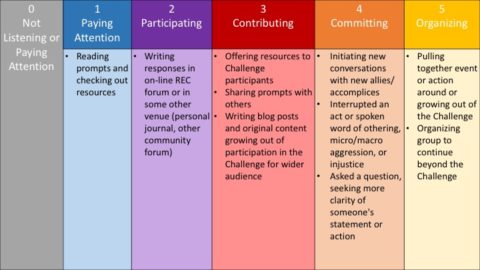
The point of the Racial Equity Challenge is not simply to spread but also deepen the commitment to racial equity and food justice. So we hope that participants return each year, and many do, and also continue the work in between. Because of this, we make sure that the Challenge continues to evolve in content and format, increasingly with a bias towards action. Four years ago, seeing how things were developing, we created the “ladder of engagement” below to think about how to continue to move people along a continuum from “not paying attention” to “actively organizing.”
“Lying, thinking
Last night
How to find my soul a home
Where water is not thirsty
And bread loaf is not stone
I came up with one thing
And I don’t believe I’m wrong
That nobody,
But nobody
Can make it out here alone.”
-Maya Angelou
It has been inspiring to see many organizations and communities self-organize to take the Challenge in-house, convening colleagues, fellow congregants, neighbors, family members and classmates to reflect together on learning and making commitments to action. This has included groups such as Health Care Without Harm; the Wallace Center at Winrock International; Michigan State University’s Center for Regional Food Systems; Friedman School of Nutrition Science and Policy at Tufts University; Southside Community Land Trust (Providence, RI); Agricultural Sustainability Institute at University of California-Davis, Georgia Organics and many others who have convened around the Challenge.
Two years ago we responded to these organic efforts and some specific requests by creating a discussion guide for facilitators to design and steward conversations in their organizations/communities. In 2019, the Challenge also went deep in the home institution of Food Solutions New England, the University of New Hampshire (the Sustainability Institute serves as the network’s “backbone”). With the support of a Professorship that I shared with Karen Spiller (and which Karen continues to hold), we did considerable “in-reach” to staff, faculty and students, including a launch event and campus presentations, which resulted in more than 500 people participating in the Challenge from UNH. We also turned the Challenge into workshops that we offered at gatherings such as the White Privilege Conference. That work has continued to grow and flourish this year.
Over the last few years, we have heard how participation is moving people from learning to action:
to create a community racial equity summit
to bring racial equity centrally into organizational strategy
to shift values in an organization to put racial equity front and center
to shift one’s job so that they can focus more centrally on issues of racial disparities and injustice
to bolster people’s courage to have courageous conversations about race, racism and white supremacy
to shift hiring practices and leadership structures
to bring a racial equity focus to food policy work
We hope these ripples will continue to be amplified this year!
So what exactly is the Challenge?
It is a self-guided (individual and group) learning journey examining the history and impacts of racism, how it is connected to our food and related systems, examples of and tools for how to undo racism and build racial equity and food justice.
How does the Challenge work?
People sign up (YOU can register here) and then starting April 5th, they receive daily email prompts focused on a different theme along with links to related resources (readings, video, audio) that take about 10-15 minutes each day. In addition, there is a robust Resource List for people to look through and continue their learning. Those who register also have access to an online discussion forum for those who want to talk and think out loud about the daily prompts and other learning along the way.
“Historically, pandemics have forced humans to break with the past and imagine their world anew. This one is no different. It is a portal, a gateway between one world and the next. We can choose to walk through it, dragging the carcasses of our prejudice and hatred, our avarice, our data banks and dead ideas, our dead rivers and smoky skies behind us. Or we can walk through lightly, with little luggage, ready to imagine another world. And ready to fight for it.”
– Arundhati Roy
How is the Challenge evolving in 2021?
To meet the growing interest and demands of participants and the expressed desire for many to go deeper and further and to replicate and extend the Challenge in different ways, we have developed a variety of additional supports.
We also offered two 2.5 hour virtual trainings for people who are interested in facilitating groups to prepare themselves for that undertaking. These sessions drew from the Discussion Guide as well as IISC’s Fundamentals for Facilitation for Racial Justice Work.
New this year we will host a facilitator debrief to hear and share about progress and challenges. This will happen on May 21, 2021 from 1:00 pm to 2:30 pm Eastern Time.
Another feature is a more robust Outreach Kit that has been pulled together by FSNE Communications Director, Lisa Fernandes. The Kit includes sample communications that can be used to recruit others to participate in the Challenge through email, social media (Twitter, Instagram and Facebook), as an outreach flyer.
This year like last, organizations (such as non-profits, agencies, schools, businesses and other groups) can register to be listed as “organizational participants”of the 21-Day Racial Equity Habit-Building Challenge. Each individual should still register with their own email address in order to receive the daily prompts during the Challenge, but organizations can now indicate to the world their support for the work of building equity and dismantling racism in our food system! Contact FSNE with any questions about this.
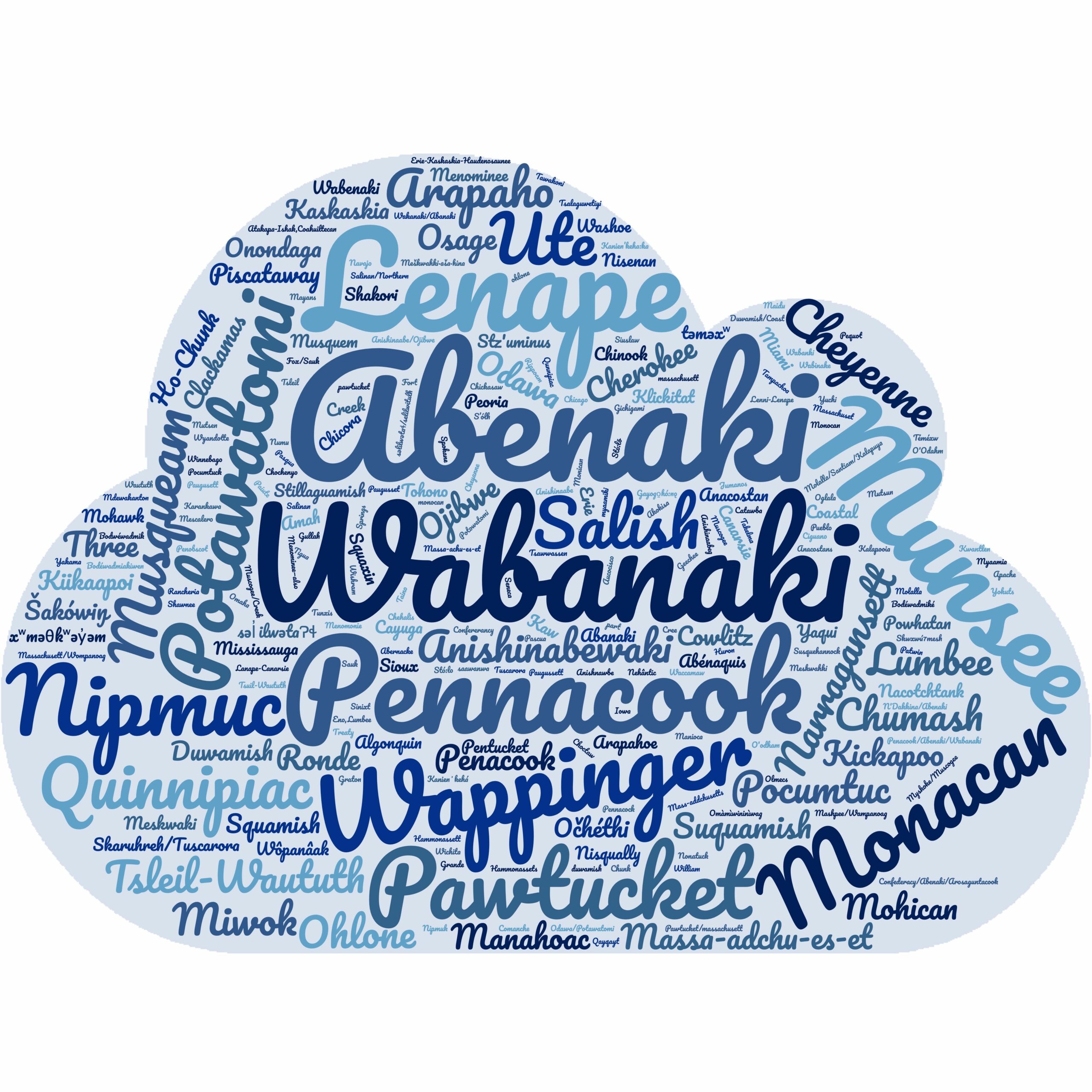
An addition this year is an optional #FSNEEquityChallengeregistration question about what indigenous traditional lands people reside upon (see below for a word cloud of answers as of a few days ago).
Also this year like last, we will host a Friday drop in discussion on Zoom for participants who would like to meet others, share what they are learning and doing and hear this from others.
A new addition this year is a crowd-sourced playlist of musical selections that move and motivate participants in their pursuit of justice and liberation. People are invited to email fsne.info@unh.edu with tunes to add to the list.
And as was the case for the past few years, we will have guest bloggersthroughout the Challenge, the numbers of which have steadily grown.
All of this is in line with how FSNE sees itself evolving as a network into its next decade, creating robust, accessible and supportive resources that might be shared and easily adapted through aligned, diverse and robust connections in the region and beyond.
What next?
Please join us, spread the word, the invitation, the conversation and the commitment to others. These are daunting times, that are laying bare the damaging and deadly patterns that have existed for some time. It is beyond time to lean in, get real, bond together, and weave the better world we know is possible!
“We are all tied to a lineage of love that has existed since time immemorial. Even if we haven’t had a direct experience of that love, we know that it exists and has made an indelible imprint on our souls. It’s remarkable to think that the entire span of human life exists within each one of us, going all the way back to the hands of the Creator. In our bodies we carry the blood of our ancestors and the seeds of the future generations. We are a living conduit to all life. When we contemplate the vastness of the interwoven network that we are tied to, our individual threads of life seem far less fragile. We are strengthened by who we come from and inspired by the those who will follow.”
“We must create civilization(s) for equitable human wellbeing within a healthy biosphere. Since our thinking produced self-inflicted existential threats, the main challenge is to find a practical way to reconcile our thinking with the logic of life.”
– all-women Emerging New Civilization(s) panel. United Nations
Image from Peter Karlsson, “Flower on Fire,” shared under conditions of Creative Commons Attribution License 2.0,
In ongoing work with a group of practitioners dedicated to advancing the study and practice of “energy systems science,” for the sake of resilient and regenerative futures, we continue to come back to the primacy of seeing and working in networked ways as being key to charting a course to a regenerative future. In fact, in some ways we might see energy systems science as being energy network science.
As Dr. Sally J. Goerner articulates, Energy System Sciences (ESS) is “an umbrella term for disciplines that use the study of energy flow networks to understand the laws of systemic health, growth and development in living, nonliving and supra-living systems.” ESS disciplines include: Chaos, Complexity, Resilience, Ecological Network Analysis, Self-Organization Theory, Nonequilibrium Thermodynamics, Panarchy, and others.
We are clearly in a moment of needing to take more seriously the human prospect on the Earth, and whether we will continue to reclaim and maintain a place as a stewardship species. Much of this comes down to being able to “think like an ecosystem” and align with Nature’s regenerative capacities. As mentioned in another post, regeneration points us to the self-feeding, self-renewing processes that living systems (including human beings and communities) use to nourish their capacity to thrive for long periods of time, as well as their ability to adapt to unexpected, sometimes threatening, circumstances.
From an energy systems/networks perspective, long-term human thriving is rooted in large part in healthy social and socio-ecological webs that are diverse, intricate and dynamic. And more specifically, as Dr. Goerner and other colleagues in the Research Alliance for Regenerative Economics highlight, aspects of social systemic health are grounded in:
Collective and adaptive learning – sharing information, working out loud, group inquiry and processing, prototyping, systemic sensing …
Collaborative culture – practicing facilitative leadership, weaving and coordination, designing for and engaging in collective innovation, linking and leveraging assets, collective decision-making, aligning practice to values such as trust, transparency, generosity …
Regenerative circulation – monitoring and tending to velocity, directionality, quality and quantity of flows of different resources …
Each of these four aspects links to network thinking and action, and can be further strengthened and guided by core principles (see this evolving list).
In the months to come, we will be fleshing out more of the practices around ESS/ENS to support network convenors, coordinators, facilitators, and weavers of all kinds, including those within organizations, to support systemic saluto-genesis (ongoing health creation).
Image by Wim Goedhart, “Forest Flow,” shared under conditions of Creative Commons Attribution License 2.0.
“At times our own light goes out and is rekindled by a spark from another person. Each of us has cause to think with deep gratitude of those who have lighted the flame within us.“
As a number of networks I am supporting are settling into the lingering reality of operating within our COVID19 context (“2020 still feels like it’s with us!”), uncertain of what resolution will look like or mean, we have been having more conversations about how to maintain momentum around key goals (food justice, health equity, equitable conservation, climate adaptation and mitigation) and also lead with care, supporting collective regenerative capacity. Through explicit asking and reading what is coming up through people’s engagement, here are some ideas for how to keep movement going over this lengthening haul in sustaining fashion.
Put movement into the movement (literally invite people to move their bodies during and in-between on-line and phone meetings)
Leverage the power of one to one conversations (they can often be more nimble and dynamic, including having people walk and talk to one another)
Keep some meetings agenda-free (and follow the emergent energy)
Share stories, music, recipes, jokes, games
Stay open to spontaneity
Lean into humor!
Do a meditation, be silent together
Give grace – “It’s okay to not be okay”
Make space for teach-ins and knowledge sharing
Invite people to not look at screens, and to look out windows
Schedule long meetings as multiple meetings with a shared agenda over time to break it up
Remember this is not ours alone to do or solve and that there are others out there, including those we do not know
What would you add?
“We never know how our small activities will affect others through the invisible fabric of our connectedness. In this exquisitely connected world, it’s never a question of ‘critical mass.’ It’s always about critical connections.“
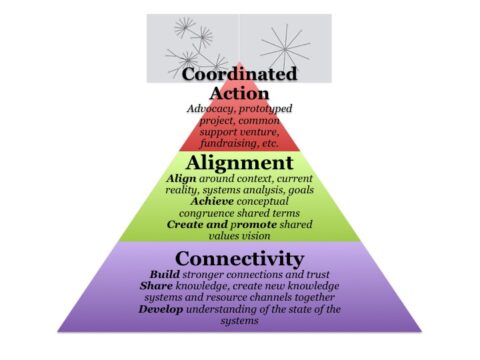
Over the past couple of years, I’ve worked with a state-wide health equity network, comprised of smaller coalitions, that has been looking at living into being more of a network in thinking and action. After some conversation and consideration, we decided to use a framework that derives from the writings of Madeleine Taylor and Pete Plastrik.
The Connectivity-Alignment-Coordinated Action/Production framework (see graphic above) lifts up three different network modes, through which value and impact is created. First of all, network value and impact is grounded at a fundamental level in creating connectivity, by building linkages and trust between key stakeholders and perhaps unusual bedfellows. This can be done by convening people; closing triangles, sharing stories, data and other forms of information; co-creating knowledge; learning together, etc. Part of the value of this connectivity is that it can lead to orthogonal thinking and bolster individual network participants’ efforts in the shared domain where the network is focused. What also might happen is self-organized action between those who are meeting one another for the first time or getting to know one another better.
“Healthy networks measure their impact, in particular by establishing the links between decentralized network action and outcomes.“
Up a level, networks may be compelled to create some kind of collective and aligned commitment or value proposition in the form of shared vision, values, public statements, etc. This can create greater impact/ripples, and provide additional value to individual participants and self-organized efforts, as they are more prone to head in the same general direction or with some kind of deeper shared understanding of context.
And then there are those instances when there is a call to some form of collective action, such as advocacy, a communications campaign, fundraising, or some other co-produced venture. This can happen even as smaller self-organized action continues (really, from a network perspective, most collective action should be about creating the conditions for those self-organized efforts, which is what is meant by “making the periphery the norm” in network building lingo).
With all of this in mind, after doing interviews, some observation, as well as evaluations and other documentation from the sub-networks of this state-wide advocacy network, a few patterns seemed to surface that suggested ways for the network to strengthen itself and leverage network effects.
Here is a list of what was surfacing as opportunities seen through the C-A-CA/P lens:
In the calls that the network does with its members, there appeared to be more of a one-directional download of information from staff (the hub) to its members (the periphery). And in various documents there appeared to be some suggestion that people were not connecting except through the hub. Furthermore, an annual report said that state partners expressed a desire to know more about one another’s capabilities, constituencies, and connections. All of this suggested an opportunity for creating greater CONNECTIVITY, especially member-to-member.
In an interview the observation was made that on membership calls there were often the same people speaking while others were silent. This suggested that greater CONNECTIVITY could be created for those who were less outspoken and silent. There appeared to be some correlation between those who were longer standing members (more outspoken) and those who were new to the network (more quiet).
In assessments of meetings, comments were made that while people appreciate the great information and education they receive, they were also eager to meet, learn from and strategize with one another. This again suggested an opportunity to strengthen member-to-member CONNECTIVITY.
Questions had come up about whether relationships with state and county lawmakers, behavioral health experts, and others might be better maximized for trust and information sharing. Another area to explore strengthening CONNECTIVITY to and among those stakeholder groups.
Related to the above, while the network’s political capital was appreciated by many members, there were also questions about democratizing that power, and helping members to be more involved in the legislative process. This suggested that beyond creating greater CONNECTIVITY among members, there might be some opportunity to provide COORDINATION support to enhance access.
“Clusters” of members in certain parts of the state had been mentioned in interviews and documents. It was observed that in one region, there is some evidence of people getting tighter and that in another region, organizations were using lists to get together. This lifted up the question about more intentional CONNECTIVITY and ALIGNMENT that the network might suggest or provide to those existing and other potential clusters to strengthen their advocacy work.
An annual report identified some expressed concern about the challenge with creating alignment among collation partners on behavioral health priorities, and that “collective buy-in” and “intentional relationship building” will be key to establishing alignment. This is another reason to keep building that trust and CONNECTIVITY and also to explore actively facilitating ALIGNMENT around core priorities.
It was shared in staff interviews that there have been questions from members about the network’s long-term vision – “Where are you trying to go?” This raised some possible opportunities to facilitate ALIGNMENT around a shared, guiding and galvanizing vision with members.
Related to the above, the suggestion was raised around exploring he coalescing of sub-networks to consolidate and create more ALIGNMENT and COORDINATION between those separate coalitions.
And here is what was offered as a set of initial recommendations:
Consider the points above and if there is agreement among staff about where to weave greater connectivity, facilitate alignment and/or coordinate activity in different domains. Specifically: Who needs to be better connected and what would that achieve? Would alignment around a shared vision and high-level goals be helpful? Who would need to be aligned?
As these opportunities are identified, consider existing network (staff) capacity to provide weaving, facilitation and coordination support. Where and how might this capacity be added or developed?
Think about ways to create greater connectivity within existing calls, meetings and trainings. For example, have a check-in question; invite people to share news, victories, needs; break people into pairs and smaller group discussions; create open space for people to explore interests and opportunities to work together.
Consider creating a toolkit and perhaps a training for building relationships and maximizing connections in networks.
Reach out to less out-spoken and newer coalition members to see if there is anything that would support their participation. Related to this, make sure there is an on-boarding process for new members so that they feel up-to-date and know how to participate.
To gauge “network impact,” follow up with members to see what they do with the content, capacity and connections they get from calls. Are they able to leverage these for greater impact in their communities and regions to create “ripple effects”?
Reach out to other networks to see how they go about democratizing power and opportunity in a network. In addition, look to other groups across the state to see how they are working with grassroots groups to mobilize around policy.
Consider having an open conversation with member organizations about how to strengthen the sub-networks (coalitions) as a network. What ideas do they have? This might include giving them some overview of networks and network effects/impacts.
Consider conducting an assessment to find and leverage “network champions.” Are there certain members who are particularly enthusiastic about and active in network activity and might be ambassadors for the collective work? Might they be more formally enlisted as network weavers?
Consider the virtual tools currently used for keeping members connected (virtual meeting platforms, shared files and documents, archives, private group pages). Are they working? Are people taking full advantage of them? Is there additional value they are looking for that might be provided by other tools?
Consider using a more formal network assessment to look for strengths and areas for growth and improvement in the network’s structures and practices. This could be conducted among staff alone and also include key partners. Examples include “Network Effectiveness: Diagnostic and Development Tool”, “Partnership Self-Assessment Tool” and “Network Health Scorecard.”
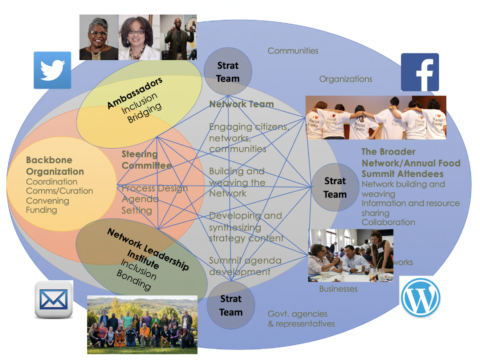
Recently a long-time member of the Food Solutions New England (FNSE) Network Team let us know that they would be transitioning out of their current job and needing to leave the network, at least the core role they have played. FSNE is entering its second, and critical, decade of work, and going through a transition itself as it strives to better weave together a regional food system that is grounded in racial justice, ecological sustainability and democratic principles. It has been quite the journey, 2020 not withstanding.
This person, and real FSNE champion, gave a tremendous gift in their email, laying out how meaningful their experience has been these last several years. In so doing, there is also a wonderful articulation of what being in a network can be all about. Here is a taste of what was so generously offered:
“What stands out to me when looking back is how many aspects of FSNE’s work are challenging: communicating complex concepts; making the most of limited time when such a rich network of folks gets together; putting up with ambiguity when structure and linearity are so comforting and in demand.
But the rewards from the process are on an equal scale with the challenge: building lasting and meaningful relationships with diverse folks from across the food system; being able to think and strategize about that system in entirely new ways; learning new ways to think and to go about work and life. … in offering this to participants, FSNE is very unique among organizations. …
I’m looking forward to what’s coming next, sensing and hoping that the world at large is more ready to support FSNE’s values now, than it was even a year ago.”
So well said! And we know FSNE is not alone.
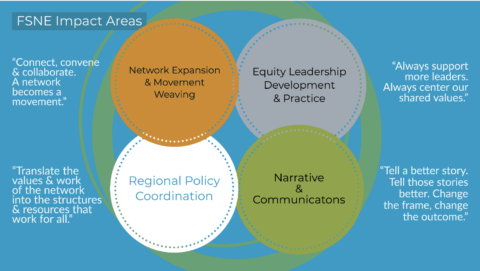
Even as the network (along with so many others) navigates complexity and disruption and continues to make “progress” around its “impact areas” (including more dense and diverse connectivity; greater advancement of the vision and values; increased regional alignment around a new food narrative; more collaboration on regional food, farm and fisheries policy; more wide-spread commitment to anti-racism in the food system), it can be hard to “see” all of this in the moment. Like so many things in life, it is only in retrospect that we can get a sense of how far we have come. And also like so many things in life, as our transitioning FSNE colleague expressed so beautifully, it is not just what we can most tangibly measure that matters, but also (and perhaps more so) qualitative change and the nature of our experiences (processes, relationships) along the way.
I am struck by how the network building and weaving field has really mushroomed over the past several years, and with it, so much learning around approaches, structures, roles, strategy, etc. I regularly hear myself say that there is no one right way to go about “net work” for change (which is why I regularly reference this compendium of thoughts on networks – “A Network Way of Working”). That said, I have found that “principles” (for lack of a better word) for network thinking and action have been helpful in a number of different contexts to support people in finding ways to leverage the promise of networks (or “network effects”).
This is a list that I continue to play with, expanding and contracting given new learning and different contexts. I recently offered the following version to a food system network. Always open to riffs and improvements …
Come First as Givers, Not Takers – Of course people should (and will) think about their self-interest, but if everyone holds out for what they are going to get, then nothing gets created in the first place. Generosity leads to generativity.
Support Intricacy & Flow, Beyond Bottlenecks & Hoarding – Many kinds of connection and robust movement of resources of all kinds is what contributes to the adaptive and regenerative capacity of networks.
Make the Periphery the Norm, Don’t Get Stuck in the Core – In the words of Kurt Vonnegut, “Out on the edge you see all kinds of things you can’t see from the center. … Big, undreamed-of things–the people on the edge see them first.”
Work with Others and/or Out Loud, Not in Isolation – Otherwise, what is the point of creating a network?! Connect, cooperate, coordinate, collaborate, and for God’s sake, share!
Value Contributions Before Credentials – Valuable contributions come from all kinds of places and people. Credentials and holding out for a certain kind of “expertise” can get in the way of seeing the greater abundance around you, benefitting from it, and contributing to it.
Lead with Love and a Sense of Abundance, Not Fear and Scarcity – Fear and scarcity narrow our view, shrink our thinking about what is possible, and inhibit our willingness to share. Love is love and does what love does.
Think Spread and Depth Before Scale – Because it’s easier in many ways, can avoid mechanical and inappropriate replication thinking, and helps to establish a more firm foundation (think roots under the tree).
Support Resilience and Redundancy Instead of Rock Stardom – Because we aren’t all that special (though we may be unique) and because its not strategic to put all eggs in one basket, however shiny. And then there’s the ego thing …
Trust in Self-Organization & Emergence, Not Permission & Predictability – COVID19 has driven this lesson home, big time. We are not in control. Life is complex, and beautifully so. Evolution is real, and so is people’s capacity to be response-able when they are trusted.
Say “We’re the Leaders!” Instead of “Who is the Leader?” – Who and what are you waiting for? And why?
Do What You Do Best and Connect to the Rest – Stop trying to do it all. It’s not possible, it creates unnecessary competition and burnout and it inhibits collaborative efficiencies (yes, they exist).
Attract a Diverse Flock, Not Birds of a Feather – Homophily (like being attracted to like) is a strong tendency in people. In network speak, we should not simply bond, but also bridge. This is important for the wok of equity and inclusion, tapping creativity and innovation, and tasting the wonder-full spice in Life.
As you review the framework, would you share your responses to the questions below in the comments?
What does it bring up for you?
Where do you find yourself focusing your thinking and efforts?
What might you want to explore, start, continue or further develop, or stop doing in any of the stages?How does the framework help you prioritize and perhaps find empowering areas for action and partnership?
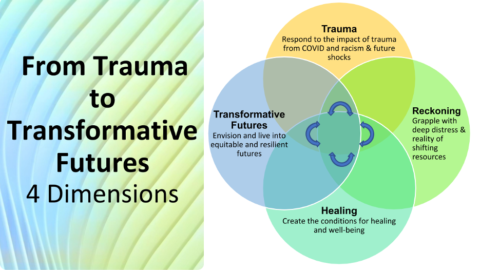
As you navigate the complex times of COVID-19 and racial uprising, consider what it would take to transition through these four dimensions, what needs to be in place, what is already in place, and what we need to reimagine and rebuild.
1 – In the Trauma Dimension: How are we responding to the impact of trauma from COVID, racism, and other shocks?
Racial Equity & Justice:
Are we removing racialized barriers to emergency resources?
Are we using a racial equity impact analysis tool to understand and evaluate our response? Even when we feel rushed?
Are we recognizing deep racial harm in our organization and networks?
Collaboration:
Are we pausing and engaging in quick and meaningful stakeholder engagement to guide our responses and ensure less harm?
Are we attending to both relationships and results as we carry out our work?
Love:
Are we acting and responding with humility, empathy, and transparency?
Are we practicing presence and accountability?
Networks:
Are we connecting with diverse networks to gather and share information and foster flows to address critical needs?
2 – In the Reckoning Dimension: How are we grappling with deep distress and the reality of shifting resources? How are we embracing racial uprisings for change? How are we embracing uncertainty?
Racial Equity & Justice:
Are we acknowledging inequities revealed by crisis?
Are we acting to undo the racialized impacts of our actions?
How are we recognizing the leadership of Black people and what are the lessons for our organizations?
Are we engaged in transparent and collaborative decision-making?
Are we facilitating conversations and activities to face the pain and opportunity of this crisis, our potential power together to make change, while also planning for next steps?
Love:
Are we embracing where people are? Their feelings, conditions, perspectives?
Are we modeling vulnerability as a sign of strength?
Are we exploring the reality through the lens of love and possibility?
Networks:
Are we setting strategic direction with critical partners?
Are we listening for and following the ideas of BIPOC communities (Black, Indigenous, people of color)?
3 – In the Healing Dimension: How are we creating the conditions for healing and well-being?
Racial Equity & Justice:
Are we supporting BIPOC people and communities to move through trauma, grief and anger toward joy?
Are white people leaning into discomfort, trauma and pain, and working that through with other white allies?
Collaboration:
Are we generating and living into community care guidelines to support self-care and collective well-being?
Are we designing and facilitating in ways that allow people to process holistically – intellectually, physically, emotionally, and spiritually?
Love:
Are we convening grounding conversations that allow for brave space, emotions, and truth sharing?
Are we offering resources for healing modalities?
Are we acknowledging all paths to healing?
Are we meeting pain with action and redistributing power and resources?
Networks:
Are we deepening networks and attending to flows of resources that create healing and well-being for people?
Are we setting up more distributive structures focusing on regenerative flows of resources of many kinds?
4 – In the Transformative Futures Dimension: How are we envisioning and living into equitable and resilient futures?
Racial Equity & Justice:
Are we pivoting from supremacist and extractive practices to what is liberating and life-honoring?
Collaboration:
Are we facilitating leaders to envision and invest in equitable and resilient futures?
Love:
Are we encouraging building futures from the lessons of love, possibility, and shared humanity?
Networks:
Are we fostering a new level of learning, sustainability, innovation and radical collaboration with people and our planet?
Are we focusing on systems change and building long-term movement?
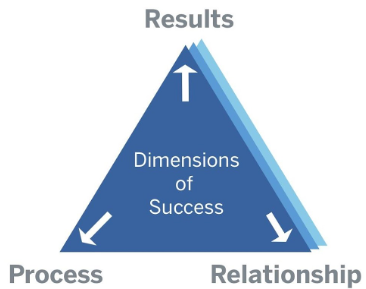
Just wrapping up a bit of work with a national network that we at IISC helped to get off the ground 5 years ago, which has seen incredible growth and success in its efforts, and which continues to make progress in these times. For us, what this means is that they have really been hitting on what we call the collaborative dimensions of success – results, process and relationships (see image above). That said, some parts of the network (particular working groups) are humming along more so than others.
In our latest meeting with the network, we helped incubate new working groups (now taking their total to 13!) and also held a gathering of existing working group members to come up with a list of success factors and what they wish they had known at the outset to set themselves up for success. This list will be provided to the new working groups to help them along. I was struck by how many of the items on the list below align with what we teach in Facilitative Leadership for Social Change. While there is no exact recipe for success, we have found over the past 27 years that there are certain practices that create conditions for more likely fluid collaboration. ‘
Here is a list of 27 distinct but related success factors that were identified:
Diversity; people with different skills and experiences, a diversity of vantage points, ideas, and learning curves.
Dividing up roles – facilitator, recorder, timekeeper, liaison, etc.
Willingness to grow and change our roles; not feeling one has to be in the original role.
Establish group working agreements for collective accountability and be open to changing them as needed.
Strong facilitation.
Understanding of the difference between a working group chair and facilitator (these may or may not be the same person).
Ensure everyone feels like they are able to contribute to group conversations if they want to; check for accessibility issues of various kinds.
Intervene around those who would otherwise dominate conversation and shut others down.
Comfort with letting go of an idea once it has been incubated; people understand that when they generate an idea or proposal that it might be changed or critiqued by the rest of the working group, to make it better.
Loosen grip on ego.
Have consistent meetings and touch points – monthly or bi-weekly – to keep on track.
Practice an ethic of love, generosity and forgiveness.
Open up to bigger sources of inspiration and creativity.
Build common language; make sure that everyone understands any acronyms or technical terms being used.
Use a process guide/map for helping working groups in their overall development and work planning; they can adjust as they see fit, but having a framework can be very helpful.
Have an agenda for your meetings and follow it, until it doesn’t make sense to do so.
Set desired outcomes each meeting, so you can determine where any conversation or agenda item is heading and when it’s over.
Make sure your meeting agendas are realistic … put on it what you can actually get to; prioritize and manage the conversation.
Give people time to connect with one another.
Check for agreement and/or for clarity around key points before moving on.
Make sure action items/next steps are captured at the end of each meeting and restated at the top of your minutes/group memory; revisit in your next meeting.
Conduct process reviews of meetings (what worked, what could be improved); keep what’s working and make changes accordingly.
Keep easy-to-digest minutes/group memories to maintain momentum; having consistent and capable support around this kind of record keeping, including key agreements and next step.
Get meeting minutes/group memories out as soon as possible to everyone, including those who may have missed a meeting.
Support onboarding of new members, so they can catch up easily and step into the flow – think about one-on-one conversations and mentorship.
Provide easy access to/support around accessing shared documents, tools and platforms.
Keep group size manageable – 10 is a nice size; if more consider sub-dividing for certain tasks (think in terms of small group ministry).
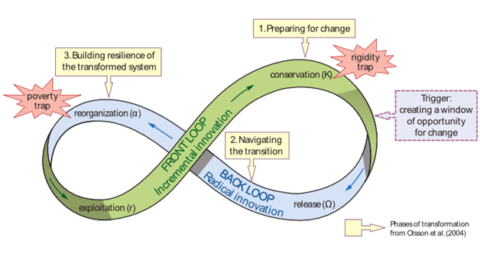
I’m fInishing up David Fleming’s book Surviving the Future, and buzzing with ideas and questions about the role of networks, network weaving and energy network science in these times of “systemic release” (see the adaptive cycle above, and more about the cycle here).
Fleming’s book, a curated collection of essays from the heftier Lean Logic, offers some compelling thinking about the trajectory of globalized and national economies – at best de-coupling, de-growth, and regeneration, and at worst catastrophic collapse – and the ways in which intentional and more localized culture building and reclamation as well as capacity conservation, development and management, might steer communities to healthier and more whole places post-market economy.
One of my favorite quotes from Fleming is that large-scale problems do not require large scale solutions; they require small-scale solutions within a large scale framework. That resonated immediately, even if I didn’t know exactly what he meant when I first read it. Re-reading more carefully, I hear Fleming making the argument that to take on systemic breakdown at scale is a fool’s errand – too massive, too slow, too much rigidity to deal with, too much potential conflict, too abstracted from real places and people.
Instead what is required is more nimble small-scale solutions happening iteratively and quickly (relative to how slow things move at larger levels). This suggests that action for resilience must happen at more local and regional levels, connecting diverse players in place, helping to encourage more robust exchanges of all kinds (including multiple “currencies”) and culture building. David Fleming offers the following definition of the lean economy (as opposed to the taut perpetual growth economy): “an economy held together by richly-developed social capital and culture, and organized around the rediscovery of community.” How might we weave that fabric even as others unravel?
Lean (network) weaving (a new term?) would focus on helping to create more intricate, high quality/high trust and diverse connections as well as facilitating robust, nourishing flows in tighter and more grounded cycles and systems. Part of the lean weaving would entail ensuring that smaller systems remain alert, quick and flexible so as to experiment, learn and adapt. And it would also maintain connection and communication between these smaller systems/clusters (Fleming’s “larger framework”), to facilitate learning and feedback of various kinds between them (not unlike proposed bioregional learning centers).
“The more flexible the sub-systems, the longer the expected life of the system as a whole.”
David Fleming
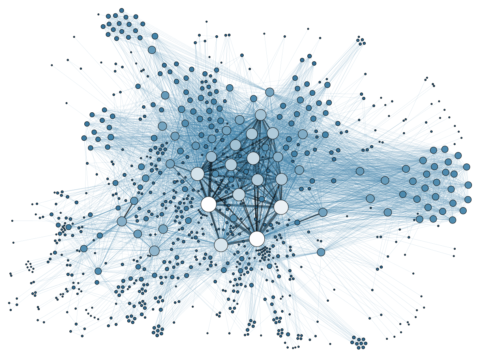
Image from Visible Networks Lab
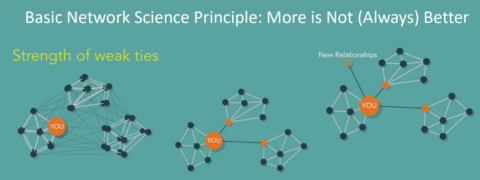
This idea of “lean weaving” also brings to mind the wisdom of network science as taught by Danielle Varda and colleagues at Visible Networks Lab. They make the point that when it comes to creating strong (resilient and regenerative) networks, more can be less in terms of the connections we have. Connectivity, like so much else in our mainstream economy and culture, can be ruled by a relentless growth imperative that is not strategic or sustainable and can cheat us of quality in favor of quantity.
More connections require more energy to manage, meaning there may ultimately be fewer substantive ties if we are spread too thin. Instead, the invitation is to think about how we mindfully maintain a certain number of manageable and enriching strong and weak ties, and think in terms of “structural holes.” For more on this network science view, visit this VNL blog post “We want to let you in on a network science secret – better networking is less networking.”
The COVID19 pandemic along with other mounting challenges may already be presenting the mandate and opportunity to get more keen and lean in our network thinkingand weaving, not simply in the spirit of austerity and regression, but to cut an evolutionary path of resilience and regeneration (renewal). Network weavers of all kinds, what are you seeing and doing in this respect?
For the past month I’ve been checking in with a dozen or so networks that I support and participate in in various ways, looking at how best to navigate these times when in some cases it feels there may be a need to ratchet down or right size expectations. With so much in flux and uncertain, with many new challenges and barriers to how people may have operated in the past, when the impulse might be to pull back or bunker down, what can weavers/coordinators do, what are they doing, to keep their networks and net/collective work vital?
Below is a list of some ideas and practices that I am seeing, hearing, and trying myself, in the name of maintaining baseline connectivity, alignment and coordinated momentum. No one of them is necessarily the “right answer” in every situation, everything being context-dependent and also needing to suit the particular nature and situation of specific networks. And having shared some of these with others, I’ve heard these can be helpful for anyone now working virtually or in-person in times of greater stress. Curious to know what resonates, and what you would add!
Bring an open heart to network interactions. People are feeling a lot in these times. It can be important to allow for and acknowledge this.
Let people know you are thinking of and appreciate them. One of the practices out there that I’ve seen and am leaning into is people sending “love notes” to others in their networks.
Create more frequent, optional and informal opportunities for people to connect. I’ve been seeing and participating in “coffee chats” that happen weekly, bi-weekly and monthly for those who are interested to drop by (virtually), check-in and share gifts and needs. This includes setting up phone calls where people can walk and talk instead of being glued to a screen for videoconferencing.
Release your grip on certain standards of performance and accomplishment. This can often create more frustration and exhaustion. Model patience and grace with yourself and others.
Allow for, and maybe even celebrate, messiness, malfunctions, and “mistakes.” This is not just about cutting people slack and reducing stress, but also inviting ongoing experimentation, improvisation, creativity and playfulness.
Shore up the core of your network. With some coordinating teams working virtually for the first time or much more often, while juggling many other balls, it can be important to establish some basic expectations around communications and other working agreements. What minimally do people need from one another in order to function well in these times? What are they able to give?
Find time to disconnect and replenish. From Zoom overload to balancing needs of home and work simultaneously, it can be crucial to find time to disconnect from conversation and interaction.
Lean back into alignment. This can be a good time to put a network’s mission, vision and values back in front of its members, to remind people what holds them together and what might ground them more deeply amidst the tumult of the times. How can these values and larger goals provide ballast and guidance?
Create more slowness, stillness, spaciousness and even silence in your network interactions. Even when connected, we can practice different kinds of pacing and spacing that can help people to restore, maintain or increase their energy.
Stem degenerative flows. The 24 hour news cycles, social media wars, and spirals of outrage can conspire to overwhelm us and suck us dry, especially when there is an insidious fear of missing out. Other than simply disconnecting, we can ask what actually nourishes us in terms of connections and flows of information, interactions and other resources. Be mindful of what you consume, as well as what you send out and communicate with others.
Lead with joy and laughter. Because it feels good and can be so radical and welcomed in these times.
Really practice shared leadership. All the time, and especially now. Do what you do best and connect to the rest. Remember you are not indispensable and that networks benefit from redundancy of role and function. I was recently in a call with 8 other facilitators to develop both an agenda and executive memo for an important meeting, and while in the past I would have dreaded these kinds of endeavors, in this instance we really needed each other given the complexity of the situation and constrained capacity of each of us.
Keep an eye towards bridging. While comfort and care are important, watch the tendency to fall back into familiar patterns and relationships that can bolster bonding (birds of a feather flocking together) in your networks at the expense of bridging to those who are different in some way, shape or form, where those differences are vital to the health of the network and its work. On this front, see this resource, “On Bridging,” from the Othering and Belonging Institute.
Keep listening for and helping to meet needs, fill gaps, and leverage opportunities. What are the critical connections and flows that the network is asking for right now? Who can help to create and support these?
Ask yourself the following question and see where it takes you:
“What is something I/we can do today that our future network (and collective work) will be grateful for and benefit from?
A couple of months ago I was invited by Visible Network Labs to give a presentation to the Network Leadership Training Academy on regenerative networks. This was of course done virtually, and I was already wanting to not simply present or talk about the topic, but invite people into some kind of embodiment of it (given regeneration is about bringing life to life!). And so here is how I, along with a team of collaborators, invited people in …
We began with a truncated grounding practice that I received from The Weston Network/Respectful Confrontation community, which invites people to align their energetic center (gut), heart and mind, while cultivating deeper connection to self, surrounding and others. At its best, this practice boosts life force (chi) and gets energy and emotion flowing within and between people. Indications from the Zoom chat afterwards were that a number of people were indeed “rejuvenated” by the practice.
Then we showed a video for the song “The Play” by Minnesota-based singer songwriter Peter Mayer. The imagery is very evocative of the grandeur of life and the lyrics invite the listener/watcher to consider their role as both observer of and participant in this amazing show of creation and evolution. What do you feel moving for you as you take this in? See below:
Then we moved on to a group read (by the diverse, ad hoc and spontaneously named Regenerative Network Players) of a number of quotes that connect to these themes of networks, life, flow and evolution. People were then invited into trios to meet one another and share what caught their attention in one or more of these quotes and why. Inviting you to do the same:
“We are the living conduit to all life. When we contemplate the vastness of the interwoven network that we are tied to, our individual threads of life seem far less fragile.” – Sherri Mitchell (Weh’na Ha’mu’ Kwasset, “She Who Brings Light,” Penobscot lawyer and activist, author of Sacred Instructions)
“Life did not take over the planet by combat, but by networking.” – Lynn Margulis (evolutionary theorist, biologist, science author, educator, and science popularizer)
“You’ve got to keep asserting the complexity and the originality of life, and the multiplicity of it, and the facets of it. This is about being a complex human being in the world.” – Toni Morrison
“We must create civilization(s) for equitable human wellbeing within a healthy biosphere. Since our thinking produced self-inflicted existential threats, the main challenge is to find a practical way to reconcile our thinking with the logic of life.” – all-women Emerging New Civilization(s) panel. United Nations
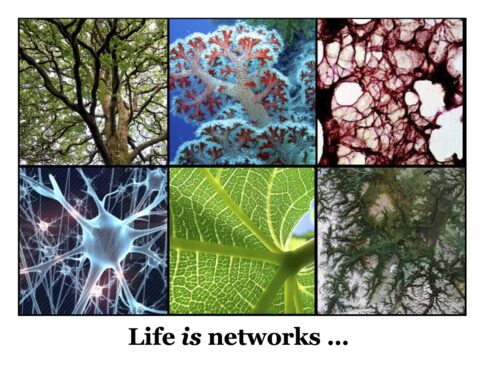
“The basic pattern of organization of a living system is the network. Ecosystems are understood in terms of food webs, i.e. networks of organisms; organisms are networks of cells, and cells are networks of molecules. More precisely, a living system is a self-generating network within a boundary of its own making. Each component of the network helps to transform and replace other components, and thus the entire network continually creates, or recreates, itself.” – Fritjof Capra (scientist, educator, activist)
“Ultimately there is no independent heroic ego, only the collective work of sustaining and evolving life by reshaping the relationships between the community and its larger context.” – Carol Sanford (thought leader, regenerative “resource,” author)
“As we learn to become better observers of our aliveness, we can more fully participate in our evolution as human beings and generate sustainable action or change that is aligned with what we care about.” – Eunice Aquilina (somatic and leadership coach, author)
“Seeing energy flows so that we can engage with them in positive ways is not some mystical, esoteric art, but the role of engaged human beings.” – Joel Glanzberg
“Look well to the growing edge. All around us worlds are dying and new worlds are being born; all around us life is dying and life is being born. The fruit ripens on the tree, the roots are silently at work in the darkness of the earth against a time when there shall be new leaves, fresh blossoms, green fruit. Such is the growing edge.” – Dr. Rev. Howard Thurman (author, philosopher, theologian, educator, and civil rights leader)
From there, we moved into a brief presentation on regenerative networks, with some of the following points:
Networks are the underlying structure of life.
That said, there is sometimes not much life or liveliness in our human networks, and sometimes they can even become deadly.
We might think of many of the problems we face in this world as being linked to the difference (as Gregory Bateson once put it) between the way humans think and the way the rest of nature works.
A key going forward is getting back in right relationship with the rest of life, and to align with the processes of regeneration.
Regeneration points us to the self-feeding, self-renewing processes that living systems (including us) use to nourish their capacity to thrive for long periods of time, as well as their ability to adapt to unexpected, sometimes threatening, circumstances …
Long-term human thriving is rooted in large part in healthy socio-ecological webs that are diverse, intricate and dynamic.
We also talked about how stories can help point us in the right directions, including a growing number of cases of the practices of ecosystem restoration and regenerative agriculture (see below).
–
“What do these stories inspire in our thinking about how we might live and practice in our human networks?” we asked.
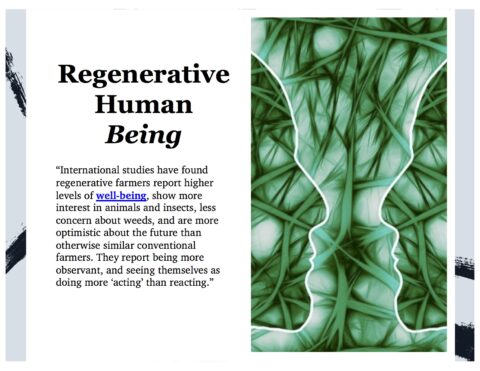
And amidst these stories of regenerative practice taking root and growing in different places, we also looked at how these approaches have impacted individual human beings, their life and liveliness. For example, research shows the following:
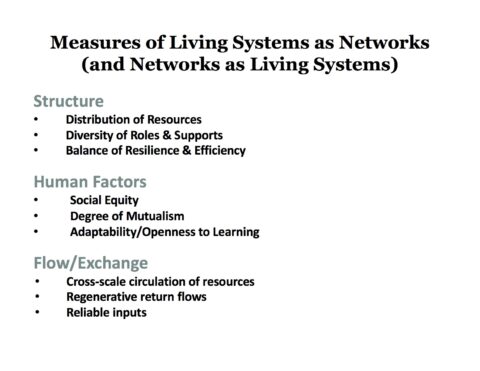
With the hope and and excitement that these kinds of revelations generate, we then presented a set of measures and design features that might help cultivate greater regenerative potential in and through people’s networks, with some time to discuss what most resonated:
There was not nearly enough time to process all of this very deeply, or to look at a list of network cultivation practices we had at the ready, but we did hear growing curiosity about what it would mean to intentionally focus on developing regenerative potential at the individual, group and larger systemic levels in a variety of contexts, which has expressed itself in follow-up emails and conversations.
Hoping the same will be the case here, if you feel so inspired. What’s moving for you now?