The Food Solutions New England 21 Day Racial Equity Habit Building Challenge for 2021 is moving into its last week and shifting from the theme of “Reckon and Repair” to “Regenerate.” And it just so happens that the Revolutionary Love Conference happened this past weekend, providing amazing array of speakers, deep wisdom, inspiration and what feels like a rich transition that aligns with where the Challenge is heading (both thematically and in its encouragement of learning and action that takes its thousands of participants from 21 days to 365). This year’s theme of Revolutionary Love was “The Courage to Reimagine,” and while I was not able to attend all of the gathering, what I did catch was nourishing, and the social media stream (#RevLove21 on Twitter) was on the best kind of fire. What follows is a harvest of 21 quotes from the presentations and conversations.
“We have become a people who accept racism and poverty as conditions, when they are actually crises.” – Rev. Traci Blackmon
“We all know someone who is more outraged by Colin Kaepernick’s knee than Derek Chauvin’s… No one hates like a Christian who’s just been told their hate isn’t Christian.” – John Fugelsang
“Public confession without meaningful transformation does nothing.” – Rabbi Danya Ruttenberg
“Too often, our framing of God prevents us from moving toward a just society—just as capitalism uses theological vocabulary but centers predatory self-interest.” – Otis Moss, III
“How can we retrain the eye to see all others as part of us, one human family. We can train our eyes to look upon the face of anyone and say, ‘You are a part of me I do not yet know. I will open myself to your story. I will let your grief into my heart.” – Valarie Kaur
“White people need to stop being white and start being ethnic again. When you leave the US no one is seeing you and saying “Oh hey you’re white!” They’ll want to know where you’re from, ethnicity carries stories – what is your STORY?” – Otis Moss, III
“I would like to get rid of words like inclusion and say democratization. I’d like for us to get rid of words like diversity and say democratization.” – Ruby Sales
“We must demand a society that will not withhold from others that which we would not want withheld from ourselves.” – Dean Kelly Brown Douglas
“I want white evangelicals to stop talking about reconciliation and talk about justice and repair.” – Robert P. Jones
“I want to stand as a bulwark that things can be different, even in the most stalwart, white supremacist, bigoted families.” – Rev. Rob Lee
“Change is possible when we stop seeing others as needy and start seeing each other as necessary.” – Rev. Traci Blackmon
“Speaking truth to power isn’t only about taking on the President or the GOP, it’s also about taming the power of our own ego.” -Irshad Manji
“Too often, our acts of moral courage go unacknowledged—even by ourselves. We don’t realize the impact we have on others who observe us, and benefit from small mundane acts of resistance in the face of unimaginable daily horror.” – Wajarahat Ali
“I love my enemies for purely selfish reasons. It moves me toward a cure for the life-denying disease of returning hate for hatred. Love may lead to defeat. It may lead to death. But it will not let hatred have the final word.” – Dr. Miguel De La Torre
“White relatives, we’re not asking for a handout of charity. This [reparations] is an invitation—a lifeline to your own humanity and liberation.” – Edgar Villaneuva
“This is a time of reckoning and reconstruction, and policy is my love language. . . . There’s been hurt and harm legislated for generations. Long before our pandemic, our nation was already in crisis.” – Ayanna Pressley
“What would you do? What would you risk, if you truly saw no stranger? How will you fight with us? … It is the practice of a community, and we all have a different role in the work at any given time.” – Valarie Kaur
“Love is always asking: How do I tell this truth and still stay in relationship?” – Krista Tippett
“Think of how much change we leave on the table when we assume that the other will never see things from our point of view, so we must get in their face and humiliate them. Think of how much social change we may be leaving on the table.” – Irshad Manji
“There are so many awesome people in every political party, every demographic of age, sexuality, gender, etc. – these awesome people have GOT to find each other.” – Van Jones
“Racism is a putrid, festering hole in our nation’s soul, and that will only change when we have the courage to love a different way. That love must become an everyday spiritual practice, like flossing or brushing our teeth.” – Dr. Rev. Jacqui Lewis
Recently a long-time member of the Food Solutions New England (FNSE) Network Team let us know that they would be transitioning out of their current job and needing to leave the network, at least the core role they have played. FSNE is entering its second, and critical, decade of work, and going through a transition itself as it strives to better weave together a regional food system that is grounded in racial justice, ecological sustainability and democratic principles. It has been quite the journey, 2020 not withstanding.
This person, and real FSNE champion, gave a tremendous gift in their email, laying out how meaningful their experience has been these last several years. In so doing, there is also a wonderful articulation of what being in a network can be all about. Here is a taste of what was so generously offered:
“What stands out to me when looking back is how many aspects of FSNE’s work are challenging: communicating complex concepts; making the most of limited time when such a rich network of folks gets together; putting up with ambiguity when structure and linearity are so comforting and in demand.
But the rewards from the process are on an equal scale with the challenge: building lasting and meaningful relationships with diverse folks from across the food system; being able to think and strategize about that system in entirely new ways; learning new ways to think and to go about work and life. … in offering this to participants, FSNE is very unique among organizations. …
I’m looking forward to what’s coming next, sensing and hoping that the world at large is more ready to support FSNE’s values now, than it was even a year ago.”
So well said! And we know FSNE is not alone.
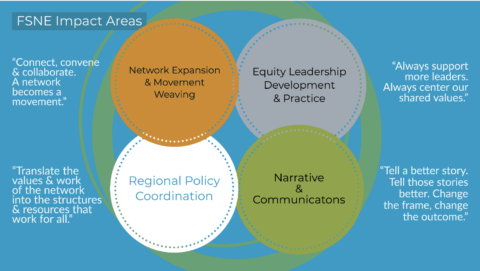
Even as the network (along with so many others) navigates complexity and disruption and continues to make “progress” around its “impact areas” (including more dense and diverse connectivity; greater advancement of the vision and values; increased regional alignment around a new food narrative; more collaboration on regional food, farm and fisheries policy; more wide-spread commitment to anti-racism in the food system), it can be hard to “see” all of this in the moment. Like so many things in life, it is only in retrospect that we can get a sense of how far we have come. And also like so many things in life, as our transitioning FSNE colleague expressed so beautifully, it is not just what we can most tangibly measure that matters, but also (and perhaps more so) qualitative change and the nature of our experiences (processes, relationships) along the way.
“Scarcity alters how we look at things; it makes us choose differently; … our single-mindedness leads us to neglect things we actually value.”
-Sendhil Mullainathan and Eldar Shafir, Scarcity: The New Science of Having Less and How It Defines Our Lives
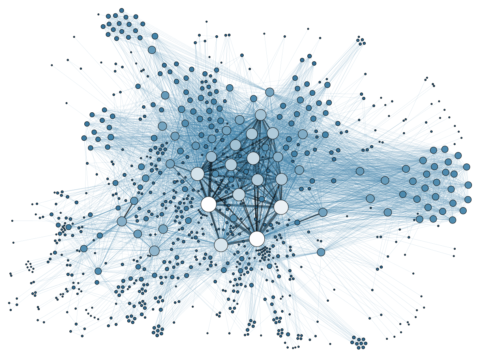
Image by geckzilla, shared under provisions of Creative Commons Attribution License 2.0.
A few weeks ago, the inimitable Seth Godin wrote a blog post about “the magnetic generosity of the network effect.” In the post, he talks about how a “scarcity mindset” can impact our willingness to share ideas. This can happen, says Seth, when we treat ideas as if we were sharing a pizza. But ideas are not pizza slices. Ideas can grow, inspire, flourish. Ideas when offered freely can give birth to innovation; in dialogue they can create even better ideas. The exchange of ideas can grow energy and enthusiasm among sharers and recipients. This is central to the notion of “network effect” – as a network grows, so does the potential of the network. It’s potential grows. Having connections is only as good as what gets shared through those connections, and in which directions. In other words, networks are made valuable not just through connectivity, but through generosity and mutuality.
I work with some groups, aspiring to be networks for change, that struggle with what I would call an “organizational mindset” in their work. Their tendency is to want to immediately put structure and boundaries on what they are doing – who is in, who is out; how we will make decisions; what committees need to be formed, who has what kind of power, etc. This is not necessarily a bad thing, except when it is driven by a scarcity mindset, an overly protectionist stance that can result in the hoarding and unwillingness to share things that are not scarce – ideas, appreciation, a skill, gratitude, love, an image, a tune – and whose sharing can create the richness of emergence and greater abundance. Read More
“We never know how our small activities will affect others through the invisible fabric of our connectedness. In this exquisitely connected world, it’s never a question of ‘critical mass.’ It’s always about critical connections.”
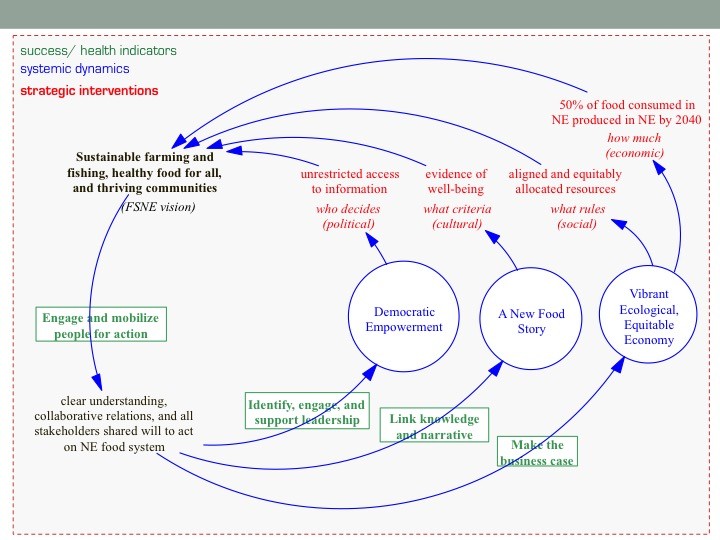
The past twelve months I had the pleasure of working with a team from Food Solutions New England to design and facilitate its first Network Leadership Institute. This initiative grew out of FSNE’s ongoing commitment to cultivating thought leadership and network leadership“to support the emergence and viability of a New England food system that is a driver of healthy food for all, racial equity, sustainable farming and fishing, and thriving communities.” Another impetus for the Institute was a year spent doing system mapping and analysis that revealed four leverage areas for advancing a just, sustainable and democratically-owned and operated regional food system, including cultivating and connecting leadership. Read More
Renewal, revival, restoration; spiritual transformation; an aspect of living systems without which there would be no life; a process through which whole new organisms may be created from fractions of organisms; an adaptive and evolutionary trait that plays out at different systemic levels.
Readers of this blog know that at IISC we do not see building networks simply as a tactic, rather networks are more fundamental as structures underlying healthy living systems (ecosystems, human communities, economies, etc.). This is especially true when there is focus on the regenerative potential of social-ecological networks. That is, in paying attention to qualities of diversity, intricacy and flow in network structures, people can support systems’ ability to self-organize, adapt and evolve in ways that deliver vitality to participants and to the whole.
In my conversations with the Research Alliance for Regenerative Economics, we have been developing a list of design principles for and indicators of the human factors in healthy (regenerative) networks. Here is a working list of 12 and readers are invited to offer adjustments, additions, and comments: Read More
“If you don’t know the kind of person I am and I don’t know the kind of person you are a pattern that others made may prevail in the world and following the wrong god home we may miss our star.”
– William Stafford, From “A Ritual to Read to Each Another”
A couple of weeks ago I was a participant in a SSIR webinar on network leadership. I spent my air time talking about Food Solutions New England as an example of a social change network that has been leveraging authenticity, generosity and trust to address issues of racial inequity in the food system. In telling the story, I realized that much of it amounts to a gradual process of shedding layers and “making the invisible visible.” Specifically, it has been about making visible power and privilege, connection and disconnection, tacit knowledge and diverse ways of knowing, and complex system dynamics. As a result, many in the network sense we are now in a better position to build from what we have in common, and that it is more likely that the vision of a vibrant, equitable and eco-logical food system will be realized. Read More
How focusing on diversity, flow and structure in human networks can be a foundation for great change.
Over the past couple of years, we at IISC have partnered with a few different social change initiatives that have engaged in system mapping to both align diverse stakeholders and surface leverage points for collective intervention. In looking back at these different mapping processes, it is striking the similarities of the areas of focus that have been identified, despite the variety of issues being addressed (food system fragility to educational disparities to public and environmental health). Across these efforts, common areas of leverage have surfaced around:
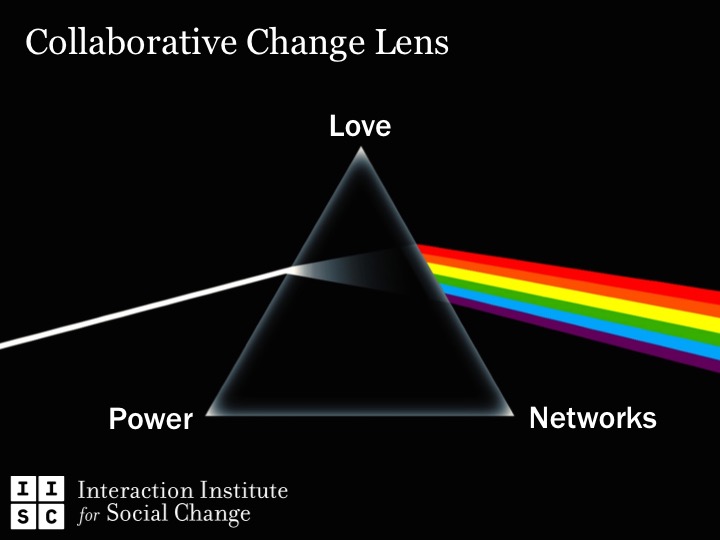
Last week, we held an internal learning session for staff and affiliates entitled “Advancing Equitable Networks.” IISC Affiliate Kiara Nagel and I presented some thoughts about our ever evolving practice of supporting network development for social change, including situating our current approach in IISC’s mission and vision, and our collaborative change lens (see above), which lifts up the importance of understanding and shifting power dynamics for equitable outcomes, embracing love as a force for social transformation and seeing networks as the underlying infrastructure of change.
We then elicited and shared some questions that are at the growing edge of our network consulting practice, including these three: Read More
A recent report out of the University of Michigan and Michigan State University highlights a number of food systems change efforts that have adopted a collective impact approach. Two of these are initiatives that IISC supports – Food Solutions New England and Vermont Farm to Plate Network. The report distills common and helpful lessons across eight state-wide and regional efforts. Here I want to summarize and elaborate on some of the article’s core points, which I believe have applicability to virtually all collaborative networks for social change. Read More
One of my mantras around network building and social change is that creating greater (and new forms of) connectivity is not simply a “so that” or a “nice to have” but is really an “as” and critical to the work of systems and structural change. This is echoed is some way, shape or form in many of the posts that appear in this space, and I think it bears repeating. Consider the following:
“Whether we learn how to love ourselves and others will depend on the presence of a loving environment. Self-love cannot flourish in isolation.”
bell hooks
Isolation can kill. Science shows how loneliness and social isolation can ravage the body and brain. As noted in an article in The New Rebublic – “A partial list of the physical diseases thought to be caused or exacerbated by loneliness would include Alzheimer’s, obesity, diabetes, high blood pressure, heart disease, neurodegenerative diseases, and even cancer.” And who are the lonely? In many cases the poor, the bullied and oppressed, the “different.” When we consider how isolation can impact genes, we see how the cycles of poverty and oppression can play out at a fundamental psychobiological level. What this calls for, in part, is work that reconnects those who are currently in isolation and on the margins from/of myriad social goods including emotional support, tangible services and other critical resources.
Disconnection breeds irresponsible behavior and prejudice. Science is helping us to understand the role of implicit bias in all of our lives and in society. Furthermore, the work of people like Paul Piff shows how those with considerable privilege who isolate from the rest of society (and keep to their own) tend to lose touch with empathy and any sense of egalitarianism. As my colleague Cynthia Parker notes, “Engaging with people unlike ourselves in situations that involve meaningful activity [and] counter-stereotypic experiences” helps to eliminate biases. In other words keeping and strengthening direct connection is a key part of the work for equity and democracy.
Important considerations for collaborative social change work: What are considered “legitimate” ways of knowing and doing? Why? What does this allow? What doesn’t it allow?
Photo by Juhansonin
I’m always interested to see diverse cognitive styles and preferences show up in the collaborative processes we help to design and facilitate at IISC. A classic difference is between those who bend more towards the analytical side of things and those who prefer to lead with intuition. This, of course, paints too stark of a dichotomy of what most people present overall, and context can often be a determinant in what people lead with. Nonetheless there are undeniable tensions that arise within groups about what constitutes “rigor” and “right method” for deriving what might be considered strategic insights. I would say that in many more “mainstream” (one might say “professional”) settings, it is often analysis and deference to some kind of “expert “that has a better chance of winning the day. And so I’ve been interested to come across a few resources that talk about and validate the place of intuition and iterative group visualization in coming up with good answers.
In a piece that appeared in the Harvard Business Review, Justin Fox writes about how instinct can beat analytical thinking. In particular, he lifts up the work of Gerd Gigerenzer from the Max Planck Institute for Human Development in Berlin, Germany. Gigerenzer’s research suggests that rational, statistical, analytical approaches work well in situations where one is able to calculate risk. The trouble, however, is that in many situations, decisions are made in considerable uncertainty, where risk and consequence are unknown because everything is quite dynamic. Read More
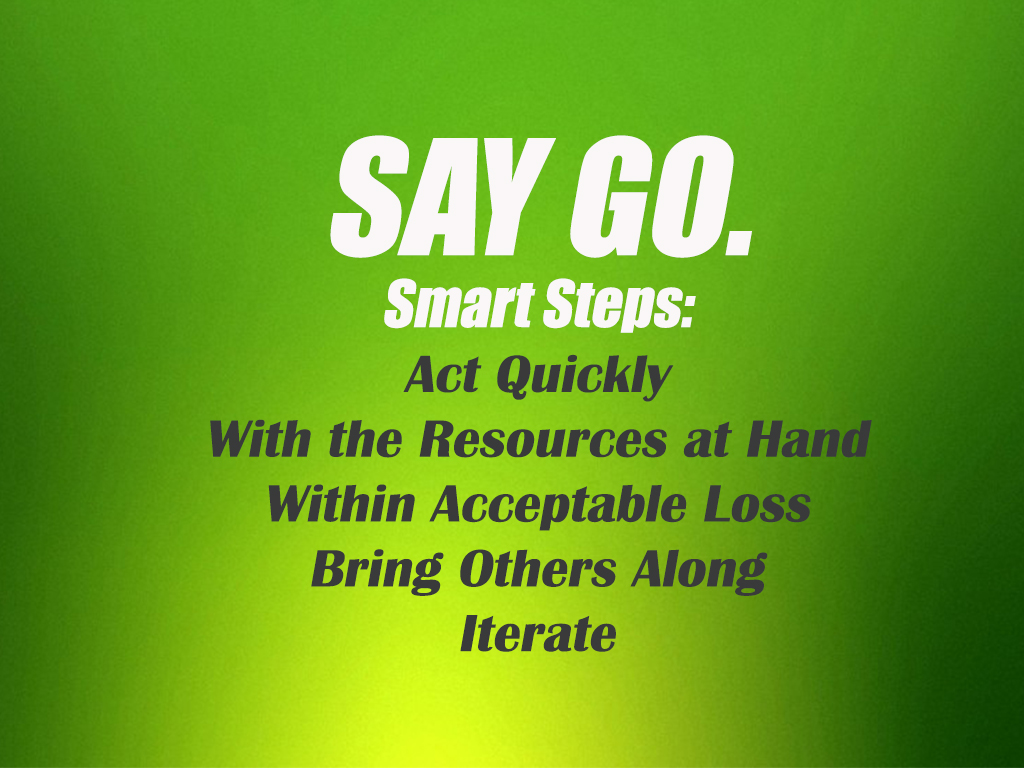
I’ve been thinking a lot about process. What is the best way to get things done? What is the most collaborative and inclusive way to move forward? Our bias towards inclusion, towards a process that is truly democratic, can often seem at odds with the idea that “action trumps everything.” Read More