How focusing on diversity, flow and structure in human networks can be a foundation for great change.
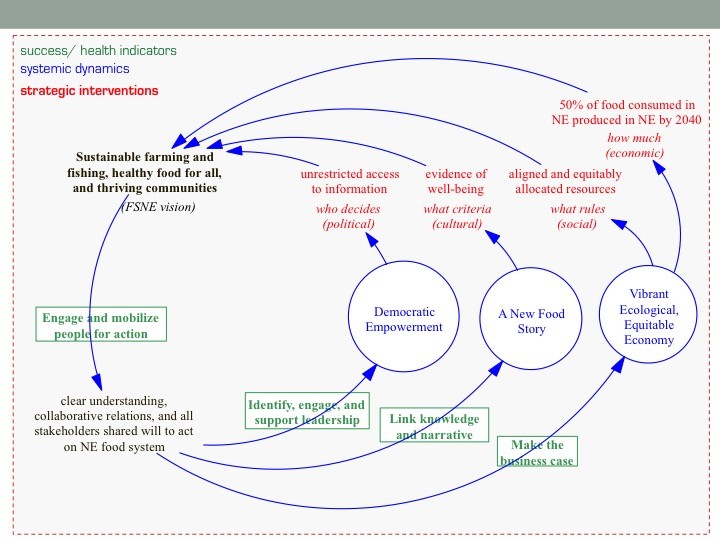
Over the past couple of years, we at IISC have partnered with a few different social change initiatives that have engaged in system mapping to both align diverse stakeholders and surface leverage points for collective intervention. In looking back at these different mapping processes, it is striking the similarities of the areas of focus that have been identified, despite the variety of issues being addressed (food system fragility to educational disparities to public and environmental health). Across these efforts, common areas of leverage have surfaced around:
Changing the dominant narrative.
Each effort has recognized that there is a dominant story that supports the existing system’s legitimacy. This has profound impact on what different players see as being possible. It is noteworthy that the narrative shifts each has called for are in the direction of more expansive and equitable definitions of health and development.
Changing information flows/making information more transparent and accessible.
Communcation is the lifeblood of social systems, and each of these initiatives has recognized that power gets bound up in who has timely access to and also who shapes critical information, as well as what kind of information is valued.
Creating more equitable access to and determination of resources.
From financial to social to living and material capital, each of these initiatives has also recognized that inequitable distribution of resources has contributed to social disparities and overall systemic vulnerability. Another significant factor is who gets to say what is deemed to be valuable in the first place.
This leverage area flows as a matter of course from the two above. Systemic sickness and brittleness is evident in the fact that fewer people and power brokers are shaping systemic opportunities and outcomes, and often for their own benefit. Each of these efforts see more distributed decision-making and implementation as key to justice, sustainability and true prosperity.
Working with government to change incentives and supports in favor of healthier and more equitable opportunities and outcomes.
Each initiative recognizes the important role of government in changing policies and procedures in the direction of more just and sustainable means and ends.
It’s interesting and perhaps not accidental that these leverage areas align with what the late system thinker Donella Meadows identified as some of the deeper leverage points to affect change in any complex human system –
the mindset (story) out of which the system arises;
the power to add, change, evolve, or self-organize system structure;
the rules of the system; and
the structure of information flows.
To get at any of these leverage areas clearly requires considerable clout – a network of diverse actors. And from our perspective at IISC, that network is not simply a means to an end.
Viewed in a certain way, and in consideration of the leverage areas mentioned above, intentionally developing human networks can be an important end in and of itself.
Part of the new story emerging across these various change efforts referenced above is a focus on what Sally J. Goerner calls “dynamic evolution,” which transcends the picture of a world built on competition, supremacy and selfishness. Through their multi-disciplinary study of energy network sciences (ENS), Goerner and her research colleagues point to an understanding of societal health as predicated upon more intricate human and organizational networks. Importantly, to deliver multiple goods in sustainable fashion, these networks must be characterized by:
social diversity
distributed empowerment and intelligence
widely circulating information and effective communication
synergistic exchanges of resources (or “capital”) of many kind
In other words, given unhealthy biases toward “efficiency,” streamlining, monoculture, concentration of resources and systemic brittleness, Goerner and colleagues see more robust network connections, flow and variety as being fundamental to social change and long-term resilience.
Taking this one step further, the Capital Institute (to whom Sally Goerner is Scientific Advisor) has created a list of 10 indicators for systemic healthwith direct ties to human network development (see their paper “Regenerative Development: The Art and Science of Creating Durably Vibrant Human Networks“). These give more specific guidance as to what systemic change initiatives might pay attention to as signs that they are on the right track.
Measures of Flow
Robust cross-scale circulation: Assesses how rapidly and well a variety of resources reach all parts of the social body.
Regenerative return flows: Assesses how much money and other resources the system recycles into building and maintaining its internal capacities, including human capital.
Reliable inputs: Assesses how much risk and uncertainty there is for critical resources upon which the system depends.
Healthy outflows: Assesses how much damage the system’s outflows do externally.
Measures of Human Factors
Degree of mutualism: Assesses the ratio of win-win vs win-lose relationships within the network.
Constructive vs exploitative: Assesses the level of value adding and capacity building activities vs. draining or “gradient degrading” (extractive) ones.
Adaptability (place in the adaptive cycle – see image above): Assesses the system’s readiness for change and its place in a classical S-curve cycle of development (related to degrees of diversity and formalized organization).
Measures of Structure
Number and diversity of roles: Assesses both the diversity and number of players perspectives in different activities critical to system functioning.
Distribution of resources: Assesses where resources, including money, go.
Balance of efficiency & resilience: Assesses the balance between levels of diversity and flexibility (resilience) and streamlining of throughput (efficiency).
I am curious to hear reactions and experiences with applying this kind of a network lens to system change efforts, and as a new member of the Research Alliance for Regenerative Economics, I look forward to sharing additional insights from energy network sciences.
The following is a slightly edited re-post of something I wrote in early 2014. Since writing this, I continue to see the need to be vigilant around not privileging extroversion in groups, to provide more opportunities to tap a range of cognitive styles to leverage fuller potential in networks.
Having read Susan Cain’s book Quiet: The Power of Introverts in a World That Won’t Stop Talking, I feel both validated (as someone of more introverted tendencies as the years pass) and able to see with new eyes. IMHO, the book is well worth the read, and if the thought of tackling the 300 pages is daunting, you might enjoy a taste via Cain’s TED Talk.
Here I want to reflect on some of the insights Cain’s work has to offer collaboration and “net work” for change. Essentially, Cain reminds us of an important element of diversity that we should not overlook in our change efforts –different cognitive processing styles and ways of responding to social stimulation.
First of all, what is introversion? Introversion is not shyness or asocial behavior. People who are introverted can certainly be shy or socially awkward, but introversion is first and foremost a response to social stimulation. Relative to those who are more extroverted, those who are introverted prefer less stimulation and tend to work more slowly and deliberately. Introversion tends to favor intimacy, listening, and some time alone.
According to Susan Cain’s assessment of the research,one third to one half of people in this country are introverted, while many can display extroverted tendencies. Well-known introverts include the likes of Mahatma Gandhi, Eleanor Roosevelt, Albert Einstein, Rosa Parks, Pablo Picasso, and Steve Wozniak.
“There’s zero correlation between being the best talker and having the best ideas.”
In a fascinating historical review, Cain traces a mainstream cultural trend in the United States that shifted preference from what she calls “the culture of character” to “a culture of personality,” where public performance and gregariousness became equated with success and strong leadership (think Dale Carnegie and his books How to Win Friends and Influence People and Public Speaking and Influencing Men in Business). To this day, in many workplaces, schools, and families, Cain suggests that there is a preference for extroverted ways of thinking and being. This flies in the face of data suggesting that introverted styles can equate with stronger academic performance and deeper knowledge in given fields.
And yet there continue to be significant shifts toward open concept workplaces and group-oriented classrooms that privilege extroversion and create painful experiences for those who are more introverted, not allowing them to shine or bring their gifts to the relatively raucous table. The result is that we risk losing the gifts and talents of “quiet leadership” and creativity.
So what to do, especially in collective change efforts? A few thoughts:
Pay attention to who speaks and does not speak up in meetings/groups and don’t immediately assume that the quiet people are aloof or uncaring.
Think carefully before opening physical spaces and group processes too much or too often. Introversion thrives in settings where there is more personal space and opportunity to reflect alone and in small groups.
Understand that brainstorming as it is often done (in person and through whole group discussion from the get-go) privileges extroversion, and that research shows it leads less to innovation and more to group bonding (not a bad thing). Make space for people to work and think alone before bringing a group and their ideas together.
Leverage social media and virtual collaborative platforms as a way of helping to maintain autonomy and avenues for creativity that can fuel innovation and allow introversion to shine.
A couple of years ago, I was turned on to the work of Louise Diamond. Diamond has been bringing insights from the dynamics of complex systems to peace building work for many years. Her efforts connect to a growing number of practitioners and thinkers who see the need to approach social change with an ecological and evolutionary mindset. In one of her papers, she extracts some of the “simple rules” that yield core practices for working in this way. Here I have adapted and adjusted some of them in application to network building for change and resilience in food systems. Read More
“As long as it remains invisible, it is guaranteed to remain insoluble.”
Margaret Heffernan, from Willful Blindness
The following is a slighted edited re-post of a piece that appeared at this time last year on our site . . .
As I look back on this past year through the lens of the work we have done at IISCsupporting networks and movements for social change, one of the most significant themes from my perspective is the value and importance of “making the invisible visible.” Over the past twelve months, we’ve facilitated many reflection sessions with diverse groups to gauge the development and impact they observe from our work together. I tend to ask people how they seechange happening at different levels: self, group, larger systems (organization, neighborhood, community, state, region, etc.). I also like to ask them to reflect via the use of stories to capture and convey significant development.
What has surfaced from this sharing is that even though some of the big goals around equity and sustainability are still ahead of us, there has been movement and part of this development comes down to seeing and being able to work with what had previously been unseen. While the methods for getting to this recognition have varied – from system mapping and analysis to network mapping to structural and power analysis to learning journeys to dialogue and tackling difficult conversations– by creating space to see, share and explore, there has been significant deepening of relationships (to self, other, the work), understanding and commitment.
So what is being made visible?
What our mental models are and how they align (or do not) with our intentions.
The power of shared values and narratives despite differing starting points and perspectives.
An understanding of how our successes do and must connect.
And why does this matter?
In her book, Willful Blindness, Margaret Heffernan shares examples of people seemingly choosing to remain oblivious to damaging conditions – in banks that sold mortgages to people who could not afford them, in the run up to unjustified wars, in communities that accept toxic conditions as a trade-off for economic gain, in poor health care or educational environments. in our country as we overlook racial disparities and socio-economic inequality. In unconscious and conscious ways, we build walls and draw lines, and even those who are aware of the existence and dangers of these can choose to be silent.
“Silence is the language of inertia.”
Margaret Heffernan
And then there are those who choose to break the silence, who choose to see or look more closely, including looking at their own contexts and chosen approaches with greater scrutiny, as well as being open to the perspectives and legitimacy of others. This is the choice of movement, of development, of breaking inertia. Making the invisible visible is not simply some airy fairy notion of “consciousness raising,” it is about achieving greater strategic and moral courage, connection and clarity. And I am hearing that it is what is giving many in the efforts of which we at IISC are a part hope that we are getting somewhere.
Here’s to more care-full seeing, compassionate listening, bolder action and significant movement and #results in the coming year.
“Networks are present everywhere. All we need is an eye for them.”
Albert-László Barabási
You may have heard a version of this story before:
There was a man who had worked at a factory for twenty years. Every night when he left the plant, he would push a wheelbarrow full of straw to the guard at the gate. The guard would look through the straw, and find nothing and pass the man through.
On the day of his retirement the man came to the guard as usual but without the wheelbarrow. Having become friends over the years, the guard asked him, “I’ve seen you walk out of here every night for twenty years. I know you’ve been stealing something. Now that you’re retired, please tell me what it is. It’s driving me crazy.”
The man smiled and replied, “Okay, wheelbarrows.”
This tale about not seeing something in plain sight reminds me of a dynamic that can ensue in network gatherings where at some point anxiety is expressed about not getting to “concrete” outcomes. This happened recently at a large convening of a national network attempting to set systemic change strategies. Read More
I spend a lot of time pondering the above questions [see post] as well, and appreciate your thoughts here. It’s very helpful.
Re: ‘going beyond abstraction to interaction’, Yes! And even further than interaction – in the past year or so, I’ve developed a deep appreciation for something June Holley said to me awhile back – ‘I always say – start with micro-collaborations.’Read More
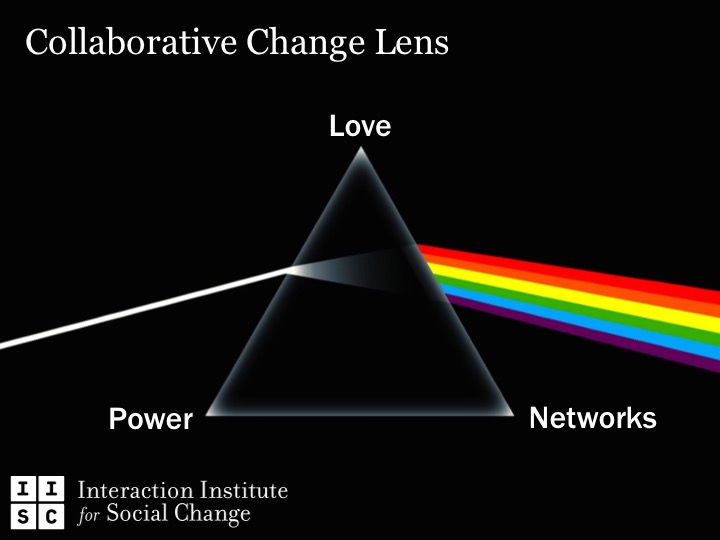
Last week, we held an internal learning session for staff and affiliates entitled “Advancing Equitable Networks.” IISC Affiliate Kiara Nagel and I presented some thoughts about our ever evolving practice of supporting network development for social change, including situating our current approach in IISC’s mission and vision, and our collaborative change lens (see above), which lifts up the importance of understanding and shifting power dynamics for equitable outcomes, embracing love as a force for social transformation and seeing networks as the underlying infrastructure of change.
We then elicited and shared some questions that are at the growing edge of our network consulting practice, including these three:
“The goal is not so much to see that which no one has seen, but to see that which everyone else sees in a totally different way.”
– Arthur Schopenhauer
I just finished reading The New Science of Sustainability:Building a Foundation for Great Change, which added depth and nuance to my understanding of the importance of thinking and working in networked ways to create social change. Lead author Sally J. Goerner isScience Advisor to the Capital Institute and lectures worldwide on how the science of “energy networks” can provide measures and an overall narrative for supporting social, economic, and ecological sustainability. Read More
I’m working with a social change network that is evolving its structure to make better use of existing resources, and we have talked about how aligning more explicitly with network principles, both in its structural design and operations, might help with this. Culling through a variety of principles from other networks with which I’ve worked, I’ve come up with the following dozen examples:
Always make opportunities to build connections/relationships/trust
“If you have come here to help me, you are wasting your time. But if you have come because your liberation is bound up with mine, then let us work together.”
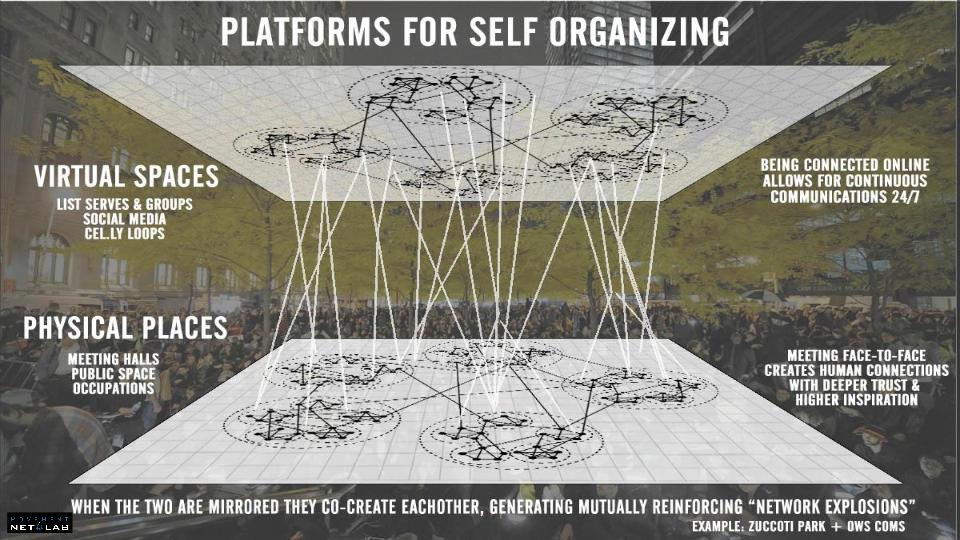
Last week I attended a gathering of network funders and practitioners in Oakland, CA hosted by Leadership Learning Community. Surrounded by so many bright lights, it was hard to get enough of any given individual or conversation. That said, one interaction that continues to stick out for me occurred with Allen Kwabena Frimpong and June Holley of Movement Netlab. Allen, June and I share an interest in supporting collaborative platforms (virtual and in-person) that can help to facilitate resource movement and exchanges of all kinds among diverse actors for the benefit of structural change. Read More
This week we lost Dr. Grace Lee Boggs. She was 100 years old. The long-time Detroit political and labor activist, author, and philosopher was a source of inspiration for many of us at IISC and in activist circles around the country and world. Dr. Boggs’ life and work is the focus of a documentary film called American Revolutionary, which POV is streaming for free until November 4.
A recent report out of the University of Michigan and Michigan State University highlights a number of food systems change efforts that have adopted a collective impact approach. Two of these are initiatives that IISC supports – Food Solutions New England and Vermont Farm to Plate Network. The report distills common and helpful lessons across eight state-wide and regional efforts. Here I want to summarize and elaborate on some of the article’s core points, which I believe have applicability to virtually all collaborative networks for social change.
First off, the authors note the importance of context. They quote Margaret Adamek from the Minnesota Food Charter, who points out that “borrowing from other states and initiatives only goes so far as ‘the unique features of each place are what dictate the strategy.'” At IISC, we could not agree more. Complex systems suggest that we cannot bring a cookie cutter approach to change. As such, there is not one single appropriate model for food systems change. That said, the authors discuss common practices that can undergird a diversity of approaches.
Investing time – It always takes longer than you think or want. While this may not be the best marketing pitch for collective impact and network building, it is good to manage people’s expectations. This work is a marathon, not a sprint. Undoing and shifting years of practices, layers of institutional structures and fixed mindsets does not happen over-night. Furthermore, it takes time to build alignment among key players.
Building trust – A recent blog post in the Stanford Social Innovations Review says it all – “In our research and experience, the single most important factor behind all successful collaborations is trust-based relationships among participants. Many collaborative efforts ultimately fail to reach their full potential because they lack a strong relational foundation.” Trust is what binds the efforts together and creates longer-term and more emergent potential.
Change begins and ends with relationships, and a big part of systems change is rewiring and bringing greater depth (trust) to existing patterns of relationships.
Being strategic about communication – Communication really is the lifeblood of networks. It’s what contributes to transparency, trust, social learning and adaptive capacity. Communication is not simply about one-way or one-to-many channels. Having myriad ways for people to connect and find one another helps to deliver value to more people in more ways.
Using stories as strategy and evaluation – In complex systems, stories become an avenue for sense-making as well as a means of capturing diverse human experiences in a system. Stories can also provide qualitative data about how systems are changing, and they tend to have stickiness and staying power that can keep people motivated and coming back.
Powerful stories are like enriched compost that can be fed back into the network to nurture new growth.
Tracking economic impact and other metrics – Arguably, economics underlies every kind of social change needed in this country. What I mean by this is that access to/ownership of resources of various kinds is key to power and self-determination, and affecting every system is the concentration and consolidation of power in ever fewer elite hands. Without tracking whether resources are growing in local communities and flowing and owned in more equitable ways, it is hard to say that we are making truly systemic change.
Engaging diverse stakeholders – Another underlying factor in every systemic issue in this country is the growing crisis of democracy. From small towns to big cities, the composition of the public is becoming increasingly complex. At IISC, we see all of our work as striving in some way, shape or form to answer the question: “How can we build the will and develop the skill of the diverse public to collectively create just and sustainable societies?” We see a future in which we are “all in;” all in providing the information and knowledge needed to understand the issues that affect us; all in making decisions that impact us; all in, and especially those who are most often left out and are most negatively impacted. This push for more inclusive processes and structures is what we call Big Democracy. In this sense, engaging diverse stakeholders is not simply a means but an end in and of itself.
Make Change Stick Beyond the MeetingTurn ideas into agreements that stick, and keep change going after the meeting ends. Perfect for teams stuck in “great conversation, little action.”