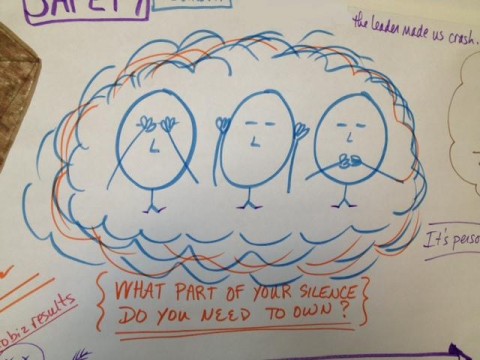
I caught this drawing posted among many other charts in IISC Learning Center. It caught my attention. I have long been familiar with the idea that silence equals complicity. But I always applied it to movement and our work for justice. I never quite thought of it as applying to organizational dynamics.
Last week, I had the privilege of spending a few hours with a delegation from Egypt—four young men who were involved in the April 6th revolution and continue to work for democracy in Egypt. They were at the end of a three week tour of the U.S. focused on the role of social media in politics and elections.They were frankly surprised that here, in the country that gave birth to Facebook, Twitter and Google, we not doing more with social media to advance our democracy. Their visit with IISC was to focus on some of the social technology that fuels social change work. Still, I thought to myself, “No pressure!”
At Transforming Race, Dr. Vandana Shiva started her talk with a provocative comment. “I don’t know why the love for monoculture and the love for power are so intimately connected.” She went on to detail the calculated efforts of the British to subjugate the Indian people, in part by imposing the production of cash crops, destroying their ability to produce food and destroying their markets.
The post below is a repost of a piece by Kathia Laszlo on the “Rethinking Complexity” blog from Saybrook University. It captures a lot of what I am exploring these days about systems thinking as an intellectual exercise to greater embodiment of doing systemically. Enjoy!
A system is a set of interconnected elements which form a whole and show properties which are properties of the whole rather than of the individual elements. This definition is valid for a cell, an organism, a society, or a galaxy. Joanna Macy says that a system is less a thing than a pattern—a pattern of organization. Read More
The spectrum of those working towards community food security is culturally and geographically diverse, spanning a broad range of people, places and activities. Organizations and individuals working in the food system and building food secure communities create complex relationships and inter-related activities. Read More
Last night we came together as IISC to bid farewell to the great Melinda Weekes; we are proud that she is moving on to be the Managing Director of the Applied Research Center. But today’s is not a post about Melinda. It is a post about community.
Sometimes you fall in love with a client. There is a sweet spot where your own heart’s purpose is fully aligned with what your client is trying to do in the world. In that sweet spot they are no longer really a client – you become true partners.
I’ve just wrapped up the contracted part of our work with Urban Bush Women, but I’m certain that ours is a partnership that will continue.
I am made greater by the sum of my connections, and so are my connections
– Stowe Boyd
Today, Curtis Odgen and I will be hosting an LLC Webinar on Collective Leadership. We are talking about a significant shift in how we organize our work for social transformation. Stowe Boyd, the net’s social anthropologist, recently posted what he calls the beginnings of an elevator pitch on “New Mutualism.” I found it resonant, relevant and tremendously exciting; here it goes:
In a world where our traditional institutions — and their leaders — are hopelessly out of date and failing at insuring our well being, we know that something new has to take their place. And fast.
Whatever the individual paths that led us to this insight, we need to first find solidarity in a challenging and chaotically changing world, because the financial and political forces that are increasingly influencing our economic and political systems seem to have small concern for us. Consider the growing income inequality in the US, as an example.
We, those of us that have come to realize that we are living precariously, living at great and increasing risk due the actions of failed institutions and broken policies, must rapidly move past the passive, consumerist, individualist mindset of the industrial era.
We, the Precariat, need to create alternative institutions, controlled by us and dedicated to investing in activities that will benefit us, rather than global corporations and the magnates that control them. We need to find common cause and grow local, regional, national, and international mutual associations, owned by the members and dedicated to decreasing the staggering risks that confront us, individually and in common. These organizations can be as diverse as unions dedicated to protecting the interests of freelancers (like the Freelancer’s Union), local food cooperatives, or international policy organizations.
Mutualist Manifesto:
We need to commit ourselves — individually and collectively — to finding common cause and the general recourse to a mutualist response to problems that confront us at every scale: in our neighborhoods, cities, regions, nations and globally. We can’t wait to be saved by others.
Core mutualist principles:
Ownership and governance of new institutions by members.
Benefits-based, not profit-based, organizational principles.
Cooperative orientation toward asset allocation, investment, and distribution of benefits.
Mutual support of the activities of other mutualist organizations.
The following post is reblogged from Seth’s Blog. We hope that it will enrich your life and much as it has ours.
The pain of a lousy boss, of careless mistakes, of insufficient credit. The pain of instability, of bullying, of inadequate tools. The pain of poor cash flow, corrosive feedback and work that isn’t worthy of you.
I’ve been reflecting on five years of work here at the Interaction Institute for Social Change. As inside so outside. My life has changed dramatically over the last five years. And so has the world. Seriousness about social transformation, commitment to the evolutionary process, a burning thirst for justice – a posture that demands sharp attunement with the present moment.
We’ve been having a good conversation at IISC about ways to challenge and re-frame race discourse in ways that are truthful, loving, compelling, welcoming and so much more. Last week, I posted a video from Jay Smooth about shifting from a discussion about “being” to a discussion about “doing.” Let’s keep the conversation going.