Author Archives for Cynthia Silva Parker

November 10, 2014

Racism. What will it take to end it?

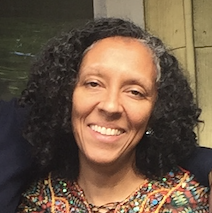
We are pleased to announce the release of Senior Associate Cynthia Silva Parker’s TedX talk. Cynthia shares moments she’s witnessed racism, and how she thinks we can end it. We hope you share this talk with your networks.

Cynthia has spent decades helping people understand how the system of racism operates. As Senior Associate at Interaction Institute for Social Change, she designs and facilitates collaborative equity and inclusion initiatives. These initiatives make change in organizations, cities, and networks. Cynthia also trains leaders through our public workshops.


She is a life-long advocate for racial equity and social justice, and for deeper awareness of each in our systems and organizations and the wider society. She focuses her observations, personal stories and career on strengthening collaborative networks by building the will, skill, knowledge and strategies to undo racism together.

7 Comments
September 3, 2014

Dawnn Jaffier, Rest in Peace

Dawnn

Photo credit: Boston Globe

Sadly, I am writing yet another memorial post, in a summer that has seen too much tragedy. This weekend, Boston laid to rest Dawnn Jaffier. By all accounts, she was a remarkable young woman who lived a life of service and love. Over the past several days, many young people have testified to Dawnn’s positive influence on their lives and many promised to continue to live as she lived, investing in the lives of young people. This time, death came at the hands of an 18 year-old young black man, allegedly bent on retaliation. Jaffier was innocently caught in the crossfire. While some are calling for an end to the festival and parade that provided the backdrop for this tragedy, I think her death cries out for renewed efforts to intervene in the complex system of internalized oppression – a system that cultivates within black people ourselves a belief in the marginal value of black life – and in a system of structural racism that allows gun trafficking to flourish despite the costs and continues to lock too many men of color out of the kinds of opportunities that could compete with the call of the streets. Dealing with either side of the equation without the other seems a fruitless endeavor.

1 Comment
August 12, 2014

Too serious? Never!

In my early days many of my friends called me too serious because of comments I would make about the racism and sexism in a Disney film or the rampant misogyny and conspicuous consumption in popular music. My kids still think so. But having come to see systems of oppression, it’s hard for me to “un-see” them when I turn to entertainment. Spoken word poet Madiha Bhatti puts out a powerful message. Much better to listen to the whole thing, but check out the refrain to whet your appetite!

Read More

Leave a comment
August 1, 2014

Blinded by Privilege

University of California researcher, Paul Piff, and his colleagues have been studying privilege.

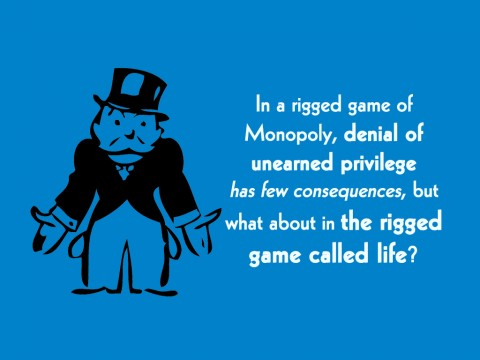
In one study, they set up a rigged game of monopoly. The players who had been randomly assigned to get more money and other advantages began to demonstrate some disturbing differences from the other players. They began to move their pieces around the board more loudly, displayed “signs of dominance and nonverbal displays of power and celebration,” ate more pretzels, and came “ruder, less and less sensitive to the plight of the poor players, and more likely to showcase how well they were doing.” After the game, the rich players attributed their success to their skills and strategy, not the systematic advantages they had over the other player, even though they knew the advantages were real and were randomly assigned.
monopoly

In a rigged game of Monopoly, denial of unearned privilege has few consequences, but what about in the rigged game called life?

Read More

5 Comments
July 18, 2014

Nurture Networks

We partnered with a foundation as they built a network of leaders who shared a deep passion for their city. In the beginning, many of the leaders wanted to do something together quickly. We encouraged them to pause, build deeper relationships, and see what emerged. Read More

Leave a comment
July 8, 2014

Love Liberates Communities From Violence

I met Juan Pacheco of Barrios Unidos recently at a gathering focused on creating an affirming narrative about boys and young men of color. He shared his own personal story—a journey from El Salvador to the U.S., from a supportive family to a gang as a substitute for family. He shares the power of love to transform violence and to liberate young people from despair, pain, and confinement within a prism of societal and self-perceptions of failure. Here are just a few of his many inspiring thoughts, quoted from two talks that you can listen to on line.

Young people join gangs to find love and belonging

“Young people in gangs are willing to hurt you to the degree that they are dying inside themselves. But they’re not dying because of their own choosing. Right. They’re dying because of that reflective mirror that they see from society that builds their identity. And they would rather choose something than be nothing. They would rather be radical failures because they can’t find success in our world…

Gangs replace a network of systems that fail young people.

Young black and Latino men are not the cause of gangs. Immigrants are not the cause of gangs. Gangs are the effect of communities that are ineffective. Somebody dropped the ball on these young people … the familia should always be there … maybe the church should have been going out to the young people … maybe it was the school … zero tolerance policies instead of listening … or their friends or community or neighborhood that didn’t give them the foundations of success, support, understanding … Eventually I made the only choice that made sense … if the groups that were supposed to take care of me didn’t, I went to the only ones that did listen to me … They were there 24/7, they operate on holidays, and gave me what I needed. I didn’t care the price I had to pay to be loved and have brotherhood… The gangs … get started because a whole bunch of young people need love and a place to belong and we as adults don’t give that to them.”

We are all part of the solution to gang violence.

“What I needed was a community that believed in redemption at a time when I didn’t believe in forgiveness…

“Everyone has a part to play in the prevention of violence in our world, even the gang members themselves… At the personal level, when you’re dealing with a young person, dealing eye-to-eye. It’s all about relationships. Programs don’t help people. People help people; people who care; people who have heart; people who are willing to give away their title and their life for these homies. And that takes corazón…

“Let us all go out and do our part … Make sure you never grow comfortable with your position or title … Revolution and change is what we need to make sure young people have dreams, alternatives and good people with good heart to move forward away from this violencia that has been marketed …”

Juan reminds me of something that was said often when I worked with the Boston TenPoint Coalition. At their best, programs are simply a great opportunity to build caring relationships between young people and adults. And, it makes me think about how to build more of those relationships myself.

Leave a comment
June 30, 2014

Self-love Liberates

Dr. Martin Luther King, Jr. is what the Community Healing Network (CHN), chaired by the late Dr. Maya Angelou, calls a “psychological freedom fighter.” The clip of Dr. King posted here is a portion of his 1967 speech, “Where do we go from here,” which is well worth reading or listening to in full.

The CHN describes the straightforward and deeply challenging struggle of black people (and I think it’s fair to say all people of color in some way) for psychological freedom from racism.

“The toxic idea that Black people are not as beautiful, lovable, capable, and worthy as other people continues to undermine our sense of self-worth, the well-being of our families, and our children’s sense of positive possibilities.

“It contributes to the Black-White academic achievement gap, the epidemic of violence among Black youth, the mass incarceration of Black men, women, and youth, and many of the other challenges facing Black people today.

“Toxic ideas about the inferiority of Black skin, Black hair, and Black people will not disappear on their own. As a people, we have to be intentional about working to overcome these ideas and other negative emotional legacies of enslavement and racism.

“We have to take the time to deepen our understanding of the impact of our history on our emotional lives and relationships, share our stories, detoxify our minds and spirits, revitalize ourselves and each other, and tell ourselves a new, liberating, and empowering story about who we are and what we are capable of doing–as individuals and as a community.

“As a people, we have accomplished great things even while carrying on our shoulders the enormous weight of the lie of Black inferiority. CHN believes that there will be no limits to what we will be able to achieve, once we free ourselves and our children from the lie, and take the time to heal.”

Some of us are reluctant to engage in this level of work because others might be tempted to think that this is the only remaining work to undo racism, or to think that the racially disparate outcomes are entirely the fault of people of color. The need for this level of internal work is real AND it’s no excuse for avoiding doing the equally hard work “out there” to address policies, practices, and opportunity structures that limit opportunity for black people and other people of color.

  1. The text of the speech (note: the emotional emancipation passages in the video above are at paragraphs 22 to 26);
  2. The audio recording of the entire speech (note: the emotional emancipation passages are at minutes 29:49 through 36:00).

Transcript of Dr. King’s speech:

Where do we go from here? First, we must massively assert our dignity and worth. We must stand up amid a system that still oppresses us and develop an unassailable and majestic sense of values. We must no longer be ashamed of being black. (All right) The job of arousing manhood within a people that have been taught for so many centuries that they are nobody is not easy.

Even semantics have conspired to make that which is black seem ugly and degrading. (Yes) In Roget’s Thesaurus there are some 120 synonyms for blackness and at least sixty of them are offensive, such words as blot, soot, grim, devil, and foul. And there are some 134 synonyms for whiteness and all are favorable, expressed in such words as purity, cleanliness, chastity, and innocence. A white lie is better than a black lie. (Yes) The most degenerate member of a family is the “black sheep.” (Yes) Ossie Davis has suggested that maybe the English language should be reconstructed so that teachers will not be forced to teach the Negro child sixty ways to despise himself, and thereby perpetuate his false sense of inferiority, and the white child 134 ways to adore himself, and thereby perpetuate his false sense of superiority. [applause] The tendency to ignore the Negro’s contribution to American life and strip him of his personhood is as old as the earliest history books and as contemporary as the morning’s newspaper. (Yes)

To offset this cultural homicide, the Negro must rise up with an affirmation of his own Olympian manhood. (Yes) Any movement for the Negro’s freedom that overlooks this necessity is only waiting to be buried. (Yes) As long as the mind is enslaved, the body can never be free. (Yes) Psychological freedom, a firm sense of self-esteem, is the most powerful weapon against the long night of physical slavery. No Lincolnian Emancipation Proclamation, no Johnsonian civil rights bill can totally bring this kind of freedom. The Negro will only be free when he reaches down to the inner depths of his own being and signs with the pen and ink of assertive manhood his own emancipation proclamation. And with a spirit straining toward true self-esteem, the Negro must boldly throw off the manacles of self-abnegation and say to himself and to the world, “I am somebody. (Oh yeah) I am a person. I am a man with dignity and honor. (Go ahead) I have a rich and noble history, however painful and exploited that history has been. Yes, I was a slave through my foreparents (That’s right), and now I’m not ashamed of that. I’m ashamed of the people who were so sinful to make me a slave.” (Yes sir) Yes [applause], yes, we must stand up and say, “I’m black (Yes sir), but I’m black and beautiful.” (Yes) This [applause], this self-affirmation is the black man’s need, made compelling (All right) by the white man’s crimes against him. (Yes)

Now another basic challenge is to discover how to organize our strength in to economic and political power. Now no one can deny that the Negro is in dire need of this kind of legitimate power. Indeed, one of the great problems that the Negro confronts is his lack of power. From the old plantations of the South to the newer ghettos of the North, the Negro has been confined to a life of voicelessness (That’s true) and powerlessness. (So true) Stripped of the right to make decisions concerning his life and destiny he has been subject to the authoritarian and sometimes whimsical decisions of the white power structure. The plantation and the ghetto were created by those who had power, both to confine those who had no power and to perpetuate their powerlessness. Now the problem of transforming the ghetto, therefore, is a problem of power, a confrontation between the forces of power demanding change and the forces of power dedicated to the preserving of the status quo. Now, power properly understood is nothing but the ability to achieve purpose. It is the strength required to bring about social, political, and economic change. Walter Reuther defined power one day. He said, “Power is the ability of a labor union like UAW to make the most powerful corporation in the world, General Motors, say, ‘Yes’ when it wants to say ‘No.’ That’s power.” [applause]

Screen Shot 2014-06-30 at 9.42.01 AM

Leave a comment
June 23, 2014

Love of her Many Identities

Check out the ways that love of her many identities frees up spoken word artist Jamila Lyiscott to be her full self. She reminds us that a  full, loving embrace of yourself and your cultures enables others to see you more fully and embrace all of your cultures, while it makes space for others to do the same for themselves. That’s change making at a personal level that can radiate outward to the entire community. 

3 Ways to Speak English
by Jamila Lyiscott

TED Talk Transcript

Today, a baffled lady observed the shell where my soul dwells
And announced that I’m “articulate”
Which means that when it comes to annunciation and diction
I don’t even think of it
‘Cause I’m “articulate”
So when my professor asks a question
And my answer is tainted with a connotation of urbanized suggestion
There’s no misdirected intention
Pay attention
‘Cause I’m “articulate”
So when my father asks, “Wha’ kinda ting is dis?”
My “articulate” answer never goes amiss
I say “father, this is the impending problem at hand”
And when I’m on the block I switch it up just because I can
So when my boy says, “What’s good with you son?”
I just say, “I jus’ fall out wit dem people but I done!”
And sometimes in class
I might pause the intellectual sounding flow to ask
“Yo! Why dese books neva be about my peoples”
Yes, I have decided to treat all three of my languages as equals
Because I’m “articulate”
But who controls articulation?
Because the English language is a multifaceted oration
Subject to indefinite transformation
Now you may think that it is ignorant to speak broken English
But I’m here to tell you that even “articulate” Americans sound foolish to the British
So when my Professor comes on the block and says, “Hello”
I stop him and say “Noooo …
You’re being inarticulate … the proper way is to say ‘what’s good’”
Now you may think that’s too hood, that’s not cool
But I’m here to tell you that even our language has rules
So when Mommy mocks me and says “ya’ll-be-madd-going-to-the-store”
I say “Mommy, no, that sentence is not following the law
Never does the word “madd” go before a present participle
That’s simply the principle of this English”
If I had the vocal capacity I would sing this from every mountaintop,
From every suburbia, and every hood
‘Cause the only God of language is the one recorded in the Genesis
Of this world saying “it is good”
So I may not always come before you with excellency of speech
But do not judge me by my language and assume
That I’m too ignorant to teach
‘Cause I speak three tongues
One for each:
Home, school and friends
I’m a tri-lingual orator
Sometimes I’m consistent with my language now
Then switch it up so I don’t bore later
Sometimes I fight back two tongues
While I use the other one in the classroom
And when I mistakenly mix them up
I feel crazy like … I’m cooking in the bathroom
I know that I had to borrow your language because mines was stolen
But you can’t expect me to speak your history wholly while mines is broken
These words are spoken
By someone who is simply fed up with the Eurocentric ideals of this season
And the reason I speak a composite version of your language
Is because mines was raped away along with my history
I speak broken English so the profusing gashes can remind us
That our current state is not a mystery
I’m so tired of the negative images that are driving my people mad
So unless you’ve seen it rob a bank stop calling my hair bad
I’m so sick of this nonsensical racial disparity
So don’t call it good unless your hair is known for donating to charity
As much as has been raped away from our people
How can you expect me to treat their imprint on your language
As anything less than equal
Let there be no confusion
Let there be no hesitation
This is not a promotion of ignorance
This is a linguistic celebration
That’s why I put “tri-lingual” on my last job application
I can help to diversify your consumer market is all I wanted them to know
And when they call me for the interview I’ll be more than happy to show that
I can say:
“What’s good”
“Whatagwan”
And of course …“Hello”
Because I’m “articulate”4
Thank you.
(Applause)


Leave a comment
June 20, 2014

One for the “Righting a Wrong” File!

The settlement of the case of the Central Park 5 is a great day for the five individuals, add a great day for the cause of racial justice. The case of Antron McCray, Raymond Santana Jr., Kevin Richardson, Yusef Salaam and Kharey Wise is a textbook case of structural racism: implicit bias, coupled with strong-arm institutional police practices used against young men of color, and a media too eager to believe the hype, leading to the conviction of five innocent young black men for a horrendous crime. The documentary about these young men, by Ken Burns, captures the intense impact of the wrongful accusation and imprisonment on the lives of the five young men and their families. 

I confess that I wept as the film told of confessions wrested from frightened, exhausted 14 year olds who were ready to say whatever would make it possible to go home to their families. I wept as I saw the assumptions drive what looked to me like extremely sloppy police work—although the actual assailant (who would confess after meeting one of the five in prison some 13 years later) was already known for other sexual assaults in the neighborhood, no one bothered to consider his possible guilt. I wept as I saw the wasted years, the broken families, and the pain that these men continue to suffer even after their release. The older my sons get (now 17, 20 and 25), the more and more young men of color around me cause me to think “That could be my son.” I feel it in my chest. I have cause to grieve almost every night, just watching the news. That kind of visceral empathy is, I think, a manifestation of the love that does justice—a love that says “I can’t bear to see anyone go through this or be treated like that.”

Today is a vindication, though it cannot undo the impact on these young lives and their families and friends. Let it serve as inspiration to redouble our efforts to undo racism in all of its manifestations.

1 Comment
June 19, 2014

Love Liberates.

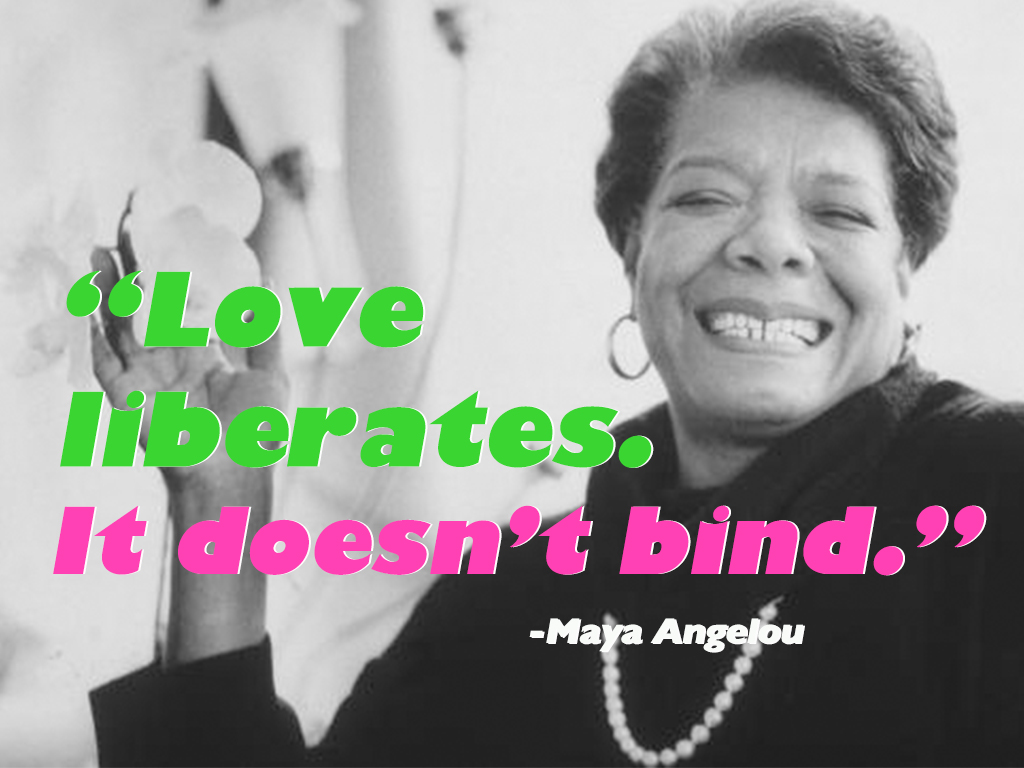
We continue to explore the power of love. Listen to Dr. Maya Angelou speak about the power of love to liberate the human spirit. She speaks of how her mother’s love liberated Maya to become her fullest self and how Maya’s love liberated her mother at the end of her mother’s life. She speaks of the unconditional love that frees a person to make their highest and best contribution to the world—a love that is at once personal and public, individually meaningful and essential to our collective lives.

“Love liberates. It doesn’t bind.”
1 Comment
May 21, 2014

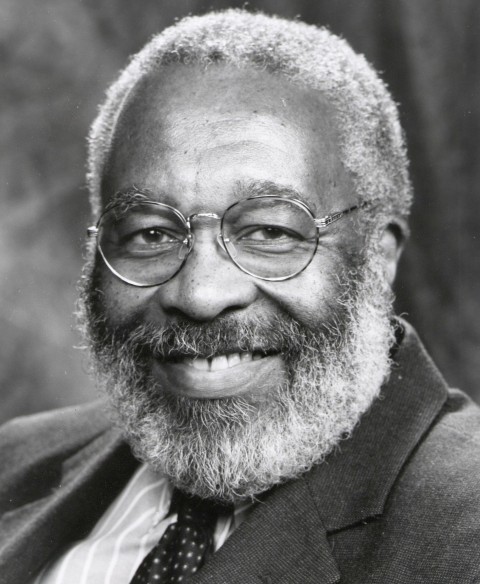
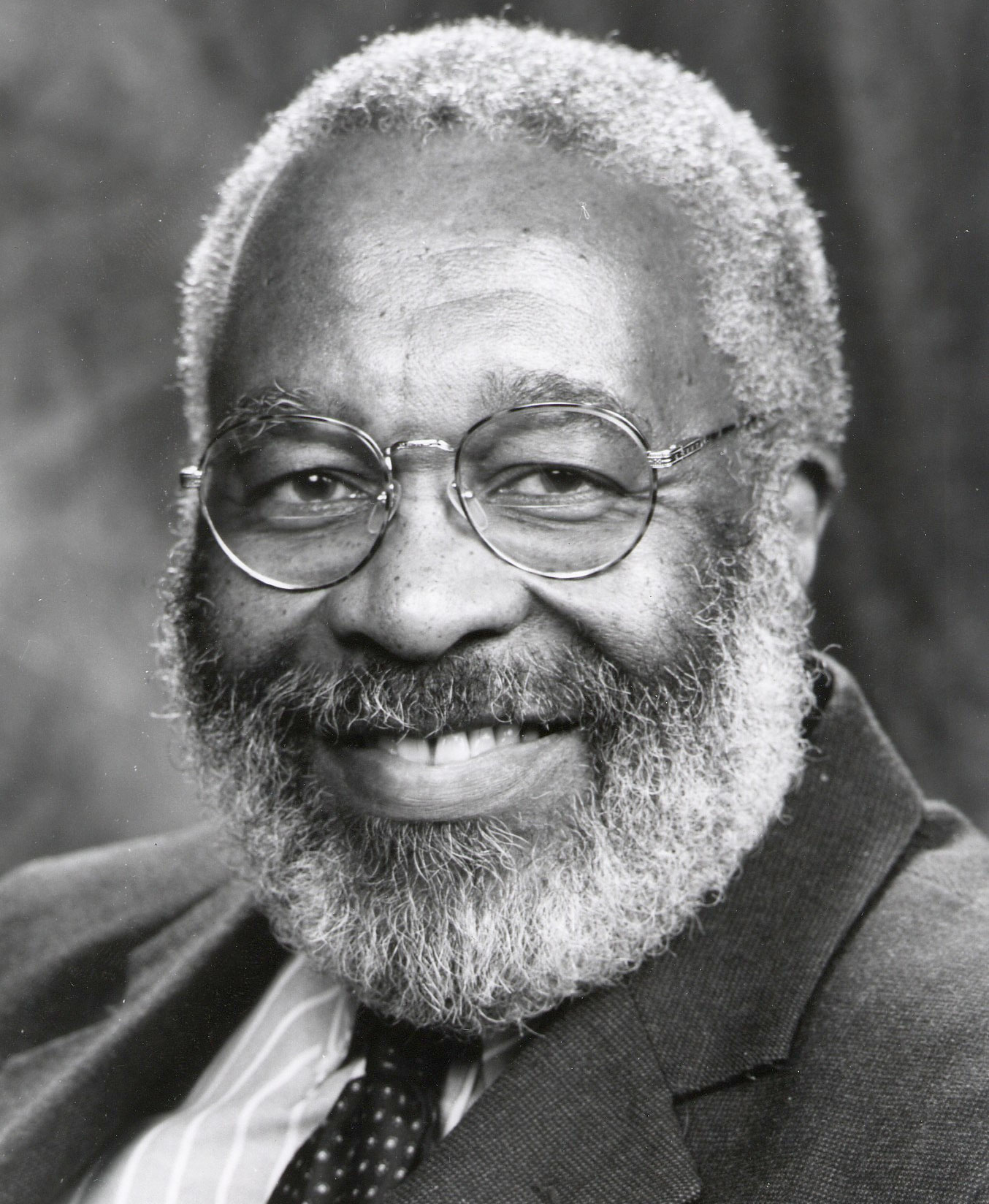
We’ve Lost an Unsung Hero—Remembering Vincent Harding

VincentHarding_cropped

Vincent Harding died on Monday and our world is emptier for it. Vincent is an unsung hero of the Civil Rights era, whose work as a speechwriter for Dr. Martin Luther King, Jr. was essential if not widely known. His best-known speech was Dr. King’s speech Beyond Vietnam, where Dr. King boldly extended his critique to U.S. foreign policy, connecting the struggle for civil rights in the U.S. with struggles for justice in other parts of the world. You can hear Vincent explain the significance of the speech in an interview with Democracy Now! You can hear or read some of his thoughts on spirituality and justice in an On Being podcast called Dangerous Spirituality. Read More

Leave a comment